


By Amir Ansari, RCIC, Ansari Immigration, Vancouver
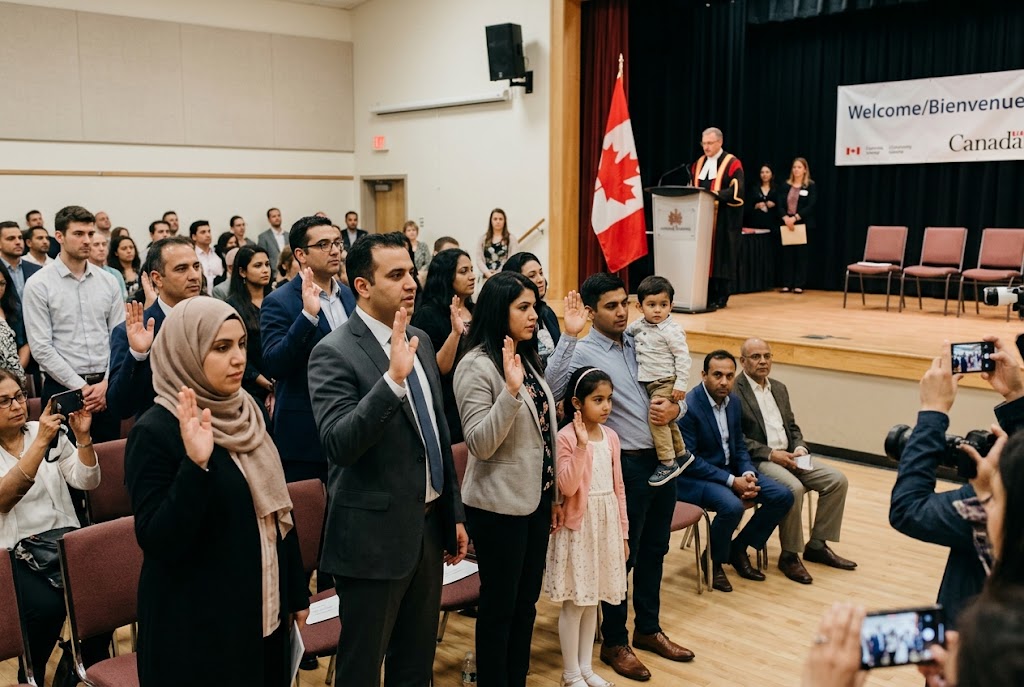
Your citizenship ceremony is the appointment where you stop being a permanent resident and become a Canadian citizen. Approval is not the finish line: if you are 14 or older, you are not a citizen until you take the oath. IRCC calls the ceremony "the last step before becoming a Canadian citizen" for most applicants, and gives you at least one week of notice.
Why the citizenship ceremony is the one appointment you cannot treat casually
Most people read the invitation as a celebration and file it away. It is also a deadline. Under the Citizenship Act, the Minister may treat your application as abandoned "if the applicant fails, without reasonable excuse, to appear and take the oath," and section 13.2(2) adds that once an application is treated as abandoned, "no further action is to be taken with respect to it." Miss it twice as a no-show and the file closes. An adult gets the right of citizenship fee back, which is $123 on IRCC's current fee list, and nothing else. IRCC commits only to refunding that fee, so plan on the remaining $530 of the $653 adult fee, the processing portion that IRCC does not list as a separate line, not coming back. Your place in a roughly 12-month queue goes with it, and you start again with a new application. The official rules for all of this are on IRCC's citizenship ceremony pages, and the sections below work through what they say and what the officer manuals behind them add.
Who has to take the oath of citizenship
The oath is a legal requirement, not a formality, and it is tied to your age on the day you take it.
Your age when taking the oath |
Do you have to take the oath? |
Notes |
18 and over |
Yes |
The oath is the final legal requirement for the grant |
14 to 17 |
Yes |
IRCC strongly encourages the parent or guardian who applied for the minor to attend and help answer questions |
Under 14 |
No |
Welcome to attend. If the child attends, the parent or guardian who applied must be at the ceremony |
Source: IRCC, Who has to take the oath. Verified October 2026.
The branches matter here. Section 3(1)(c) of the Citizenship Act makes the grant conditional, for a person 14 or older on the day citizenship is granted, on the fact that "he has taken the oath of citizenship." If you cannot understand the significance of the oath because of a mental disability, a waiver is available, and IRCC's officer guidance routes that request through a medical opinion on form CIT 0015. Accommodations, which are help to take the oath rather than an exemption from it, are requested separately. A person granted citizenship as a stateless person born to a Canadian parent under subsection 5(5) of the Act does not take the oath at all, and subsection 5(6) says so expressly. IRCC's own officer manual still cites the former section 5.5 for this, which is a useful reminder that the manuals lag the statute.
There is also a prohibition layer that rarely gets explained, and section 22(1) of the Act reaches the ceremony directly: "Despite anything in this Act, a person shall not be granted citizenship under subsection 5(1), (2) or (4) or 11(1) or take the oath of citizenship" while, among other things, the person is serving a sentence, is on probation or parole, or is charged with or on trial for certain offences. IRCC's officer instructions are blunt about the consequence: a person who never met, or no longer meets, the requirements may not take the oath. If a prohibition surfaces after the oath but before the results are recorded, the certificates are not cancelled, the person is still considered a citizen, and the file goes to the Case Management Branch to consider revocation. If something has changed in your circumstances between approval and your ceremony date, particularly a criminal charge, that is a conversation to have before the ceremony, not at it.
The oath of citizenship, word for word
You will repeat the oath after the presiding official. IRCC publishes the wording so you can practise it, and encourages candidates to repeat it in both official languages. The English version reads:
Source: IRCC, What to expect at the ceremony. Verified October 2026.
Section 24 of the Citizenship Act requires that the person "shall swear or affirm in the form set out in the schedule and in accordance with the regulations." The schedule's printed text still names Queen Elizabeth the Second, so the wording candidates actually say is the version IRCC publishes above. Swearing and affirming are equally valid: you swear if you want to refer to a religious belief, and you may bring a holy book; you affirm if you do not. The oath is delivered bilingually whatever the ceremony's language format, running English first outside Quebec and French first inside it. Where a candidate says at check-in that they are not willing to uncover during the public ceremony because of a sincerely held religious belief, the officer instructions provide for the oath to be repeated privately beforehand, in front of a female judge or presiding official. For the identity check alone, IRCC will accommodate removing a face covering in a private room in either format.
What happens at a citizenship ceremony
Both formats run a few hours, and your invitation tells you the arrival time and duration. The order of events differs in one practical way that catches people out: what happens to your permanent resident card.
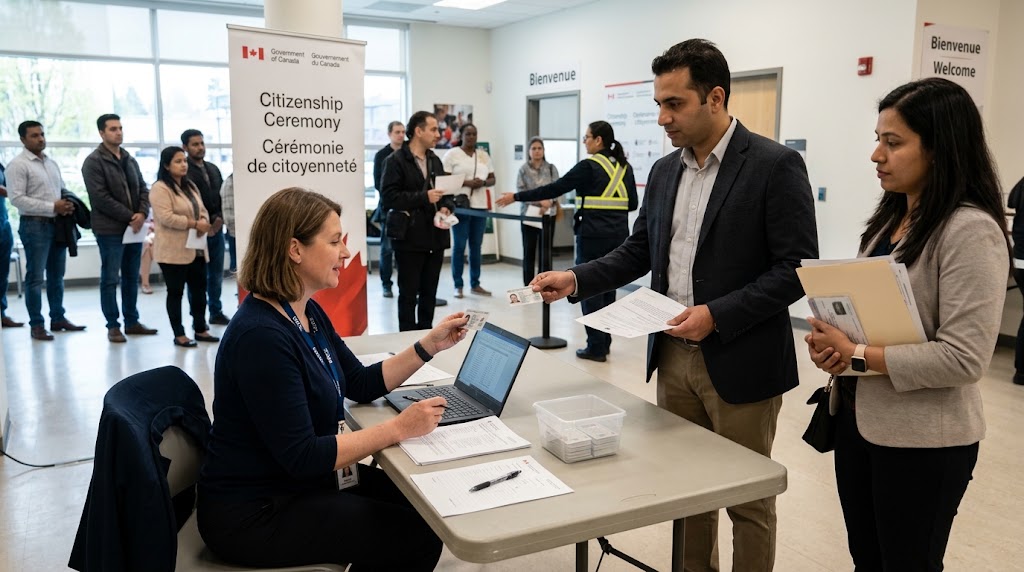
At an in-person ceremony, you are directed to registration, where staff verify your identity, ask questions to confirm nothing prevents you from becoming a citizen, and collect your permanent resident card along with the signed release and consent form from your invitation. You wait in the ceremony room until every candidate is registered, which at a room of over 100 candidates takes a while. The ceremony runs, candidates take the oath, new citizens receive their certificate, and you sign the Oath or Affirmation of Citizenship form.
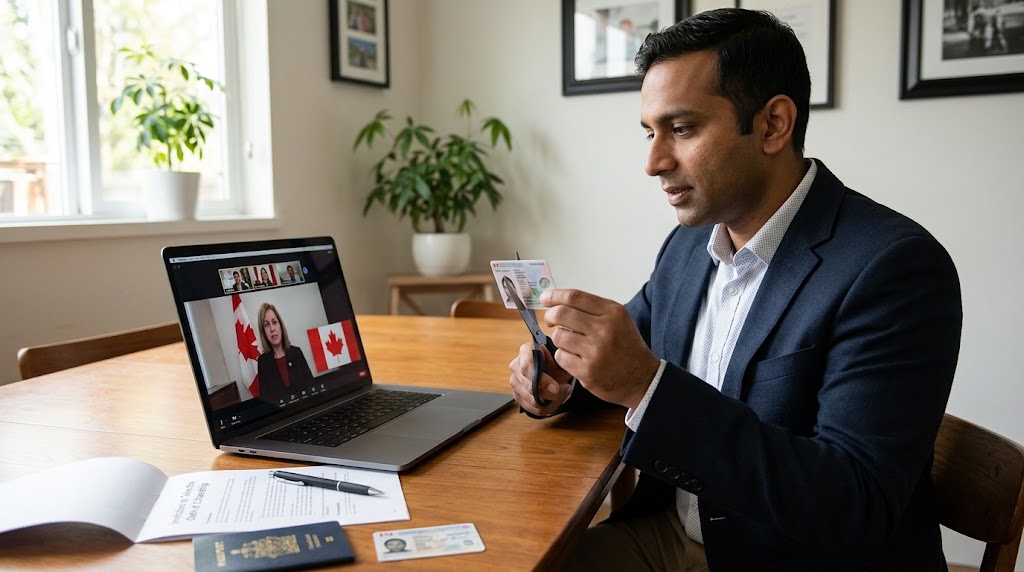
At a virtual ceremony, you join by the link in your invitation and replace your screen name with the seat number printed on page one. At larger ceremonies of over 100 candidates you may wait up to 30 minutes to be admitted. In a private registration, staff verify your identity even if you are wearing a face covering, ask the same eligibility questions, and have you cut your permanent resident card with scissors. Bring the scissors: IRCC lists them as a thing to have ready. If the connection drops, reconnect with the same link and passcode; if you cannot, IRCC may email or call you, or you can email the address in your invitation to be rescheduled. IRCC names Chrome, Edge and Firefox as compatible browsers, and asks family members who applied together to appear from the same device if they can.
That card destruction is the moment worth planning around. Whether it is collected or cut, you leave the ceremony without a permanent resident card and without a passport, holding a certificate that is not a travel document. If you have travel booked in the weeks after your ceremony, work out the sequencing first.
One instruction applies to both formats and is stated without exception: you must sign the Oath or Affirmation of Citizenship form on the day you take the oath, not the day before and not the day after, and you must return it. IRCC's officer instructions go further, requiring that the countersigning date match the date the oath was taken, and that the form cannot be signed before the oath at all. Follow it exactly, but do not panic if something slips: the same officer instructions say results are not postponed because an unsigned form is discovered, and that in those cases the person is a Canadian citizen and the certificate is valid.
What to bring to your citizenship ceremony
Everyone brings the invitation plus proof of permanent residence, and adults bring two pieces of identification, at least one showing a photo and signature.
Your ceremony invitation
Your permanent resident card, even if it has expired, or your Confirmation of Permanent Residence (IMM 5292 or IMM 5688). A minor's card is required even if the minor does not attend
Two pieces of ID for an adult, at least one with photo and signature. If the PR card is one of them, the second must be issued by a federal, provincial or territorial government
Two pieces of ID for a minor applicant, which do not need to show a photo or signature
One piece of ID for a parent or guardian who applied for a minor and is attending with them
A translation with the translator's affidavit for any foreign ID that is not in English or French
Your Record of Landing (IMM 1000), but only if you became a permanent resident before June 28, 2002 and still have it
Scissors, for a virtual ceremony, to cut your PR card during registration
Your virtual seat number, from the first page of the invitation
The signed permission release and consent form, required for an in-person ceremony and for a virtual one only if it came in your invitation
Optional: a holy book for the oath, a water bottle for an in-person ceremony, and a phone or camera for photos
Source: IRCC, What to bring to the ceremony. Verified October 2026.
A note on the Record of Landing that reads like housekeeping and is not. IRCC's instruction is to "Keep your Record of Landing or Confirmation of Permanent Residence," because you may need it later for benefits such as Old Age Security. It proves when your Canadian residence began, which citizenship itself does not. Do not surrender your only copy.
On dress, IRCC asks for business attire suited to the occasion, and explicitly accepts traditional, religious or ceremonial clothing, head coverings, red and white, medical masks and face coverings. In person you stand for the oath and the anthem if you are able, and skip scented products. Virtually, you sit throughout, keep your head and shoulders visible, use no virtual background, and do not photograph or record the registration or the ceremony. Promoting a business or presenting political views is not permitted in either format.
When your citizenship ceremony is scheduled, and the number IRCC does not publish
You are invited after your application is approved, and the invitation arrives at least one week before the date. It is emailed if IRCC has your email address; otherwise IRCC may call, and will mail it if it cannot reach you. The invitation carries the date and time, the format, the videoconference link or the location, and the language of the ceremony.
Here is the honest answer to the most-asked timing question. IRCC's live figure for a citizenship grant is about 12 months, as of October 9, 2026, and that figure covers the whole application rather than the ceremony alone. IRCC publishes no separate standard for the interval between the test and the oath. Its own pages say only that the wait depends on current processing times and your situation, and that a tracker showing "In progress" for the ceremony means scheduling is still underway. So anyone quoting you a confident number of weeks between your test and your ceremony is estimating. Check the current official figure rather than a third-party chart, and watch your tracker and your email, including the junk folder.
How to reschedule a citizenship ceremony, and the distinction that decides the outcome
You can ask to reschedule, and the accepted reasons are broader than people assume: switching between virtual and in-person, which is allowed once, being unavailable, being outside Canada, changing the language format, having no child care for an in-person ceremony, moving closer to an in-person location, illness, and other reasons reviewed case by case. The deadline is 30 days after the ceremony date on your invitation, and the request goes by reply to the office that sent the invitation, which is IRCC's preferred route, or through IRCC's web form, with the reason in the subject line. For a rescheduling request, that subject line is "Ceremony – Request for rescheduling".
Being outside Canada when the invitation lands is a different request, and the two get conflated. If you want to take the oath from abroad, reply to the invitation with the subject line "Outside Canada – Oath of Citizenship" and include your full name, your application number, the date you were last in Canada, the date you plan to return, and your reasons for asking to take the oath from outside Canada, including any special or urgent circumstances. If what you actually want is a later date in Canada, that is a rescheduling request and takes the rescheduling subject line instead. Note too that IRCC asks applicants to be available in Canada for the test if they are between 18 and 54, any interview, and the ceremony, and to tell IRCC if they plan to leave Canada for more than two weeks in a row.
Now the part that is not on the applicant pages. IRCC's officer manual on abandonment sets out two different outcomes for a reason that is accepted, and which one you get changes how many chances you have left. "An applicant must receive 2 notices before an application can be abandoned," the manual states, and a decision-maker who accepts your explanation must then decide whether your circumstances warrant a fresh first notice or only a final one.
What you tell IRCC |
What the manual says the officer should issue after a FIRST missed ceremony |
What that means for you |
Temporary illness, school exams, work commitments, technological problems, travel |
A final notice |
One more chance, and it is your last |
The event is cancelled or rescheduled |
A new first notice |
The count resets |
Extreme weather, long-term or recurring illness, travel delays with supporting documentation, exceptional personal circumstances |
A new first notice |
The count resets |
A request for an unavailability period |
A discretionary extension, generally not exceeding 6 months from the date of the request, then a final notice |
A new date, but the manual requires a final notice once the extension is granted, so you are still on your last chance |
Source: IRCC, Procedure: Abandonment. Verified October 2026.
Those outcomes are for a first missed ceremony, and the stage matters more than the reason. Once you are already on a final notice, the manual gives that same exceptional-circumstances list only a new final notice rather than a reset, and if you ask for an unavailability period at that stage, the manual says education or travel related to work or vacation is not an acceptable reason following a final notice, and that only exceptional circumstances such as long-term or recurring illness may be approved.
The unavailability period deserves its own warning, because it looks like the safe option and is not. The manual provides for an extension of generally up to 6 months from the date of the request, and then says that after an extension has been granted, a final notice must be sent. You buy time; you do not buy back your second chance.
One piece of good news the applicant pages do not give you: at the first-notice stage, even an explanation the officer judges unreasonable still results in a rescheduled event and a final notice, communicated as a notice of review of explanation. A weak reason the first time is not fatal.
Read the first two table rows together. "I have exams that week" and "I am away for work" are ordinary, true, and land you on a final notice. A documented travel delay or a long-term illness can reset the count instead. The difference is not whether your reason is good; it is which category the officer puts it in, and whether you attached anything. Ansari Immigration treats the ceremony invitation as the start of a 30-day clock rather than a save-the-date, and sends the explanation with its documents the first time rather than after a second letter arrives.
One more thing the manual records: a request made before the ceremony date is treated the same way as one made within 30 days after it. There is no bonus for being early, but there is no penalty either, and contacting IRCC early is how you avoid being processed as a no-show.
If you are holding an invitation you cannot use and you are not sure which category your situation falls into, that is a 20-minute conversation, and the RCIC who would handle your file is the person who answers.
Ask about your ceremony invitation
What happens if you simply do not show up
If you never contact IRCC, a clock runs that nobody tells applicants about. The manual gives you 30 calendar days after the event to come forward with an explanation. If none arrives, the decision-maker waits a further 15 calendar days, 45 in total, then records you as a no-show, reschedules you into a new event and sends a final notice. That is the mechanism behind what the applicant page describes as an automatic reschedule after a first miss, and it is why a first miss is survivable.
A second miss is where it ends. IRCC begins abandoning and closing the application. Adults are refunded the right of citizenship fee; minors are not, because they never paid it, the minor grant fee being $100 processing-only. To pursue citizenship after that, you file a new application.
It is worth knowing that the manual constrains officers rather than encouraging them. "Abandonment should be used only when all other options have been exhausted," it says, and it adds that "Where there is sufficient information on file to make a decision, a decision-maker should elect to make a decision on a file rather than treating it as abandoned." The manual requires two notices before a file can be abandoned, and says further opportunities "should only be provided in exceptional circumstances." So the counter-argument people reach for, that IRCC will surely understand, is half right: the policy genuinely is designed to avoid closing files. It just does not extend past the second notice, and nothing in it obliges an officer to treat work or school as exceptional.
Does a single missed ceremony feel like a fair place to put that much weight, given how little notice the invitation gives? Tell us what you think below.
A worked example, using the real numbers
The following is illustrative rather than a particular client file, and every figure in it comes from the official sources cited above.
An applicant in Burnaby pays the adult fee of $653, of which $123 is the right of citizenship fee and the remaining $530 is processing. Her approval comes through and her invitation lands on a Tuesday for a virtual ceremony 10 days later. She is in Manila that week for a family funeral.
She replies to the inviting office the same day, before the ceremony date, asking to reschedule with the subject line "Ceremony – Request for rescheduling", and sets out her full name, application number, the date she was last in Canada, the date she returns and her reasons, attaching her booking confirmation and the funeral notice.
Because her situation is documented and falls under exceptional personal circumstances rather than ordinary travel, the officer's guidance points to a new first notice. She is rescheduled with her two opportunities intact.
Had she written only "I will be travelling," the same guidance points to a final notice: rescheduled once, with no margin left, and at that stage work or vacation travel is expressly not an acceptable reason.
Had she said nothing at all, the 45-day clock would have run, she would have been recorded as a no-show, and the reschedule would have arrived as a final notice regardless of how good her reason was.
Had she then missed the rescheduled date too, the file would close. She would receive the $123 back, lose the other $530, and rejoin a roughly 12-month queue with a fresh application.
The spread between step 2 and step 5 is $530, about a year, and one email.
If your application is already closed, read this before you reapply
IRCC's applicant page is categorical: if the application is closed, you must file a new one. Its officer manual is not quite so final, and the difference is worth knowing about.
The manual's reactivation section says abandoned applications can be reactivated where they were abandoned by a citizenship official in error, or where a court directs reconsideration after judicial review. It also records that "An applicant may request that IRCC reconsider its decision," and that an officer then "has the discretion to decide to consider the request or not." Where it appears an administrative error was made, such as correspondence sent to the wrong address, the Client Support Centre refers the file to the local office if less than six months have passed since the abandonment, or to the Case Processing Centre in Sydney if longer. A supervisor then reviews whether the abandonment procedures were properly applied and documented. If there was an error, or if the process "was not sufficiently documented," the supervisor must re-open the case, record detailed notes and contact the applicant.
There is a second door as well. The manual records that some requests to review an abandonment decision, such as those received through the Minister's office, go directly to the Case Management Branch, which can determine and direct that a file should be reactivated. It also notes that abandoned files are kept at the local office for six months in case of litigation or reactivation, which is what makes the under-six-months and over-six-months split above meaningful.
Two cautions, because this is a narrow door and not a general appeal. It turns on an IRCC error or an inadequately documented process, not on your reason being sympathetic. And the manual flags a cost trap: before an abandoned application is reactivated, IRCC checks whether the right of citizenship fee has already been refunded, and if it has, you must repay that $123 and show proof of payment before reactivation goes ahead.
The honest summary is that IRCC tells applicants to start over and tells its officers there is a reconsideration route. If you believe your ceremony invitation went to an old address, or you never received it, that is the fact pattern this section was written for, and it is worth raising before paying a second application fee.
After the citizenship ceremony: your certificate, and a 90-day window
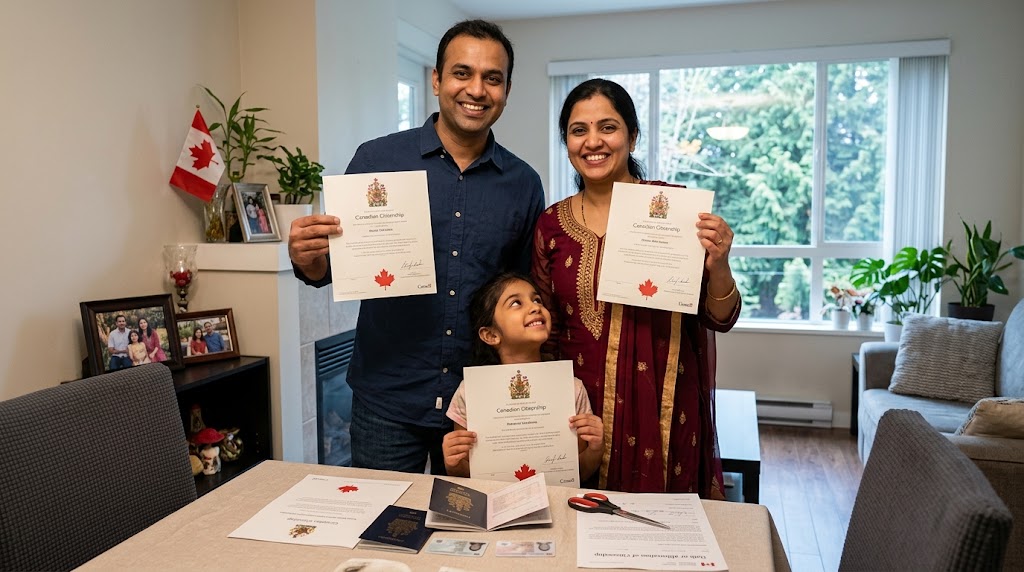
You chose an electronic or paper certificate in your application, and IRCC asks you to confirm that choice at the ceremony. Your certificate shows the date you became a citizen.
Certificate format and ceremony type |
When you get it |
E-certificate |
Available in the IRCC Portal within 5 business days of IRCC receiving your signed and dated oath form |
Paper, in-person ceremony |
Handed to you at the ceremony, after you take the oath |
Paper, virtual ceremony |
Mailed to your Canadian address 2 to 4 weeks after IRCC receives your signed oath form |
Source: IRCC, After the citizenship ceremony. Verified October 2026.
Check the personal information on both sides as soon as it arrives, and then follow the instruction most people ignore: "Do not laminate your certificate." A plastic coating can damage it and can stop IRCC confirming the information or reading the barcode, which is precisely what gets checked when you apply for a passport.
There is a 90-day deadline here that is easy to miss, and one condition attached to it that decides everything. Where the mistake is IRCC's and you supplied correct information in your application, IRCC replaces the certificate free of charge if you ask within 90 days of the ceremony or of the certificate being mailed (IRCC, what to do if there is a mistake on your certificate). Its officer instructions put the same rule to staff: no fee if the request is made within 90 days, for a correction due to an administrative error. After 90 days, or where the error came from your own application rather than IRCC's processing, a replacement means a complete proof of citizenship application and its fee, currently $75, against a proof of citizenship processing time of about 34 months as of October 9, 2026. Name and date-of-birth changes are approved only where IRCC concludes there was an error in determining your legal name or date of birth. So read the certificate the day it arrives, and if the error is IRCC's, say so in writing inside the 90 days. Our guide to replacing or updating a citizenship certificate covers that route in detail.
With the certificate in hand you can apply for a Canadian passport, and if yours is an e-certificate you must print it to do so. You no longer renew a permanent resident card or count days against a residency obligation. If you are wondering whether you keep your original nationality, that depends on the other country's law rather than Canada's, and our post on dual citizenship in Canada sets out the Canadian side.
Where this leaves you
If you are waiting on a ceremony, the practical list is short. Keep your email address current with IRCC and watch the junk folder, because the invitation may arrive with a week's notice. Keep your expired PR card. If you cannot attend, write before the date, name a category the manual treats as exceptional if that is honestly your situation, and attach the documents. If you have already missed one, treat the next invitation as final, because the manual says it is.
Becoming a citizen is also the end of a long compliance road, and the permanent residence requirements you were meeting until now stop applying the moment you take the oath. If you are not yet at the ceremony stage, the day counting still matters, and our guide to calculating physical presence for citizenship is where that starts.
Frequently asked questions about the citizenship ceremony
How long after the citizenship test is the oath ceremony in Canada?
IRCC does not publish a standard interval between the citizenship test and the oath ceremony, so there is no reliable number to quote. The published figure is for the whole grant application, about 12 months as of October 9, 2026, and the only commitment attached to the ceremony itself is that your invitation arrives at least one week before the date. If your online tracker shows the ceremony section as "In progress," scheduling is still underway. Confirm the current figure on IRCC's processing times page rather than relying on a third-party estimate.
What should I wear to a citizenship ceremony?
IRCC asks for business attire suited to the occasion, and explicitly accepts traditional, religious or ceremonial clothing, head coverings, red and white colours, medical masks and face coverings. If you wear a face covering, you may be asked to remove it briefly for identity verification during registration, and IRCC will accommodate doing that in a private room, or a private virtual room for an online ceremony. You can put it back on for the ceremony itself. For in-person ceremonies, avoid scented products.
Can I reschedule my citizenship ceremony?
You can request a rescheduling, and the request must reach IRCC within 30 days after the ceremony date shown on your invitation. Accepted reasons include unavailability, illness, being outside Canada, switching between virtual and in-person once, changing the language format, and lacking child care for an in-person ceremony. Reply to the office that sent the invitation, which IRCC prefers, or use IRCC's web form, with the subject line "Ceremony – Request for rescheduling". Whether you keep two chances or are left with one depends on how the officer categorises your reason, so attach supporting documents where you have them.
Can I bring guests to my citizenship ceremony?
Whether you can bring guests to an in-person ceremony depends on the size of the ceremony and the room set-up, so you may not be able to bring any, and your own invitation is what tells you how many. Guests at a virtual ceremony may sit in the same room as you but must not join from a separate device and must not be disruptive. You are required to stay on screen, or in the room, for the entire ceremony either way. If you cannot arrange child care for an in-person ceremony, that is an accepted reason to request a rescheduling.
Can I attend my citizenship ceremony from outside Canada?
Taking the oath from outside Canada is possible but exceptional, because IRCC's officer instructions say the oath must be taken at a citizenship ceremony unless the Minister directs otherwise. Those instructions add that administering the oath over the phone is not in keeping with the legislation, the regulations or the department's policy direction, and that only limited cases abroad are handled by a foreign service officer with the Registrar's approval. If you are outside Canada when your invitation arrives, reply to it with the subject line "Outside Canada – Oath of Citizenship" and give your full name, application number, the date you were last in Canada, the date you plan to return, and your reasons. If you would rather simply take a later date in Canada, that is a rescheduling request instead.
How do I apply for a Canadian passport after the citizenship ceremony?
You apply for a Canadian passport once you have your citizenship certificate, which is the document that proves citizenship; the ceremony itself does not give you travel rights. A paper certificate is handed over at an in-person ceremony, mailed 2 to 4 weeks after a virtual one, and an e-certificate appears in the IRCC Portal within 5 business days of IRCC receiving your signed oath form. If yours is an e-certificate, you must print it to apply for a passport, and do not laminate a paper one, because a coating can prevent the barcode being read during a passport application.
Why work with Ansari Immigration
Deciding whether you need help at all is the honest question, and for a straightforward ceremony you do not. Compare the two situations:
Your situation |
What it needs |
Invitation received, you can attend, documents in order |
No representation needed. Read the invitation, bring the list above |
A missed ceremony, a final notice, a closed file, or a change in your circumstances since approval |
Worth a professional read before you reapply or write back |
Citizenship representation at Ansari Immigration is a flat CAD $1,000, quoted upfront, with each additional family member charged the same professional fee. Every file is handled personally by the firm's licensed RCIC (R709304), regulated by CICC, with a reply within one business day, and document-expiry reminders continue after your file closes. Returning clients receive a 15% discount.
Book a consultation about your citizenship file
at $80 for 30 minutes.
And if you have already been through a ceremony, which part was least clear at the time? Tell us below. Keep it general, and for advice on your own file use a consultation.
Related Posts
Canada Citizenship Application Processing Time in 2026: How long the grant application takes before you reach the ceremony stage, with the current official figure.
How to Check Citizenship Application Status in Canada (2026): Where to watch for the approval and the ceremony invitation, and what each tracker status means.
Proof of Canadian Citizenship: How to Apply for, Replace, or Update Your Citizenship Certificate (2026): What to do if your certificate is wrong, lost, or needed again after the 90-day window closes.
This article is for general information only. It is not legal advice. Program criteria, requirements, processing times, and selection approaches can change without notice. Always confirm details on official government websites or consult a licensed Regulated Canadian Immigration Consultant (RCIC) for advice specific to your situation.