
How to Calculate Physical Presence in Canada for Citizenship: The 1,095-Day Rule Explained

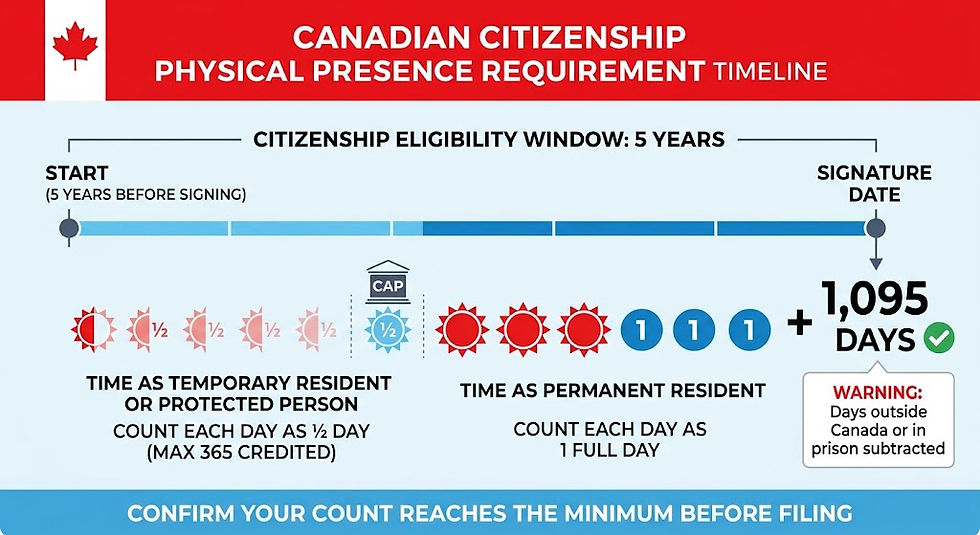
Here is how to calculate physical presence in Canada for citizenship: count each day you were physically in Canada as a permanent resident as one full day, count each day you spent in Canada before becoming a PR (as a temporary resident or protected person) as a half day up to a maximum of 365 days, and confirm the total reaches at least 1,095 days within the five years right before you sign your application. That total, and how you build it, is what IRCC checks first. You can verify your own count with the official physical presence calculator before you file.
The reason this deserves care: physical presence is the single requirement most applicants miscount, and a count that falls even one day short, or that IRCC recalculates lower after reviewing your travel history, can get your application returned or refused. You do not lose the days, but you lose months of waiting and a non-refundable window of stress. Getting the math right the first time is cheaper than getting it wrong.
How many days of physical presence do you need for Canadian citizenship?
You must have been physically in Canada for at least 1,095 days (three years) during the five years immediately before the date you sign your citizenship application, according to IRCC's citizenship eligibility rules. Only that five-year window counts. Any time in Canada before the window opens does not help you, no matter how long you have lived here.
There is a second threshold inside that total that catches people by surprise: at least 730 of your days must be days you held permanent resident status. Because pre-PR time is capped (more on that below), you cannot reach 1,095 on temporary-resident credit alone. IRCC's current guidance states the eligibility period must include at least 730 days as a permanent resident.
IRCC also encourages you to apply with more than 1,095 days. A buffer protects you if a trip you forgot, or a border date that differs from your memory, lowers your real total. Applicants who apply at exactly 1,095 have no room for a single error.
How to calculate physical presence in Canada for citizenship, step by step
Follow the same method IRCC's calculator uses:
Set your five-year window. It ends on the day you plan to sign the application and starts five years earlier.
Count each day you were physically in Canada as a permanent resident inside that window as one full day.
Count each day you were physically in Canada before you became a PR, while you held temporary resident status (visitor, student, worker, or temporary resident permit holder) or protected person status, as one half day.
Cap that pre-PR credit at 365 days, no matter how many half days you accumulated.
Subtract every full day you spent outside Canada.
Add the full days and the capped half-day credit together. If the total is 1,095 or more, you meet the physical presence requirement.
A few subtractions people miss: time spent serving a sentence of imprisonment, on parole, or on probation does not count as time in Canada. And if you made a refugee claim, the days between your claim and a positive protected-person decision are not credited.
The pre-PR half-day credit is where most people go wrong
The most common miscalculation is simple and expensive: applicants count the years they spent in Canada as a student or worker before getting PR as full days. They are not full days.
Most people count each pre-PR day as a full day, when it only counts as half.
That single misunderstanding can put a real count hundreds of days below what the applicant thinks they have. Consider what it means in practice: to earn the maximum 365-day pre-PR credit, you need 730 actual days (two full years) of physical presence in Canada as a temporary resident inside your five-year window. Anything beyond 730 pre-PR days gives you nothing extra, because the credit is capped. When someone tells us they have five years in Canada but only two of those were as a PR, their citizenship math is usually a year off from where they assumed it was.
Is your own count built on full days you should have halved? That is exactly the check worth doing before you file, not after IRCC does it for you. If the pre-PR portion of your timeline is large, an eligibility check with Ansari Immigration's licensed RCIC settles it in a single conversation.
A worked example of the physical presence calculation
Here is how the halving and the cap play out for a typical timeline inside a five-year window:
Time in Canada | Status | Actual days | Days credited |
|---|---|---|---|
Before PR | Temporary resident (student, then worker) | 900 | 365 (capped, not 450) |
After PR | Permanent resident | 780 | 780 |
Total credited | 1,145 |
Source: IRCC citizenship eligibility page. Verified August 2026.
In this example the applicant is over 1,095 and eligible, but notice two things. The 900 pre-PR days did not become 450 half days, because the 365-day cap applied first. And the comfortable-looking 1,145 total is really only a 50-day buffer, so a few forgotten trips abroad could still pull it under the line.
Use the official physical presence calculator
You do not have to do this by hand. IRCC provides an official physical presence calculator, and it is the most reliable way to check your count. If you apply online, the calculator lives inside your online account and you must complete it there. If you apply on paper, use the online calculator and print the result to include with your application, or fill out the CIT 0407 form. IRCC also offers an optional travel journal to record trips outside Canada so your absences are accurate before you calculate.
Whichever tool you use, your count is only as good as your travel history. Reconstruct every departure and return, including short trips to the United States, before you trust the total.

Why this matters for your citizenship application
Physical presence is not a formality you clear on the way to the citizenship test. It is the eligibility fact an officer scrutinizes most closely, because it is objective and easy to disprove against entry and exit records. Building your count on the pre-PR half-day rule, keeping a buffer above 1,095 days, and reconstructing your absences honestly are what keep a citizenship application moving instead of coming back. Note that you must hold permanent resident status to apply at all, though you can apply with an expired PR card, and most applicants reach that status through Express Entry or a provincial program before the citizenship clock even starts.
Miscounted your physical presence and not sure how far off you are? Tell us how you are counting the pre-PR years in the comments, and keep it general. For a review of your specific timeline, a consultation is the right place.
Frequently asked questions about calculating physical presence for citizenship
How do you calculate physical presence for Canadian citizenship?
Add every full day you were in Canada as a permanent resident to your capped pre-PR credit (each pre-PR temporary-resident day counts as a half day, up to 365), within the five years before you sign your application. The total must reach 1,095 days.
How many days of physical presence do you need for Canadian citizenship?
At least 1,095 days (three years) in the five years right before the date you sign your application. IRCC encourages applying with more than the minimum to absorb any calculation error.
Does time before permanent residence count toward physical presence?
Yes, but at half value. Each day in Canada as a temporary resident or protected person before you became a PR counts as one half day, to a maximum of 365 credited days. Time before your five-year window does not count at all.
What counts as a day of physical presence in Canada?
A day you were physically present in Canada. Days outside Canada do not count, and time spent serving a sentence of imprisonment, on parole, or on probation is excluded, as is refugee-claim time before a positive protected-person decision.
Can I apply for citizenship with exactly 1,095 days?
You can, but IRCC recommends against it. With no buffer, a single forgotten trip or a border date that differs from your record can drop you below the minimum and lead to a returned or refused application.
Related Posts
Canada Citizenship Application Processing Time in 2026: How long IRCC currently takes to process a citizenship application after you file.
How to Check Citizenship Application Status in Canada (2026): Where to track your application once it is submitted and what each stage means.
What Is a Landed Immigrant in Canada?: What permanent resident status is and why you need it before the citizenship clock counts.
Ready to confirm your count before you file?
Three signs your count needs a professional read before you sign: much of your time came before PR, you have frequent or hard-to-reconstruct trips abroad, or your total sits within a month of 1,095. Any one of those is what Ansari Immigration checks in an $80, 30-minute consultation, and if your count is clean, you will hear that too. Ansari Immigration files are handled personally by the firm's licensed RCIC, regulated by CICC, with citizenship representation at a flat $1,000 quoted upfront and additional family members quoted separately.
Confused about any step of the count? Ask in the comments, we read every one, and keep it general for anything specific to your own file.
This article is for general information only. It is not legal advice. Program criteria, requirements, processing times, and selection approaches can change without notice. Always confirm details on official government websites or consult a licensed Regulated Canadian Immigration Consultant (RCIC) for advice specific to your situation.


Comments