
How to Decline Canadian Citizenship by Descent After Bill C-3: The Free R7.1 Route and the Surrender-Letter Myth

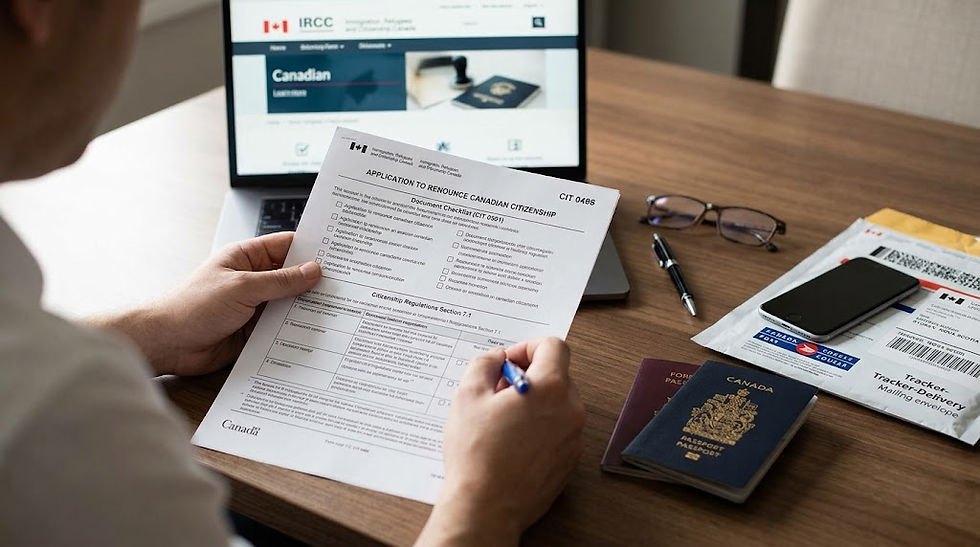
If Bill C-3 made you a Canadian citizen by descent and you do not want it, you can decline Canadian citizenship by descent by renouncing under section 7.1 of the Citizenship Regulations. That route, form CIT 0496, charges no fee and is open to people who became citizens automatically through the 2009, 2015, or 2025 amendments. There is no separate "surrender letter."
Here is why that sentence matters more than it looks. Since Bill C-3 took effect on December 15, 2025, the first-generation limit on citizenship by descent has been removed in many situations, and a large group of people born abroad before that date became Canadian automatically, in most cases without applying and sometimes without wanting it. Declining is a deliberate legal act, not a default: if you do nothing, the citizenship stays. And the free route to decline is not open to everyone who wants out. Choose the wrong form and IRCC returns your package, costing you months. This guide explains who can use the free route, who cannot, what you give up, and how the process actually works.
In the questions Ansari Immigration fields about Bill C-3, the surprise is rarely that a relative became a citizen. It is that the person wants to decline it and assumes the only path is the standard paid renunciation, when a free, officer-decided route often fits their situation better.
Can you decline Canadian citizenship you never asked for?
Yes. Canadian law lets you give up citizenship through a process called renunciation, and it does not matter that the citizenship arrived automatically. What changed with Bill C-3 is who is affected: in many cases, people in the second generation born abroad and beyond, and restored "Lost Canadians," are now citizens automatically, so a group that never applied for anything now has a reason to ask how to opt out.
The important nuance is that renunciation is a decision you have to make and document. Being a citizen by descent is not something you can quietly decline by never applying for a citizenship certificate. If the law made you a citizen, you are one until IRCC approves a renunciation and issues the document that ends it.
Why would anyone decline Canadian citizenship by descent?
A second passport usually reads as a gift, so it is worth stating the other side plainly. Canadian citizenship is durable, passes to your own children under the new rules, and lets you live and work in Canada without a permit. For most people, keeping it is the obvious choice, and declining is a decision you should not rush.
The reasons people do decline are specific. Some countries restrict or penalize dual citizenship, so an automatic Canadian citizenship can put a government post, a security clearance, or a renounced-the-other-citizenship requirement at risk. Some citizens abroad want to avoid Canadian tax filing obligations or the administrative weight of a status they will never use. Others simply do not want a citizenship they did not choose. The resolution is the same in every case: the question is not whether the reason is good enough for someone else, it is whether you will actually use the status, and whether holding it creates a concrete problem where you live. If it does, the law gives you a clean way out. If you are unsure, the status is not urgent, and you can take the time to decide.
The two renunciation routes, and why the difference matters
IRCC runs two separate renunciation applications, and they are not interchangeable. The newer one, under section 7.1 of the Citizenship Regulations, was built for people who became citizens automatically through legislative amendments, including the Bill C-3 group. The older one, under subsection 9(1) of the Citizenship Act, is the general route for any adult citizen. They differ on fee, residence, and age in ways that decide which form you are even allowed to file.
Feature | R7.1 route (form CIT 0496) | Subsection 9(1) route (form CIT 0302) |
|---|---|---|
Who it is for | People who became citizens automatically through the 2009, 2015, or 2025 amendments, including the Bill C-3 descent group | Any adult Canadian citizen |
Fee | No fee | $100 |
Must you live outside Canada | No | Yes, you must not live in Canada |
Minimum age | Minors may apply; all parents sign, and the applicant also signs if 14 or older | 18 or older |
Other citizenship needed | Yes, you must be or will become a citizen of another country | Yes, same requirement |
Outcome | A renunciation document showing the date you ceased to be a citizen | A certificate of renunciation |
Source: IRCC, Guide CIT 0496 (R7.1) and Guide CIT 0302 (subsection 9(1)), canada.ca. The R7.1 guide and form pages are dated December 18, 2025.
The practical takeaway is that the free route is also the more flexible one: no fee, and you can file it while living in Canada. That is unusual, because the standard renunciation specifically requires you to be outside Canada.
Not sure which renunciation route your citizenship falls under, R7.1 or subsection 9(1)? That is a 30-minute question: ask Ansari Immigration's licensed RCIC directly for $80.
Who can use the free R7.1 route, and the first-generation trap
Here is the part that catches people. The R7.1 route is for citizens who were included by the amendments. It is not for everyone with a Canadian parent. Under IRCC's guide, the group that acquired citizenship because they were born outside Canada after February 14, 1977 to a Canadian parent under the original first-generation rule, the classic first generation born abroad, cannot use R7.1. Those citizens were never blocked by the first-generation limit in the first place, so the law does not treat them as newly included, and they must use the subsection 9(1) route with its $100 fee and its live-outside-Canada requirement.
Bill C-3's own group, the people this guide is really about, are covered by R7.1. In plain terms, if you were born outside Canada before December 15, 2025 in the second generation or later, were caught by the old first-generation limit, and became a citizen only because Bill C-3 removed it, you are in the free route. Minors can renounce under R7.1 too, with each parent signing and the applicant also signing if they are 14 or older. The subsection 9(1) route has no path for a minor to renounce at all.
What you give up when you renounce
Renunciation is final and total. IRCC's guides are blunt: once you renounce, you lose all the rights and privileges of being a Canadian citizen and have no status in Canada. If you later want to return permanently, you would have to qualify for and apply for a permanent resident visa. If you want to come temporarily to visit, work, or study, you would need a temporary resident visa or permit, if you are eligible. You also have to return any Canadian citizenship certificates in your possession, and your citizenship ends on the date stated on the renunciation document, not the day you mailed the form.
This is why the decision deserves real thought rather than a reflex. Opting out to avoid a filing obligation today can cost far more than it saves if your life later brings you back toward Canada through family, work, or study.

The "surrender letter" myth
There is no IRCC form called a "surrender letter," and you do not decline citizenship by writing one. The phrase circulates online, and it causes two different mistakes. The first is thinking you can renounce by sending IRCC a letter saying so; you cannot, the only route is the prescribed application and documents. The second mistake runs the other way: some people are told that if they received a "surrender letter," their claim to citizenship is already gone. It is not. If Bill C-3 made you a citizen, you remain one until you choose to renounce and IRCC approves it. Treat "surrender letter" as loose shorthand, and work from the actual IRCC application instead.
That also answers the objection people reach for first: can you not just ignore the whole thing and never apply for a certificate? No. Citizenship by descent under Bill C-3 exists automatically, by law, whether or not you ever ask for proof of it. Declining it takes a positive step, the renunciation application, and nothing less removes the status.
A worked example, two cousins, two different forms
Consider two cousins, both living in the same country abroad, both wanting nothing to do with a Canadian citizenship they did not seek.
Leila was born abroad in 2015 to a Canadian mother who was herself born abroad. Under the old rule, Leila was blocked by the first-generation limit and was never a citizen. Bill C-3 removed that limit and made her a citizen automatically, retroactive to her birth. Because she is in the group the amendments included, Leila uses the free R7.1 route, form CIT 0496, with no fee, and she can file it even while visiting Canada.
Her cousin Omar was born abroad in 2016 to a father who was born in Canada. Omar was always the first generation born abroad, so he was already a citizen long before Bill C-3; the new law did not change his status. He wants out too, but R7.1 is closed to him. Omar must use the subsection 9(1) route, form CIT 0302, pay the $100 fee, and show he lives outside Canada. Same family, same goal, two different forms, decided entirely by which generation made each of them a citizen and when.
Did Bill C-3 make someone in your family a citizen who would rather not be? Tell us how you are weighing the decision in the comments, and keep it general.
How to decline Canadian citizenship by descent under R7.1
The R7.1 application is a paper process mailed to IRCC's Case Processing Centre in Sydney, Nova Scotia. You can read the full IRCC instruction guide for R7.1 before you start. The steps are:
Confirm you qualify: you became a citizen automatically through the 2009, 2015, or 2025 amendments, you are or will become a citizen of another country, and you understand the significance of renouncing.
Gather the documents on the Document Checklist (CIT 0501), including proof of your Canadian citizenship, proof of your other citizenship, and the required identity documents and photo.
Complete the Application to Renounce Canadian Citizenship, R7.1 (CIT 0496), and add the Use of a Representative form only if someone is filing on your behalf.
Pay nothing: there is no fee for the R7.1 application.
Mail the signed, dated package to the Case Processing Centre in Sydney, and keep a tracked-delivery receipt.
If the application is approved, IRCC issues a renunciation document showing the exact date you ceased to be a Canadian citizen. From that date forward you are subject to the ordinary immigration rules if you want to enter Canada.
Frequently asked questions about declining Canadian citizenship by descent
Does it cost anything to decline Canadian citizenship under Bill C-3?
No, the R7.1 route for people who became citizens automatically through the 2025 amendments has no application fee, which is the main difference from the standard subsection 9(1) renunciation that charges $100.
Can a child decline Canadian citizenship by descent?
Yes, a minor can renounce under the R7.1 route, but the application must be signed by each parent or legal guardian, and the applicant must also sign it if they are 14 or older, while the standard subsection 9(1) route has no renunciation path for minors at all.
If I ignore it, am I still a Canadian citizen under Bill C-3?
Yes, if Bill C-3 made you a citizen you remain one automatically whether or not you apply for a citizenship certificate, so declining requires a formal renunciation application rather than simply doing nothing.
Do I have to live outside Canada to use the R7.1 route?
No, the R7.1 route does not require you to live outside Canada and IRCC accepts applications from people living in Canada, which is the opposite of the subsection 9(1) route that requires you to live outside Canada.
Can I get my Canadian citizenship back after renouncing?
Renunciation is final and leaves you with no status in Canada, so regaining citizenship later is not automatic and would generally mean qualifying for permanent residence again and then applying, which is why the decision should not be rushed.
Why work with Ansari Immigration
Three signs your Bill C-3 situation needs a professional read: you are not sure whether the new rules made you or your child a citizen in the first place; you want out but cannot tell whether the free R7.1 route or the paid subsection 9(1) route fits your generation; or renouncing would affect a government post, a security clearance, or a dual-citizenship rule where you live. Ansari Immigration will tell you plainly when the honest answer is that you can file the form yourself, and when it is not. The firm is led by a licensed RCIC regulated by CICC, with flat, transparent fees quoted upfront. Any one of those three signs is worth an $80, 30-minute consultation.
And if you have already started a renunciation or a descent claim, tell us where it got complicated in the comments, keeping it general; for your own file a consultation is the right place.
Related Posts
Canadian Citizenship by Descent: New Legislation and What It Means for You: who qualifies through a parent, grandparent, or great-grandparent after Bill C-3, and how to prove it.
Does Canada Accept Dual Citizenship? What Immigrants Need to Know in 2026: how Canada treats a second nationality, which matters when you decide whether to keep or decline citizenship.
How to Calculate Physical Presence in Canada for Citizenship: The 1,095-Day Rule Explained: the same 1,095-day count that decides descent for children born abroad on or after December 15, 2025.
This article is for general information only. It is not legal advice. Program criteria, requirements, processing times, and selection approaches can change without notice. Always confirm details on official government websites or consult a licensed Regulated Canadian Immigration Consultant (RCIC) for advice specific to your situation.


Comments