


Canadian citizenship by descent is the passing of Canadian citizenship from a Canadian parent to a child born outside Canada. Since Bill C-3 took effect on December 15, 2025, it is no longer capped at the first generation born abroad. Many people with a Canadian grandparent, or even a great-grandparent, are now citizens and do not know it.
That last point carries real stakes. If Bill C-3 made you a citizen, you may have been one for months without a single document to show for it, and the only way to confirm it is a citizenship certificate, which now takes roughly 33 months to issue. If you are planning to travel to Canada, work here, or claim a benefit, the gap between being a citizen and being able to prove it is where the delays live. This guide explains who qualifies, how far back the chain can reach, and how to turn a maybe into a certificate.
What Bill C-3 changed about Canadian citizenship by descent
For years, Canadian citizenship by descent was limited to the first generation born outside Canada. This was called the first-generation limit, set out in section 3(3)(a) of the Citizenship Act. In plain terms: if your Canadian parent was themselves born abroad, they generally could not pass citizenship to you if you were also born abroad. The line stopped at one generation.
That rule was struck down. In December 2023, the Ontario Superior Court of Justice held in Bjorkquist et al. v. Attorney General of Canada, 2023 ONSC 7152 that the first-generation limit violated the mobility and equality rights in the Canadian Charter of Rights and Freedoms and was unconstitutional. The court suspended its declaration to give Parliament time to fix the law, and the government responded by legislating rather than appealing. Bill C-3 is that fix.
Bill C-3 removed the first-generation limit in some situations. Citizenship by descent can now flow to the second generation born abroad and beyond, as long as the connection back to a Canadian citizen is real. The change does not take anything away from people who were already citizens before the bill became law: if you were already Canadian, you still are.
Who qualifies for Canadian citizenship by descent now
Here is the part that trips up almost everyone, including the summaries you will see at the top of a search page. The rules are not the same for everyone. What matters most is a single date: December 15, 2025, the day Bill C-3 took effect. The test is different depending on whether you were born or adopted before that date or on or after it.
First, how generations are counted. IRCC treats the first generation as the first person born or adopted outside Canada to a Canadian citizen, where that Canadian was either born in Canada or became a citizen through naturalization. Their child, also born outside Canada, is the second generation, and so on.
The table below is the short version. The two sections after it explain each row.
If you were born or adopted outside Canada |
What Bill C-3 does |
Before December 15, 2025 (second generation or later) |
In most cases you are automatically a Canadian citizen. No day-count test is applied to you. |
On or after December 15, 2025 (second generation or later) |
You may be a citizen if your Canadian parent was also born or adopted abroad and spent at least 1,095 days in Canada before your birth or adoption. |
Already a citizen before Bill C-3 |
Unchanged. You are still a citizen. |
Source: Change to citizenship rules in 2025, IRCC (canada.ca), page updated December 24, 2025. Verified September 2026.
If you were born before December 15, 2025
If you were born outside Canada to a Canadian parent before December 15, 2025, and you were caught by the old first-generation limit, Bill C-3 most likely made you a citizen automatically, and it did so retroactively. There is no requirement for your parent to prove any specific number of days in Canada for this group. This applies whether you are the second generation, the third, or further down the line, provided citizenship descended without a break.
This is the single most misread part of the new law. Automated answers and quick summaries often apply the 1,095-day substantial-connection test to everyone. For people born before December 15, 2025, that is wrong: the day-count test is not the gate.
If this made you a citizen and you do not want to be one, there is a formal way to give it up, called renouncing citizenship. That is a deliberate choice, not a default.
If you were born on or after December 15, 2025
For births and adoptions on or after December 15, 2025, Bill C-3 uses a substantial-connection test. A child born abroad in the second generation or later may be a citizen if their Canadian parent was also born or adopted outside Canada and that parent spent at least 1,095 days (three years) in Canada at any point before the child’s birth or adoption. The days are counted cumulatively, so they do not have to be consecutive.
If you are a Canadian citizen by descent planning to have children abroad, this is the rule that decides whether your citizenship reaches them. The 1,095-day count is the same threshold used for the physical presence requirement in a citizenship grant, and getting the arithmetic right matters. Keep records of your time in Canada, because you may need to prove those days years later.
How many generations back can you claim, grandparent or great-grandparent?
Because the first-generation limit is gone, the question is no longer one generation or none. It is whether Canadian citizenship travelled down an unbroken chain to you. Each link in that chain has to trace back to a Canadian citizen. If a link in the chain was not a Canadian citizen when their child was born, the chain breaks there, and descent stops.
For people born before December 15, 2025, that unbroken chain can reach back through a grandparent or a great-grandparent, because that group is covered second generation or later with no day-count test. So an adult born abroad whose Canadian-born great-grandparent’s citizenship passed down through a grandparent and a parent, each of them a citizen at the time of the next birth, can be a citizen today.
Who this does not help is just as important. It does not make you a citizen if the chain was broken, for example if the ancestor lost or never held Canadian citizenship at the relevant time, or if the line runs through someone who was only ever a citizen of another country. It does not override the rules for adopted children, who apply through a separate direct-grant route rather than becoming citizens automatically. If your chain breaks and you are not a citizen by descent, other routes such as family sponsorship or permanent residence may still apply.
A worked example, tracing the chain
Consider two people with the same Canadian great-grandparent, and watch how the date changes the answer.
Maria was born in Argentina in 1994. Her great-grandfather was born in Halifax; his citizenship passed to her grandmother (born abroad), then to her mother (born abroad), then to Maria. Every person in that line was a Canadian citizen when their child was born, so the chain is unbroken. Because Maria was born before December 15, 2025, and she was previously blocked only by the first-generation limit, Bill C-3 most likely made her a citizen automatically. There is no day-count test for her. Her practical task is not to qualify but to prove it: assemble the birth and citizenship records for four generations and apply for a certificate.
Now take Maria’s son, born in Argentina in March 2026, after the cut-off. He is the next generation abroad, so his eligibility runs on the substantial-connection test, not the automatic rule. He can be a citizen only if Maria, his Canadian parent, spent at least 1,095 days in Canada before his birth. Maria studied in Toronto for two academic years and spent later summers there, adding up to about 700 days. That is short of 1,095, so on these facts her son is not a citizen by descent. If Maria had reached three cumulative years in Canada before he was born, the answer flips. Same family, same great-grandfather, opposite outcomes, decided by a date and a day count.
Does your family’s chain look more like Maria’s or her son’s? Share how far back your Canadian line goes in the comments, and keep it general, because for advice on your own case a consultation is the right place.

How to prove your Canadian citizenship by descent
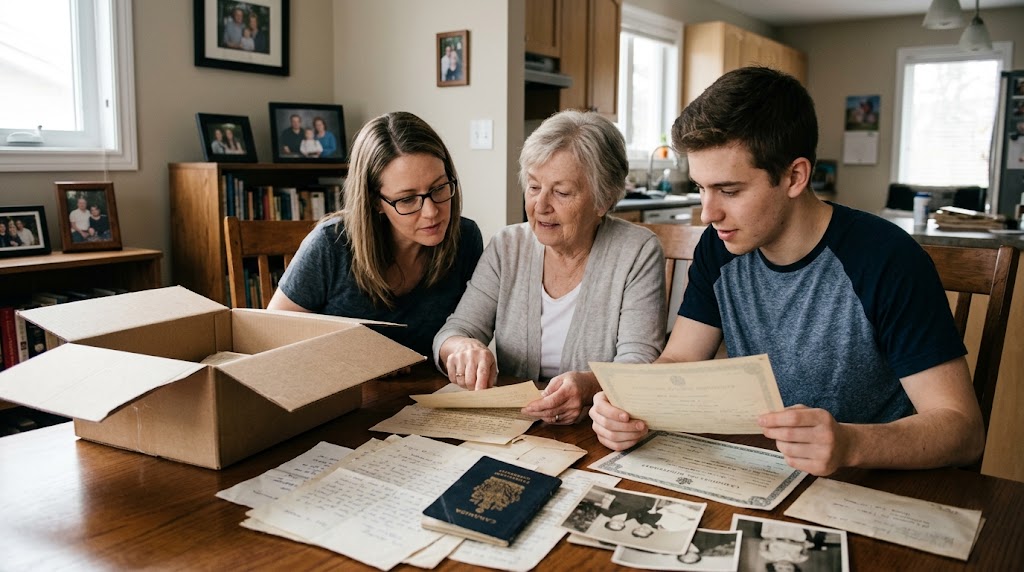
Being a citizen and being able to prove it are two different things. To confirm your status, you apply for a citizenship certificate, the document that proves Canadian citizenship. When you apply, IRCC reviews your lineage and, if you qualify, issues the certificate. You then use it to apply for a Canadian passport.
Three things to plan around:
The fee is a flat 75 dollars for proof of citizenship.
The processing time is long. As of September 3, 2026, IRCC’s published processing time for a proof of citizenship application is about 33 months, up sharply over the past year as applications surged after Bill C-3. Treat that number as a moving target and check the official processing times tool the week you apply, because it changes monthly.
The application is on paper, and the form changes. The citizenship certificate application form was quietly replaced in August 2026. Do not rely on a copy you downloaded weeks ago. Download the current form from the official IRCC form page the same week you mail your package, and gather original documents for every generation in your chain, which for multi-country families is often the slowest step.
Because the certificate is what unlocks a passport, and the passport is what lets you enter Canada smoothly, the order matters: certificate first, then passport, then travel. A citizenship certificate is not a travel document on its own. It is also worth understanding how citizenship sits at the end of the permanent residence pathway, and how dual citizenship is treated, since most people who gain status by descent keep their existing nationality as well.
Not sure your chain is unbroken? Before you commit to a 33-month wait, Ansari Immigration can review your lineage and tell you which records IRCC will want, so a returned package does not cost you two years.
Book a Consultation with Ansari Immigration
Common mistakes and what goes wrong
The refusals and delays on descent files cluster around a few predictable errors.
Assuming the 1,095-day rule applies to you when you were born before December 15, 2025. It usually does not. People talk themselves out of applying because they think they cannot meet a day count that was never their test.
Assuming you are not a citizen because your parent was born abroad. That was the old first-generation limit. It is gone for many people. The only way to know for certain is to apply for the certificate and let IRCC assess the chain.
Treating a distant Canadian ancestor as automatic proof. The chain has to be unbroken and documented. One missing citizenship record or one link who was not a citizen at the right moment can stop the claim.
Mailing an out-of-date form or an incomplete document set, then waiting two years to find out. On a 33-month queue, a returned or incomplete package is not a small delay.
Frequently asked questions about Canadian citizenship by descent
How does Canadian citizenship by descent work now?
Citizenship passes from a Canadian parent to a child born outside Canada. Since Bill C-3 (December 15, 2025), it is no longer limited to the first generation, so second-generation-and-later descendants can qualify if the chain of citizenship is unbroken.
Can I claim Canadian citizenship through a grandparent or great-grandparent?
Often yes, if you were born before December 15, 2025 and citizenship descended without a break through each generation. For births on or after that date, your Canadian parent must also have spent at least 1,095 days in Canada before your birth.
What is the 1,095-day rule for citizenship by descent?
For children born or adopted abroad on or after December 15, 2025 in the second generation or later, the Canadian parent must have spent at least 1,095 cumulative days in Canada before the birth or adoption. It does not apply to people born before that date.
How do I claim Canadian citizenship by descent?
Apply for a citizenship certificate through IRCC, providing birth and citizenship records for each generation in your chain. If IRCC confirms you qualify, it issues the certificate as proof, which you can then use to apply for a passport.
How much does proof of citizenship cost and how long does it take?
The fee is a flat 75 dollars. As of September 3, 2026, IRCC’s published processing time for a proof of citizenship application is about 33 months. This figure changes monthly, so confirm it on the official processing times page before you apply.
Am I still a citizen if I was already Canadian before Bill C-3?
Yes. Bill C-3 does not remove citizenship from anyone who already had it. It only extends citizenship to more people affected by the old first-generation limit.
Why work with Ansari Immigration: descent files live or die on documents, and the chain is only as strong as its weakest record. Ansari Immigration is led by a licensed RCIC regulated by CICC, practising since 2019, who teaches immigration law at three colleges. Every file is handled personally by the firm’s licensed RCIC, start to finish, with flat, transparent fees quoted upfront and no juniors or call centres. A consultation is 80 dollars for 30 minutes.
If you think a Canadian parent, grandparent, or great-grandparent might make you a citizen, book a consultation with Ansari Immigration and we will map your chain and the documents you will need before you commit to a 33-month queue.
And if you have already started tracing your line, tell us in the comments where the chain gets murky. Keep it general, because for advice on your own case a consultation is the right place.
Related Posts
Proof of Canadian Citizenship: How to Apply for, Replace, or Update Your Citizenship Certificate (2026): the step-by-step on the certificate that proves your citizenship by descent.
How to Calculate Physical Presence in Canada for Citizenship: The 1,095-Day Rule Explained: how the same 1,095-day count is measured, including the pre-PR half-day trap.
Does Canada Accept Dual Citizenship? What Immigrants Need to Know in 2026: what happens to your existing nationality when you gain Canadian status by descent.
This article is for general information only. It is not legal advice. Program criteria, requirements, processing times, and selection approaches can change without notice. Always confirm details on official government websites or consult a licensed Regulated Canadian Immigration Consultant (RCIC) for advice specific to your situation.