


If you are trying to convert IELTS to CLB, or match a CELPIP, PTE Core, TEF Canada or TCF Canada result to a Canadian Language Benchmark (CLB) or Niveaux de compétence linguistique canadien (NCLC) level, this page puts every official conversion in one place. The numbers below come directly from IRCC's Express Entry language test results page and are current as of the page's June 22, 2026 update. Your language level is the single biggest lever most people can move on their Express Entry score, so getting the conversion right, and entering the exact scores IRCC expects, matters more than almost any other document in your file.
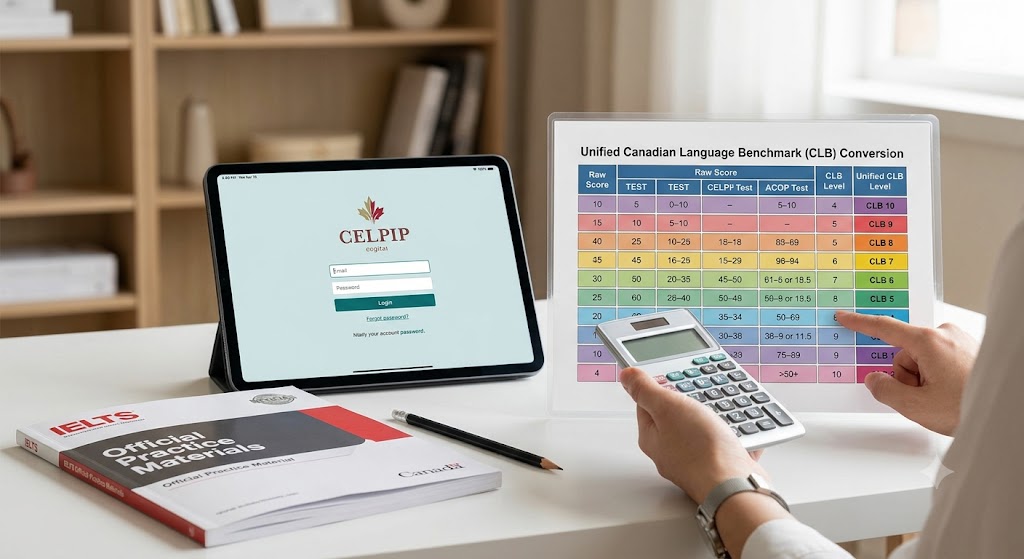
Why the exact conversion matters before you enter a single score
The equivalency is not just trivia. IRCC uses the CLB or NCLC level, not your raw test score, to decide whether you meet a program's minimum and how many points you earn. Enter the wrong figures and the consequences are real: for TEF Canada, IRCC warns that you must enter only the scores from the Équivalence ancien score column, and that entering the wrong scores can lead to a refused application. The same page states plainly that if you apply for permanent residence with language results that have expired (older than two years), your application will be refused. This is an accuracy document, not a formality, and it is worth reading the official IRCC language test results page alongside this chart.
Unsure whether the scores on your report convert the way you think? A 30-minute Ansari Immigration consultation settles it before you enter a single number.
IELTS to CLB conversion chart (every band)
IELTS General Training is one of three accepted English tests for Express Entry. IRCC does not accept the IELTS One Skill Retake for Express Entry. Here is the full IELTS to CLB conversion across all four abilities and every benchmark from CLB 4 to CLB 10.
CLB 10 and above: Speaking 7.5 to 9.0, Listening 8.5 to 9.0, Reading 8.0 to 9.0, Writing 7.5 to 9.0
CLB 9: Speaking 7.0, Listening 8.0, Reading 7.0, Writing 7.0
CLB 8: Speaking 6.5, Listening 7.5, Reading 6.5, Writing 6.5
CLB 7: Speaking 6.0, Listening 6.0, Reading 6.0, Writing 6.0
CLB 6: Speaking 5.5, Listening 5.5, Reading 5.0, Writing 5.5
CLB 5: Speaking 5.0, Listening 5.0, Reading 4.0, Writing 5.0
CLB 4: Speaking 4.0, Listening 4.5, Reading 3.5, Writing 4.0
Source: IRCC, Express Entry: Language test results (canada.ca). Verified July 2026.
Notice that listening runs ahead of the other abilities: a listening band of 8.0 is only CLB 9, while a reading of 7.0 already reaches CLB 9. That asymmetry is exactly where applicants lose points they assumed they had.
CELPIP to CLB conversion chart
CELPIP-General is the simplest conversion of all: your CELPIP level in each ability equals the same CLB level. A 9 across all four abilities is CLB 9; a 7 across the board is CLB 7.
CLB 10 and above: CELPIP 10 or higher in speaking, listening, reading and writing
CLB 9: CELPIP 9 in each ability
CLB 8: CELPIP 8 in each ability
CLB 7: CELPIP 7 in each ability
CLB 6: CELPIP 6 in each ability
CLB 5: CELPIP 5 in each ability
CLB 4: CELPIP 4 in each ability
Source: IRCC, Express Entry: Language test results (canada.ca). Verified July 2026.
PTE Core to CLB conversion chart
PTE Core (Pearson Test of English) is the newest accepted English option for Express Entry. Its scoring bands are the least intuitive, so transcribe carefully.
CLB 10 and above: Speaking 89+, Listening 89+, Reading 88+, Writing 90+
CLB 9: Speaking 84 to 88, Listening 82 to 88, Reading 78 to 87, Writing 88 to 89
CLB 8: Speaking 76 to 83, Listening 71 to 81, Reading 69 to 77, Writing 79 to 87
CLB 7: Speaking 68 to 75, Listening 60 to 70, Reading 60 to 68, Writing 69 to 78
CLB 6: Speaking 59 to 67, Listening 50 to 59, Reading 51 to 59, Writing 60 to 68
CLB 5: Speaking 51 to 58, Listening 39 to 49, Reading 42 to 50, Writing 51 to 59
CLB 4: Speaking 42 to 50, Listening 28 to 38, Reading 33 to 41, Writing 41 to 50
Source: IRCC, Express Entry: Language test results (canada.ca). Verified July 2026.

TEF Canada to NCLC conversion chart (French)
For French, IRCC uses the NCLC scale. With TEF Canada, your level is based on the Équivalence ancien score (previous score equivalency) column of your statement of results, not the Score / 699 column. Enter only these numbers.
NCLC 10: Speaking 393 to 450, Listening 316 to 360, Reading 263 to 300, Writing 393 to 450
NCLC 9: Speaking 371 to 392, Listening 298 to 315, Reading 248 to 262, Writing 371 to 392
NCLC 8: Speaking 349 to 370, Listening 280 to 297, Reading 233 to 247, Writing 349 to 370
NCLC 7: Speaking 310 to 348, Listening 249 to 279, Reading 207 to 232, Writing 310 to 348
NCLC 6: Speaking 271 to 309, Listening 217 to 248, Reading 181 to 206, Writing 271 to 309
NCLC 5: Speaking 226 to 270, Listening 181 to 216, Reading 151 to 180, Writing 226 to 270
NCLC 4: Speaking 181 to 225, Listening 145 to 180, Reading 121 to 150, Writing 181 to 225
Source: IRCC, Express Entry: Language test results (canada.ca). Verified July 2026.
TCF Canada to NCLC conversion chart (French)
TCF Canada is the second accepted French test. Speaking and writing are scored on a small scale (out of 20), while listening and reading use a larger points range.
NCLC 10 and above: Speaking 16 to 20, Listening 549 to 699, Reading 549 to 699, Writing 16 to 20
NCLC 9: Speaking 14 to 15, Listening 523 to 548, Reading 524 to 548, Writing 14 to 15
NCLC 8: Speaking 12 to 13, Listening 503 to 522, Reading 499 to 523, Writing 12 to 13
NCLC 7: Speaking 10 to 11, Listening 458 to 502, Reading 453 to 498, Writing 10 to 11
NCLC 6: Speaking 7 to 9, Listening 398 to 457, Reading 406 to 452, Writing 7 to 9
NCLC 5: Speaking 6, Listening 369 to 397, Reading 375 to 405, Writing 6
NCLC 4: Speaking 4 to 5, Listening 331 to 368, Reading 342 to 374, Writing 4 to 5
Source: IRCC, Express Entry: Language test results (canada.ca). Verified July 2026.
How to read this chart without losing points
Three rules govern how these conversions actually work, and each one trips up applicants who skim.
Every ability is converted separately. IRCC converts your speaking, listening, reading and writing to a CLB level one at a time. You do not get an overall band the way IELTS reports one.
Your lowest ability decides your benchmark for eligibility. If three abilities land at CLB 9 and one sits at CLB 7, you meet the CLB 7 minimum, not CLB 9. For meeting a program minimum, the weakest ability governs.
Points are still awarded ability by ability. For scoring, each ability earns points on its own converted level, so a single weak skill both drags your eligibility benchmark down and costs you points in that skill.
The practical takeaway: your weakest ability is worth more attention than your strongest. Pushing a lone reading score from CLB 8 to CLB 9 often does more for your file than adding a point to a skill you are already strong in.
Minimum CLB and NCLC levels by Express Entry program
The benchmark you need depends on which Express Entry program you qualify under. These minimums are set by IRCC and apply to all four abilities unless noted.
Federal Skilled Worker Program, first official language: English CLB 7, French NCLC 7
Federal Skilled Worker Program, second official language: English CLB 5, French NCLC 5
Canadian Experience Class, NOC TEER 0 or 1 job: English CLB 7, French NCLC 7
Canadian Experience Class, NOC TEER 2 or 3 job: English CLB 5, French NCLC 5
Federal Skilled Trades Program, speaking and listening: English CLB 5, French NCLC 5
Federal Skilled Trades Program, reading and writing: English CLB 4, French NCLC 4
Source: IRCC, Express Entry: Language test results (canada.ca). Verified July 2026.
For the Canadian Experience Class, the level you need depends on the National Occupational Classification (NOC) group your job falls under. If you are unsure which TEER your occupation sits in, our guide to the Canada Express Entry system walks through where language fits in the wider eligibility picture, and our plain-language explainer on what Express Entry is covers the programs side by side.
From Amir's desk: how CLB conversion actually decides scores
In practice, the language chart is where I see the most avoidable point losses, and almost none of them are about English or French ability. They are about how the conversion works.
The first pattern is the lowest-ability trap. A client comes in convinced they are a CLB 9, because three of their four IELTS bands convert to CLB 9. But their listening sits at 7.5, which is only CLB 8, so for eligibility they are a CLB 8, and every calculation that assumed CLB 9 was wrong. When I explain this to students I teach it as one rule: your score is your weakest skill, not your best one. Before anyone reserves a retake, we find the one ability that is capping the file and target only that skill.
The second pattern is choosing the wrong test. IELTS, CELPIP and PTE Core all feed the same CLB result, so no test gives you more points. What differs is where each test's cut-offs sit relative to your strengths. A candidate half a band short on IELTS reading has sometimes reached the same CLB on CELPIP, where reading is scored differently, without actually improving. It is not a loophole, it is matching the test to how you actually perform.
The third pattern is the quiet refusal risks that IRCC lists but does not dwell on: entering TEF Canada scores from the wrong column, using a result that has crept past the two-year mark, or submitting an IELTS One Skill Retake that Express Entry does not accept. Any one of these can undo an otherwise strong profile. I would rather a client spend twenty minutes confirming the exact numbers than lose a year in the pool over a transcription mistake.
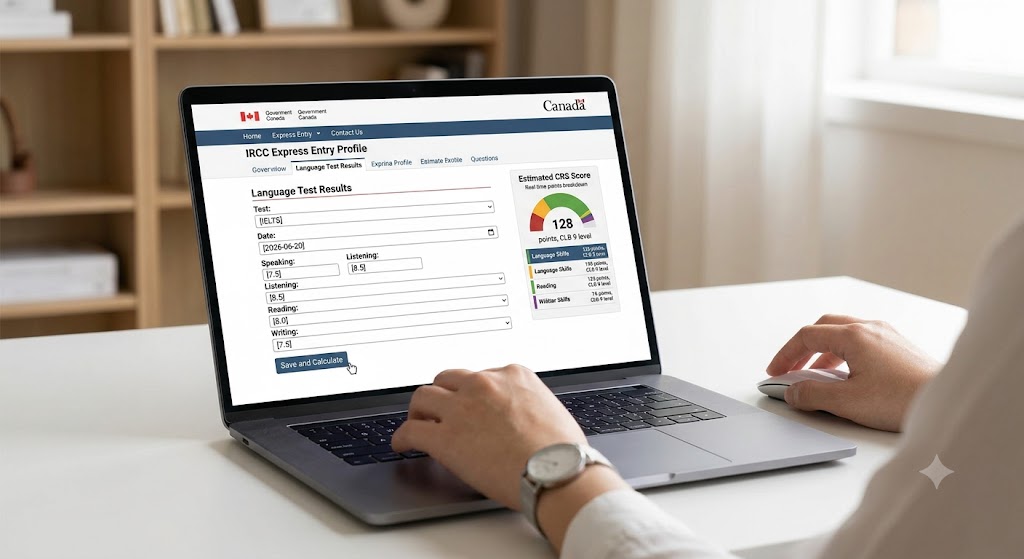
How your language scores affect your Express Entry score
Language is not a pass or fail gate. Once you clear the program minimum, higher CLB levels keep earning you Comprehensive Ranking System (CRS) points toward permanent residence, and strong French as a second official language can add points on top of your first language. Because language points compound with age, education and work experience in the CRS formula, a single benchmark improvement often moves your total score more than any other change you can make in a few weeks. For the exact point values, walk through our breakdown of how to calculate your CRS score in 2026 and the companion CRS points breakdown that covers every factor. If French is realistically within reach for you, our guide to earning 50 points for French in Express Entry explains how the second-language bonus stacks up.
Not sure which of your four abilities is actually capping your CRS score? That is a 30-minute question, and Ansari Immigration's licensed RCIC will read your test report with you and point to the one skill worth retaking, at an $80 consultation.
Which language test felt easier for you, and did your converted CLB match what you expected? Share it in the comments, real experiences help others choosing a test.
What to do if your situation does not fit the standard case
Several common situations sit outside the clean conversion tables, and each has an official rule.
You could not complete a test section because of a disability. IRCC provides a language averaging tool to calculate averaged scores for the abilities you could not complete, and you enter those averaged scores in your profile. IRCC verifies both the averaged scores and the underlying results.
You took a TEF Canada test between December 11, 2023 and May 6, 2024. CCI Paris Ile-de-France temporarily modified the NCLC scoring during that window and has since reverted to the current Express Entry grid. If you were affected, CCI emailed you an updated score, and you must update your Express Entry profile with it, or an invitation could be refused on incorrect scores.
Your results are close to two years old. Results must be less than two years old both when you complete your profile and when you submit your application for permanent residence. If they will expire first, retake the test or apply before they expire, because IRCC will refuse an application submitted with expired results.
You are wondering about the second official language. Adding a second official language at NCLC or CLB 5 across all four abilities can add points, but only if you meet the minimum in every ability. Fall short in one, and the second-language bonus is zero.
You need language scores for something other than Express Entry. Programs such as the Post-Graduation Work Permit and many Provincial Nominee Program streams have their own language rules and sometimes their own minimum benchmarks. Do not assume the Express Entry minimums carry over to a work permit or PNP application; confirm the specific program's requirement first. Our overview of work permits in Canada is a useful starting point for the permit side.
Frequently asked questions about IELTS to CLB
What is CLB 7 in IELTS?
CLB 7 in IELTS General Training is 6.0 in each of speaking, listening, reading and writing. Because the minimum for the Federal Skilled Worker Program and for Canadian Experience Class TEER 0 or 1 jobs is CLB 7, a 6.0 in all four abilities is the common entry benchmark. Our detailed guide to the CLB 7 IELTS score covers the exact bands and edge cases.
What is CLB 9 in IELTS?
CLB 9 in IELTS is 7.0 speaking, 8.0 listening, 7.0 reading and 7.0 writing. The listening requirement is the one people miss: a 7.5 listening is only CLB 8, so you need a full 8.0 in listening to reach CLB 9 in that ability.
What is CLB 5 in IELTS?
CLB 5 in IELTS is 5.0 speaking, 5.0 listening, 4.0 reading and 5.0 writing. CLB 5 is the minimum for Canadian Experience Class jobs in NOC TEER 2 or 3 and for a second official language under the Federal Skilled Worker Program.
How do I calculate my CLB score?
Convert each ability separately using the chart for your test, then take your lowest converted ability as the benchmark you meet for eligibility. There is no averaging across the four abilities for eligibility. For scoring, each ability still earns points on its own level. IRCC's official conversion tables are the authority for each figure.
What is CLB 7 in CELPIP?
CLB 7 in CELPIP-General is a 7 in each ability. CELPIP converts one to one, so your CELPIP level in speaking, listening, reading and writing is your CLB level in that ability with no separate conversion needed.
What is CLB 7 in TEF Canada?
NCLC 7 (the French equivalent of CLB 7) in TEF Canada, using the Équivalence ancien score column, is 310 to 348 in speaking, 249 to 279 in listening, 207 to 232 in reading and 310 to 348 in writing. Enter only the equivalency column scores, not the Score / 699 results.
Related Posts
CLB 7 IELTS Score: Exact Band Requirements and Equivalency — A deeper look at the single most-searched benchmark and what a 6.0 across all four IELTS bands really requires.
IELTS vs CELPIP: Which Test Is Easier for Canadian Immigration? — How the two English tests differ in format and where each one may suit your strengths.
How to Calculate Your CRS Score in 2026: Step-by-Step — Turn your converted CLB levels into Express Entry points, factor by factor.
Talk to Ansari Immigration before you retake a test
Three signs your language file needs a professional read before you book another test: one ability is quietly capping your CLB while the others look strong, you are weighing IELTS against CELPIP or PTE Core and cannot tell which fits you, or your results are approaching the two-year expiry. Ansari Immigration is led by a licensed RCIC who teaches immigration law at three colleges and trains practicing consultants, so a $80, 30-minute consultation reads your score report the way IRCC will and tells you which single skill is worth the retake. For Express Entry representation, the flat fee is CAD $3,000 with all family members included, quoted upfront. Book your consultation with Ansari Immigration, and if you have a question about your specific scores, ask it in the comments and keep it general; for advice on your own case, a consultation is the place for it.
This article is for general information only. It is not legal advice. Program criteria, requirements, processing times, and selection approaches can change without notice. Always confirm details on official government websites or consult a licensed Regulated Canadian Immigration Consultant (RCIC) for advice specific to your situation.