


For Canadian immigration, the IELTS vs CELPIP decision comes down to fit, not difficulty: IRCC accepts both as proof of English and converts each to the same Canadian Language Benchmark (CLB) scale, so neither earns you more points on its own. The right test is the one that matches how you read, listen, speak, and write.
IELTS vs CELPIP: the key differences at a glance
Both tests are approved by Immigration, Refugees and Citizenship Canada for economic immigration. You must take the IELTS General Training option (not Academic, and not the IELTS One Skill Retake) or the CELPIP-General test. The differences are in format, not in how IRCC values them.
Delivery: CELPIP is fully computer-delivered, including a recorded speaking section answered at the computer. IELTS General Training offers a computer or paper option, and its speaking section is a face-to-face interview with a live examiner.
Scoring: CELPIP reports whole-number levels (1 to 12). IELTS reports band scores from 0 to 9 in half-band steps. This is the heart of the celpip vs ielts score difference: CELPIP levels line up cleanly with CLB, while IELTS bands have to be mapped.
English variety: CELPIP uses North American English and everyday Canadian contexts. IELTS uses an international English style.
Availability: IELTS is offered in more countries worldwide. CELPIP is concentrated in Canada and a smaller number of overseas centres, including test sites in Metro Vancouver.
Format and fee details are set by the test administrators, so confirm the current options and pricing directly on the official CELPIP and IELTS websites before you book.

How IELTS and CELPIP scores convert to CLB
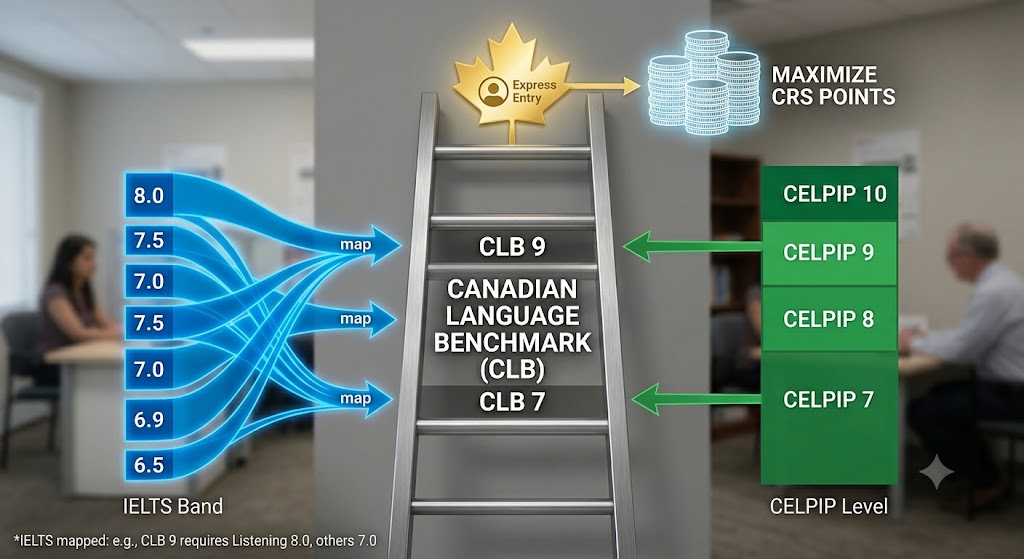
IRCC does not score you on a raw IELTS band or CELPIP level. It converts your result in each of the four abilities, speaking, listening, reading, and writing, into a CLB level, and your CRS points flow from there.
CELPIP is the simpler conversion: a CELPIP level equals the same CLB level in each ability, so a 7 across the board is CLB 7, and a 9 across the board is CLB 9. IELTS General Training needs a lookup. According to IRCC’s official language test equivalency chart, CLB 7 requires a 6.0 in each of speaking, listening, reading, and writing. CLB 9, the level that unlocks the highest language points, requires Listening 8.0, Reading 7.0, Writing 7.0, and Speaking 7.0.
In practice, the candidates we see at Ansari Immigration lose points to one rule more than any other: IRCC sets your CLB ability by ability, and your weakest section controls whether you meet a threshold. A strong reader who slips to 5.5 in IELTS listening sits below CLB 7 in that ability, no matter how high the other three are. When choosing between the tests, look honestly at your weakest skill, because that is the score that will decide your benchmark.
If you are deciding between the two tests for Express Entry, talk to Amir Ansari, RCIC before you book. A short consultation can map your target CRS score to the exact CLB level you need and help you pick the test format that protects your weakest ability. You can reserve a consultation time directly.
Which test is easier, IELTS or CELPIP?
There is no official "easier" test, and IRCC does not favour one over the other. Whether CELPIP or IELTS is easier depends entirely on you. Test takers who are comfortable typing, prefer answering speaking prompts to a screen rather than a person, and are used to North American accents often find CELPIP more natural. Those who have prepared with British-style materials, want the option of writing on paper, or feel calmer speaking to a live examiner often do better on IELTS.
A practical tip we give clients: take a free official practice test for each format before deciding. The celpip vs ielts which is easier question almost always answers itself once you have sat through a sample of both under timed conditions.
Which test should you take for Express Entry and Canada PR?
For Express Entry, the test choice has no effect on your eligibility or your score, only on your comfort. Both feed the same Canadian Language Benchmark result that IRCC uses to award language points and to confirm you meet the program minimum, which is CLB 7 in all four abilities for the Federal Skilled Worker Program and for Canadian Experience Class jobs in TEER 0 or 1.
What matters far more than the brand on the certificate is your benchmark. Improving from CLB 7 to CLB 9 can add meaningful CRS points, which is why language is one of the most controllable levers when you increase your Express Entry points. Whichever test you choose, enter the scores carefully when you create your Express Entry profile, because a transposed band can change your benchmark and your invitation odds.
Why this matters for your immigration application
One detail catches applicants off guard regardless of which test they pick: your results must be less than two years old both when you complete your Express Entry profile and when you submit your application for permanent residence. IRCC will refuse an application filed with expired language results. If your scores are close to the two-year mark and you have not yet been invited, plan to retest or apply before they expire.
This is exactly the kind of avoidable mistake that costs people an entire Express Entry round. Treat your language test date as a deadline, not a formality.
If your test results are aging or your benchmark is sitting just below the level you need, do not guess your way through it. Amir Ansari, RCIC (regulated by the College of Immigration and Citizenship Consultants) can review your scores against your target programs and tell you whether to retest, which test fits you, or whether you are already where you need to be. Book a consultation to get a clear answer.
Frequently asked questions about IELTS vs CELPIP
Is CELPIP easier than IELTS?
There is no official answer, because IRCC accepts both equally and converts each to the same CLB scale. CELPIP feels easier to test takers who are comfortable with computers and North American English. IELTS can feel easier to those who prefer a paper option or a live speaking examiner.
Which is easier, IELTS or CELPIP?
It depends on your strengths. The format differences, computer versus paper and recorded versus face-to-face speaking, drive most of the preference. Try an official practice test of each before you commit.
Is CELPIP better than IELTS for Canadian immigration?
Neither is better for your score. Both are approved by IRCC and feed the same CLB result. CELPIP’s one advantage is a cleaner conversion, since CELPIP levels match CLB levels directly, while IELTS bands must be mapped.
How is CELPIP different from IELTS?
CELPIP is fully computer-delivered with whole-number levels from 1 to 12 and North American English. IELTS General Training offers paper or computer delivery, a live speaking interview, and half-band scores from 0 to 9 in international English.
Which is better, CELPIP or IELTS, for Canada?
For Canadian immigration, choose the test that matches your strengths and is convenient to book where you live. Both are accepted for Express Entry and most economic programs, so the deciding factors are format comfort and test-centre availability, not IRCC preference.
Related Posts
Canada CLB Score: What CLB 5 and CLB 7 Mean: How IRCC converts your IELTS or CELPIP results into the benchmark that decides your language points.
How to Create Express Entry Profile in Canada: A step-by-step guide to entering your language scores and the rest of your profile correctly.
How to Increase Your Express Entry Points: Why raising your language benchmark is one of the fastest ways to lift your CRS score.
New to studying in Canada? Read this guide before getting your Canadian student visa.
This article is for general information only. It is not legal advice. Program criteria, requirements, processing times, and selection approaches can change without notice. Always confirm details on official government websites or consult a licensed Regulated Canadian Immigration Consultant (RCIC) for advice specific to your situation.