
What Is Express Entry in Canada? A Plain-Language Guide

Updated: Sep 30
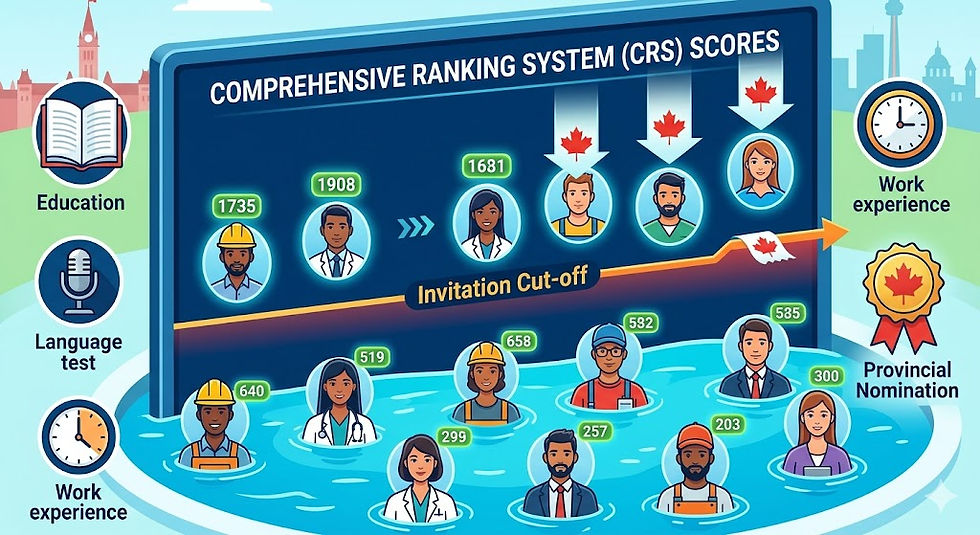
Express Entry in Canada is the online system the federal government uses to manage applications for permanent residence from skilled workers. It is not an immigration program itself. It is a pool where eligible candidates are ranked against each other by points, and the highest-ranked are invited to apply for permanent residence in regular rounds.
That one distinction, a ranking competition rather than a first-come queue, is what most people get wrong about it. Understanding it changes how you approach your whole application.
What Is Express Entry in Canada, and Who Is It For?
Express Entry manages three federal economic immigration programs in one system: the Canadian Experience Class, the Federal Skilled Worker Program, and the Federal Skilled Trades Program. To enter the pool, you must first be eligible for at least one of these three programs. You cannot enter Express Entry on its own.
It is built for skilled workers: people with skilled work experience (classified under National Occupational Classification TEER categories 0, 1, 2, or 3), enough language ability in English or French, and, for most programs, the education to back it up. If you qualify for one program, you can also be considered for a Provincial Nominee Program through the same profile.
How Express Entry Works in Canada: The Three Steps
The process has a simple shape, even though the details run deep.
Step 1: Confirm you are eligible and create a profile
You check that you meet the minimum requirements of at least one of the three programs, then create an online Express Entry profile. The profile asks about your age, education, language test results, work experience, and family situation. Your profile is valid for 12 months. If you are not invited within that time, it expires and you can submit a new one.
Step 2: Get ranked by your CRS score
Once your profile is accepted, you enter the pool and receive a score under the Comprehensive Ranking System (CRS), out of 1,200 points. The CRS is built on four parts and assesses your skills, education, language ability, work experience, and other factors. Everyone in the pool is ranked against everyone else by this number.
Step 3: Receive an invitation to apply
In each round of invitations, IRCC sets a cut-off score and invites the highest-ranked candidates above it. There are three types of rounds: general rounds (open to all three programs), program-specific rounds (one program, such as the Provincial Nominee Program), and category-based rounds (targeting a specific goal, such as candidates with certain work experience or French-language ability). If your score clears the cut-off for that round, you get an invitation to apply for permanent residence.
The Three Express Entry Programs
Each program has its own minimum requirements. These are the core differences, taken from IRCC's current eligibility criteria.
Canadian Experience Class (CEC): For people with skilled Canadian work experience. You need 1 year of skilled work in Canada within the last 3 years, and language ability of CLB 7 for TEER 0 or 1 jobs (CLB 5 for TEER 2 or 3). No education or job offer required to qualify.
Federal Skilled Worker Program (FSWP): For skilled workers with foreign or Canadian experience. You need 1 year of continuous skilled work within the last 10 years, CLB 7 in all four language abilities, and secondary education. A job offer is not required, though you can score points for one.
Federal Skilled Trades Program (FSTP): For people qualified in a skilled trade. You need 2 years of work in the trade within the last 5 years, CLB 5 in speaking and listening (CLB 4 in reading and writing), and either a valid full-time job offer of at least 1 year or a certificate of qualification from a Canadian authority.
Thinking about which program fits your profile? Amir Ansari, RCIC, reviews your work history, language results, and timeline together so you target the right program before you build a profile, not after a refusal. You can book a consultation to map your route through Express Entry.
How Your CRS Score Decides Everything
The CRS is where Express Entry is won or lost. Points come from your age, education, language ability, and work experience, plus combinations of those factors, and additional points for things like a provincial nomination or a sibling who is a citizen or permanent resident living in Canada.
One change matters more than any other right now. As of March 25, 2025, IRCC removed job-offer points from the CRS. A job offer used to add 50 points for most skilled positions and 200 points for senior management roles. Those points are gone for all current and future candidates. If you read older guides that tell you to chase an LMIA-backed job offer purely for CRS points, that advice is out of date. A job offer can still be part of your eligibility for the Federal Skilled Trades Program and some provincial streams, so it is not worthless, but it no longer moves your CRS score.
In practice, the candidates we see clear recent cut-offs tend to win on the fundamentals: strong language scores (a higher CLB is the single most cost-effective lever for most people), Canadian work experience, and a credential assessment that captures their full education. For candidates stuck in the middle of the pool, a provincial nomination is the most reliable way up, because a nomination adds enough points to make an invitation almost certain. For our Vancouver and B.C. clients, that often means looking at the BC Provincial Nominee Program alongside Express Entry, since the two systems connect through the same profile.

What Happens After You Get an Invitation to Apply
An invitation to apply is not permanent residence. It is permission to submit a full application, and the clock starts immediately. Your invitation is valid for 60 days only. Within that window you complete the application form, upload your documents (police certificates, proof of funds, language results, a medical exam, and more), and pay your fees.
This 60-day sprint is where careful candidates and rushed ones separate. If your situation changed since you submitted your profile, for example your language results expired or you lost a provincial nomination, your score could drop below the cut-off, and submitting anyway risks a refusal with no fee refund. IRCC's longstanding service standard has aimed to process most complete applications within about six months, but actual processing times change from year to year, so confirm the current estimate on IRCC's official processing times tool before you plan around it.
Why This Matters for Your Immigration Application
Treating Express Entry as a queue, where you assume that submitting a profile eventually leads to an invitation, is the most common and costliest misunderstanding. It is a ranking system. If your score sits below recent cut-offs, doing nothing means waiting indefinitely while your 12-month profile quietly expires. The candidates who succeed treat the months in the pool as time to raise their score: retaking a language test, finishing a credential assessment, gaining another year of skilled experience, or pursuing a provincial nomination.
Express Entry is the fastest federal route to permanent residence for many skilled workers, but only when your score keeps pace with the cut-offs.
Not sure whether your CRS score is competitive, or what to fix first? Amir Ansari, RCIC, a Regulated Canadian Immigration Consultant who files Express Entry applications and teaches immigration law, can review your profile and give you a concrete plan. Book a consultation to find your fastest realistic route to permanent residence.
Frequently Asked Questions About Express Entry in Canada
How does Express Entry work in Canada?
You confirm you qualify for one of three federal programs, create an online profile, and receive a CRS score out of 1,200. IRCC ranks everyone in the pool and, in regular rounds, invites the highest-scoring candidates to apply for permanent residence.
Who is eligible for Express Entry?
Skilled workers who meet the minimum requirements of at least one of the three programs: the Canadian Experience Class, the Federal Skilled Worker Program, or the Federal Skilled Trades Program. Each has its own work experience, language, and education thresholds.
How long does Express Entry take?
After an invitation, you have 60 days to submit a complete application. IRCC has historically aimed to process most complete Express Entry applications within about six months, but current times vary, so check IRCC's official processing times tool for the latest estimate.
How many points do you need for Express Entry?
There is no fixed pass mark. Each round sets its own CRS cut-off based on who is in the pool and how many invitations are issued, so the score you need changes from draw to draw. You must score above that round's cut-off.
Can international students apply for Express Entry?
Yes. Many graduates qualify through the Canadian Experience Class after gaining one year of skilled Canadian work experience, often on a post-graduation work permit. Study time alone does not count as work experience, but it can support your profile.
Do you need a job offer for Express Entry?
No, not for most candidates. The Canadian Experience Class and Federal Skilled Worker Program do not require a job offer, and as of March 25, 2025, a job offer no longer adds CRS points. A valid job offer is still required for the Federal Skilled Trades Program and some provincial streams.
Related Posts
How to Create Express Entry Profile in Canada: Step-by-Step Guide: A walkthrough of building your profile once you have confirmed you are eligible for one of the three programs.
Express Entry Processing Time in Canada: What to Expect in 2026: How long the steps actually take, from profile to invitation to a final decision on permanent residence.
Canada CLB Score: What CLB 5 and CLB 7 Mean for Your Immigration Application: Why your language benchmark is the most cost-effective lever for raising your CRS score.
IRCC also runs targeted rounds: see how Express Entry category-based selection works.
Choosing the right NOC matters: read about NOC code mistakes after an ITA.
This article is for general information only. It is not legal advice. Program criteria, requirements, processing times, and selection approaches can change without notice. Always confirm details on official government websites or consult a licensed Regulated Canadian Immigration Consultant (RCIC) for advice specific to your situation.



Comments