

Canada PR eligibility for international students almost always runs through one sequence: study, graduate, work, then apply for permanent residence. There is no program that converts a study permit directly into PR. You become eligible by gaining skilled Canadian work experience after you graduate, usually on a post-graduation work permit, and then applying through Express Entry or a Provincial Nominee Program. This guide maps the full roadmap and the eligibility rules at each step.
The one rule that surprises most students first
Here is the practitioner reality that catches people off guard. The Canadian Experience Class, the main Express Entry route for graduates, requires one year of skilled Canadian work experience in the three years before you apply. According to IRCC, work experience gained while you were a full-time student, including time on a co-op work term, does not count toward that requirement.
In practice, the students we see who plan well treat their study years as the qualifying step and their post-graduation work as the experience-building step. The work that makes you PR-eligible is almost always the work you do after you graduate, on a post-graduation work permit. That single distinction reshapes how you should plan your timeline from day one.

Canada PR eligibility for international students: the core route
The most common path has four stages:
Study at a designated learning institution and complete a program that qualifies you for a post-graduation work permit.
Apply for a post-graduation work permit (PGWP) within 180 days of finishing your program.
Use the PGWP to gain at least one year of skilled Canadian work experience.
Apply for permanent residence through Express Entry (Canadian Experience Class) or through a Provincial Nominee Program.
For the Canadian Experience Class, IRCC sets these key requirements: one year (1,560 hours) of paid Canadian work experience in an occupation in NOC TEER category 0, 1, 2, or 3, gained while authorized to work, in the three years before you apply. The language requirement is Canadian Language Benchmark (CLB) 7 for TEER 0 or 1 jobs, and CLB 5 for TEER 2 or 3 jobs. There is no education requirement and no job offer requirement for this class.
Step 1 and 2: study permit to PGWP
Your PGWP is the bridge between studying and qualifying for PR, so its eligibility rules matter. IRCC requires that your program was at least eight months long at a PGWP-eligible designated learning institution, that you kept full-time status each semester (part-time is allowed only in your final semester), and that you apply within 180 days of confirmation you completed your program.
Two newer rules deserve attention. If you submitted your study permit application on or after November 1, 2024, and you graduated from a college or non-degree program, you must graduate in an eligible field of study. There are no field-of-study requirements for bachelor's, master's, or doctoral graduates. Separately, if you submitted your PGWP application on or after November 1, 2024, you must meet a language requirement: CLB 7 for university graduates and CLB 5 for college graduates. You can hold only one PGWP in your lifetime, and programs of English or French as a second language do not qualify.
Step 3 and 4: work experience to permanent residence
Once you are working on your PGWP, you are building the experience that unlocks permanent residence. Express Entry manages three federal programs, and the Canadian Experience Class is the natural fit for most graduates because it rewards Canadian work experience. When you create an Express Entry profile, IRCC ranks you against other candidates using the Comprehensive Ranking System (CRS). Higher-ranked candidates receive invitations to apply, and an invitation gives you 60 days to submit your PR application.
Two levers help graduates who are sitting mid-pool. The first is category-based selection: IRCC holds rounds for specific categories, which currently include healthcare and social services, STEM, trades, education, transport, and French-language proficiency. If your post-graduation job sits in one of these fields, a category round can invite you at a lower score than a general round. The second is a provincial nomination, which adds substantial extra points to your CRS score and effectively guarantees an invitation. If you are nominated, you must settle in the province that nominated you.
Considering your own study-to-PR timeline? Amir Ansari, RCIC, can map your specific program, work plan, and target CRS score into a realistic PR strategy before you make decisions you cannot easily undo. Book a planning session through the Ansari Immigration consultation page.
A comparison of the main PR routes for graduates
How the routes line up
Canadian Experience Class (Express Entry): best for graduates with one year of skilled Canadian work. Core eligibility: one year of TEER 0 to 3 Canadian experience, CLB 7 for TEER 0 or 1 and CLB 5 for TEER 2 or 3. No job offer required.
Category-based Express Entry round: best for graduates working in a targeted field such as health, STEM, trades, education, transport, or French. Core eligibility: Express Entry eligibility plus the category's specific criteria. No job offer required.
Provincial Nominee Program: best for graduates tied to one province, including BC. Core eligibility is province-specific, and many streams favour local graduates. A job offer is often required, and it varies by stream.
For BC-based graduates, the BC PNP runs streams that international graduates frequently use, and a nomination pairs well with Express Entry through the British Columbia route. Criteria and draw scores change, so confirm the current BC PNP requirements before you commit to a stream.
A typical situation at Ansari Immigration
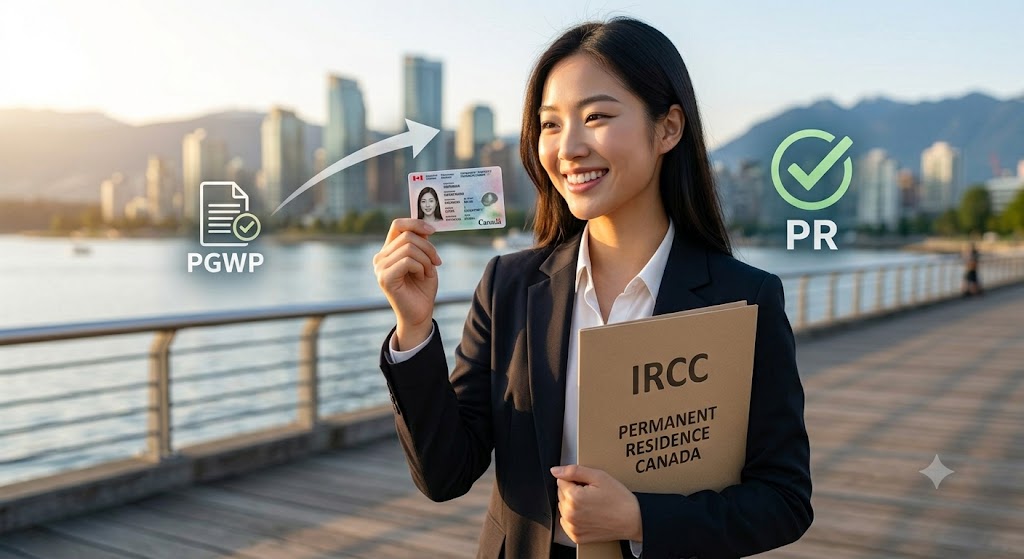
A common Metro Vancouver scenario: a student finishes a two-year college diploma in Burnaby, applies for a three-year PGWP, and starts a TEER 1 job in tech or health. They want to file for PR immediately. The honest answer is that they cannot use their study-period or co-op hours, so they need roughly twelve months of post-graduation work before the Canadian Experience Class door opens. We use that first year to also lift their CRS score: a higher language test result, a spousal profile decision, and a BC PNP registration in parallel. The students who plan this sequence early, rather than in their final PGWP year, almost always have more options.
Frequently asked questions about Canada PR eligibility for international students
Can international students apply for PR in Canada?
Yes, but usually not directly from a study permit. Most international students become eligible after they graduate and gain skilled Canadian work experience, then apply through Express Entry or a Provincial Nominee Program.
How do international students get PR in Canada?
The standard route is study, then a post-graduation work permit, then at least one year of skilled Canadian work, then a PR application through the Canadian Experience Class or a PNP. Some provincial streams invite graduates earlier.
How can international students get PR in Canada faster?
Target a higher CRS score, aim for a job in a category-based selection field, and register for a relevant Provincial Nominee Program. A nomination adds substantial CRS points and is often the most reliable accelerator.
Does Canada give PR to international students without work experience?
It is difficult. Federal economic routes reward Canadian work experience, and study-period work does not count toward the Canadian Experience Class. Some PNP graduate streams have lighter experience requirements, so confirm current criteria for your province.
When can an international student apply for PR in Canada?
You can create an Express Entry profile once you meet a program's minimum requirements, which for the Canadian Experience Class means after about one year of qualifying post-graduation work. PNP timing varies by stream.
Related Posts
PR Pathways in Canada 2026: The 5 Most Accessible Routes to Permanent Residence: A wider look at the most accessible PR routes beyond the student pathway.
PGWP Canada 2026: Complete Guide to Eligibility, Length, and Application: Full eligibility, permit length, and application detail for the post-graduation work permit.
How to Become a Permanent Resident of Canada as an International Student in B.C.: The BC-specific angle on moving from study to permanent residence.
Not sure which PR route fits your program and province? Amir Ansari, RCIC, regularly helps Vancouver-area graduates sequence their PGWP, work experience, and Express Entry or BC PNP application so nothing is left to chance. Reserve a consultation through the Ansari Immigration consultation page to build your plan.
Staying longer to study? See our guide on renewing your study permit in Canada.
Considering a break in your studies? Read whether international students can take a semester off.
This article is for general information only. It is not legal advice. Program criteria, requirements, processing times, and selection approaches can change without notice. Always confirm details on official government websites or consult a licensed Regulated Canadian Immigration Consultant (RCIC) for advice specific to your situation.