


The Agri-Food Pilot closed to new applications on May 14, 2025, and IRCC's own program page still says it will only finish files accepted before that date. Of the eight occupations the pilot covered, only two sit in a skill band Express Entry accepts. An application already in the queue can still support a bridging open work permit.
That last sentence is the part that matters most right now, because the people still affected by this program are not new applicants. They are workers whose permanent residence application went in before the cutoff and whose employer-specific work permit is now running down while they wait. The consequence of getting this wrong is not a delay. It is loss of status, loss of the job that underpins the application, and in one documented case, a returned application with nowhere left to refile. Ansari Immigration, a Vancouver RCIC practice, treats a closed pilot as a timing problem before it is an eligibility problem: the first number to check is not the applicant's score, it is the expiry date on the work permit.
Byline: Amir Ansari, RCIC, Ansari Immigration, Vancouver.

Why the Agri-Food Pilot ended on May 14, 2025, and why it could not simply be extended again
The Agri-Food Pilot did not end because a minister changed their mind. It ran out of statutory runway. The pilot was created by Ministerial Instructions under section 14.1 of the Immigration and Refugee Protection Act, the provision that lets the Minister stand up an economic immigration class outside the regulations. That power comes with two hard limits written into the Act itself.
The first is volume. Subsection 14.1(2) states that "... no more than 2,750 applications in a class established under subsection (1) may be processed in any year." The second is time. Subsection 14.1(9) says an instruction "has effect for the period specified in the instruction, which is not to exceed five years starting on the day on which the instruction first takes effect," and then closes the door: "No amendment to or renewal of an instruction may extend the five-year period."
The pilot first took effect on May 15, 2020. Five years later is May 14, 2025. The 2023 amendment had already pushed the end date out to that statutory maximum and removed the occupational sub-caps at the same time. Nothing further was available: subsection 14.1(9) does not grant one extension, it bars any amendment or renewal from reaching past five years at all.
This is not inference. IRCC said it plainly in its January 3, 2025 notice capping the final intake: the pilot "can only run for a maximum of 5 years, and this time period will be reached on May 14, 2025," and "The pilot cannot be extended beyond this date." Keeping an agri-food permanent residence route alive after that would have required fresh Ministerial Instructions or a regulation, not a renewal.
This is the single most useful thing to understand about any federal immigration pilot, including the ones running now. The Rural Community Immigration Pilot is built on the same authority, carries the same 2,750-application annual ceiling, and is described in IRCC's own instructions as operating for five years. A pilot is a dated instrument. Treating one as a permanent pathway is how people end up planning around a route that disappears.
What happens to an Agri-Food Pilot application that was already filed
Applications accepted before May 14, 2025 are still being processed, and nothing in the closure changes the eligibility rules they are assessed against. What the closure does change is that there is no second attempt, which raises the cost of every avoidable error in the file.
Three operational points govern what an applicant in that position can actually do.
IRCC does not publish a processing time for this pilot, and here is exactly where it is absent
IRCC's processing times tool does not list the Agri-Food Pilot. Under Economic immigration, the program list runs: Atlantic Immigration Program, Canadian Experience Class, Caregivers (all programs), Provincial Nominees, Self-employed persons (Federal), Quebec Business Class, Skilled workers (Federal), Skilled trades (Federal), Skilled workers (Quebec), Start-up visa. There is no agri-food entry. The pilot's own after you apply page gives no timeline either, only a list of things that lengthen processing: incomplete applications, unclear documents, missing certified translations, identity verification, medical consultations, criminal or security issues, and consultations with other offices.
As of October 2026, then, there is no official Agri-Food Pilot processing time to quote. Anyone presenting one is estimating. If IRCC adds the program to the tool, that page is where it will appear, and it is worth checking there rather than relying on a third-party figure.

What IRCC does publish is the size of the queue the applicant is sitting in, which is more useful than it sounds.
Period |
Maximum applications processed |
Source of the limit |
January 1 to December 31, 2024 |
2,750 |
Annual ceiling under IRPA section 14.1 |
January 1 to May 14, 2025 |
1,010 prorated (1,000 electronic and 10 alternate format) |
Final-year cap set in the program delivery instructions |
After May 14, 2025 |
0, no new applications accepted |
Five-year limit under IRPA subsection 14.1(9) |
Source: Agri-Food Pilot program delivery instructions, putting an application into processing and IRPA section 14.1. Verified October 2026.
One timing point is widely misread, including by pages that still describe the pilot as having run to the middle of May. May 14, 2025 was the pilot's end date, not necessarily the day intake stopped. IRCC's January 2025 notice set the final intake to run until the 1,010 applications were received or the pilot expired, whichever came first, and the Federal Court case discussed below records the program as already closed to new applications by the time a decision issued in early March 2025. If you were counting on filing in the final weeks, the cap is the reason you could not.
Your work permit while you wait: the Agri-Food Pilot qualifies for a bridging open work permit, but not at the same stage as Express Entry
This is the question practitioners are actually asking. An ATIP release of the IRCC Representative Support mailbox log (file A-2026-19052) records a representative inquiry dated January 19, 2026 headed, in substance, work permit options for a client while an agri-food immigration application is pending. The reply was not released, but the published instruction answers it.
The Agri-Food Pilot is on the list of classes whose principal applicants can get a bridging open work permit under exemption code A75. The catch is the stage. For the three Express Entry programs, the trigger is passing the section R10 completeness check, which happens early. For the Agri-Food Pilot, IRCC's bridging open work permit instructions set the trigger at a positive eligibility assessment on the non-Express Entry application for permanent residence. That is a substantive assessment, not an intake formality, and it lands much later.
The practical effect: an agri-food applicant cannot plan a bridging permit around the acknowledgement of receipt. The window opens only once the file has been positively assessed, which is why the employer-specific permit extension, not the bridge, is usually the near-term move. Our post on types of work permits in Canada sets out the difference between the two instruments.
Your spouse's open work permit: nobody is excluded by skill level, but TEER 4 and 5 families wait longer
Family open work permits are available to Agri-Food Pilot families at every skill level. What changes with skill level is the moment the window opens, and there are two official instruments describing it in different language, which is where readers get lost.
The officer instruction (modified April 16, 2026) states that "family members of AFP applicants at all job skill levels are eligible to apply for an OWP," then splits the timing. Where the principal applicant is in a TEER 2 or TEER 3 occupation, the family member is eligible once the principal has submitted the permanent residence application, the principal's work permit has at least six months of validity remaining when the family member's application is received, and the family member meets the general work permit requirements. Where the principal applicant is in a TEER 4 or TEER 5 occupation, the application must first have passed the R10 completeness check, with the same six-month and general-eligibility conditions. The instruction then adds the detail that reconciles everything: at that stage "the applicant will receive the acknowledgement of receipt letter informing them of their family members eligibility."
The client-facing page, open work permits for family members of foreign workers (modified June 12, 2026), organises the same entitlement by route rather than by TEER, and adds one condition the officer instruction does not mention. On the route for workers who have already applied for permanent residence under a listed economic program, which names the Agri-Food Pilot, there is no skill-level condition at all, but the principal's work permit must have been "issued or approved because you applied for an economic class permanent residence program or pilot." On the separate pathway route for low-skilled workers, the page requires both "a labour market impact assessment (LMIA)-based work permit in the agriculture or low-wage stream of the Agri-Food Pilot" and "an acknowledgment of receipt letter from us confirming that your application for permanent residence is complete."
Three practical conclusions survive that comparison. Six of the pilot's eight occupations are TEER 4 or 5, so most of these families are waiting for the acknowledgement of receipt rather than filing the day the application goes in. The six months of validity is measured when IRCC receives the family member's application, not when you start preparing it, so a permit with seven months left is already tight. And if your permit is an ordinary LMIA-based agricultural or low-wage permit, read the client-facing route carefully, because that is the one written for you.
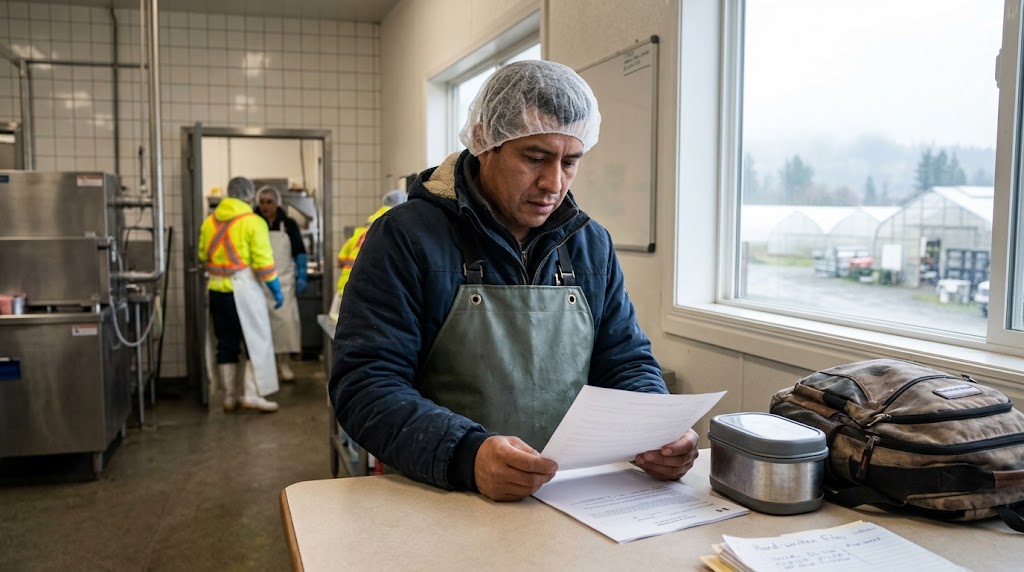
What to check this week if your Agri-Food Pilot application is still pending
The expiry date on your employer-specific work permit, and how many months of validity remain
Whether your employer is willing and able to support an extension on the same LMIA-based position
Whether you have received the acknowledgement of receipt letter, which is the trigger for a TEER 4 or 5 family member's open work permit, and whether you have had a positive eligibility assessment, which is the separate and later trigger for a bridging open work permit
Whether every family member listed on your IMM 5406 also appears on your IMM 0008, with nationality and status
Whether your contact details on file are current, because IRCC corresponds to the address on the application
Three signs an Agri-Food Pilot file needs a professional read before you act: your work permit expires inside the next six months, your employer has changed or restructured the position since you applied, or you have received a request for documents you are not sure how to answer. Ansari Immigration will tell you plainly if there is nothing worth filing, which on a closed pilot is sometimes the honest answer.
Check your options in a 30-minute consultation ($80)
Did your Agri-Food Pilot application go in before the May 2025 cutoff? If you have had any contact from IRCC since, say roughly when in the comments. Real timelines help the people still waiting, and keep it general rather than case-specific.
What a returned application cost one BC applicant: Li Rong v Canada, 2026 FC 266
The failure mode on a closed program is not refusal. It is a return for incompleteness at a moment when refiling is impossible, and there is now a Federal Court decision showing exactly how that plays out.
In Li Rong v The Minister of Citizenship and Immigration, 2026 FC 266 (decided February 26, 2026), the applicant was a resident of British Columbia who applied under the Agri-Food Pilot in January 2025. His Generic Application Form, IMM 0008, left out his spouse's biological son from a prior relationship. He had disclosed that child on the Additional Family Information form, IMM 5406. On March 4, 2025, an officer returned the application as incomplete under sections 10 and 12 of the Immigration and Refugee Protection Regulations.
The Court dismissed the judicial review. It found the officer's decision reasonable, noting that the two forms do not collect the same information: "Notably, nationality and immigration status appear to be captured by IMM 0008 but not by IMM 5406." It found no breach of procedural fairness, holding that the onus to file a complete application rests with the applicant and the officer had no duty to flag the omission. It expressly found no evidence of any intention to misrepresent or conceal the child. And it recorded that the Program "had reached its maximum intake and was closed to new applications," so there was no route back.
Read that sequence carefully. A disclosed child, on the wrong form, in a year when the final 1,010-application cap had filled, cost a complete pathway to permanent residence. No misrepresentation finding, no bad faith, no appeal. The same form-level discipline is why we wrote about Express Entry NOC code mistakes after an ITA: on capped and time-limited programs, completeness is the whole game.
What officers are still instructed to look for in the files that remain
For anyone still in the queue, the assessment has not softened. The pilot's instruction on ability to become economically established (modified November 20, 2025) tells officers that where the selection criteria alone are not a sufficient indicator, they may weigh the current job or job offer, language ability, work experience, and education, with the weight varying case by case.
Two lines in it are worth knowing. The instruction states that if the officer "is not satisfied that the individual intends to enter the labour market," they "should consider refusing the application." And it tells officers that what is critical is comparing the National Occupational Classification requirements for the occupation against what the applicant has actually shown, giving the example of someone offered an industrial meat cutter position with no relevant training or experience, where there is little alignment between stated labour market intentions and demonstrated skills.
The counterweight is also in the instruction: officers must examine all the information for internal consistency, and the applicant "should be invited to address any concerns that arise," in accordance with procedural fairness. In other words, an officer who doubts the labour market intention is expected to put that concern to the applicant first. If a request for information arrives that reads like a challenge to whether the job is real, that is the moment the file is decided, not a formality.
Which of the eight Agri-Food Pilot occupations still has a permanent residence route in 2026
The pilot's value was never its volume. It was that it accepted TEER 4 and TEER 5 work experience, which the three Express Entry programs do not. The Express Entry eligibility page (modified June 22, 2026) confirms the Canadian Experience Class and the Federal Skilled Worker Program accept work experience in TEER 0, 1, 2 or 3 only, with the Federal Skilled Trades Program narrower still. Our NOC and TEER guide explains how to read your own code.
Occupation |
NOC 2021 |
TEER |
Express Entry route today |
Other federal or BC route |
Agricultural service contractors and farm supervisors |
82030 |
2 |
Yes, CEC or FSW on general criteria |
BC PNP Skilled Worker, RCIP |
Butchers, retail and wholesale |
63201 |
3 |
Yes, and named in the trade occupations category |
BC PNP Skilled Worker, RCIP |
Specialized livestock workers and farm machinery operators |
84120 |
4 |
No |
RCIP; FCIP (French, NCLC 5); Atlantic Immigration Program |
Industrial butchers and meat cutters, poultry preparers |
94141 |
4 |
No |
RCIP; FCIP (French, NCLC 5); Atlantic Immigration Program |
Meat cutters and fishmongers, retail and wholesale |
65202 |
5 |
No |
RCIP or FCIP, job offer in the same five-digit NOC |
Livestock labourers |
85100 |
5 |
No |
RCIP or FCIP, job offer in the same five-digit NOC |
Harvesting labourers |
85101 |
5 |
No |
RCIP or FCIP, job offer in the same five-digit NOC |
Labourers in food and beverage processing |
95106 |
5 |
No |
RCIP or FCIP, job offer in the same five-digit NOC |
Source: eligible occupations from the Agri-Food Pilot eligible industries and occupations page; TEER read from the NOC code itself, where the second digit identifies the TEER category, and corroborated for NOC 63201 on IRCC's own category table; Express Entry bands from the Express Entry eligibility page; rural pilot bands from the RCIP and FCIP instructions; TEER 4 job offers under the Atlantic Immigration Program; BC stream rule from WelcomeBC. Verified October 2026.
The Express Entry agriculture category is gone, and one occupation walked across to trades
Through 2024 and 2025 there was a second federal route: category-based selection included an agriculture and agri-food category. IRCC's report to Parliament on category-based selection records that the 2024 version listed three eligible occupations, and that when the category was re-established for 2025 the list held only retail and wholesale butchers.
For 2026 the category does not exist. The official page, modified June 22, 2026, lists ten current categories: French-language proficiency, healthcare and social services, STEM, trades, education, transport, physicians with Canadian work experience, senior managers with Canadian work experience, researchers with Canadian work experience, and skilled military recruits. Butchers at NOC 63201 now appear inside the trade occupations list, which requires twelve months of full-time experience in the past three years in a single listed occupation.

An internal IRCC memorandum to the Minister seeking approval of the 2026 categories, released under the Access to Information Act (file 1A-2025-01280), set out that reasoning before the decision was announced. It recommended "not renewing the agriculture category in place in 2025," on the basis that only one occupation remained eligible and that occupation belonged in trades. The same memorandum recommended raising the minimum work experience for the renewed categories from six months to one year, which IRCC's February 18, 2026 announcement confirmed. The published outcome matches the recommendation on both points.
One trap comes with that move. An internal officer standard operating procedure obtained under the Access to Information Act instructs that where it is determined a client does not meet membership of the category they were invited under, that finding is not treated as a refusal, and that candidates must meet the requirements of the round and of the underlying Express Entry program. A butcher invited in a trades round still has to qualify for the Canadian Experience Class or the Federal Skilled Worker Program on its own terms. We cover that scenario in what happens if you are invited but do not meet the category.
In British Columbia, the provincial route closed to these workers too
This is where the local picture is bleaker than the national one. BC PNP Skills Immigration now runs two streams for workers, Skilled Worker and Health Authority, alongside a temporary rural and remote health support initiative, and the WelcomeBC worker page (last updated May 28, 2026) states that a Skilled Worker job offer "must be in a NOC TEER 0, 1, 2, or 3 occupation." No entry-level or semi-skilled stream is listed, and the page notes the program prioritises workers who meet BC's labour market and economic development needs, pointing readers to the BC PNP's selection of workers list.
So for a greenhouse worker in Abbotsford, a mushroom harvester in Langley or a food-processing labourer in Surrey at TEER 4 or 5, neither Express Entry nor the BC provincial nominee program is open on skill level alone. Two federal routes remain, and both are community-based. The Rural Community Immigration Pilot (instructions modified June 23, 2026) sets specific terms: a job offer from a designated employer in a participating community, a certificate of recommendation from that community, at least 75% of the work performed inside community boundaries, one year of experience totalling 1,560 hours, and for a TEER 5 job offer, experience in the same five-digit NOC. Language is CLB or NCLC 4 for TEER 4 and 5 offers, the same bar the Agri-Food Pilot used. Its sister program, the Francophone Community Immigration Pilot (modified June 23, 2026), runs the same TEER structure including TEER 5 job offers in the same five-digit NOC, but requires NCLC 5 in French in all four skills regardless of the job's skill level.
Geography is the deciding factor. IRCC selected 14 RCIP communities, three of them in British Columbia: West Kootenay, North Okanagan Shuswap and Peace Liard. The Francophone pilot's six communities include Kelowna, BC, which is the one option on this list within reach of a French-speaking applicant who does not want the far north or the Kootenays. None of the 20 communities is in Metro Vancouver, so for a worker in Surrey or Abbotsford this is a relocation decision rather than a paperwork one.
One more check matters before anyone packs. Each community designates its own employers and sets its own priority sectors and occupations, and IRCC does not publish those lists centrally. Whether agriculture or food processing is a priority occupation in West Kootenay, North Okanagan Shuswap, Peace Liard or Kelowna has to be confirmed with that community directly, and it can change. For a TEER 4 worker there is also a third federal route outside BC: the Atlantic Immigration Program accepts a TEER 4 job offer where the position is permanent, in the four Atlantic provinces.
Was closing the Agri-Food Pilot the right call? The honest case on both sides
It is worth putting both arguments on the table, because readers will have heard only one.
The case for closing it is real. The pilot was capped at 2,750 applications a year, a rounding error against national admissions. By its final year its Express Entry sibling category had shrunk to a single occupation, which made the category hard to justify as a distinct selection instrument. IRCC's own stakeholder consultation on 2026 priorities, reproduced in the memorandum to the Minister, found opinion on an agriculture and agri-food category genuinely split: 29% of respondents rated the need great, 27% average, 16% little, and 19% saw no need at that time. And a program built on employer-specific LMIA work permits concentrates leverage in the employer's hands, which is a program integrity concern IRCC has acted on elsewhere.
The case against is the arithmetic of demand. IRCC figures released under the Access to Information Act (file A-2026-09348, data as of February 16, 2026) show agricultural work permits and extensions issued for countries in the Americas rising from 54,835 in 2019 to 79,285 in 2025, the highest in that series. The seasonal program stayed roughly flat, 37,220 to 39,435, while the non-seasonal agricultural worker grouping more than doubled, from 17,615 to 39,850.
Read those numbers with their limits attached, because they are easy to overstate. They count permits and extensions issued rather than unique people, they cover countries in the Americas only, they are rounded to the nearest five, and the non-seasonal figure is a National Occupational Classification grouping rather than a count of farm jobs, so it also captures occupations such as transport truck drivers. Even discounted for all of that, the direction is unambiguous: Canada's reliance on temporary agri-food labour grew through the same period in which the only federal permanent residence route built for that workforce was wound down. That is not a contradiction IRCC has publicly reconciled, and the department has announced no successor program.
Resolving it: both things are true. The pilot was too small to matter at the policy level and too important to matter at the individual level. The honest conclusion for a worker is not that the system is broken, it is that the permanent residence route for TEER 4 and 5 agri-food work is now geographic rather than occupational. It runs through a designated rural or Francophone community, or through the Atlantic provinces at TEER 4, or through moving into a TEER 3 role such as retail and wholesale butcher where Express Entry and the trades category are open. Our temporary foreign worker program guide covers the work permit side of that in more detail, and the permanent residence overview sets out the classes that remain.

Frequently asked questions about the Agri-Food Pilot
Is the Agri-Food Pilot still open in Canada?
No, the Agri-Food Pilot closed to new applications on May 14, 2025, and IRCC states it will continue processing only those applications it accepted before that date. The program pages remain online, marked closed, because applications filed before the cutoff are still in progress. Anything you read describing current eligibility criteria is describing a program you can no longer apply to.
Can I still get PR through the Agri-Food Pilot in 2026?
Only if your application was accepted before May 14, 2025, in which case it is still being processed under the original rules and can still result in permanent residence. There is no 2026 intake, no waiting list and no late filing. If you did not apply before the cutoff, the realistic federal options are the Rural Community Immigration Pilot or, if your occupation sits in TEER 0 to 3, Express Entry.
Will the Agri-Food Pilot be extended or reopened?
It cannot be extended, and IRCC said so directly in its January 3, 2025 notice: "The pilot cannot be extended beyond this date." The reason is statutory, because subsection 14.1(9) of the Immigration and Refugee Protection Act caps an instruction of this kind at five years and bars any amendment or renewal from going past that period. The pilot took effect on May 15, 2020 and used its full five years. Reviving an agri-food route would require fresh Ministerial Instructions or a regulation creating a new class, and IRCC has not announced either.
What is the Agri-Food Pilot processing time?
IRCC does not publish a processing time for the Agri-Food Pilot, and as of October 2026 the program does not appear in the Economic immigration list in IRCC's processing times tool. Its own after you apply page gives no timeline, only the factors that lengthen processing. Any specific month figure you see quoted for this pilot is an estimate rather than an official service standard, so check the IRCC processing times page before relying on one.
What was the Agri-Food Pilot program?
The Agri-Food Pilot was a federal permanent residence pathway, running from May 15, 2020 to May 14, 2025, for experienced non-seasonal workers in meat product manufacturing, greenhouse and mushroom production, and animal production other than aquaculture. It accepted up to 2,750 applications a year and required one year of eligible Canadian work experience totalling at least 1,560 hours in the past three years, language at CLB or NCLC 4, a qualifying job offer, and Canadian secondary school or an equivalent assessed credential. Applicants living in Canada could choose to meet either the job offer requirement or the education requirement, while applicants outside Canada had to meet both, and settlement funds were required unless the applicant was already working in Canada on a valid permit.
Can my spouse work while my Agri-Food Pilot application is pending?
Yes, family members of Agri-Food Pilot applicants can apply for an open work permit at every skill level, but the timing turns on your occupation's TEER category rather than on whether you qualify. If your occupation is TEER 2 or 3, your spouse can apply once you have submitted the permanent residence application. If it is TEER 4 or 5, the application must first have cleared the completeness check, which is the point at which IRCC sends the acknowledgement of receipt letter. Either way your own work permit must have at least six months of validity remaining when IRCC receives your spouse's application, and if your permit is an LMIA-based permit in the agriculture or low-wage stream, the client-facing instructions require that acknowledgement of receipt too.
When is the Agri-Food Pilot accepting applications again?
There is no reopening date, because the pilot reached the five-year statutory maximum for instructions of this kind and expired rather than pausing. The 2025 intake was capped at 1,010 applications and the Federal Court has recorded that the program reached its maximum intake and closed to new applications. If a replacement pathway for agri-food workers is created, it will be announced as a new program with its own instructions.
Related Posts
Bridging Open Work Permit (BOWP): Who Qualifies and How to Apply in Canada (2026): the permit that keeps you working while a permanent residence application is assessed, and the stage at which each class becomes eligible.
Rural Community Immigration Pilot (RCIP) 2026: Participating Communities, Eligibility, and How to Apply: the federal route that still accepts TEER 4 and TEER 5 job offers, and the communities where it operates.
NOC Code Canada 2026: TEER Categories Explained and How to Find Your Code: how to read your own occupation code and TEER level, which decides which programs are open to you.
Why work with Ansari Immigration
Workers regularly come to us after a program they were counting on closed, convinced nothing is left, when the real issue is a work permit expiring before anyone looked at the alternatives. Flat, transparent fees quoted upfront. Every Ansari Immigration file is handled personally by the firm's licensed RCIC, with all forms, IRCC correspondence and follow-ups included, and document-expiry reminders that continue after your file closes.
If your Agri-Food Pilot application is still pending, or you are trying to work out which route is left for your occupation, bring it to Ansari Immigration and get a straight answer on what is actually available.
Book a 30-minute consultation ($80)
And if you have been through this closure yourself, tell us in the comments what IRCC has told you so far, keeping it general, since for advice on your specific file a consultation is the right place.
This article is for general information only. It is not legal advice. Program criteria, requirements, processing times, and selection approaches can change without notice. Always confirm details on official government websites or consult a licensed Regulated Canadian Immigration Consultant (RCIC) for advice specific to your situation.