
Express Entry Category-Based Selection: What Happens If You're Invited But Don't Meet the Category (2026)

An invitation through Express Entry category-based selection is not a guarantee of permanent residence. If IRCC decides you did not actually meet the category you were invited under, the law lets an officer refuse to issue your PR visa, but only in specific circumstances, and there are narrow exceptions that can still save the application. Whether you are approved or refused turns on why and when you fell short, not on the invitation itself.
That gap between being invited and actually landing is where files go wrong. A category shortfall with no exception ends in a refusal and a lost invitation, so you drop back into the pool and wait for another round. Worse, the wrong fix, claiming an occupation or a language result you cannot actually support, is misrepresentation under section 40 of the Immigration and Refugee Protection Act, which carries a five-year bar. The rule that governs all of this is IRPA section 11.2, and IRCC's public category-based selection page tells you who is eligible but says nothing about what happens if you are invited and then fall short. This post fills that gap.
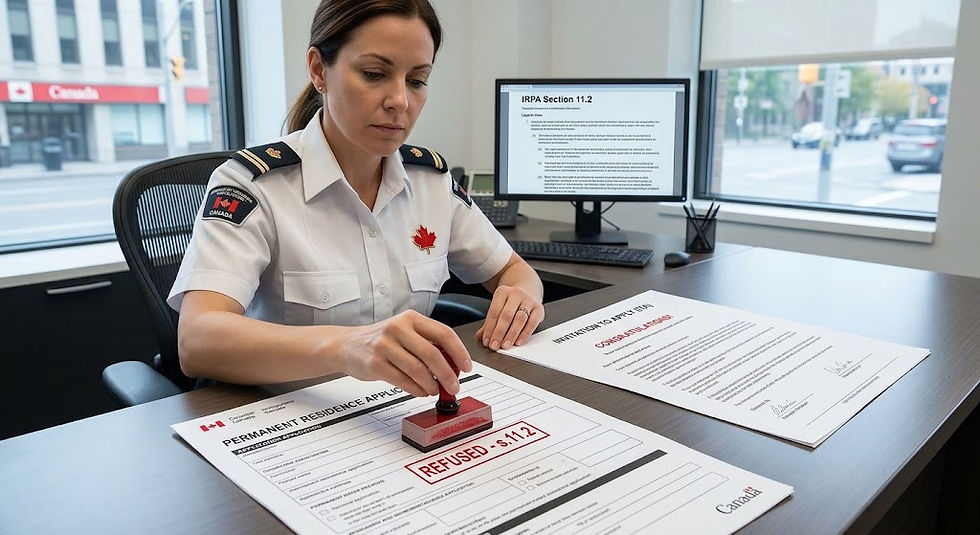
What category-based selection actually asks of you
In a category-based round, IRCC invites candidates in the Express Entry pool who are eligible for a specific category the Minister has set to meet an economic goal, then ranks those candidates and invites the top scorers. As of 2026, the current categories are French-language proficiency, healthcare and social services, STEM occupations, trade occupations, education occupations, transport occupations, physicians, senior managers and researchers with Canadian work experience, and skilled military recruits.
Here is the part that trips people up. To be invited through a category, IRCC's own page says you must do two separate things: meet the minimum Express Entry criteria, including being eligible for one of the three programs it covers (Canadian Experience Class, Federal Skilled Worker, or Federal Skilled Trades), and meet all of the requirements in the instructions for that round. Category membership is a second gate on top of program eligibility, and each round's instructions set the exact occupation, experience, or language requirement. Being high in the pool is not the same as clearing both gates.
The rule everyone skips: IRPA section 11.2
When your application arrives, an officer does not simply rubber-stamp the invitation. Under IRPA section 11.2(1), an officer may not issue your PR visa if, at the time you were invited or at the time IRCC received your application, you: (a) did not meet the Express Entry eligibility criteria; (b) did not have the qualifications your ranking and invitation were based on; or (c) did not meet the criteria for membership in the category you were invited under.
Read paragraph (c) again, because it is the answer to the question this post is about. If you were invited under STEM, trades, or healthcare and the officer decides you did not actually meet that category, that is a stated ground to withhold the visa. So the flat claim you will see in some AI-generated answers, that an unmet category is automatically a refusal, is closer to the truth than the hopeful forum take that an invitation locks in your PR. But it is still not the whole picture, because of what comes next.
The exceptions the quick answers leave out
Section 11.2(2) is where the nuance lives, and it is exactly what an AI Overview or a thin summary skips. An officer may still issue the visa in two situations, measured at the time IRCC received your application.
The birthday exception. If the only reason you fell short, on eligibility, ranking, or category, is that your birthday happened after the invitation was issued (age affects points and some criteria), the officer may still issue the visa.
The score-drop exception. If you no longer have the qualifications you were ranked on at invitation, the officer may still issue the visa, but only if you still meet the Express Entry eligibility criteria, you still meet the category membership, and your rank is still no lower than the cut-off rank from your round.
Notice what the second exception protects and what it does not. It protects a candidate whose CRS slipped after the invitation, as long as they genuinely still belong to the category. It does nothing for a candidate who never met the category in the first place. That is the line between an approval and a refusal.
Three different ways to fall short, and only some are survivable
Not meeting the category is one of three failures section 11.2 treats differently. Confusing them is why people either panic when they should not or relax when they should not.
What went wrong | The provision | Can an exception save it? |
|---|---|---|
You no longer meet a category (e.g. your experience does not match the campaign NOC) | s.11.2(1)(c) | Only the birthday exception; otherwise no |
Your CRS score dropped after the invitation (e.g. a job offer lapsed) | s.11.2(1)(b) | Yes, if you still meet eligibility, still meet the category, and your rank is still at or above the cut-off |
You no longer meet basic Express Entry eligibility for your program | s.11.2(1)(a) | Only the birthday exception; otherwise no |
Source: Immigration and Refugee Protection Act, section 11.2 (justice.gc.ca). Verified September 2026.
Two candidates, opposite outcomes
Here is how this typically plays out. Picture two people invited in the same STEM round.
Priya is invited under STEM. At the application stage the officer reads her reference letters and concludes her actual duties match a different NOC than the STEM occupation she was invited on. She never met that category. No birthday issue applies, and the score-drop exception cannot help, because this is a category-membership failure, not a post-invitation score change. Under section 11.2(1)(c) the officer may not issue the visa. Her application is refused, her invitation is spent, and she is back in the pool looking for another round.
Daniel is also invited under STEM, with a job offer that had lifted his CRS score. Before he submits, the job offer lapses and his score would now sit below the round's cut-off. But his STEM experience is real and still qualifies him for the category, he still meets Express Entry eligibility, and, without the lapsed points, his rank is still at or above the cut-off rank from his round. Under the section 11.2(2) score-drop exception, the officer may still issue his visa. Same round, same worry that the situation changed, completely different result, because Daniel's problem was his score and Priya's problem was the category.

The trap that turns a refusal into a five-year problem
The most dangerous move is trying to make the category fit when it does not, describing duties you did not perform to match a campaign NOC, or submitting a language result that will not hold up. That is not a scoring tactic. Under IRPA section 40, misrepresenting or withholding a material fact that could induce an error in the administration of the Act makes you inadmissible, and the consequences dwarf a refusal: a five-year period of inadmissibility, during which section 40(3) says you cannot even apply for permanent residence. A refusal costs you a round. A misrepresentation finding costs you five years. If your category fit is genuinely borderline, that is a reason to get the file assessed, not to round up.
In practice, the invitation is the beginning of the verification, not the end of it. Officers read the reference letters against the category you were invited on, and a mismatch there is a very different problem from a CRS score that simply dropped.
If your category fit is borderline, a short review now costs far less than a refusal or a five-year misrepresentation problem. Ansari Immigration will tell you honestly where your file stands before you submit.
But the category page said I was eligible
The common objection is that IRCC's category page listed you as eligible when you built your profile, so how can the officer say otherwise later. The answer is in the timing built into section 11.2: category membership and eligibility are tested at the time you were invited and again at the time IRCC receives your application. Your profile is self-declared; the officer verifies it against documents. In between, experience windows move, language tests expire, and a claimed occupation can be reassessed against your actual duties. Meeting a category in the pool is not the same as meeting it at both moments the law cares about. If you were invited under a category you were not fully sure about, that is exactly the file worth a second look before you submit, not after a refusal. Were you invited under a category you were not certain you met, and what did you do? Tell us in the comments, keeping it general; for advice on your own file, use a consultation.
What to confirm before you submit under a category
Your reference letters show the lead statement and a substantial number of the main duties of the exact NOC the round targeted, not a close-but-different occupation.
Your qualifying experience falls inside the window the round's instructions require, counted to the right dates.
Any language result the category relies on is still valid and meets the level the round set (for the French category, that means the required level in all four abilities).
You still meet basic eligibility for your program (CEC, FSW, or FST), independent of the category.
If anything changed since your invitation, you know whether it is a category problem or only a score problem, because section 11.2 treats them differently.
Where the official sources go quiet
IRCC's public category-based selection page is clear on who qualifies, and it states plainly that a category-based round only supplements other rounds and may not run at all if enough eligible candidates are being invited through general or program-specific rounds. What it does not tell you is what happens if you are invited and then found not to meet the category. That answer is not on the guidance page at all; it lives in IRPA section 11.2. IRCC's internal officer material treats a category-membership shortfall as a step in the assessment rather than an instant refusal, which is consistent with the officer running the section 11.2(2) exception analysis before deciding. So the honest reading sits between the two loud answers online. A genuine category shortfall, one you met at neither moment the law checks, is effectively a mandatory refusal, because section 11.2(1) says the officer may not issue the visa and only the narrow birthday exception can override that. What is not automatic is the conclusion that you failed the category at all: the real grey zone is whether you actually met it, and whether your problem is a true category failure or only a survivable score drop. That is the question worth answering before you submit, not after.
Frequently asked questions about Express Entry category-based selection
What is category-based selection in Express Entry?
It is a type of Express Entry round where IRCC invites candidates who are eligible for a specific category the Minister has set, such as STEM or healthcare, then ranks those candidates by CRS and invites the top scorers. You still must be eligible for one of the three Express Entry programs underneath the category.
What happens if I do not meet the category I was invited under?
Under IRPA section 11.2(1)(c), an officer may not issue your PR visa if you did not meet the category at invitation or at application. Narrow exceptions in section 11.2(2) can still allow issuance, but a genuine category-membership failure usually results in a refusal and the loss of that invitation.
Can my Express Entry application be refused after an ITA?
Yes. An invitation is not an approval. The officer verifies your eligibility, your ranking qualifications, and your category membership under section 11.2, and can refuse if you no longer meet them and no exception applies.
Do I have to meet the category when I apply, or only when I was invited?
Both. Section 11.2 measures your eligibility and category membership at the time the invitation was issued and again at the time IRCC receives your application. A change between those two moments can matter.
Is STEM still an Express Entry category in 2026?
Yes. As of 2026, STEM occupations remain one of the current categories listed on IRCC's category-based selection page, alongside French-language proficiency, healthcare, trades, education, transport, physicians, senior managers, researchers, and skilled military recruits.
Is being invited under a category the same as being eligible for Express Entry?
No. Category membership is a second requirement on top of program eligibility. You must both qualify for one of the three programs and meet the category's requirements. Failing either one is a ground to withhold your visa under section 11.2.
Related Posts
Express Entry NOC Code Mistakes After ITA: What Nanda v Canada Means: How a wrong or mismatched NOC after your invitation can unravel a file, and what the Federal Court said about it.
How Express Entry Category-Based Selection Can Fast-Track Your Canadian PR: Why category rounds often cut lower than program rounds, and who qualifies for each category.
Express Entry Draw History 2026: Every Round, CRS Cut-Off, and Category: The full 2026 table of rounds, cut-offs, and which categories IRCC has actually invited.
Get your category fit checked before you submit
Why work with Ansari Immigration: every Express Entry file is handled personally by the firm's licensed RCIC regulated by CICC, start to finish, with direct access to your consultant and no call centres. Express Entry representation is a flat CAD 3,000, all family members included, quoted upfront.
If you were invited under a category you are not sure you meet, have it reviewed before you submit. See how it fits the wider Express Entry and permanent residence pathways, and tell us in the comments how you handled your own category invitation, keeping it general.
This article is for general information only. It is not legal advice. Program criteria, requirements, processing times, and selection approaches can change without notice. Always confirm details on official government websites or consult a licensed Regulated Canadian Immigration Consultant (RCIC) for advice specific to your situation.



Comments