

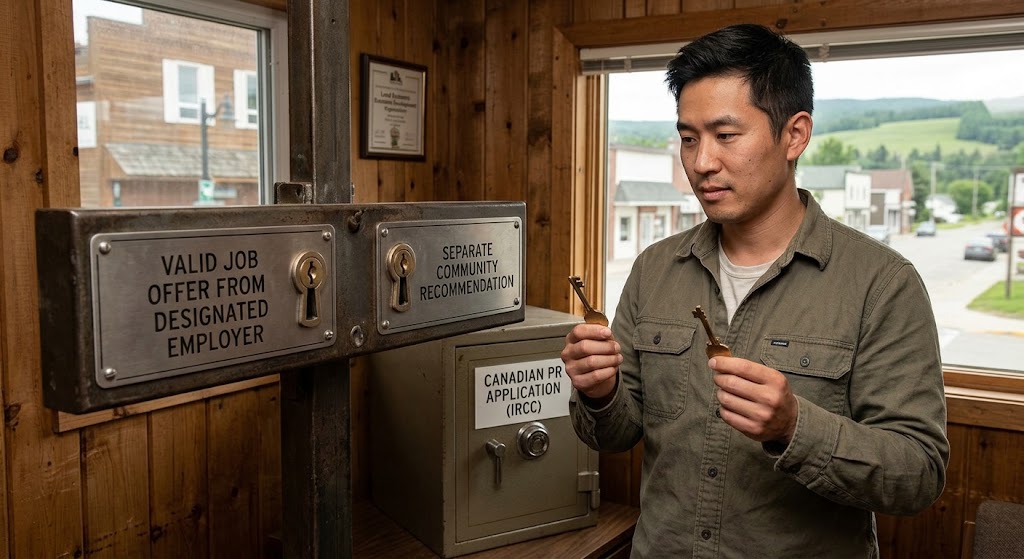
The Rural Community Immigration Pilot is a permanent residence pathway that lets skilled workers get Canadian PR by taking a job with a community-approved employer in one of 14 smaller communities. It runs on two keys, not one: you need a valid job offer from a designated employer, and a separate recommendation from that community, before you can apply to IRCC. Miss either key and the application does not move.
That two-key design is where most people get stuck, so it is worth being blunt about the stakes up front. You cannot pick a community, apply to IRCC directly, and sort out a job later. Without a job offer from an employer the community has designated, and a community recommendation on top of it, there is nothing to submit. Worse, the pressure to secure that job offer feeds a real scam: presenting a purchased or fake job offer as genuine is misrepresentation under the Immigration and Refugee Protection Act, and a misrepresentation finding can make you inadmissible to Canada for five years. The pilot is a genuine route to PR, but only if you enter it the way it is built. Everything below is drawn from IRCC's official Rural Community Immigration Pilot pages, verified this month, and it feeds one of the main permanent residence pathways we help clients weigh.
What is the rural community immigration pilot?
The Rural Community Immigration Pilot (RCIP) offers permanent residence to skilled workers who want to work and settle in rural and more remote communities. IRCC selected 14 communities that showed they can support and benefit from newcomers, and each one approves certain local employers to hire for jobs they cannot fill with the workers already there.
It launched on January 30, 2025. It is widely understood as the successor to the earlier Rural and Northern Immigration Pilot (RNIP), and some communities that took part in RNIP now appear on the RCIP list, though IRCC's current pages describe RCIP on its own terms rather than as a continuation. RCIP is a time-limited economic immigration pilot delivered through IRCC's program delivery instructions rather than a permanent program, so its rules and its list of communities can change while it runs.
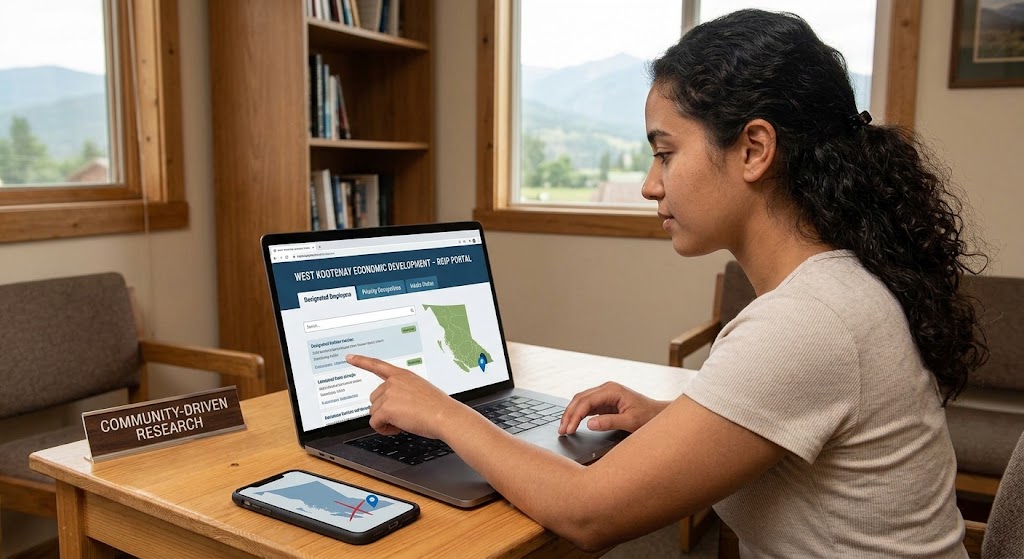
Here is the part that trips people up. RCIP is community-driven. Each community is run by a local economic development organization that identifies its own labour gaps, designates its own employers, and recommends candidates to IRCC. IRCC processes the PR application at the end, but the front door is the community, not Ottawa.
Who qualifies: rural community immigration pilot eligibility
To apply for permanent residence under this pilot, you must meet five requirements:
A valid job offer from a designated employer in the community.
At least 1 year (1,560 hours) of related paid work experience in the past 3 years.
Proof of your language ability from an approved test, at the level required for the job you are offered.
A Canadian educational credential, or a foreign credential with an Educational Credential Assessment showing it is equivalent.
Proof that you have enough money to support yourself and your family when you arrive.
Two of these deserve a closer look because they are where files fall apart.
The job offer has to be the right kind of job offer
Any job offer will not do. It has to come from an employer the community has specifically designated, and the role has to be in that community's priority sector or occupation. Communities post their designated employers and open roles on their own websites when they are ready, and each one manages its own pace. A job offer from a business in a participating community that has not been designated does not count.
The work experience has to match the job
The 1,560 hours in the past three years must be in work that is related to the job you have been offered. Think of it the way an officer does: they read the main duties of your past work against the occupation you are being hired into and look for a genuine match. Experience that does not line up with the offered role is the quiet reason many economic PR applications get refused, so this is worth checking before you count yourself in.
For the exact language level and the exact settlement-funds amount, confirm the figures on IRCC's official work experience, language, and settlement funds pages, because they are tied to your specific job and family size and can change.
The 14 participating communities (including 3 in BC)
There are 14 RCIP communities across five provinces. If you are searching for the rcip communities in bc, note that three are in British Columbia, but none are in Metro Vancouver. They are in the interior and the north, so a Lower Mainland worker would need to be willing to relocate to take part.
Province |
Participating communities |
Nova Scotia |
Pictou County |
Ontario |
North Bay, Sudbury, Timmins, Sault Ste. Marie, Thunder Bay |
Manitoba |
Steinbach, Altona/Rhineland, Brandon |
Saskatchewan |
Moose Jaw |
Alberta |
Claresholm |
British Columbia |
West Kootenay, North Okanagan Shuswap, Peace Liard |
Source: IRCC, Rural Community Immigration Pilot: Get a job offer. Verified September 2026.
Each community runs its own website with its designated employers, priority occupations, and intake status. That is the single most important practical fact about this pilot, and it leads to the next point.
Where IRCC's guidance goes quiet, and what it means for you
Here is what IRCC does not publish, and what no AI summary can tell you: there is no central IRCC list of which communities are currently accepting candidates, which occupations each one is prioritizing this month, or any Express Entry style points cut-off. IRCC's pages set the national rules and then defer to the communities for everything local. Each community sets its own priority occupations, its own intake windows, and its own selection approach, and can pause intake when it is full.
For an applicant, that means your real research is not on canada.ca. It is on the specific community's website, confirming that they are open, that your occupation is on their priority list, and that they have designated employers hiring for it. Two people with identical profiles can get opposite answers simply because one community's intake is open and another's is closed. Treat any third-party site that presents a single national RCIP requirements checklist as incomplete: the national eligibility is only half the picture, and the community half is the half that decides whether you can apply at all.
Can I get a work permit through the RCIP?
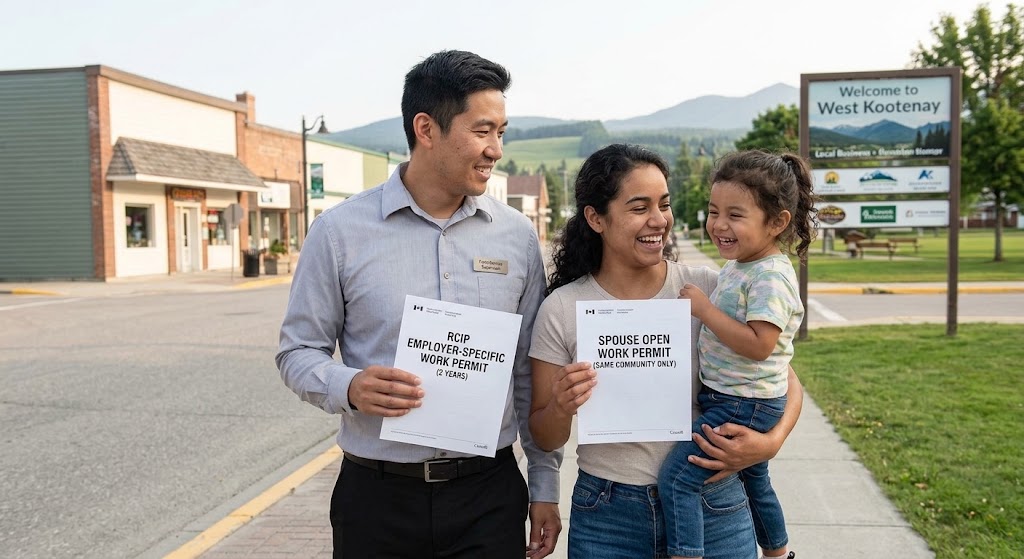
Yes. If you have applied for permanent residence under the pilot, you may also be eligible for an optional 2-year work permit so you can start working while your PR application is processed. This rcip work permit is employer-specific: it is only for the pilot, it is valid for 2 years, and it only lets you work for the employer who offered you the job. It is a closed permit, so it behaves differently from the open work permits many newcomers are used to.
To qualify for it you need an eligible offer of employment from your designated employer, a recommendation from the participating community, and to otherwise be eligible to apply for a work permit. Your spouse or common-law partner can apply for an open work permit at the same time, though their permit only lets them work in the same community as you. This is a meaningful advantage over waiting abroad: the family can be in the community, earning and settling, well before the PR decision lands.
How to apply for the rural community immigration pilot
Choose a participating community and check its website for open intake, priority occupations, and designated employers.
Get a valid job offer from one of that community's designated employers, in an eligible occupation.
Have the employer send your community recommendation application to the community, which verifies the offer is genuine and in a priority sector, and that you meet the pilot's requirements.
Once the community recommends you, apply to IRCC for permanent residence online, with your work experience, language, education, and settlement-funds documents.
Optionally, apply for the 2-year work permit (and your spouse's open work permit) so you can work while you wait.
Government processing fees apply to the PR application and are separate from any professional fees; confirm the current amounts on IRCC's official fee list before you budget.
A typical RCIP timeline: how it plays out
Here is how the pieces fit together, using an illustrative worker (not a real client, and built only from the pilot's published rules). Consider a food-service supervisor with about 14 months, roughly 1,560 hours, of related full-time experience in the past three years, who lines up a job offer from an employer that West Kootenay, BC has designated for that occupation.
First the community reviews the offer and the profile, confirms the role is a priority and the offer is genuine, and issues a recommendation. Only then can the worker apply to IRCC for permanent residence, submitting the language test result at the level the job requires, an Educational Credential Assessment for a foreign diploma, and proof of settlement funds. Alongside the PR application, the worker applies for the optional 2-year work permit tied to that employer, and the spouse applies for an open work permit valid in West Kootenay. The practical payoff: the family relocates and starts working within months, while the PR application is processed in the background.
Now flip one variable. If that same worker had the offer from a West Kootenay business that was never designated, none of it works, because there is no recommendation to be had. The job offer, not the CRS score or the savings balance, is the hinge the whole plan turns on.
What goes wrong: the RCIP mistakes to avoid
Treating any job in a participating community as qualifying. The employer must be designated by that community, and the role must be in a priority occupation.
Paying for a job offer. Presenting a bought or fake offer, or a guaranteed recommendation, as genuine is misrepresentation under IRPA section 40 and can make you inadmissible to Canada for five years.
A work-history mismatch. If your 1,560 hours are not clearly related to the offered job's duties, expect scrutiny.
Skipping the community step. You cannot apply to IRCC for RCIP PR without a community recommendation first.
Assuming a community is open. Intake and priority occupations differ by community and change; confirm on the community's own site before you commit.
Applying to the wrong program. There is no conversion between pilots; if you applied under the wrong stream you generally have to withdraw and refile, and pay again.
Getting this sequence right is worth a second opinion before you relocate your life. If one of the points above made you pause, an eligibility check with Ansari Immigration's licensed RCIC is a 30-minute question ($80), not a leap.
Which RCIP community are you exploring? Share it in the comments, keep it general, and it helps others mapping the same options.
How the RCIP compares to other PR routes
RCIP sits alongside the Francophone Community Immigration Pilot, which uses the same community-driven design for French-speaking workers, and both are worth weighing against Express Entry and the Provincial Nominee Program. If you have a strong Comprehensive Ranking System score, Express Entry may be faster and does not tie you to one employer or town. If you have a provincial connection, a PNP stream may fit better. RCIP shines when you have, or can realistically get, a genuine job offer in one of the 14 communities and you actually want to live there. The settlement intent is not a formality; the pilot exists to fill rural labour gaps, and communities recommend people they believe will stay.
Frequently asked questions about the rural community immigration pilot
What is the rural community immigration pilot?
It is a Canadian permanent residence pathway, launched January 30, 2025, that lets skilled workers get PR by taking a job with a community-designated employer in one of 14 participating rural communities. Each community identifies its labour needs and recommends candidates to IRCC.
Which communities are part of the RCIP?
Fourteen communities across five provinces: Pictou County (NS); North Bay, Sudbury, Timmins, Sault Ste. Marie, and Thunder Bay (ON); Steinbach, Altona/Rhineland, and Brandon (MB); Moose Jaw (SK); Claresholm (AB); and West Kootenay, North Okanagan Shuswap, and Peace Liard (BC).
Can I get a work permit through the RCIP?
Yes. Once you apply for PR under the pilot, you may qualify for an optional 2-year employer-specific work permit to work while you wait, and your spouse or common-law partner can apply for an open work permit valid in the same community.
How do I apply for the rural community immigration pilot?
Get a job offer from a designated employer in a participating community, have the employer send your recommendation application to the community, and once recommended, apply to IRCC for permanent residence online with your work, language, education, and funds documents.
Do I need a job offer for the RCIP?
Yes. A valid job offer from a community-designated employer is mandatory, and it must be in that community's priority sector or occupation. There is no RCIP route without one.
Is the RCIP the same as the Rural and Northern Immigration Pilot (RNIP)?
No. RNIP was the earlier rural pilot; RCIP is the new pilot that launched in 2025. Some communities that joined RNIP now take part in RCIP, but they are separate programs with their own rules.
Related Posts
Francophone Community Immigration Pilot (FCIP): Who Qualifies and How to Apply in 2026: The sister community pilot for French-speaking skilled workers, with its own list of communities.
PR Pathways in Canada 2026: The 5 Most Accessible Routes to Permanent Residence: How the rural pilots stack up against Express Entry, the PNP, and other routes to PR.
In-Canada Workers Initiative 2026: What IRCC's 33,000-Worker PR Acceleration Really Means: The broader push to move workers already in smaller communities into permanent residence.
Why work with Ansari Immigration
You pay for a straight answer, not a pitch. If the honest read is that no RCIP community is open for your occupation yet, or that Express Entry is your faster route, that is what Ansari Immigration will tell you. Every file is handled personally by the firm's licensed RCIC (R709304), with flat, transparent fees quoted upfront and additional family members quoted separately.
Three signs your RCIP plan needs a professional read before you commit: your job offer is from a business the community has not designated, your past work does not clearly match the offered occupation, or you are unsure whether your target community is even accepting candidates right now. Any one of these is exactly what a $80, 30-minute consultation with Ansari Immigration is built to settle.
Have a general question about the pilot? Ask it in the comments, we read every one, and keep it general because case-specific advice belongs in a consultation.
This article is for general information only. It is not legal advice. Program criteria, requirements, processing times, and selection approaches can change without notice. Always confirm details on official government websites or consult a licensed Regulated Canadian Immigration Consultant (RCIC) for advice specific to your situation.