

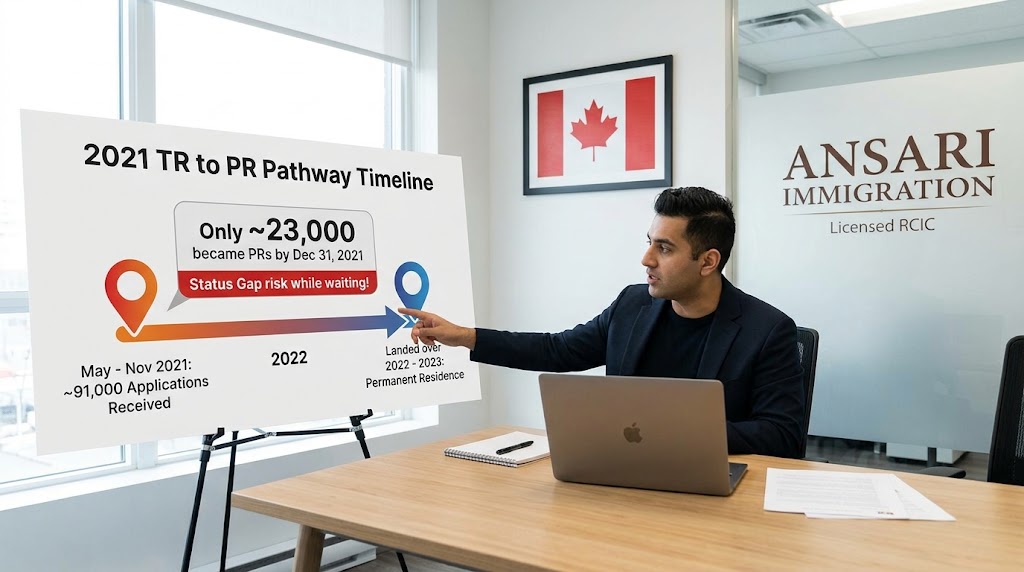
The TR to PR Pathway 2021 was a one-time public policy that opened on May 6, 2021 and closed on November 5, 2021, with its three main streams capped at 90,000 applications. IRCC's own records show roughly 91,000 applications were received, but only about 23,000 people had become permanent residents by December 31, 2021. The rest were landed over the following two years.
About 23,000: the number of people who had become permanent residents under the TR to PR Pathway by December 31, 2021, out of roughly 91,000 applications received. Source: IRCC decision memo released under the Access to Information Act, file A-2025-97652.
That gap between applying and landing is the whole story of this pathway, and it is the single most useful thing to understand before a new route to permanent residence fills up. Being accepted into a pathway and actually becoming a permanent resident are two different dates, and in 2021 they were often more than a year apart. Applicants who treated the first date as the finish line are the ones who ran into trouble with their status while they waited.
What the TR to PR Pathway 2021 was, and who could apply
The pathway was a set of temporary public policies made under section 25.2 of the Immigration and Refugee Protection Act, not a permanent program. IRCC designed it to give permanent residence to temporary residents already living and working in Canada through the pandemic: essential workers and recent international graduates. Intake ran from May 6, 2021 until November 5, 2021, or until each stream hit its cap, whichever came first.
There were six streams. Three carried hard application caps, and three French-speaking streams had no cap at all.
Stream |
Application cap |
Workers in health care |
20,000 |
Workers in other essential occupations |
30,000 |
International graduates from a Canadian institution |
40,000 |
French-speaking health care workers |
No cap |
French-speaking essential workers |
No cap |
French-speaking international graduates |
No cap |
Source: Temporary public policies, Temporary Resident to Permanent Resident Pathway, canada.ca. Verified October 2026.
The Government of Canada's own announcement put it plainly: "Up to 90,000 new permanent residents will be admitted under these 3 streams." To qualify, an applicant had to be physically in Canada, working with authorization, proficient in English or French, and otherwise admissible. The capped English-language streams filled quickly, which is why so many people remember the pathway as the one that closed almost immediately.
How long did the TR to PR Pathway 2021 take?
This is where the headline and the reality part ways. The pathway was sold as an accelerated route, but processing did not keep pace with intake. IRCC received roughly 91,000 applications, yet only about 23,000 applicants had actually become permanent residents by the end of 2021. The remaining tens of thousands were processed through 2022 and into 2023.
IRCC's internal decision memo is candid about this. It acknowledges that many applicants would not be approved for permanent residence until 2023, and that this timeline fell short of the accelerated pathway the policy was announced as. Some files were expected to take around 24 months from application to landing. The department attributed the lag to set-up challenges, the volume of portal applications filed in the first days, and a decision to spread admissions across the 2022 to 2023 immigration levels plans rather than land everyone at once.
Why only about 23,000 landed in 2021
The 90,000 cap was never a promise of 90,000 landings in one year. It was a cap on how many applications IRCC would accept. Each of those applications still had to be assessed for eligibility and admissibility, and admissions were counted against annual levels-plan targets that were already crowded with other priorities. So the up-to-90,000 figure describes intake, while the roughly 23,000 figure describes how many people had completed the process by December 31, 2021.
This distinction matters because it is exactly the number a searcher is looking for when they ask how many people actually got PR through the pathway, and it is a number that lives only in IRCC's own records, not on any public program page. A public page will tell you a pathway existed and that it closed. It will not tell you that landing lagged intake by two years.
The status trap that caught some applicants
The longer a decision takes, the longer an applicant has to keep valid temporary status in Canada, because the pathway required applicants to hold valid status to remain eligible. Two problems followed from the delay.
First, people whose work permits were expiring needed a way to keep working while they waited. IRCC addressed this with a replacement open work permit public policy, signed on April 21, 2022, that extended the pathway's open work permits to December 31, 2024, rather than letting them lapse at the end of 2022. According to IRCC's own records, about 2,500 applicants whose permits were set to expire on December 31, 2022 were issued automatic replacements. If your file is moving slowly, a bridging solution like an open work permit is often what keeps your authorization to work intact.
Second, and more quietly, some applicants relied on an interim-work email tied to a post-graduation work permit that was valid only until May 31, 2023, and never applied to extend or restore their status. When that email expired, they were out of status, which broke the pathway's valid-status requirement. IRCC's own guidance told officers to hold those files rather than refuse them outright, but the episode is a clear warning: an interim notice is not the same as restored status, and letting status lapse while you wait can undo an application you already qualified for.
There was also a quieter fix on the other side. The original policy required applicants to be physically in Canada at the moment of the final decision, which meant a trip abroad could trigger a refusal. IRCC introduced a separate public policy allowing permanent resident visas to be issued to applicants who were otherwise approved but outside Canada, so that travel alone would not sink an approved file.

Not sure whether your current status actually covers you until your PR decision lands? That is a 30-minute question, and it is exactly the kind of thing Ansari Immigration's licensed RCIC checks before a gap opens.
Ask our RCIC: book a 30-minute consultation
Is the TR to PR pathway open again in 2026?
Not in the way most people assume. The 2021 pathway is permanently closed; its intake ended on November 5, 2021, and it did not reopen. What arrived in 2026 is a different mechanism with a different name: the In-Canada Workers Initiative, announced in Budget 2025. The government has said it aims to move up to about 33,000 existing in-Canada work permit holders to permanent residence across 2026 and 2027, with a focus on workers who have lived outside Canada's largest urban centres.
The crucial difference is how you get in. The 2021 pathway was an open intake you applied to directly within a window. The 2026 initiative is an acceleration measure: IRCC speeds up eligible permanent residence applications that are already in the system under participating programs, rather than opening a new stream you file into. In practice that means the way to benefit is to already be in a qualifying program with a strong, complete application, not to wait for an application window to open. Because the details of a new measure can change, confirm the current rules on the official IRCC pages before you rely on anything.
For many temporary residents, the realistic route to permanent residence today runs through programs like the Canadian Experience Class under Express Entry, so building a strong profile there is often the practical move.
The 2021 experience is still the right preparation, because the same pressure applies to any PR route: the people who land first are the ones whose documents were ready early and whose status stays valid through a long wait. A short checklist to get ahead of that:
Confirm your current status and its expiry date, and know your plan to extend, restore, or bridge it before it runs out.
Have your language test results valid and in hand, not booked for later.
Keep proof of qualifying Canadian work experience or your Canadian credential organized and current.
Gather police certificates early, since they are often the slowest document to obtain.
Decide in advance how you will keep working if your permit expires before a decision.
What the TR to PR Pathway 2021 teaches 2026 applicants
The honest reading of 2021 is two-sided. On one hand, the pathway worked: it accepted roughly 91,000 applications and ultimately moved a large group of temporary residents to permanent residence. On the other hand, it was not the fast track it was billed as, and tens of thousands of people spent 2022 and 2023 managing their status while they waited. Both things are true, and anyone hoping to benefit from a 2026 route to permanent residence should plan for the second reality rather than the first headline.
The common objection is that the pathway hit its cap in a day, so clearly it worked. Hitting a cap measures demand and how fast people filed, not how fast anyone landed. The two are easy to confuse and expensive to confuse, because the applicant who assumes accepted means done is the one who lets a work permit or a status document lapse during a two-year wait. Treat the invitation to apply as the start of the clock, not the end of it.

Frequently asked questions about the TR to PR Pathway 2021
What was the TR to PR pathway 2021?
The TR to PR Pathway 2021 was a one-time temporary public policy that let temporary residents already in Canada apply for permanent residence between May 6 and November 5, 2021. It covered essential workers, health care workers, and recent international graduates, with three capped English streams and three uncapped French-speaking streams.
How long did the TR to PR pathway take?
Processing took far longer than the pathway's accelerated billing suggested, with IRCC's own memo noting many applicants would not be approved until 2023 and some files taking around 24 months from application to landing. Only about 23,000 of roughly 91,000 applicants had become permanent residents by December 31, 2021.
How many people got PR through the TR to PR pathway?
About 23,000 people had become permanent residents under the pathway by December 31, 2021, out of roughly 91,000 applications received, according to IRCC's own decision memo, with the remainder landed across 2022 and 2023. The exact final total is not published on any program page.
Is the TR to PR pathway open again in 2026?
The 2021 pathway is permanently closed and did not reopen, and the 2026 measure is a different mechanism called the In-Canada Workers Initiative rather than a new open intake you apply to directly. It accelerates permanent residence applications already in the system for eligible in-Canada workers, so confirm the current rules on official IRCC pages before relying on anything.
Will there be another TR to PR pathway like 2021?
There is no guarantee of another open-intake pathway identical to 2021, because each measure is created as its own policy with its own rules, and the 2026 approach accelerates existing applications rather than opening a new stream. The practical takeaway is to keep your status, documents, and language results current so you can act quickly whenever any route opens.
Related Posts
Canadian Experience Class: Full 2026 Eligibility Guide: The main permanent-residence route for temporary residents already working in Canada now that the 2021 pathway has closed.
How to Become a Permanent Resident of Canada: A plain-language overview of the main routes to Canadian permanent residence and how they fit together.
Restoration of Status in Canada: Processing Time and How to Apply in 2026: What to do if your temporary status lapses while you wait, and why it matters for pathway eligibility.
Three signs your TR to PR plan needs a professional read before you apply: your current permit expires before a decision is likely, your status rests on an interim notice rather than a clear extension or restoration, or you are not certain your Canadian work experience counts the way IRCC measures it. Whatever your situation, it has very likely crossed this desk before, because Ansari Immigration has handled more than 6,000 cases since 2019, each one run personally by the firm's licensed RCIC, regulated by CICC. A 30-minute consultation ($80) is where that read starts.
Book your 30-minute consultation
Did you apply under the 2021 pathway, or are you weighing a 2026 route now? Tell us how long your wait ran in the comments, since real timelines help everyone else planning their own, and keep it general, for advice on your specific file use a consultation.
This article is for general information only. It is not legal advice. Program criteria, requirements, processing times, and selection approaches can change without notice. Always confirm details on official government websites or consult a licensed Regulated Canadian Immigration Consultant (RCIC) for advice specific to your situation.