


The Canadian citizenship test is a 20 question knowledge test that most adult applicants between 18 and 54 must pass on the way to citizenship. You need 15 correct answers, you get 45 minutes, and in 2026 most people take it online from home with a webcam. Here is how it works and how to prepare properly.
How the Canadian Citizenship Test Works in 2026
In most cases, if you are between 18 and 54 years old on the day you sign your citizenship application, you have to take the test. You are exempt if you are under 18 or over 55, or if you asked for and received a waiver. IRCC explains the full process on its official citizenship test page.
20 questions, either multiple choice or true or false
A passing score of at least 15 out of 20 (75 percent)
A 45 minute time limit that cannot be paused
Your choice of English or French
Up to 3 chances to pass
The format is consistent across every version of the test, as listed above. Most applicants are invited to take the test online. If you need an accommodation, IRCC will arrange an in person test (written or oral) or a Microsoft Teams video call instead.
If you gave an email address in your application, the invitation arrives by email as a PDF attachment (otherwise IRCC mails it to you or may call). Most people receive it 1 to 3 months after they receive the acknowledgment of receipt (AOR) for their application. You cannot book the test yourself. The invitation gives you a 30 day window, and all 3 attempts have to happen inside that window if you test online. Watch your junk folder for emails ending in cic.gc.ca or canada.ca, because missing the invitation is an avoidable setback.
What Is on the Test
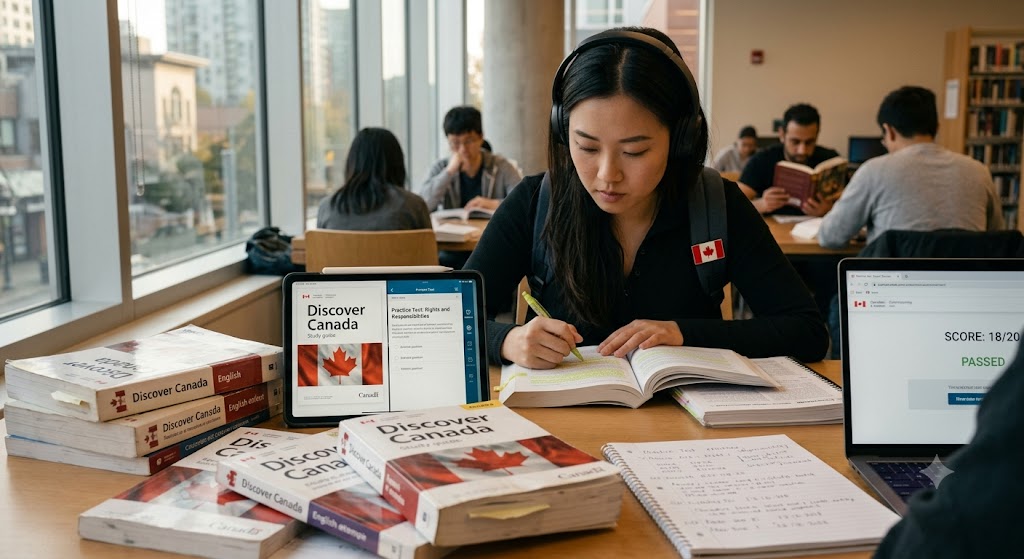
Every question comes from one official source: Discover Canada, The Rights and Responsibilities of Citizenship. IRCC states that all test questions are based on the information in that official study guide, which is free to read online, download as a PDF or eBook, listen to as audio, or order on paper.
The questions cover the rights and responsibilities of citizenship plus Canada's history, geography, economy, government, laws, and symbols. The test does not assess your English or French. Language ability is noted separately by a citizenship officer if you are ever invited to an interview.
Taking the Citizenship Test Online: The Rules That Catch People Off Guard
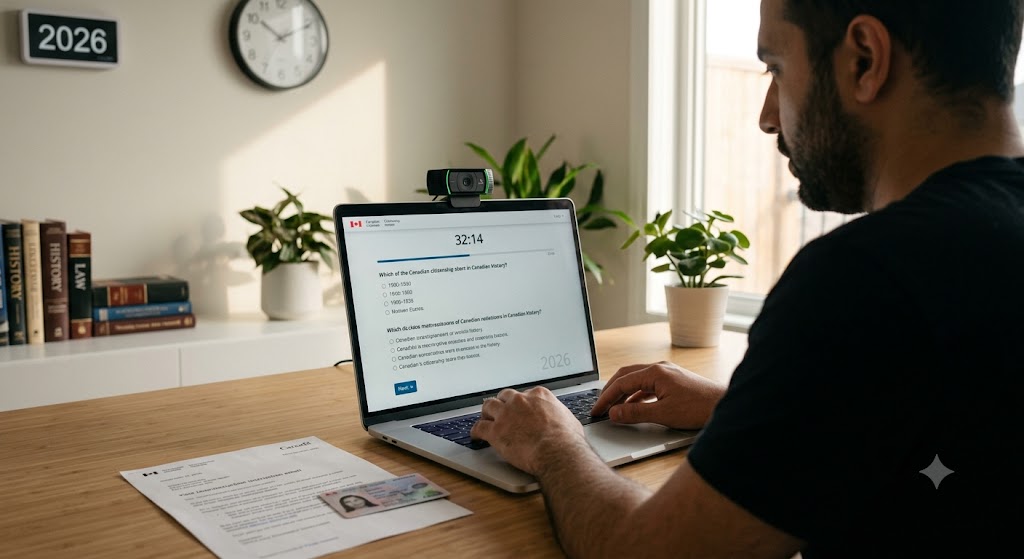
The online test is convenient, but it comes with strict conditions, and IRCC can invalidate a result over technical issues or suspected cheating. The details are on the official online test page. The ones that surprise applicants most:
You must use a desktop, laptop, or tablet with a webcam, on Chrome or Safari. Phones, Chrome on an iPad, the Microsoft Surface Pro, and VPN connections are all off limits.
Your webcam takes random photos during the test to confirm you are alone and that you match your ID photos.
You must test alone, in the same place where you took the photos of yourself and your ID, with no personal documents like a diploma visible in the background.
No study materials, no second devices, and never the browser back button.
Acceptable ID includes your PR card even if it has expired, or a valid piece of photo ID with your signature such as a driver's licence.
The sign in link IRCC emails you expires after 15 minutes, so request it when you are actually ready.
You do not need to be in Canada to take the online test, and a public library computer is allowed.
In practice, the applicants who lose a test attempt usually lose it to logistics, not knowledge: a webcam that will not connect, a VPN left running, or a roommate walking through the frame.
From Amir's Desk: How to Actually Prepare
Amir Ansari, a Regulated Canadian Immigration Consultant (licensed RCIC) who also teaches immigration law at three colleges, gives every citizenship client the same advice: download the practice questions and go over them multiple times until they are second nature. Reading Discover Canada once is not preparation. The test rewards repetition, because the questions that sink people are specific dates, names, and government structure, not general knowledge about Canada. IRCC publishes official study questions drawn from the guide, and working through them repeatedly until you consistently score well above 15 out of 20 is the most reliable way to pass on the first attempt.
Here in Metro Vancouver, the Richmond Public Library's free practice test is so popular that thousands of people search for it every month, and public libraries across Burnaby, Surrey, and Vancouver stock Discover Canada in multiple formats. Use whatever practice source you like, but remember that only Discover Canada itself defines what can be asked.
Preparing for citizenship and unsure whether your residency days, travel history, or application file are actually in order before you reach the test stage? Amir Ansari, RCIC, reviews citizenship files and flags problems before IRCC does. Book a consultation to have your situation assessed.
What Happens After the Test
If you test online, your score appears on screen immediately after you submit, but that result is unofficial. A citizenship officer then reviews it to make it official, which IRCC says can take a few days or a few weeks. There is no confirmation email, so print or email yourself the results page before closing it. Many of our clients find this waiting period more stressful than the test itself: the tracker simply shows In progress until the review is done, and refreshing it hourly will not speed anything up.
Once your result is official, your application status in the online tracker updates to one of four outcomes (IRCC does not send email updates): decision made, an invitation to an interview, an invitation to a retest, or an invitation to a hearing. If you pass, IRCC may still invite you to an interview to verify your identity, your documents, or your eligibility, and then invites you to the citizenship ceremony where you take the oath. IRCC does not publish a fixed wait between the test and the ceremony; timing depends on your file and current citizenship processing times. You will need your application number and UCI number for the test sign in and any follow up with IRCC.
What Happens If You Fail
You have up to 3 chances to pass within your 30 day online window. If you fail all 3 attempts, IRCC invites you to a hearing with a citizenship official rather than refusing you outright. At the hearing, the officer may test your knowledge of Canada orally (20 questions, 15 to pass), ask about your residence in Canada, and assess your English or French (up to 9 questions, 6 to pass). Hearings run 30 to 90 minutes. If you fail the hearing, IRCC refuses the application, and you would need to reapply and pay the fees again.
The lesson from the files we see is simple: treat the first attempt as the only one. Applicants who fail are almost never short on time in Canada, they are short on structured preparation.
Already had a failed attempt, an invalidated result, or a hearing invitation? Do not walk into the next stage unprepared. Amir Ansari, RCIC, can review what went wrong and prepare you for the retest, interview, or hearing. Reserve a consultation time before your next date.
Becoming a citizen starts with holding and maintaining permanent residence in Canada, and for most applicants that PR was obtained through Express Entry. If citizenship is your end goal, the residency and record keeping habits that make the citizenship application smooth start on day one as a PR.
Frequently Asked Questions About the Canadian Citizenship Test
How many questions are on the Canadian citizenship test?
The test has 20 questions, either multiple choice or true or false. You need at least 15 correct answers (75 percent) to pass, and you have 45 minutes.
Is the Canadian citizenship test hard?
Most prepared applicants pass. The difficulty comes from specifics: dates, names, and how government is structured. People who study Discover Canada and drill practice questions repeatedly usually find the real test easier than expected.
How do I prepare for the Canadian citizenship test?
Study the free official guide, Discover Canada, in any format, then work through the official study questions repeatedly until correct answers are second nature. Every test question is based on the guide.
After the Canadian citizenship test, how long until the oath?
IRCC does not publish a fixed timeline from test to ceremony. Your online result is reviewed by an officer within days to weeks, and the ceremony invitation follows based on your file. Check the status tracker rather than waiting for an email.
Can I take the Canadian citizenship test online?
Yes. Most applicants take it online with a webcam, from anywhere including outside Canada. You need a desktop, laptop, or tablet on Chrome or Safari, and you cannot use a phone or a VPN.
What happens if you fail the Canadian citizenship test?
On the online test, you get up to 3 attempts within your 30 day window. Failing all 3 leads to a hearing with a citizenship official, and failing the hearing means the application is refused and you must reapply with new fees.
Related Posts
Canada Citizenship Application Processing Time in 2026: What to Expect: How long each stage of the citizenship application takes, including when the test invitation typically arrives.
Does Canada Accept Dual Citizenship? What Immigrants Need to Know in 2026: Whether you can keep your original citizenship when you become Canadian.
How to Contact IRCC (Immigration Canada): Phone, Web Form, Online Account, and More: Every official channel for reaching IRCC about your application, and when to use each one.
This article is for general information only. It is not legal advice. Program criteria, requirements, processing times, and selection approaches can change without notice. Always confirm details on official government websites or consult a licensed Regulated Canadian Immigration Consultant (RCIC) for advice specific to your situation.