
How to File Taxes in Canada as a Newcomer: A Complete First-Time Guide (2026)

Updated: Jul 31
Learning how to file taxes in Canada is one of the most important financial steps you take after arriving, and it is simpler than most newcomers fear. In Canada, your tax obligations are based on your residency for tax purposes, not your immigration status. Once you establish significant residential ties (a home, a spouse or common-law partner, or dependants), you generally report your world income for the part of the year you were a resident and file an income tax and benefit return. Filing does more than settle any tax owing: it unlocks benefit and credit payments like the GST/HST credit and the Canada child benefit, and it quietly builds the paper trail that later supports your permanent residence, citizenship, and family sponsorship goals.

How the Canadian tax system works for newcomers
The single most important idea to understand about how to file taxes in Canada is that the system runs on residency, not on your visa. The Canada Revenue Agency (CRA) considers you a newcomer for tax purposes for the first year you are a resident of Canada for income tax purposes. Your residency status is decided by the ties you build here, not by the stamp in your passport. A person on a work permit, a study permit, or a brand-new permanent resident card can all be residents for tax purposes if they have significant residential ties such as a home in Canada, a spouse or common-law partner, or dependants living with them.
Once you are a resident for tax purposes, you report your world income in Canadian dollars for the part of the year you were a resident. World income is income from all sources, inside and outside Canada. For the part of the year before you arrived, you generally only report certain Canadian-source income, such as employment in Canada. This part-year treatment is one of the biggest differences between a newcomer's first return and every return that follows.
If you are genuinely unsure whether you became a resident for tax purposes, the CRA lets you ask for an opinion by completing Form NR74, Determination of Residency Status (entering Canada). When explaining this to clients, the distinction we stress is that resident for tax purposes and permanent resident for immigration are two separate tests that happen to share a word. You can be a tax resident long before you are a permanent resident, and that is exactly why so many newcomers need to file in their very first year.
How to file taxes in Canada: a step-by-step process
Here is the practical sequence for how to file taxes in Canada for the first time, from landing to notice of assessment:
Get your Social Insurance Number (SIN). You need a SIN to file, and you cannot file online without one. If you have applied but not yet received your SIN and the deadline is near, the CRA says to file a paper return without it (attach a note explaining why) to avoid a late-filing penalty.
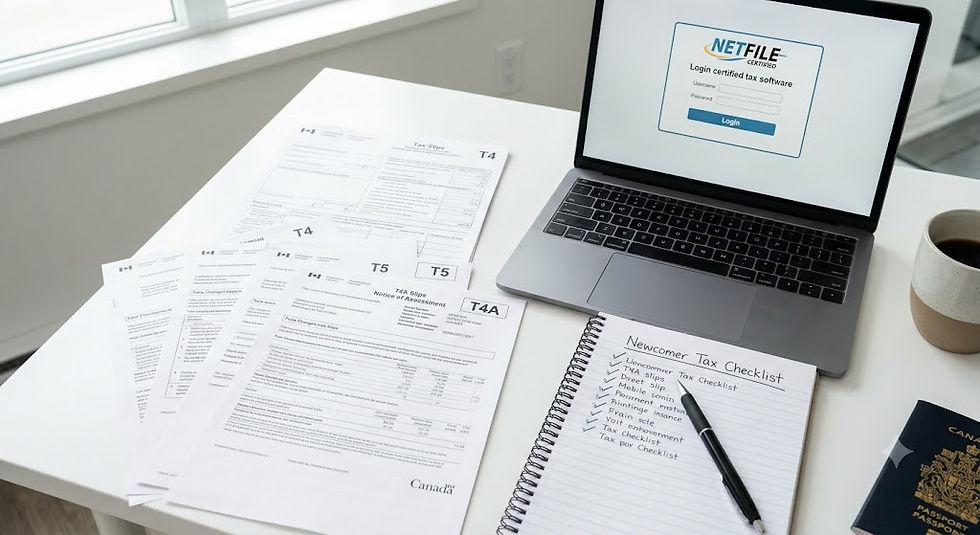
Gather your income slips and documents. Employers issue T4 slips for employment income; banks and payers issue T4A, T5, and similar slips. Keep records of any foreign income for the part of the year you were a resident.
Note your date of entry. Your first return asks for the date you became a resident of Canada. The CRA uses that date to prorate certain credits, so enter it accurately.
Choose how to file. You can use NETFILE-certified software (some options are free) to file electronically, or you can mail a paper return using the income tax package for your province or territory.
Report your income and claim your credits. Report world income for your resident period, then claim the deductions and non-refundable tax credits you qualify for.
File by the deadline and pay any balance owing. For most people the deadline is April 30; pay any tax owing by the same date to avoid interest.
Get your notice of assessment (NOA) and open a CRA account. After the CRA processes your return, it issues an NOA showing your refund or balance. Register for a CRA account to track refunds, benefits, and future correspondence.
Filing electronically with direct deposit is the fastest route: the CRA says a NETFILE return can produce a refund within about eight business days, while a paper return can take up to eight weeks to process. Newcomers who file online in their first year still need a SIN to do so.
What income and documents you need to file
A recurring question in our Vancouver consultations is simply what documents do I need to file my taxes in Canada? The honest answer is that a first-year newcomer file is usually straightforward, but the paperwork spans both your Canadian and pre-arrival life. Use this checklist as a starting point:
Your SIN (or proof you have applied for one)
Your date of entry, the date you became a resident of Canada
T4 slips for Canadian employment income
T4A, T5, T3 and other slips for pensions, investment, or trust income
Records of foreign income earned during your resident period, converted to Canadian dollars
Your spouse's or common-law partner's net world income for the year (needed even if it is zero)
Receipts for deductions and credits: tuition (T2202), medical expenses, childcare, donations, rent or property tax where a provincial credit applies
Your Canadian banking details for direct deposit of refunds and benefits
If you are still working through your first months here, our newcomer to Canada checklist covers the SIN, banking, and health-card steps that naturally come before your first tax filing.
The main ways newcomers file, and what each one suits:
NETFILE-certified software (some free): best for simple to moderate returns, requires a SIN, and typically delivers a refund in about 8 business days.
Free tax clinic (CVITP): for those with a modest income and a simple tax situation; a SIN (or proof you applied) is needed, with similar refund timing when filed electronically.
Paper return by mail: the route if you do not yet have a SIN or have a complex first-year situation; processing can take up to 8 weeks.
Professional tax preparer: best if you have foreign income, tax-treaty questions, or self-employment; a SIN is required.
One newcomer-specific rule catches people off guard: you generally cannot deduct registered retirement savings plan (RRSP) contributions in the first year you file a return in Canada, because your RRSP deduction room is built from income reported in prior Canadian tax years. Your room starts accumulating from this first return forward.
Deadlines, penalties, and free ways to file
For most individuals, the 2025 income tax and benefit return has to be filed on or before April 30, 2026, and any balance owing is due the same day, according to the CRA's filing due dates. If you or your spouse or common-law partner carried on a business, your filing deadline is generally June 15, 2026, but any tax you owe is still due by April 30, 2026. When a deadline lands on a weekend or public holiday, the CRA treats your return as on time if it is received or postmarked by the next business day.
Missing the deadline has a concrete cost. If you file late and owe tax, the CRA charges a late-filing penalty of 5% of your balance owing, plus 1% of that balance for each full month your return is late, up to a maximum of 12 months. If you were charged a late-filing penalty in 2022, 2023, or 2024 and received a demand to file, the repeated late-filing penalty rises to 10% of your balance owing plus 2% per full month, up to 20 months. On top of the penalty, the CRA charges compound daily interest on any unpaid balance starting the day after the due date, at a rate that can change every three months.
The reassuring part: if you cannot pay, you should still file on time, because the late-filing penalty applies to the balance owing, not to the act of filing. Filing on time with a balance you pay later avoids the penalty entirely and only leaves interest to manage.
Cost should never be the reason a newcomer skips filing. If you have a modest income and a simple tax situation, you may be able to have your return completed at no charge through a free tax clinic under the Community Volunteer Income Tax Program, and several NETFILE-certified software products are free to use. Filing, not the method you choose, is what protects your benefits. Filing also keeps payments flowing on schedule, and our guide to the GST/HST credit and Canada child benefit payment dates shows exactly when those deposits arrive once your return is processed.
If you are unsure whether your first-year residency dates or foreign income were handled correctly, Amir Ansari, RCIC can review how your tax filing lines up with your immigration timeline before it becomes a problem. Book a consultation to make sure your first Canadian tax year is set up to support, not complicate, your PR and citizenship plans at reserve a consultation time.
Common mistakes newcomers make when filing taxes in Canada
Most first-year filing problems are not about complicated math. They come from a handful of predictable misunderstandings:
Assuming immigration status decides everything. Newcomers on work or study permits often believe they do not need to file. If you are a resident for tax purposes, you may need to file even in a partial first year, especially to start or continue benefits.
Reporting the whole year of world income. You only report world income for the part of the year you were a resident of Canada, not for the months before you arrived. Over-reporting can cost you money.
Not filing because there was no income. You often still need to file with no income to receive the GST/HST credit, the Canada child benefit, and related provincial payments, and to keep them flowing in future years.
Forgetting the date of entry. Leaving it blank or guessing can distort the prorated credits the CRA calculates for your first year.
Trying to file online without a SIN. You cannot NETFILE without a SIN; if yours has not arrived and the deadline is close, file on paper with a note.
Overlooking a spouse's world income. You must report your spouse's or common-law partner's net world income even if it is zero, because several credits and benefits depend on it.
Missing benefit applications. You can start some benefits as soon as you arrive, even before your first return, but you must keep filing every year to keep receiving them.
How filing taxes in Canada affects your immigration and PR status
This is where a tax return quietly becomes an immigration document, and it is the part most newcomers underestimate. In practice, we regularly ask clients for their notices of assessment and filed returns when we build a case, because a consistent Canadian tax history is some of the strongest independent evidence a person actually lived and settled in Canada.
A few concrete connections we see at Ansari Immigration:
Permanent residence and the residency obligation. Permanent residents must meet a physical-presence obligation to keep their status. Filed Canadian tax returns and notices of assessment help demonstrate the years you were actually here, which matters when you renew a PR card or defend your status. Our guide to the permanent residence residency obligation explains how presence is assessed.
Citizenship physical presence. Applying for citizenship requires meeting a physical-presence threshold, and IRCC asks whether you filed Canadian taxes for the relevant years. A clean filing record supports the days you claim.
Express Entry and Canadian experience. If you are moving from a work permit toward permanent residence through Express Entry, your T4 income and tax records corroborate the Canadian work experience you are claiming.
Family sponsorship income. Sponsoring parents or grandparents, and some spousal situations, hinge on income the sponsor proves with notices of assessment. If you plan to sponsor family, your filed returns are the document IRCC relies on, which is why we walk sponsors through the family sponsorship income tests early.
International students planning to stay. Students on a study permit who file each year build both benefit entitlements and a tax record that strengthens a later PR application.
A real pattern we see: a newcomer arrives mid-year on a work permit, assumes they are too new to file, and skips their first return. Two or three years later they apply for citizenship or sponsor a parent, and the gap in their tax history forces a scramble to explain missing years. The fix is almost always the same and almost always cheap: file every year from the first, even a nil return, so the record is unbroken when an immigration officer eventually looks at it.

Frequently asked questions about how to file taxes in Canada
When do you have to file taxes in Canada?
For most individuals, the 2025 tax return must be filed on or before April 30, 2026, and any balance owing is due the same day. If you or your spouse or common-law partner ran a business, the filing deadline is generally June 15, 2026, but any tax owing is still due April 30, 2026. If a deadline falls on a weekend or public holiday, the CRA accepts your return as on time if it is received or postmarked by the next business day. Filing on time also protects your benefit and credit payments from interruption.
What documents do I need to file my taxes in Canada?
You need your SIN (or proof you applied), your date of entry to Canada, and your income slips, most commonly T4 slips for employment plus any T4A, T5, or T3 slips. Keep records of foreign income for the part of the year you were a resident, converted to Canadian dollars, and your spouse's or common-law partner's net world income. Gather receipts for credits such as tuition (T2202), medical expenses, childcare, and donations, and have your Canadian banking details ready for direct deposit.
How do I file taxes in Canada for the first time?
Get a SIN, collect your income slips, and note the date you became a resident of Canada. Then choose how to file: NETFILE-certified software (some options are free), a free tax clinic if your situation is simple, or a paper return if you do not yet have a SIN. Report your world income for the part of the year you were a resident, claim your credits, and file by the deadline. After processing, the CRA issues a notice of assessment; register for a CRA account to manage everything online.
Can you file taxes for free in Canada?
Yes. If you have a modest income and a simple tax situation, you may be eligible to have your return completed and filed at no cost through a free tax clinic under the Community Volunteer Income Tax Program. Several NETFILE-certified software products are also free to use for electronic filing. Filing for free is common and fully legitimate, and it still gives you access to the same refunds, benefits, and notice of assessment as any paid method, so cost is never a reason to skip your return.
What happens if you don't file taxes in Canada?
If you owe tax and file late, the CRA charges a late-filing penalty of 5% of your balance owing plus 1% for each full month you are late, up to 12 months, and compound daily interest on the unpaid amount. Repeated late filing can raise the penalty to 10% plus 2% per month. Beyond the money, not filing can pause or stop your GST/HST credit, Canada child benefit, and other payments, and it leaves gaps in the tax record that immigration applications may later rely on.
Do you have to file taxes in Canada if you have no income?
Often yes. Even with no income, you generally need to file to start or keep receiving the GST/HST credit, the Canada child benefit, the Canada Carbon Rebate where it applies, and related provincial or territorial payments. Filing a nil return also keeps your tax history continuous, which matters for future benefits and for immigration applications that ask whether you filed Canadian taxes. For most newcomers, filing every year is the safe default regardless of income.
Does filing taxes affect my immigration status in Canada?
Filing taxes does not change your immigration status, but your tax record supports it. Notices of assessment and filed returns help show the years you were physically in Canada, which is relevant to the PR residency obligation and citizenship physical-presence requirements. Sponsors prove income with notices of assessment, and Express Entry applicants use tax records to corroborate Canadian work experience. A consistent filing history is one of the most useful documents an immigration file can have, so filing from your first year is worth the small effort.
Your first Canadian tax year and your immigration timeline should be planned together, not in isolation. Whether you are on a work permit, a study permit, or a new PR card, Amir Ansari, RCIC (verify his licence on the CICC public register) can help you make sure your filing history strengthens your future PR, citizenship, or sponsorship application. Reserve a consultation time to get your newcomer tax and immigration strategy aligned from year one.
Related Posts
CRA benefit payment dates 2026: When the GST/HST credit, Canada child benefit, and related payments arrive, and what newcomers need to know to keep them.
How newcomers build a credit score in Canada: A practical guide to building Canadian credit from scratch after you arrive.
How to get a SIN number in Canada: Why the Social Insurance Number is your first step before you can work or file taxes.
This article is for general information only. It is not legal advice. Program criteria, requirements, processing times, and selection approaches can change without notice. Always confirm details on official government websites or consult a licensed Regulated Canadian Immigration Consultant (RCIC) for advice specific to your situation.



Comments