
What Is a Permanent Resident Travel Document (PRTD)?

Updated: Sep 9
A permanent resident travel document is an official document that lets a permanent resident of Canada return to the country by commercial vehicle when they do not have a valid PR card. If your PR card is expired, lost, stolen, or damaged while you are outside Canada, you need a permanent resident travel document to board a flight, bus, boat, or train back to Canada.
It is not a new PR card, and it is not a visa. It is a single-use travel document that gets you home, after which you apply for a new PR card from inside Canada.
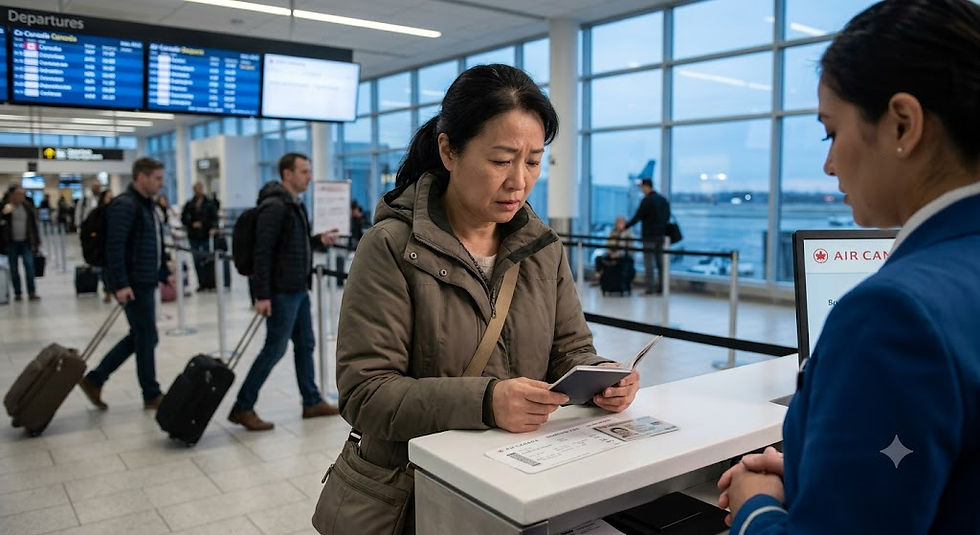
When you need a permanent resident travel document
According to IRCC, you can apply for a permanent resident travel document if you:
have permanent resident status in Canada,
do not have a valid PR card showing that status,
are outside Canada, and
will return to Canada by airplane, boat, train, or bus.
The most common situation is simple: a permanent resident travels abroad and their PR card expires, or it is lost, stolen, or damaged while they are away. Airlines and other commercial carriers will not let you board for Canada without proof of status, so the PRTD is what gets you on the plane.
If you are driving back to Canada in a private vehicle, the rules are different, and you should confirm your options before you travel rather than assume.
PRTD vs PR card: the difference that trips people up
A PR card and a permanent resident travel document both prove your status, but they are not interchangeable. Your PR card is the wallet-sized card you use to re-enter Canada as many times as you like while it is valid. A PRTD is issued when you are stuck abroad without that card, and IRCC states a PRTD is normally only valid for one single entry. Once you use it to enter Canada, you should apply for a new PR card right away.
A key point that reassures a lot of worried travellers: you do not lose your PR status just because your PR card expires. IRCC is explicit that an expired card does not change your status. You remain a permanent resident until an officer makes a formal decision otherwise. The expired card is a travel problem, not a status problem, which is exactly why the PRTD exists.
If your status documents are part of a larger question, our overview of what counts as proof of status, including the Confirmation of Permanent Residence, explains how these documents fit together.
Worried your PR card will expire while you are abroad and you are not sure you still qualify to return? Amir Ansari, RCIC, reviews your specific travel and residency situation before you book, so you are not improvising at an airport. Reserve a consultation.
How to apply for a permanent resident travel document
IRCC now lets most applicants apply online. The basic steps are:
Read the official instruction guide (IMM 5529) and gather the documents on the checklist (IMM 5644).
Complete the application for a permanent resident travel document (IMM 5444) in the Permanent Residence Portal. You can apply on paper only if you cannot apply online and need an accommodation.
Submit a complete application for each family member who needs one. Each application must show the person still meets the requirements to remain a permanent resident, for example that they do not have a removal order.
Pay the $50 fee and include your proof of payment. The fee is not refunded once IRCC starts processing.
Submit the application and all supporting documents through the portal.
If your application is missing information or documents, IRCC will return it to you, which costs you time you may not have if a flight is booked. Applicants in some countries have extra requirements; for example, if you are applying from China with a Chinese passport, you must include an official exit and entry record.
There is also an urgent process for situations such as a serious illness or a lost or stolen PR card. If your travel is time-sensitive, confirm whether you qualify for urgent processing before you submit.
The residency obligation: the 730-day rule the officer checks
A permanent resident travel document application is not just a document request. When you apply, the officer assesses whether you still meet your residency obligation and whether you are still a permanent resident.
The rule IRCC applies is the 730-day rule: to keep PR status, you must have been in Canada for at least 730 days within the last five years, as set out in IRCC's guidance on permanent resident status. Those 730 days do not have to be continuous, and in some cases time spent outside Canada can count toward the total. This is the same residency obligation that applies when you renew your PR card from inside Canada.
This is why a PRTD application matters more than it looks. If your days are short, the application puts your status under direct review while you are outside the country. Even then, IRCC confirms you remain a permanent resident until an official decision is made, so the worst move is to guess and hope at the check-in counter.

From Amir's desk: what I tell permanent residents stuck abroad
In practice, the single biggest mistake I see is treating the permanent resident travel document as an easy stand-in for the PR card. It is not. It is a temporary document that normally gets you one trip back to Canada, and the application itself is also a check on whether you still qualify as a permanent resident. People assume it is a quick formality, do not budget time for processing, and end up delaying or cancelling travel plans.
My advice to clients is straightforward. If you are abroad without a valid card, treat the PRTD as the tool that gets you home, not as a replacement card. Once you are back in Canada, sit down with a professional and confirm two things: that you still meet the residency obligation, and that you can apply for a new PR card cleanly. If your days in Canada are borderline, get advice before you apply, because a PRTD application abroad is the moment IRCC looks closely at your status.
As an RCIC regulated by the College of Immigration and Citizenship Consultants, I would rather have that conversation with a client before they book a non-refundable ticket than after a carrier refuses to board them.
Why this matters for your permanent residence
Your ability to travel and your PR status are linked, but they are not the same thing. A permanent resident travel document solves the travel side when your card is missing or expired, but it does not fix an underlying residency problem. Permanent residents in Metro Vancouver, Burnaby, Surrey, and Richmond who travel often for work or family should plan card renewals early and keep their days in Canada documented, so an expired card abroad becomes a minor errand rather than a crisis. If permanent residence is the goal you are still working toward, our guide to permanent residence in Canada and the Express Entry pathways shows where these documents fit in the bigger picture.
Frequently asked questions about the permanent resident travel document
What is a permanent resident travel document?
It is an official IRCC document that lets a permanent resident return to Canada by airplane, boat, train, or bus when they do not have a valid PR card. It proves your status to carriers and is normally valid for one single entry.
Is a permanent resident card a travel document?
A valid PR card is what you use to re-enter Canada, so in practice it serves that role. But if your card is expired, lost, stolen, or damaged while you are abroad, you cannot use it, and you need a permanent resident travel document instead.
Can I apply for a permanent resident travel document from inside Canada?
No. The PRTD is for permanent residents who are outside Canada without a valid card. If you are already in Canada and your card is expired or lost, you apply for a new or replacement PR card, not a PRTD.
How long does a permanent resident travel document take and how long is it valid?
Processing times vary, and IRCC processes PRTD applications on a priority basis. A PRTD is normally valid for a single entry only. The exact validity period is shown on the document itself; confirm the current validity details in IRCC's official PRTD guide before you rely on a specific timeframe.
What happens if I do not meet the 730-day residency obligation?
The officer may find you no longer meet the residency obligation and refuse the application. Even so, you remain a permanent resident until an official decision is made, and a refusal can be appealed. This is exactly the situation where you should get professional advice before applying.
Do I still need a PRTD if my PR card just expired?
If you are outside Canada and returning by a commercial carrier, yes, because the carrier needs proof of valid status to let you board. Remember that your status does not end when the card expires, so once you are back you simply renew the card from inside Canada.
If you are a permanent resident abroad without a valid PR card, or you are unsure whether you still meet the residency obligation, Amir Ansari, RCIC, can review your file and map out the safest way back to Canada. Book your consultation here and travel with a plan, not a guess.
Related Posts
PR Card Renewal Processing Time in Canada 2026: How long it takes to get a new PR card once you are back in Canada and ready to renew.
PR Residency Obligation Canada: What the 730-day rule really means before you travel or renew your status.
Most Commonly Asked Questions by CBSA Officers at Canadian Airports: What to expect at the border when you arrive back in Canada.
This article is for general information only. It is not legal advice. Program criteria, requirements, processing times, and selection approaches can change without notice. Always confirm details on official government websites or consult a licensed Regulated Canadian Immigration Consultant (RCIC) for advice specific to your situation.


Comments