
CRA Benefit Payment Dates 2026: GST/HST Credit, CCB, and What Newcomers Need to Know

Updated: Jul 27
If you have recently arrived in Canada or are in the process of settling here, one of the first practical questions you will have is: when does the money arrive?
The Canada Revenue Agency (CRA) administers several major benefit payments that go directly into the bank accounts of eligible residents, including the GST/HST credit, the Canada Child Benefit, and provincial benefits like the Ontario Trillium Benefit. For many newcomers, these payments are a meaningful part of the household budget in the first years after arrival.

2026 is a particularly important year to understand the CRA benefit payment schedule. The GST/HST credit is being replaced by a new program called the Canada Groceries and Essentials Benefit (CGEB) starting July 3, 2026. The new benefit comes with a 25 percent increase in payment amounts that will remain in effect for five years, through 2031. If you are already receiving the GST/HST credit, you will automatically transition to the CGEB; you do not need to reapply.
This guide covers every major CRA benefit payment date for 2026, who qualifies as a newcomer to Canada, and how to apply before filing your first tax return.
Table of Contents
Key 2026 CRA Benefit Payment Dates at a Glance
GST/HST Credit Payment Dates 2026
Canada Groceries and Essentials Benefit: The New Program Starting July 3, 2026
Canada Child Benefit (CCB) Payment Dates 2026
Ontario Trillium Benefit (OTB) Payment Dates 2026
CRA Benefits for Newcomers to Canada: Who Qualifies
How to Apply for CRA Benefits Before Filing Your First Tax Return
The Immigration Connection: Why Your Status in Canada Matters
Frequently Asked Questions About CRA Benefit Payment Dates
Key 2026 CRA Benefit Payment Dates at a Glance
Use the quick-reference dates below to find the next payment for each benefit.
GST/HST Credit and Canada Groceries and Essentials Benefit (CGEB)
January 3, 2026: GST/HST Credit (2024 tax return)
April 4, 2026: GST/HST Credit (2024 tax return)
June 5, 2026: One-time top-up payment (2024 tax return)
July 3, 2026: Canada Groceries and Essentials Benefit / CGEB (2025 tax return)
October 2026 (approx. first Friday): CGEB second quarterly payment
Canada Child Benefit (CCB) 2026
January 20, 2026
February 20, 2026
March 20, 2026
April 20, 2026
May 20, 2026
June 19, 2026
July 20, 2026
August 20, 2026
September 18, 2026
October 20, 2026
November 20, 2026
December 11, 2026
Ontario Trillium Benefit (OTB) 2026
OTB payments for the 2026 benefit year are issued monthly on the 10th of each month, starting July 10, 2026. If the 10th falls on a weekend or statutory holiday, the payment is issued on the last business day before the 10th.
GST/HST Credit Payment Dates 2026
What Is the GST/HST Credit?
The GST/HST credit is a tax-free quarterly payment made by the CRA to help low- and moderate-income individuals and families offset the cost of goods and services tax and harmonized sales tax. Eligibility and payment amounts are determined each July based on your previous year's tax return.
You do not need to apply for the GST/HST credit if you have already filed a Canadian tax return; the CRA automatically assesses your eligibility when processing your return. However, if you are a new resident of Canada who has not yet filed a return, you can apply directly using Form RC151.
2026 GST/HST Credit Payment Schedule
The GST/HST credit is paid quarterly. The 2025-2026 benefit year runs from July 2025 to June 2026 and is based on your 2024 income tax return. In 2026, the two remaining payments from this cycle were:
January 3, 2026
April 4, 2026
In addition, the federal government introduced a one-time top-up payment to bridge existing recipients into the new Canada Groceries and Essentials Benefit:
June 5, 2026 (one-time top-up, issued to recipients eligible for the January 2026 payment)
The quarterly GST/HST credit payment for July 2026 will not be issued under that name; starting July 3, 2026, the program transitions to the Canada Groceries and Essentials Benefit.
If you are unsure whether a payment was deposited, sign into CRA My Account at canada.ca to check your benefit entitlement and payment history.

Canada Groceries and Essentials Benefit: The New Program Starting July 3, 2026
Why the GST/HST Credit Is Being Replaced
On July 3, 2026, the Canada Groceries and Essentials Benefit (CGEB) officially replaces the GST/HST credit. The government designed the CGEB to help Canadians cover the cost of groceries and household essentials during a period of elevated living costs. Legislation passed in February 2026 confirmed the program, and the June 5 one-time top-up was an early measure to provide immediate relief.
Critically, the eligibility rules for the CGEB are identical to those of the GST/HST credit. If you were receiving the GST/HST credit, you will receive the CGEB automatically. No application, form, or CRA login is required to make the switch.
CGEB Payment Dates Starting July 2026
The CGEB follows the same quarterly payment schedule as the old GST/HST credit. Payments go out at the start of each quarter:
July 3, 2026: first CGEB payment (based on your 2025 tax return)
October 2026: second payment (approximately the first Friday of the month)
January 2027: third payment
April 2027: fourth payment
The July 2026 payment is the first to be calculated from your 2025 income tax return. If you filed your 2025 return on time, the CRA will have assessed your 2026-27 entitlement automatically.
How Much Is the Canada Groceries and Essentials Benefit?
Starting with the July 2026 payment, CGEB amounts are 25 percent higher than what the GST/HST credit would have paid. This enhancement runs for five years, from 2026 through 2031.
A single senior with $25,000 in net income will receive approximately $950 across all four quarterly CGEB payments for the benefit year, including the June one-time top-up.
A couple with two children and $40,000 in net income will receive approximately $1,890 across the benefit year, including the top-up.
Your actual amount depends on your net family income and family composition. Use the CRA's child and family benefits calculator at canada.ca, or sign into My Account, to see your personalized entitlement.
Canada Child Benefit (CCB) Payment Dates 2026
What Is the Canada Child Benefit?
The Canada Child Benefit is a monthly, tax-free benefit for families with children under 18 years of age. It replaced the previous Universal Child Care Benefit in 2016 and is income-tested: the benefit is higher for lower-income families and phases out at higher income levels. The CCB is calculated using the previous year's tax return and a new 12-month benefit year begins every July.
Full CCB Payment Schedule for 2026
The CRA issues CCB payments on the 20th of each month. When the 20th falls on a weekend or federal statutory holiday, the payment is issued on the last business day before the 20th.
January 20, 2026
February 20, 2026
March 20, 2026
April 20, 2026
May 20, 2026
June 19, 2026
July 20, 2026
August 20, 2026
September 18, 2026
October 20, 2026
November 20, 2026
December 11, 2026
How Much Is the CCB?
Up to $7,786.92 per year (approx. $648.91/month) for each child under age 6
Up to $6,570.00 per year (approx. $547.50/month) for each child aged 6 to 17
These amounts apply to families with an adjusted family net income at or below $36,502. The benefit phases out at higher income levels. Amounts for the 2026-2027 benefit year starting July 2026 will be indexed to inflation.

Ontario Trillium Benefit (OTB) Payment Dates 2026
What Is the Ontario Trillium Benefit?
The Ontario Trillium Benefit is a provincial benefit administered by the CRA. It combines three Ontario tax credits into a single monthly payment:
The Ontario Energy and Property Tax Credit (OEPTC)
The Northern Ontario Energy Credit (NOEC)
The Ontario Sales Tax Credit (OSTC)
The OTB is available to Ontario residents and is based on the previous year's provincial tax return. It is particularly useful for newcomers in Ontario who are renting, as rent paid qualifies as an eligible expense for the energy and property tax credit.
OTB 2026 Payment Dates
Payments for the 2026 OTB benefit year are based on your 2025 provincial tax return. The CRA begins issuing monthly payments on July 10, 2026, continuing monthly through June 10, 2027.
If your 2026 OTB entitlement is $500 or less, the CRA will issue a single lump-sum payment in June 2026 rather than monthly payments.
If your entitlement is more than $500, you can choose between monthly payments or a single lump sum in June 2027.
OTB is only available to Ontario residents. If you live in another province, your province may have its own benefit programs administered separately.
CRA Benefits for Newcomers to Canada: Who Qualifies
Who Qualifies for the GST/HST Credit and CGEB?
To receive the CGEB, you must be a resident of Canada for income tax purposes. This includes:
Canadian citizens
Permanent residents
Certain temporary residents who have lived in Canada for at least 18 months and who hold a valid permit
You must also be at least 19 years of age (or have a spouse or common-law partner, or be a parent living with a child).
Do Work Permit Holders Qualify?
Temporary residents on work permits or study permits may qualify for the CGEB after 18 months of continuous residence in Canada, provided they hold a valid permit and are considered residents for tax purposes.
When Can You Start Receiving Benefits?
New residents do not have to wait until filing their first tax return to receive CRA benefits. For the CGEB and the CCB, new residents can apply using Form RC151 immediately after arriving in Canada.
The CRA will calculate a prorated payment based on your estimated income for the year you become a resident. The next scheduled quarterly payment after your application is processed will include your first entitlement.
How to Apply for CRA Benefits Before Filing Your First Tax Return
Applying for the CGEB on Arrival: Form RC151
Form RC151 is the form new residents use to apply for the CGEB before filing their first return.
If you have no children, you can complete Form RC151 online through the CRA website.
If you have children under 19, download the PDF version of Form RC151, fill it out, and mail it to your CRA tax centre with proof of birth for each child.
You and your spouse or common-law partner (if applicable) each need a Social Insurance Number (SIN) to apply. Your SIN is issued by Service Canada and is one of the first documents to obtain after arriving in Canada.
Applying for the CCB as a New Resident
To apply for the Canada Child Benefit as a new resident, complete the application through the CRA website or by mailing Form RC66. You will need to provide proof of your child's birth and your own immigration documents confirming your residency status.
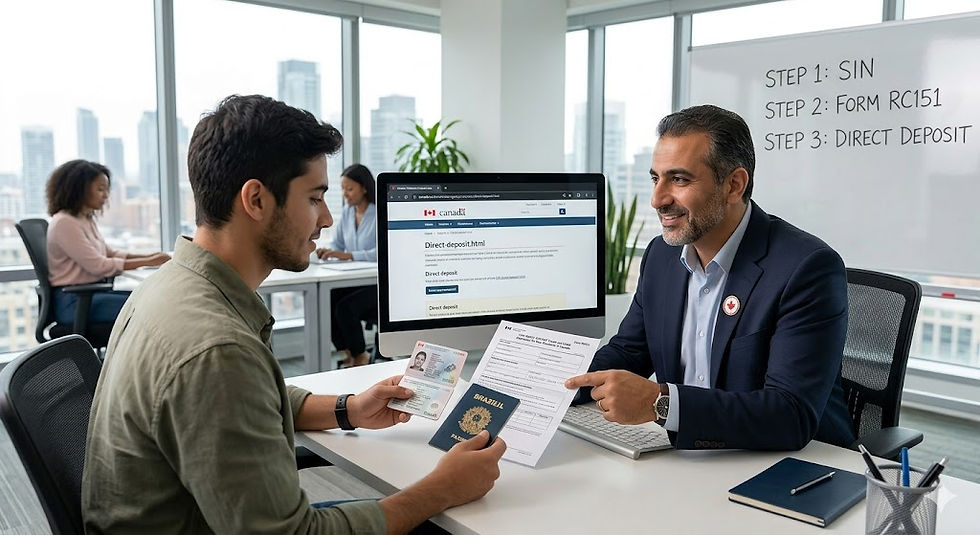
Set Up Direct Deposit with the CRA
All CRA benefit payments are issued by direct deposit or cheque. Setting up direct deposit through CRA My Account is strongly recommended: it is faster, more secure, and eliminates the risk of a cheque being delayed or lost in the mail.
The Immigration Connection: Why Your Status in Canada Matters
CRA benefits and immigration status are more closely linked than many newcomers expect. Your eligibility for the CGEB, CCB, and provincial benefits depends not only on your income but on how the CRA classifies your residency status.
Permanent residents qualify for CRA benefits on the same terms as Canadian citizens. From the date you land as a PR holder, you are considered a Canadian resident for income tax purposes, and you can apply for the CGEB and CCB immediately using Form RC151.
Temporary residents, including those on work permits or study permits, can qualify for the CGEB after 18 months of continuous Canadian residency. The CCB is available to temporary residents sooner, provided you have been a resident for at least 18 months and hold a valid permit.
This distinction matters in a practical way: families who arrive as permanent residents can access CCB and CGEB payments from their first months in Canada, providing meaningful financial support during the settlement period.
"For many of our clients, receiving the first CCB payment is a tangible sign that they are fully settled in Canada," says Amir Ansari, RCIC (licence R517765). "Part of our job as immigration consultants is making sure clients know about these benefits and apply through Form RC151 right after landing, rather than waiting a year or more."
If you are thinking about transitioning to permanent residency, achieving PR status earlier means earlier access to full benefit eligibility. Several PR pathways are available, including Express Entry. The PR Pathways in Canada 2026 guide covers the five most accessible routes in detail.
If you just landed as a permanent resident and want to understand the full settlement process, the Newcomer to Canada Checklist covers the first 90 days step by step, including CRA registration, SIN applications, and provincial health card enrollment.
For a deeper look at the economic immigrant settlement obligations introduced in 2026, see Settlement Services Canada: What Economic Immigrants Must Do.
Frequently Asked Questions About CRA Benefit Payment Dates
When is the next CRA benefit payment?
As of June 2026, the upcoming payment dates are: CGEB first quarterly payment on July 3, 2026; CCB on July 20, 2026; and OTB on July 10, 2026. Sign into CRA My Account to see your exact scheduled payment.
What is the Canada Groceries and Essentials Benefit, and does it replace the GST/HST credit?
Yes. The CGEB replaces the GST/HST credit starting July 3, 2026. Eligibility rules are identical, and all current GST/HST credit recipients will receive the CGEB automatically. CGEB payments are 25 percent higher than the old credit for five years (2026 through 2031).
What are the GST/HST credit payment dates for the 2025-2026 benefit year?
The GST/HST credit payments for the 2025-2026 benefit year were: July 4, 2025; October 3, 2025; January 3, 2026; April 4, 2026; and a one-time top-up on June 5, 2026.
What are the CCB payment dates for 2026?
Canada Child Benefit payments in 2026 are scheduled for: January 20, February 20, March 20, April 20, May 20, June 19, July 20, August 20, September 18, October 20, November 20, and December 11.
Who qualifies for the CGEB as a newcomer to Canada?
To qualify, you must be a resident of Canada for income tax purposes and be at least 19 years of age (or have a spouse, common-law partner, or child living with you). Permanent residents qualify immediately on landing. Temporary residents may qualify after 18 months of continuous Canadian residency.
How do I apply for CRA benefits as a new immigrant who has not filed a tax return?
Apply using Form RC151, available on the CRA website. If you have no children, complete the online version. If you have children under 19, download the PDF and mail it with proof of birth to your tax centre. You will need a Social Insurance Number for yourself and your spouse or partner.
What are the Ontario Trillium Benefit (OTB) payment dates for 2026?
The 2026 OTB benefit year begins July 10, 2026, with monthly payments continuing on the 10th of each month through June 10, 2027. If your total 2026 OTB entitlement is $500 or less, the CRA will issue it as a lump sum in July 2026.
How much is the Canada Child Benefit in 2026?
For the 2025-2026 benefit year, the CCB is up to $7,786.92 per year for each child under age 6, and up to $6,570.00 per year for each child aged 6 to 17. These maximum amounts apply to families with adjusted net income at or below approximately $36,500.
Related Posts
These posts from the Ansari Immigration blog cover topics closely connected to what you have just read.
Newcomer to Canada Checklist: Practical Advice for Newcomers: a step-by-step guide to SIN applications, CRA registration, and provincial programs in your first 90 days.
Settlement Services Canada: What Economic Immigrants Must Do: settlement obligations and deadlines for economic immigrants in Canada.
PR Pathways in Canada 2026: The 5 Most Accessible Routes to Permanent Residence: if you are currently on a temporary permit and want to understand your options for achieving PR status.
Am I Eligible for Permanent Residence in Canada?: a plain-language overview of who qualifies for each pathway.
Why work with Ansari Immigration
Flat, transparent fees quoted upfront. Every Ansari Immigration file is handled personally by the firm's licensed RCIC (practicing since 2019, 6,000+ cases), with all forms, IRCC correspondence and follow-ups included. And you pay for a straight answer, not a pitch: if permanent residence is not the right move for you yet, that is exactly what you will hear.
Which benefit payment matters most in your household planning? Tell us in the comments. When you are ready to talk about your status or your next application, book an $80, 30-minute consultation with Ansari Immigration.
Disclaimer: This post is for general information only. CRA benefit amounts depend on your net family income, family composition, and individual circumstances. The information in this guide reflects CRA program rules as of June 2026 and may change. For advice specific to your tax situation, consult a registered tax professional or contact the CRA directly at 1-800-387-1193.



Comments