


Your UCI number Canada, short for Unique Client Identifier, is the eight or ten-digit number IRCC assigns you the first time you apply, and it stays with you for life across every application. It is printed on your IRCC letters, your permits and your PR card, but, as Ansari Immigration explains to clients in Vancouver, it is not the same number as the document number printed on those cards. Mixing the two up is one of the most common form-filling mistakes we see.
Getting this right matters more than it looks. Enter the wrong number where a form asks for your UCI, or apply under a second UCI you did not know you had, and IRCC can struggle to link your new application to your existing record. That can mean processing delays, a request for clarification, or history sitting under an identifier the reviewing officer is not looking at. This guide covers exactly where the UCI appears, how to tell it apart from every other number on your documents, and what to do when something looks wrong. You can confirm the basics on the official IRCC Help Centre pages What is my client ID? and Where can I find my client ID/UCI?.

What Does UCI Stand For?
UCI stands for Unique Client Identifier. IRCC also calls it your client ID or client identification number, and on many documents the field is generally labelled “Client No.” or “No. du client.” All of these terms point to the same number. If a government form asks for your “client ID,” it wants your UCI number.
The purpose of the UCI is simple: it is how IRCC keeps every application, letter and document you have ever had tied to one person. It is assigned once, when IRCC first receives an application from you, and it does not change when you switch from a study permit to a work permit, or from temporary status to permanent residence, or from permanent residence to citizenship.
What Does a UCI Number Look Like?
The UCI number appears in one of two formats:
Eight digits: 0000-0000
Ten digits: 00-0000-0000
When you fill out an online form or the IRCC portal, enter the number without hyphens or spaces. For example, 1234-5678 becomes 12345678. Older clients often have an eight-digit UCI, while more recent applicants tend to have the ten-digit version, but both are equally valid and neither expires.
Where to Find Your UCI Number Canada on Official Documents
Your UCI number Canada appears on every official document IRCC has ever sent you. Here are the specific places to look:
1. IRCC letters and emails |
The acknowledgment of receipt (AOR) you received when you submitted an application will show your UCI in the header or first paragraph. |
2. Canadian visa stamp in your passport |
If you have a visitor visa, study permit, or work permit stamped into your passport, your UCI is printed directly on it. |
3. Temporary Resident Permit (TRP) |
The UCI appears on the face of the document. |
4. Permanent Resident (PR) card |
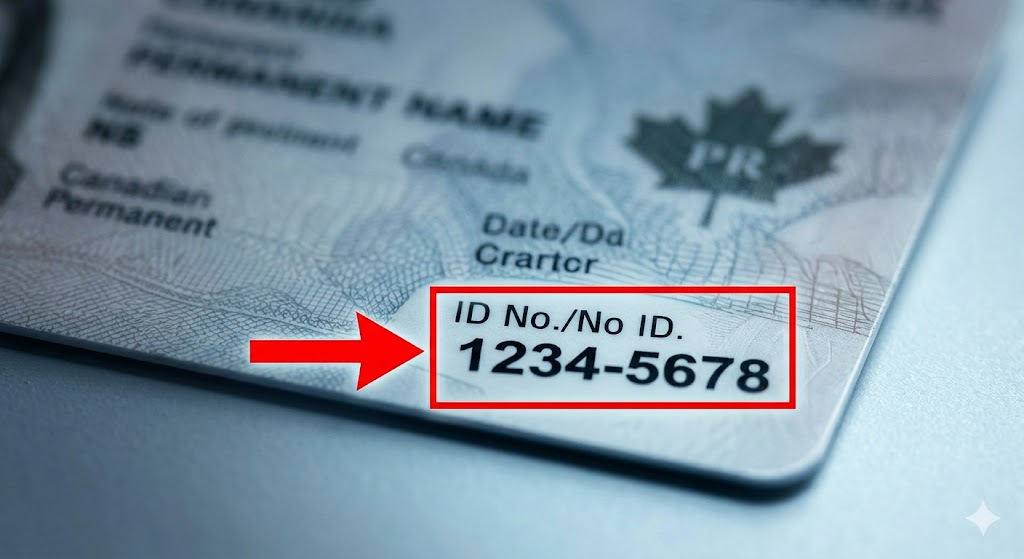
On the front of the card, under “ID No/No ID.” |
5. Landing documents |
IMM 1000, IMM 5292, and IMM 5688 all contain your UCI. |
6. Notice of Decision letter |
Any decision letter from a Case Processing Centre or visa office will include it. |
Source: IRCC Help Centre, Where can I find my client ID/UCI? Verified September 2026. The specific field labels above reflect the documents’ own layouts.
If you have been issued any type of Canadian immigration document, your UCI is on it. The single most reliable place is any letter IRCC has sent you, because the number is printed in plain text in the header rather than tucked into a card field. On a study permit or work permit, look for “Client No.” on the same line as, or just below, your name and date of birth. On your study permit document number page you will notice a separate number entirely, which is the next thing to untangle.
UCI Number vs Document Number vs Application Number
This is where most of the confusion lives, and it is worth slowing down on. Your immigration documents carry several different numbers, and they do very different jobs. Here is how they compare:
Number |
What it identifies |
Does it change? |
Format |
UCI (client ID) |
You, the person |
Never, one for life |
0000-0000 or 00-0000-0000 |
Document number |
One specific card or permit |
Yes, a new card or permit gets a new one |
Letters and digits printed on the document |
Application number |
One specific application |
Yes, different for every application |
Usually a letter followed by digits |
Group or family ID |
A set of applications filed together |
Tied to that submission |
Assigned per submission |
The practical takeaway: your UCI identifies you, while a document number identifies a piece of plastic and an application number identifies a file. When you renew a PR card, the document number changes but your UCI does not. When you submit a new work permit application, you get a new application number but the same UCI. If a form asks for your UCI and you enter the document number off the front of your PR card instead, you have given IRCC a number that belongs to a card, not to you.
Have you ever second-guessed which number a form was actually asking for? You are not alone, and the label is the tell. If you want a quick sanity check before you submit, ask in the comments and keep it general, and for advice on your specific file use a consultation.
What If You Do Not Have a UCI Number Yet?
If this is your first application to IRCC, you will not have a UCI number yet, and that is expected. When a form asks for your UCI, write “Not Applicable” or “N/A.” If you are applying online and the form will not accept “N/A,” leave the field blank. IRCC assigns your UCI when it receives your application, and your acknowledgment of receipt (AOR) will show it.
There is one specific carve-out worth knowing. IRCC’s guidance states plainly: “If you have not dealt with us since 1973, you will not have a UCI or a Client ID.” IRCC’s client records system dates from the early 1970s, so anyone whose only prior contact predates it is treated as a first-time applicant.

Do Canadian citizens and permanent residents have a UCI?
Yes, if they have ever applied to IRCC. A UCI is created the first time you deal with the department, whether that was a visitor visa, a study permit, a PR application or a citizenship grant. Naturalized citizens and permanent residents keep the UCI they were first assigned. People born in Canada who have never filed anything with IRCC generally will not have one, which is why a Canadian-born spouse sponsoring a partner may find they have no UCI to enter.
What If You Have Two Different UCI Numbers?
Occasionally a person ends up with two UCIs. This usually happens when IRCC’s system creates a new client record for a later application instead of matching it to the existing one, for example when a name is spelled differently, a date of birth was entered incorrectly on an earlier file, or an application was submitted before an earlier record was fully created. The result is that your immigration history gets split across two identifiers.
This is a genuine problem, not a cosmetic one. If your work history, prior applications and biometrics sit under UCI A, but your new permanent residence application is filed under UCI B, the officer reviewing UCI B may not see the record that supports your case. It can look, from their side, like you have less history than you actually do.
Here is the part most guides miss. IRCC’s public Help Centre pages explain what a UCI is and where to find it, but they give applicants no self-service way to merge two of them. The actual procedure lives in IRCC’s internal operational manual on identity management, which is published for staff. It instructs officers that “all records associated with the same client must be householded (in the Global Case Management System (GCMS)),” that “requests for this action must be sent to the Operations Support Centre (OSC),” and that officers “must not create the new application” until the records have been merged. In plain terms: the fix is a records consolidation IRCC does internally, not something you can do yourself in your account.
The practical route for you as the applicant is to flag it early. Contact IRCC through the IRCC web form, state both UCI numbers, and ask that your records be householded under a single identifier before your next application is finalized. Keep copies of documents showing each UCI so you can prove both belong to you. Because IRCC does not publish a client-facing timeline for this, confirm the current process on IRCC’s official pages before you rely on it.
Here is how this typically plays out. Say an applicant first got a visitor visa in 2019 under an eight-digit UCI, then a study permit was later filed with a slightly different transliteration of their surname and the system opened a second, ten-digit UCI. Years on, when they apply for permanent residence, their Canadian work experience is documented under the first UCI while the PR file runs under the second. The most reliable move is to flag both numbers to IRCC in writing at the start, ask that the files be consolidated, and reference the merged record in the application, rather than hoping the officer connects two identifiers on their own.
Not sure which of your numbers is the UCI, or worried you might have two? Whatever the situation, it has almost certainly crossed this desk before. A 30-minute Ansari Immigration consultation ($80) with a licensed RCIC settles it before you submit.
Check it with Ansari Immigration
What If Your UCI Looks Wrong or a Form Pre-Filled the Wrong One?
If a number labelled as your UCI does not match the one on your older IRCC letters, do not assume the newest document is right. Compare it against an official IRCC letter, which is the most authoritative source, and against your IRCC secure account. If an online portal has pre-filled a UCI that is not yours, or that does not match your documents, stop and verify before submitting, because an application linked to the wrong client record is far harder to fix after the fact than before. When the numbers genuinely conflict and you cannot tell which is correct, contact IRCC through the web form rather than guessing.
Is Your UCI Number Confidential? Can Someone Misuse It?
Your UCI is not a public number, and you should treat it like any other identifier tied to your identity. On its own it does not grant access to an application, because IRCC accounts and submissions require additional credentials and verification, but you should still avoid posting it publicly, sharing it in online forums, or including it in screenshots you send around. Share it only with IRCC, your designated representative, or an authorized third party who genuinely needs it to act on your file. If you believe your UCI or IRCC account has been compromised, contact IRCC through the official web form.
How to Find Your UCI If You Have Lost or Forgotten It
If you cannot find your UCI, you have a few reliable options:
Check any previous IRCC letter, email or document in your files, the number is printed on all of them.
Log into your IRCC secure account, if you have one. Your UCI appears in your account profile and on your application details.
Look at a copy of any previous application, even a refused one, because the UCI appears on all correspondence you received.
If you applied recently and have not received an AOR yet, your UCI has not been assigned. IRCC issues the AOR once it opens your application and confirms it is complete, and how long that takes varies by application type, so check IRCC’s processing times and application-status tools rather than assuming a fixed number of days. If your application is well past the expected window with no confirmation, contact IRCC to verify it was received. If you need your full file history to reconstruct what IRCC has on record, you can also order your GCMS notes, which are filed under your UCI.
Frequently Asked Questions About UCI Numbers in Canada
Is my UCI number the same as my application number?
No. Your UCI number Canada identifies you as a person and never changes. Your application number identifies a specific application and is different for each one you submit. The formats differ too: UCI numbers use the 0000-0000 or 00-0000-0000 format, while application numbers typically start with a letter followed by digits.
Where is my UCI number on my PR card?
On a permanent resident card, your UCI is generally shown on the front, in the field labelled “ID No./No ID.” Be careful not to confuse it with the card’s own document number, which is specific to that piece of plastic and changes when you replace a lost PR card or renew it. Your UCI stays the same.
Where is the UCI number on my study permit or work permit?
It is generally printed in the personal information section, usually on the same line as or immediately below your name and date of birth, labelled “Client No.” or “No. du client.” This is a different number from the work permit document number shown elsewhere on the permit.
Do Canadian citizens have a UCI number?
Yes, if they have ever applied to IRCC for anything. A naturalized citizen keeps the UCI first assigned to them. A person born in Canada who has never filed with IRCC generally will not have one.
Can someone misuse my UCI number?
On its own, a UCI does not grant access to your application, because signing in and submitting requires additional credentials and verification. Still, treat it as private: share it only with IRCC, your representative, or an authorized third party, and avoid posting it publicly or in forums.
Does my UCI number change when I become a permanent resident?
No. Your UCI stays the same throughout your entire immigration journey, from your first temporary resident application through permanent residence and citizenship. It is a permanent identifier, not a document-specific one.
Related Posts
Study Permit Document Number: What It Is and Where to Find It: How to spot the document number on your study permit and when IRCC asks for it.
Work Permit Document Number Canada: Where to find the document number on your work permit and what it looks like.
GCMS Notes Canada: How to Order Your IRCC File: How to request the full record IRCC holds under your UCI, including officer notes.
Get Your Documents Checked Before You Submit
Doing it alone: you match each field to the right number yourself, hope the portal pre-filled the correct UCI, and trust that IRCC links your new application to your existing record.
With Ansari Immigration (flat, transparent fees quoted upfront): the firm’s licensed RCIC reviews your identifiers and documents before anything is submitted, and if you may be carrying two UCIs, sorts it out first so your history stays in one place. Ansari Immigration is led by a licensed RCIC regulated by CICC, and it will tell you honestly when your situation needs professional help and when it does not.
Have a UCI or identifier question we did not cover? Ask in the comments, keep it general, and we read every one. When you are ready for a file-specific answer, book a 30-minute consultation with Ansari Immigration ($80).
Book a 30-minute consultation ($80)
This article is for general information only. It is not legal advice. Program criteria, requirements, processing times, and selection approaches can change without notice. Always confirm details on official government websites or consult a licensed Regulated Canadian Immigration Consultant (RCIC) for advice specific to your situation.