


IMM 5708 is the form a person already in Canada uses to extend a visitor stay, change the conditions of that stay, or remain as a temporary resident permit holder. It costs $100 per person. IRCC's own processing time data put a visitor extension at 341 days on October 21, 2026.
That last number is the reason this page exists. A visitor extension now takes longer than the stay it grants, which turns one decision into the whole outcome: whether you file before your current status expires. File in time and your status continues by operation of law while you wait. File a day late, or step out of Canada while you wait without the right document to come back, and the authorized stay you were waiting on is over. The rule that ends it sits in the Regulations, not on any of the three IRCC pages a visitor is likely to read.
By Amir Ansari, RCIC, Ansari Immigration, Vancouver.
If your status runs out in the next two months and you are not sure which of the three boxes on IMM 5708 applies to you, Ansari Immigration can tell you before the deadline decides it for you.
Ask which application is yours
What the IMM 5708 form actually is, and the three applications it carries
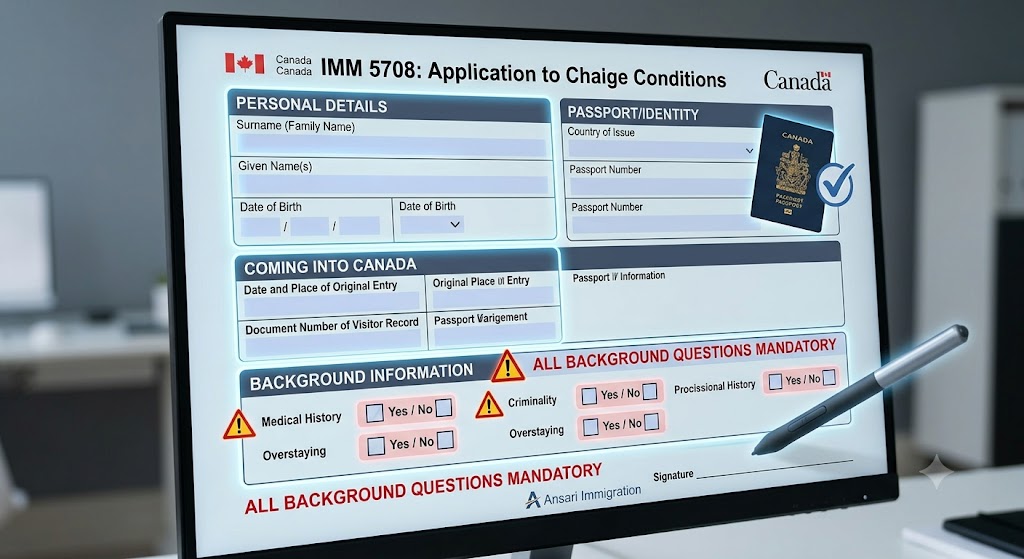
The official name of the form is the Application to Change Conditions, Extend my Stay or Remain in Canada as a Visitor or Temporary Resident Permit Holder. One form, three jobs.
Extend a visitor stay. You are an admissible visitor and you want more time. If approved, you receive a visitor record with a new expiry date.
Change the conditions of your stay. For example, a worker or student authorized to work or study without a permit who needs a document reflecting new conditions.
Remain in Canada as a temporary resident permit holder. A temporary resident permit, or TRP, is a different instrument for a different person: someone who is inadmissible to Canada but has a compelling reason to be allowed in or allowed to stay.
The first and the third sit side by side in the form's own title, and that is where most of the trouble starts.
The mistake that costs the most
In practice, says Amir Ansari, RCIC of Ansari Immigration in Vancouver, three errors account for most visitor extension problems, in this order: not knowing when to apply, not knowing what actually makes an application strong, and, the biggest, mistaking a visitor extension or visitor record for a temporary resident permit. They are not variations of one thing. A visitor record extends an authorized stay for someone who is admissible. A TRP is relief for someone who is not.
The official consequence of that mix up is written down, and it is severe. IRCC's officer instruction on maintained status states that people applying for an initial or subsequent TRP do not maintain their temporary resident status, and that they cannot renew a work or study permit or keep working or studying until a decision is made on the TRP application. A visitor who applies to extend before expiry keeps status throughout processing under the Regulations. Same form, opposite protection. At 341 days of processing, the difference between those two positions is close to a year of lawful presence.
Where to get IMM 5708, and which version is current
The form and its instruction guide are both published, and you should never have to hunt for them. The current form sits on IRCC's own IMM 5708 page, and the field by field instructions are in Guide 5551, Applying to Change Conditions or Extend Your Stay in Canada.
Two details answer a question thousands of people type every month. First, the PDF on that page carries its own version stamp, Last updated: September 2023, even though the page around it carries an October 6, 2026 date. The form has not changed in three years; the page around it has. Second, the form will not open properly on a phone. IRCC's page says plainly that the form may not open on tablets or mobile phones, and that you need Acrobat Reader version 10 or higher.
You also cannot choose paper by preference. IRCC's apply page states that you must apply online for a visitor record, and allows a paper application in only two situations: you cannot apply online because of a disability, or there is a problem with the online application.
Form |
When it applies |
IMM 5708 |
The application itself. Every applicant. |
IMM 5558 |
Document checklist. A personalised version is generated inside the online application. |
IMM 5409 |
Statutory Declaration of Common-law Union, if you are relying on a common-law relationship. |
IMM 5476 |
Use of a Representative, if a representative is acting for you. |
IRM 0002 |
Request for a Change of Sex or Gender Identifier, if your identifier differs from your current or past Canadian temporary resident document. |
Source: IRCC's IMM 5708 form page and Guide 5551. Verified October 2026.

The deadline that decides everything, and the midnight UTC cut off
The eligibility rule is a regulation, not a guideline. Under IRPR 181(1), a foreign national may apply for an extension only if "the application is made by the end of the period authorized for their stay" and "they have complied with all conditions imposed on their entry into Canada."
Read the second half of that again. Compliance is not a scoring factor on an extension, it is an entry condition for applying at all. Someone who worked without authorization during the stay they now want extended has a problem with 181(1)(b) before an officer reaches the merits.
On timing, Guide 5551 is explicit: "For any permit, you should always apply at least 30 days before your current status expires." IRCC's officer instruction on maintained status is harder edged about the final moment. It states that all applications must be submitted before midnight UTC on the date the applicant's status expires, and that for a paper application the officer will backdate the received date by 7 days to account for mail delivery delays.
That UTC detail matters more here than almost anywhere in Canada, and the arithmetic is ours rather than IRCC's: Vancouver runs at UTC minus seven or minus eight, the largest offset of any major Canadian population centre, so IRCC's filing day rolls over in the late afternoon Pacific, not at local midnight. A Metro Vancouver applicant who believes they have until midnight on the last day may already be filing a day late. An internal IRCC operational manual printout obtained under the Access to Information Act, dated February to March 2023, recorded the same UTC convention for electronic applications and the same seven day mail backdating for in-Canada extension applications, which is useful corroboration of a rule that is otherwise easy to miss. Neither source changes the only safe practice, which is to treat the last day as unusable.
Confirm the exact date your current status ends: the date in your passport stamp, the date on your visitor record, work permit or study permit, or, with no stamp and no document, six months from the day you arrived.
Confirm your passport is valid beyond the stay you are asking for. Guide 5551 states that the validity of your temporary resident status cannot exceed the validity of your passport.
If you are required to give biometrics, check whether your most recent collection is still inside its ten-year window.
Decide which of the three applications on the form you are actually making.
File at least 30 days before expiry, and never on the last day.
How long an IMM 5708 visitor extension takes in 2026
IRCC publishes this figure itself and updates it regularly. As of October 21, 2026, the posted times for in-Canada extension applications are not comparable across categories, and visitors are the worst served by a wide margin.
Application |
Posted processing time |
Visitor extension (visitor record) |
341 days |
Work permit extension |
121 days |
Study permit extension |
56 days |
Visitor visa applied for inside Canada |
12 days |
Source: IRCC's Check processing times data, updated October 21, 2026. Verified October 2026.
A visitor waits roughly six times as long as a student and nearly three times as long as a worker for a decision on the same kind of in-Canada extension. The figure is also moving in one direction: our own reading of the same official data in June 2026 put visitor extensions at 314 days, so the posted wait has grown by about a month in four months.
There is a structural oddity in that number worth naming. IRCC's officer instruction on visitor records, which carries a 2019 date, says an in-Canada application typically includes an extension or restoration of 6 months, "but this may vary from case to case." At a posted 341 days, many applicants will spend longer waiting for the document than the document will be valid once it arrives. That is not a reason to skip the application. It is a reason to understand exactly what you are living on while you wait.
What maintained status gives you, and what it does not
If you applied before your status expired, IRPR 183(5) extends the authorized period by operation of law. The provision opens "Subject to subsection (5.1)," and then reads that where "a temporary resident has applied for an extension of the period authorized for their stay and a decision is not made on the application by the end of the period authorized for their stay, the period is extended until" either the day a decision is made, if the application is refused, or the end of the new period, if it is allowed. The carve out in 183(5.1) removes that benefit from anyone subject to a declaration under subsection 22.1(1) of the Act, so maintained status is automatic for almost everyone who files in time, but not literally everyone. Subsection 183(6) adds that the temporary resident "retains their status, subject to any other conditions imposed, during the extended period." IRCC calls this maintained status, and it used to be called implied status.
Four things it does not give you.
It does not let you start working or studying. A work permit holder who applied as a visitor must stop working when the work permit expires. A study permit holder who applied as a visitor may not keep studying after the study permit expires. The category you applied in is the category you are maintained in.
It does not survive a departure from Canada. See the next section.
It does not survive a withdrawal. An IRCC procedure for withdrawing a temporary residence application, released under the Access to Information Act, instructs agents to check first whether the person is on maintained status and to have the client expressly confirm they understand that withdrawing ends it. If you withdraw in order to refile something cleaner, you are giving up the status you are standing on.
It does not survive an application returned as incomplete. Guide 5551 is categorical here: an application rejected as incomplete is considered to have never been submitted, and therefore you would not be able to maintain your status on it.
The officer instruction adds the other half, which is better news than it sounds: because the rejected application is treated as if it had never been submitted, the applicant is in status until their existing temporary resident status expires, so if there is still time on the clock you can refile properly. Read the two together rather than separately. You lose the benefit of that application, you do not lose the days you already had, and the only thing that saves you is having filed early enough to have days left.
Two smaller rules in the same instruction are worth having. Officers are told to indicate "Status maintained as per R183(5)" in the User Remarks section of the new document, with an exception for a work or study permit issued to someone who left Canada on maintained status and was allowed back in. And if the extension is refused, the 90 day restoration period under section R182 begins on the date of refusal, not on the date your original status expired. People assume the opposite and write themselves off months too early.
The trip that ends your stay, and the question representatives keep asking IRCC
Leaving Canada while an extension is pending ends the authorized stay you are waiting on, and the rule that does it is in the Regulations rather than on any IRCC extension page. IRPR 183(4) provides that the period authorized for a temporary resident's stay ends on the earliest of several events, and the first one listed is "the day on which the temporary resident leaves Canada without obtaining prior authorization to re-enter Canada."
For the pending application case, IRCC's officer instruction says the same thing in plainer words: a temporary resident's maintained status ends when they leave Canada. Re-entry is possible only if they are visa exempt under section R190 or hold a valid multiple-entry visa, and the border services officer then sets a fresh period of stay on arrival. A visa required national who travels solely to the United States or St. Pierre and Miquelon is considered to be visa exempt on return under subparagraph R190(3)(f)(ii), which is why a weekend in Point Roberts is survivable and a wedding in Manila may not be.
Now the part that is genuinely unresolved, and it is a narrow claim rather than a sweeping one. The rule above is published for people whose application is still pending. The question that is not answered anywhere a reader will find is the other one: what happens to a visitor record that has already been issued when its holder leaves Canada.
All three of IRCC's public extension pages do discuss leaving Canada, and the hub page carries a whole section on what you need to re-enter if you travel outside Canada as a temporary resident. What none of them does is tell you what going actually costs you. The page about the document says a visitor record "is not a visa" and that it "doesn't guarantee that you can leave and then re-enter Canada," which is about the document you need to come back, not about the validity of the record you already hold. Guide 5551 says that if you leave temporarily and do not have a new document to re-enter Canada, you will have to re-apply. IRCC's officer instruction on visitor records, which carries a May 21, 2019 date and is now more than seven years old, sets out the date by which the holder must leave and notes that departure is verified by the CBSA, but says nothing about returning and nothing about the record becoming invalid. None of these four documents cites IRPR 183(4), and none tells the reader that the authorized period ends on departure.
The gap is not theoretical, and we can measure it. An Access to Information release of the IRCC Immigration Representatives mailbox for January and February 2026, file A-2026-19052, lists 1,177 distinct subject lines across 3,431 messages. Among them, licensed representatives put this one question to IRCC at least five separate times under five different file references, from a request due in June 2025 through to requests due in March 2026, under subject lines including the validity of a visitor record after the holder leaves Canada, visitor record validity upon leaving Canada, and visitor record invalidity. When regulated professionals ask the department the same question five times in ten months, the published guidance is not doing its job.
Our reading is that IRPR 183(4)(a) governs the issued record too, because the provision speaks to the authorized period of stay rather than to any particular document, and a visitor record is the document that records that period. As of October 2026, no IRCC page we could find states this for visitor record holders, which is a narrower point than IRCC being silent about travel: the pages tell you what to carry back, not what leaving does to your status. Confirm your own position against IRCC's visitor record instruction and Guide 5551 before relying on it, and if you hold a visitor record and need to travel, make sure you hold a valid entry document for the return before you go.
The pattern Amir describes most often is a reader who arrives convinced they need a temporary resident permit, or convinced a visitor record will fix an admissibility problem it cannot touch. Those two applications sit on the same form and give opposite protection while you wait, and Ansari Immigration will say so plainly rather than file the one you asked for: the firm does not sell a service that is not the right service for the situation. A 30 minute consultation is where you find out which of the three applications on IMM 5708 is actually yours.
Find out which application is yours
A worked example, with the real numbers
Here is how this typically plays out. The scenario is illustrative and built only from the verified rules above, not from a client file.
A visitor arrives in Burnaby on May 20, 2026 to help with a new grandchild. The passport is stamped with no handwritten date, so the authorized stay is six months and ends on November 20, 2026. The family wants six more months.
Working backwards from November 20 and applying Guide 5551's 30 day instruction, the application should be submitted by about October 21, 2026. Add the UTC problem and the practical target is the afternoon of a weekday in mid October, not the evening of November 19. Cost: $100 for the extension, plus $85 for biometrics if a new collection is required, plus $100 for each additional family member extending at the same time. IRCC's fee list carries the extension as "Extend your stay as a visitor, per person" with no family maximum of any kind. The $500 family maximum on that list belongs to the visitor visa and reaches only a family of five or more applying at the same time and place, so it never touches an extension.
Filed on October 20, 2026, the application attracts maintained status from November 21. At the posted 341 days, a decision would be expected around late September 2027. During those ten months the visitor is lawfully in Canada, cannot work, cannot study in a programme requiring a permit, and cannot leave the country without a valid multiple-entry visa or visa exempt status for the return. If the extension is approved in September 2027, the new visitor record runs from the decision date. If it is refused, status runs to the refusal date and a 90 day restoration window opens from that day.
The decision the family actually faces is therefore not whether to extend. It is whether this person can accept ten months without travel. That is the conversation to have in October, not in November.
What goes wrong on an IMM 5708 application
Refusals on visitor extensions are rarely mysterious once you see which test an officer is applying. IRPR 181(2) says an officer "shall extend" the authorization if, following an examination, it is established that the foreign national "continues to meet the requirements of section 179." Section 179 is headed Issuance and is the temporary resident visa test, imported wholesale into the in-Canada extension. Its paragraph (b) requires that the person "will leave Canada by the end of the period authorized for their stay under Division 2". Those last three words are the hinge: Division 2 is where section 183 sits, so the test an officer applies to your extension points straight back at the authorized period rules above.
So an in-Canada extension is judged on the same will-you-leave question as a visa application filed from abroad. That is why Guide 5551 asks for your reasons for staying longer, proof of identity and of your current status, proof of financial support such as a guarantor's letter or bank statements, and, specifically, "Details about your plans to leave Canada, particularly the date and time of departure and the means of transportation." That is not bureaucratic padding. It is the evidence for section 179(b), and it is far more concrete than most applicants expect.
The recurring failure modes, each traceable to a rule above.
Filing after status expired. Not a weak application, an ineligible one under 181(1)(a). The route is restoration.
Filing while out of compliance. Unauthorized work or study during the current stay runs into 181(1)(b).
No answer to the will-you-leave question. Section 179(b) is where thin applications die.
A passport that expires inside the requested period. Guide 5551 caps status at passport validity, and IRPR 183(2), itself "Subject to subsections (3) to (5)," lets an officer fix a period other than six months on the basis of your means of support in Canada, the period you asked for, and the expiry of your passport.
An expiring biometrics window. For a person required by section 10.01 of the Act to provide biometrics, IRPR 183(4)(c.1) ends the authorized period when the ten years following their most recent collection run out, so an old enrolment can cap a new document.
An incomplete package. Returned, treated as never submitted, and no maintained status from it.
Leaving Canada mid process without a re-entry document.
If your status has already expired: restoration, not an extension
If the date has passed, IMM 5708 is still the form, but you are no longer asking for an extension. Under IRPR 182(1), on application made by a visitor, worker or student within 90 days after losing temporary resident status as a result of failing to comply with a condition imposed under paragraph 185(a), any of subparagraphs 185(b)(i) to (iii) or paragraph 185(c), an officer "shall restore that status if, following an examination, it is established that" the person meets the initial requirements for their stay, has not failed to comply with any other conditions imposed, and is not the subject of a declaration made under subsection 22.1(1) of the Act. IRPR 182(2) adds that an officer shall not restore the status of a student who is not in compliance with a condition set out in subsection 220.1(1).
The money is different too. Restoring status as a visitor costs $246.25 on IRCC's fee list, against $100 for an extension, and no visa fee is required. Guide 5551 is blunt about the rest: there is no guarantee that we will approve your application, and you may not study or work in Canada until the restoration application and any associated study or work permit application have been approved. Remaining in Canada without valid status is unlawful, and the guide notes that it is an offence under section 127 of the Immigration and Refugee Protection Act to knowingly make a false statement on the form.
Have you waited longer than the posted time on a visitor extension, or had one refused on the will-you-leave question? Tell us what happened in the comments, keeping it general, since real timelines help everyone else reading this page.
IMM 5708 compared with IMM 5709, IMM 5710 and IMM 5257
IMM 5708 is the in-Canada form for visitors and temporary resident permit holders, IMM 5709 is the same application for students, IMM 5710 is the same application for workers, and IMM 5257 is a visitor visa application rather than a status application at all. Picking the wrong one usually costs a full processing cycle.
Form |
Who uses it |
What you receive |
IMM 5708 |
A visitor, a person authorized to work or study without a permit, or a temporary resident permit holder, all already in Canada |
A visitor record, or a new temporary resident permit |
IMM 5709 |
A student in Canada extending or changing a study permit |
A new study permit |
IMM 5710 |
A worker in Canada extending or changing a work permit |
A new work permit |
IMM 5257 |
A person applying for a visitor visa |
A temporary resident visa, which shows you meet the requirements needed to travel to Canada, and is not status |
Source: IRCC's application forms and guides pages. Verified October 2026.
The distinction that answers the question people search most often: IRCC describes a visitor visa as an official document placed in your passport that shows you meet the requirements needed to travel to Canada, while a visitor record sets the new expiry date by which you must leave once you are already here. Guide 5551 states that the application for an initial TRV is always made outside Canada, and an initial electronic travel authorization has its own separate process. If your parents are the ones extending, the super visa route is worth comparing before you file another six month extension.
Frequently asked questions about the IMM 5708 form
What is the IMM 5708 form?
IMM 5708 is IRCC's Application to Change Conditions, Extend my Stay or Remain in Canada as a Visitor or Temporary Resident Permit Holder, used by people already in Canada to extend a visitor stay, change the conditions of a stay, or remain as a TRP holder. An approved visitor extension produces a visitor record carrying a new expiry date, which becomes your deadline to leave.
How do I submit the IMM 5708 form online?
You submit IMM 5708 through an IRCC online account, where you answer the eligibility questions, upload your completed form and documents, and pay the fee by card, and IRCC's apply page states that you must apply online for a visitor record unless a disability prevents it or there is a problem with the online application. You need a scanner or camera for your documents and a valid credit or debit card.
Where do I download IMM 5708, and which version is current?
Download IMM 5708 only from IRCC's own form page, where the PDF currently carries the version stamp Last updated: September 2023 even though the page around it carries an October 6, 2026 date. Open it on a computer with Acrobat Reader version 10 or higher, because IRCC warns that the form may not open on tablets or mobile phones. Third party sites that reproduce the form are not IRCC and should not be used to file.
How much does an IMM 5708 application cost?
IRCC's fee list sets Extend your stay as a visitor, per person at $100.00, biometrics at $85.00 per individual or $170.00 for a family of two or more where they are required, and restoring visitor status instead at $246.25 with no visa fee. There is no family maximum on the extension, so each family member extending pays their own $100.
How long does an IMM 5708 visitor extension take?
IRCC's posted processing time for a visitor extension was 341 days as of October 21, 2026, compared with 121 days for a work permit extension and 56 days for a study permit extension. Posted times are averages that move, so check IRCC's processing times tool on the day you file rather than relying on any figure you read elsewhere, including this one.
Can I leave Canada while my IMM 5708 application is being processed?
Leaving Canada ends the maintained status you are relying on, because IRPR 183(4)(a) ends the authorized period on the day a temporary resident leaves Canada without obtaining prior authorization to re-enter. You can return only if you are visa exempt or hold a valid multiple-entry visa, and the border officer then sets a new period of stay, so a trip in the middle of a 341 day wait is a decision with real cost.
What is the difference between IMM 5708 and IMM 5257?
IMM 5708 is an in-Canada application about how long you may stay and under what conditions, while IMM 5257 is a visitor visa application about whether you meet the requirements needed to travel to Canada, and Guide 5551 states that the application for an initial TRV is always made outside Canada. Someone already here who wants more time needs the visitor record route, not a new visa.
My status already expired, can I still use IMM 5708?
Yes, but the application becomes a restoration request rather than an extension, and IRPR 182 allows it only within 90 days of losing status, costs $246.25 instead of $100, and does not permit work or study until it is approved. Guide 5551 states there is no guarantee that we will approve your application, so restoration should never be treated as a routine second chance.
Related Posts
What Is a Visitor Record in Canada? IMM 1442 Explained (2026): What the document you receive after an approved IMM 5708 application actually says and does.
What Is Implied Status in Canada?: How the status you hold while an extension is pending works, and where people lose it.
Restoration of Status in Canada: Processing Time and How to Apply in 2026: The 90 day route for anyone whose status expired before they filed.
Get the right IMM 5708 application filed, before the date decides for you
Why work with Ansari Immigration
Flat $500 for a visitor extension filed from inside Canada, quoted upfront, with each additional family member at the same professional fee. Every file is handled personally by the firm's licensed RCIC, start to finish. Ansari Immigration is led by a licensed RCIC regulated by CICC who teaches immigration law at three colleges and runs professional development workshops for practicing RCICs.
Book a 30 minute consultation at $80 and bring your expiry date with you. And if this page settled something you had wrong, say which part in the comments, since the questions readers ask here shape what we write next.
This article is for general information only. It is not legal advice. Program criteria, requirements, processing times, and selection approaches can change without notice. Always confirm details on official government websites or consult a licensed Regulated Canadian Immigration Consultant (RCIC) for advice specific to your situation.