


For many routine, low-risk visitor visa applications, part of the decision is automated: since January 2022, an IRCC system can issue a positive eligibility decision on a Canada visitor visa without an officer weighing your case individually. The system never refuses, and an officer still reviews admissibility and makes the final call. IRCC's published notice on this was last updated January 2022.
That gap matters more than it sounds. Whether a computer is approving your Canada visitor visa eligibility, or a human officer is reading your file line by line, changes what actually gets scrutinized, how fast you hear back, and what a refusal does and does not mean. It also corrects the single most common panic we see: the belief that "an AI refused me." It did not. A computer can clear the eligibility half of a routine file, but by design it cannot refuse one.
Does a computer really approve Canada visitor visas?
Yes, for a slice of applications, and the mechanism is more specific than "AI decides." IRCC confirms publicly that advanced data analytics have helped sort and process more than one million visitor visa (TRV) applications from high-volume countries since 2018, with routine files assessed 87 percent faster. What the public page does not spell out, but IRCC's own internal memo does, is how the approval half works.
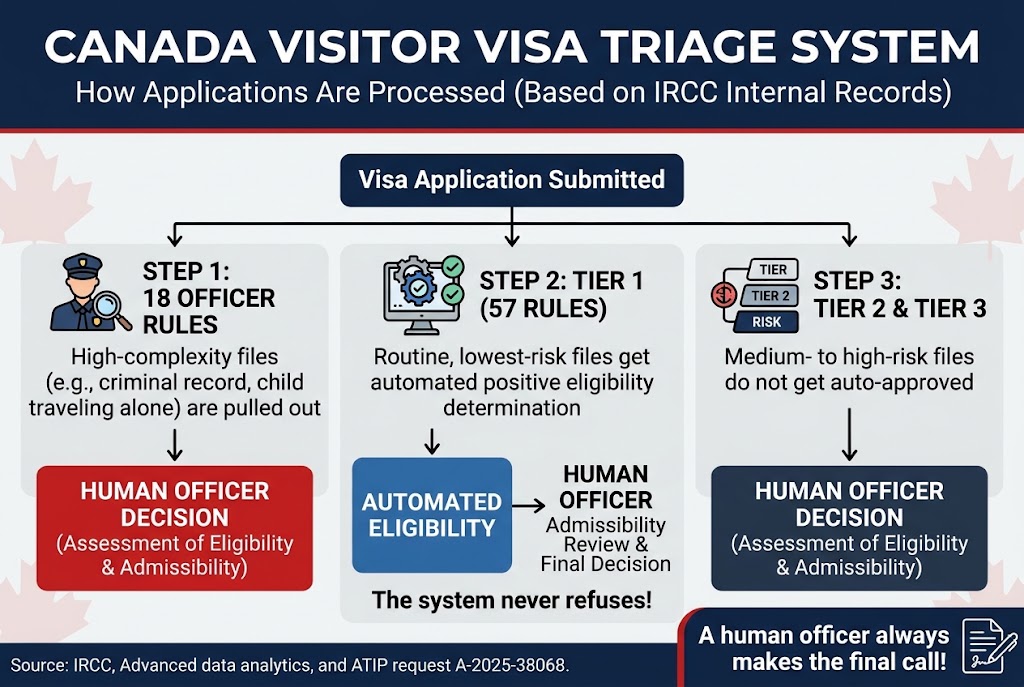
Internal records released under the Access to Information Act (request A-2025-38068) describe a three-step triage for overseas TRV applications:
First, 18 "officer rules" pull potentially higher-complexity applications out of the queue and send them straight to a human officer. Second, the remaining applications go into a model that sorts them into three tiers by risk and complexity. Third, the lowest-risk tier, Tier 1, receives an automated positive eligibility determination, selected by 57 rules.
In plain terms: if your file lands in Tier 1, a computer, not a person, decides that you meet the eligibility test to be a genuine visitor. An officer then reviews admissibility and issues the visa.
Triage step |
Who decides |
What happens |
18 officer rules |
Human officer |
Higher-complexity files, for example a criminal record or a child travelling alone, are pulled out and processed manually from the start. |
Tier 1 (57 rules) |
Automated system |
Routine, lowest-risk files get an automated positive eligibility determination; an officer then clears admissibility and issues the visa. |
Tier 2 and Tier 3 |
Human officer |
Remaining files are not auto-approved; an officer assesses eligibility and admissibility. |
Source: IRCC, Advanced data analytics to help process TRV applications, and IRCC internal memo released under ATIP request A-2025-38068. Verified October 2026.
One line from the memo captures the scale of the shift.
In the visitor visa files Ansari Immigration reviews, a refusal always carries an officer's name and reasons, never the system's, which is exactly what these internal documents predict.
What the automated system does not do
This is where the headline "a computer approves your visa" needs its guardrails, because every real rule has carve-outs.
The system never refuses. IRCC's public notice states it plainly: "The system never refuses or recommends refusing applications," and "only an IRCC officer can refuse an application." Every negative decision is a human decision.
It does not touch admissibility. Eligibility, meaning are you a genuine visitor who will leave, and admissibility, meaning criminality, security, misrepresentation, and health, are two separate tests. The automation only ever addresses eligibility, and only for Tier 1. An officer always assesses admissibility before any visa is issued.
It does not apply to everyone. The 18 officer rules divert higher-complexity files, for example applicants flagged for a criminal record, or a child travelling alone who needs a consent letter, to a person for normal processing. Tier 2 and Tier 3 files are not auto-approved. And the predictive eligibility model that estimates approval probability existed, as of the released documents, only for the India and China caseloads, not the rest of the world. A separate IRCC tool triages visitor visa applications filed from inside Canada.
It does not police your identity, and the triage model itself does not track fees. The internal triage manual is explicit that the model ignores cost recovery and does not replace officer vigilance on identity, fraud, and inadmissibility. Fees are not skipped, though: staff confirm they are paid as a basic requirement before a file ever enters the automated lane.
The part almost no one explains: who is legally accountable
Canadian immigration law requires a human decision-maker. IRPA section 11(1) says a visa "may be issued if, following an examination, the officer is satisfied that the foreign national is not inadmissible and meets the requirements of this Act." So how can a computer make an eligibility determination at all?
IRCC solved this by naming a senior official as the human on the hook. According to the internal records released under ATIP request A-2025-38068, a Director General is asked to become the "Officer of Record" and, in the memo's own words, "will be considered to be making eligibility determinations under the Immigration and Refugee Protection Act (IRPA) using the automated system." The Director General reviews and approves the rule sets; the system then applies them at scale. Those same internal records describe several layers of quality assurance that monitor accuracy and make sure individual officers are "not fettered" by the triage.
The practical consequence is subtle but real: for a Tier 1 file, no individual officer has personally weighed whether you look like a genuine visitor. Per those internal records, officers are instructed not to re-review an automated Tier 1 eligibility approval unless something surfaces during the admissibility check or passport verification. The genuineness call that applicants agonize over may never have been made by a person at all.
A worked example: two applicants, two completely different paths
Picture two parents in Metro Vancouver, each sponsoring a visiting relative, both filing a standard V-1 family visit application.
Applicant A is a 45-year-old with a clean history, a valid passport covering the whole trip, a complete application, fees paid, and prior travel to the United States confirmed. Her file meets the pre-conditions, clears the 18 officer rules, and the model drops her into Tier 1. The 57 rules return a positive eligibility determination automatically. An officer opens the file only to confirm admissibility, sees nothing adverse, and issues the visa. No human ever debated whether she is a "real" visitor.
Applicant B is the same age, same relative, but was refused a US visa two years ago and is bringing a grandchild who needs a consent letter. One of the 18 officer rules catches the complexity, so his file never enters the automated lane. A human officer assesses eligibility and admissibility together, reads the consent letter, weighs the prior refusal, and may send a procedural fairness letter before deciding.
Same form, same city, same family, opposite journeys through the system, and only one of them was ever "approved by a computer." Knowing which lane you are likely in is the difference between expecting a fast, lightly-touched decision and preparing for a full manual read.
Three signs your visitor visa file is not a routine one: you or your applicant hold a prior visa refusal from any country, there is a criminal record or other inadmissibility question, or a child is travelling without both parents. If any apply, your file is likely headed to an officer rather than the automated lane, and a 30-minute review with Ansari Immigration's licensed RCIC can tell you what that officer will be looking for.
But I heard AI refused my visa
This is the objection worth meeting head on, because it is usually wrong, and believing it leads people to the wrong fix.
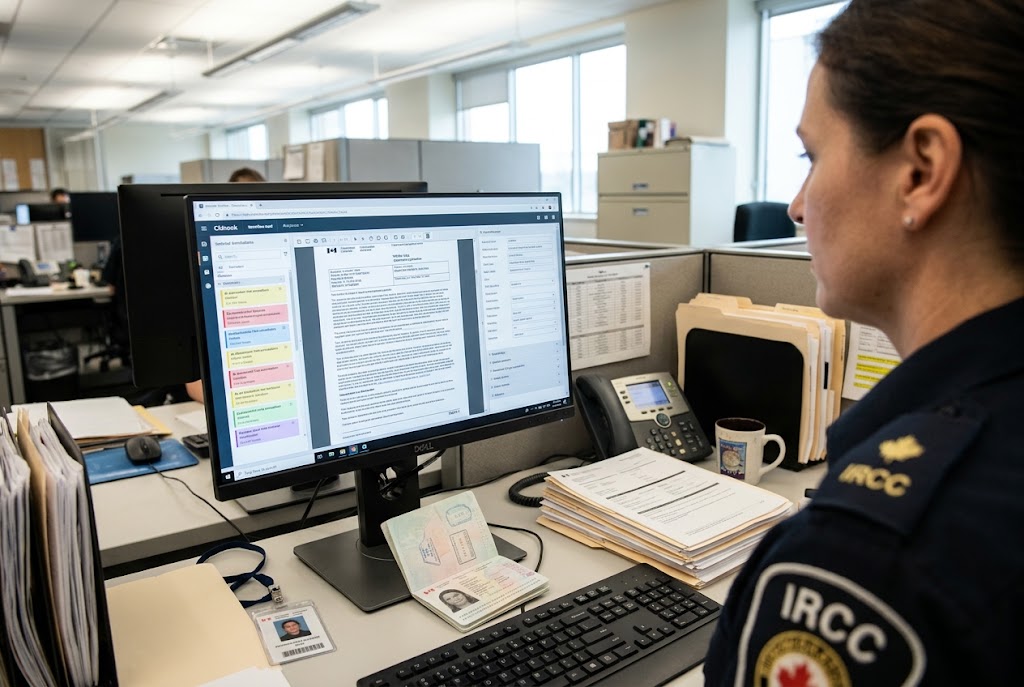
When applicants say a computer refused them, they are often thinking of Chinook, the workflow tool officers use to view and work applications. Chinook and the triage model display information to officers, including automatically generated case annotations that summarize what is in the Global Case Management System. They do not issue refusals. As covered in our breakdown of whether a computer refuses your visa and the IRCC Chinook question, the refusal itself is always an officer's decision, written under that officer's name.
Why does this matter? Because if a refusal is a human decision, the response is a human-facing one: order your GCMS notes to see the officer's reasoning, address the specific concern, and reapply or seek reconsideration. Chasing a phantom "AI error" wastes the one thing a refused applicant has little of, which is time.
What this actually means for your application
Follow the chain to its end. If routine files are auto-approved on eligibility, the leverage is in two places.
Before you file, make the pre-conditions airtight, because they are checked by staff before the triage even runs. A file that fails a basic check never reaches the smooth automated lane:
You are a foreign national applying for a visa.
Your passport is valid for the entire intended stay.
Your application is complete.
Your fees are paid.
Any required US travel history is verifiable.
After you file, remember that a file can sit idle for days for reasons that have nothing to do with an officer's workload. The triage model refreshes only twice a week, and "wait bins" hold files pending biometrics or information-sharing results. A quiet week is often the system's schedule, not a problem with your case.
And if you are refused, treat it as the human decision it is. The refusal came from an officer, so the officer's reasons, visible in your GCMS notes, are what you answer. If your visit is also a step toward settling here, the permanent residence pathways are assessed separately, and holding visitor status does not by itself help or hurt them.
Did your visitor visa come back faster or slower than you expected? Share your timeline and the country you applied from in the comments. Keep it general, and for advice on your specific case use a consultation.
Frequently asked questions about a computer approving your Canada visitor visa
Does a computer approve Canada visitor visas?
Yes, for routine low-risk applications an IRCC system can issue an automated positive eligibility decision on a visitor visa, but a human officer still reviews admissibility and makes the final decision, and the system itself never refuses an application.
Can a computer refuse my Canada visitor visa?
No, IRCC's automated system never refuses a visitor visa and does not even recommend refusal, so every refused application is the decision of a human officer rather than a computer, despite how it may feel.
Is Chinook refusing visa applications?
No, Chinook is a workflow and data-display tool that shows officers the triage system's case annotations and application details, and it does not decide or refuse applications, which officers do themselves.
Which visitor visa applications are decided by an officer instead of a computer?
Higher-complexity applications are routed to a human officer by 18 built-in rules, for example applicants with a criminal record or a child travelling alone who needs a consent letter, and these files get a full manual review.
Does the automated system assess whether I am a genuine visitor?
For Tier 1 routine files the system applies 57 rules to decide eligibility, and officers are told not to re-review that eligibility unless something surfaces, so your genuineness may not be assessed individually by a person.
How can I tell if a computer approved my visitor visa?
You usually cannot tell from your IRCC account, but ordering your GCMS notes reveals the triage bin and the case annotations an officer saw, which is the closest window most applicants get into how their file was handled.
Why work with Ansari Immigration
Doing it alone, you assemble the proof of funds, the ties, and the invitation, then hope your file lands in the routine lane. With Ansari Immigration, the firm's licensed RCIC, regulated by CICC, builds the file so the pre-conditions are airtight and flags anything that would divert it to an officer. Flat fees are quoted upfront: $1,000 for a visitor visa from outside Canada, $500 from inside Canada, with additional family members at the same flat fee. Every file is handled personally, with no juniors and no call centres.
Not sure which lane your application is in? Tell us your situation in the comments, or book a consultation (80 dollars for 30 minutes) and Ansari Immigration will read your file the way an officer will.
Related Posts
Did a Computer Refuse Your Visa? IRCC Chinook and the AI Question: The refusal side of the same system, and why a refused visa is always an officer's decision.
GCMS Notes Canada: What They Are and How to Order Your IRCC File: How to see the triage annotations and officer reasoning behind your own application.
Canada Visitor Visa Processing Time 2026: Current Wait Times by Country: What the twice-weekly triage and wait bins mean for how long your file actually takes.
This article is for general information only. It is not legal advice. Program criteria, requirements, processing times, and selection approaches can change without notice. Always confirm details on official government websites or consult a licensed Regulated Canadian Immigration Consultant (RCIC) for advice specific to your situation.