


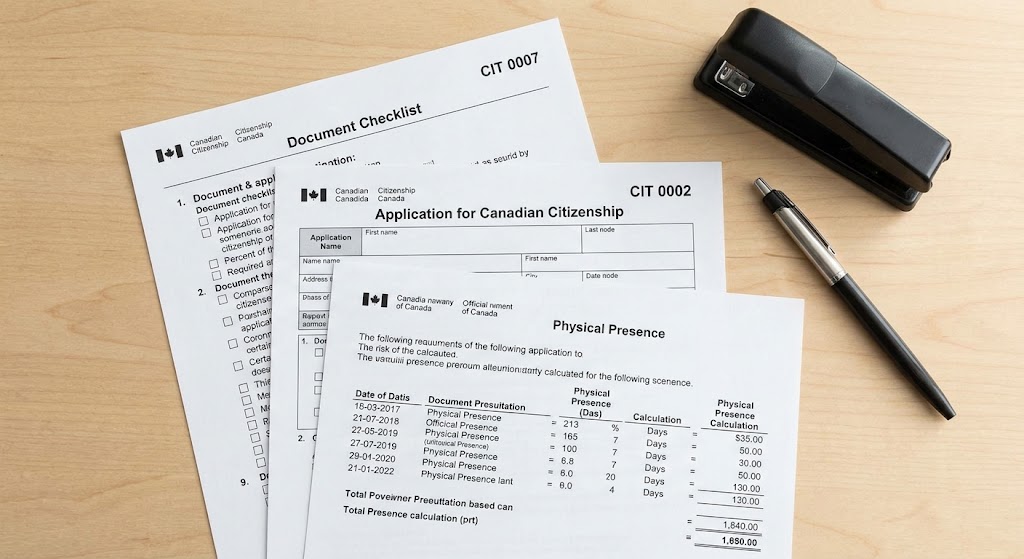
The Canadian citizenship application checklist for an adult comes down to eight required items: the document checklist (CIT 0007), the application form (CIT 0002), colour copies of your passports, your physical presence calculation, language proof if you are 18 to 54, two pieces of ID, two citizenship photos, and your fee receipt. Some applicants need a handful of extra documents on top of those.
Getting this list right is the difference between a smooth application and a returned one. IRCC is explicit that if your documents are not clear and easy to read, or if you submit the wrong ones, it can return your application or take longer to process it. A return does not just cost weeks, it resets your place in the queue. The full requirements live on IRCC's official citizenship forms and documents page and its document checklist (CIT 0007), which this guide walks through in plain language.
What this checklist covers
The documents every adult applicant must include
The documents you add only if they apply to your situation
The 2026 application fee and what to submit as your receipt
How to assemble and submit the package so it is not returned
The Canadian citizenship application checklist: documents everyone must include
Every adult applying for a grant of citizenship under subsection 5(1) must provide all of the following. Open the official checklist alongside this table so you can tick each item as you gather it.
Required document |
What to include |
Document checklist (CIT 0007) |
The completed checklist, placed on top of your package if you apply on paper. |
Application form (CIT 0002) |
The completed and validated adult application form. |
Passports and travel documents |
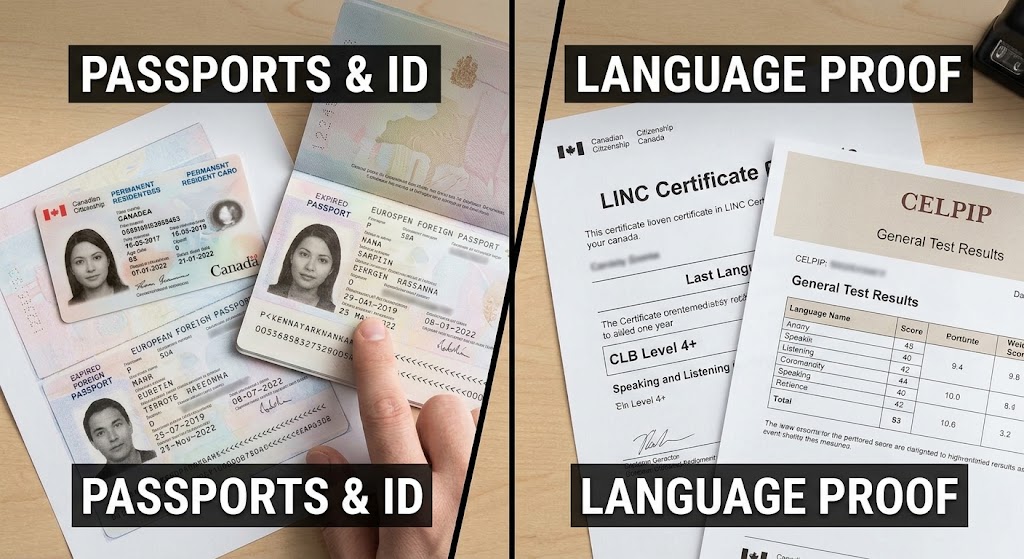
Colour photocopies of the identity pages of every passport and travel document that covers your five-year eligibility period, including expired ones and any extension-stamp pages. |
Physical presence calculation |
Your printed physical presence calculation from IRCC's official calculator. |
Language proof (adults 18 to 54 only) |
One accepted proof: education in English or French, an approved third-party test, a LINC or CLIC certificate, or a provincial program certificate, showing CLB level 4 or higher in speaking and listening. |
Two pieces of personal ID |
Photocopies of two IDs showing your name, photo and date of birth. If one is your PR card, the second must be issued by a Canadian federal, provincial or territorial government. |
Two citizenship photos |
Two identical, printed colour photos that meet IRCC's citizenship photo specifications. |
Fee receipt |
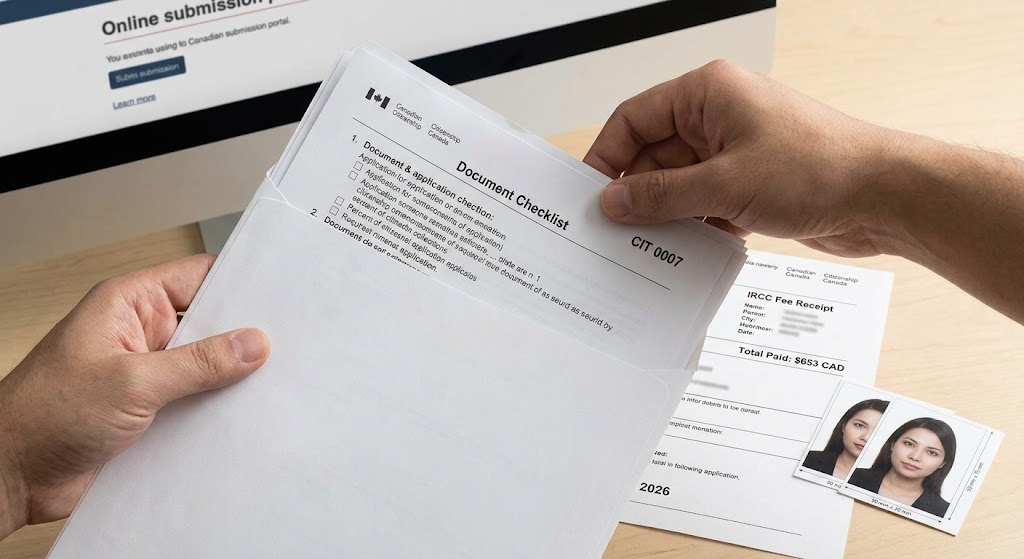
Your printed proof that you paid the application fee. |
Source: IRCC, Adults: forms and documents to apply on paper and CIT 0007. Verified August 2026.
A few of these deserve a closer look, because they are where applications stall.
Passports and travel documents
You copy the identity pages, not the whole passport, but you copy them for the entire five-year eligibility period. That means an expired passport you held during those years still has to be in the package. IRCC's eligibility period runs five years back from the date you sign your form and must include the 730 days you spent as a permanent resident. If there is a stretch with no passport, you explain why in question 14 of the form.
Physical presence calculation
Citizenship generally requires 1,095 days (three years) of physical presence in the five years before you apply, though your exact figure depends on your history, so confirm it with IRCC's official physical presence calculator rather than estimating. Print the result and include it. Our guide to the realistic citizenship application processing time explains what happens after you submit.
Language proof (ages 18 to 54)
If you sign your application between 18 and 54, you must prove CLB level 4 or higher in speaking and listening, with only one accepted proof of your choice. This is where people slip: a language test can show a strong overall score yet not meet the listening-and-speaking breakdown IRCC actually reads. Check the accepted tests and scores before you pay for one.
Documents you include only if they apply to you
Depending on your situation, IRCC asks for additional documents. Add any of these that describe you:
Use of a Representative form (IMM 5476), if you have a paid or unpaid representative acting for you.
A police certificate, if you were in any country outside Canada for 183 days or more in a row, at any point in the past four years, since the age of 18.
A certified translation, for any document that is not in English or French, submitted with the original-language copy.
A name change document, if you legally changed your name.
Date of birth change documents, if you want your citizenship certificate to show a different date of birth than your immigration document.
The Change of Sex or Gender Identifier form (IRM 0002), if you want your certificate to show a different gender than your immigration document.
The Residence Outside Canada form (CIT 0177), if you spent time abroad as a Crown servant or their family member during your eligibility period.
A guardianship document, if you are applying as the legal guardian or caregiver of an adult applicant.
A waiver (exemption) request, if you cannot meet the language, test or oath requirement for a disability or other accessibility reason.
Most applicants need none or only one of these. The police certificate is the one people overlook most, because the 183-days-in-a-row rule catches long trips they did not think of as time spent living abroad.
Not sure whether your time abroad triggers a police certificate, or which language proof IRCC will accept? That is a 30-minute question for Ansari Immigration's licensed RCIC ($80).
Book a consultation ($80, 30 min)
The 2026 Canadian citizenship application fee
Your fee receipt is a required document, so you pay before you submit. For an adult grant of citizenship, the fee has two parts: a $530 processing fee and the right of citizenship fee. IRCC increased the right of citizenship fee from $119.75 to $123 effective March 31, 2026, so the current adult total is $653 for applications received on or after that date. The processing fee itself is unchanged at $530.
Confirm the exact amount for your situation on IRCC's official fee list the day you pay, since fees are indexed and can change without notice. After you pay online, print the receipt and include it in your package.
How to assemble and submit your package
Order matters. IRCC asks you to place your documents and forms in the order shown on the checklist, with the completed checklist on top. If you apply online, the required documents are listed inside your account and you must follow those instructions, using this checklist only as a reference. Clear, readable colour copies protect you: an unreadable scan is treated the same as a missing document.
Before you file, it is worth confirming you actually meet the underlying requirements this paperwork supports, because the strongest package cannot fix an eligibility gap. If you are not sure your presence days add up, or a tax year is missing, resolve that first. Which requirements you must still meet can also change with age.
Have you started gathering these documents yet, and which one is slowing you down? Share it in the comments, it helps other applicants know what to prepare early, and keep it general, for advice on your own file use a consultation.
Why the checklist matters for your citizenship application
Citizenship is usually the last step in a journey that began with permanent residence, often through Express Entry or another pathway years earlier. After all that time and cost, a citizenship application returned over a missing passport page or the wrong language test is an avoidable setback. A complete, correctly ordered package is the cheapest insurance you have, and it is entirely within your control. Once your application is in, our guides on the citizenship test and how to check your citizenship application status cover what comes next.
Frequently asked questions about the Canadian citizenship application checklist
What documents do I need for Canadian citizenship?
Adults need the CIT 0007 checklist, the CIT 0002 application form, colour copies of all passports covering the five-year eligibility period, a physical presence calculation, language proof if you are 18 to 54, two pieces of ID, two citizenship photos, and a fee receipt. Some applicants add situational documents such as a police certificate or a name change document.
Do I need a police certificate for Canadian citizenship?
Only if you were in a country outside Canada for 183 days or more in a row, at any point in the past four years, since you turned 18. If that applies, IRCC requires a valid police certificate from that country, and it can ask for one at any point during processing.
Do I have to prove my language for Canadian citizenship?
Yes, if you sign your application between the ages of 18 and 54. You provide one accepted proof showing CLB level 4 or higher in speaking and listening, such as an approved language test, education completed in English or French, or a LINC, CLIC or provincial program certificate.
How many photos and pieces of ID do I need?
Two identical, printed colour citizenship photos that meet IRCC's specifications, and photocopies of two pieces of personal ID showing your name, photo and date of birth. If one ID is your PR card, the second must be issued by a Canadian federal, provincial or territorial government.
How much is the Canadian citizenship application fee in 2026?
For an adult grant of citizenship, the fee is $530 in processing plus a $123 right of citizenship fee, for a total of $653 on applications received on or after March 31, 2026. Always confirm the current amount on IRCC's official fee list before paying.
Can I apply for citizenship online instead of using the paper checklist?
Yes. When you apply online, the required documents are listed inside your application account, and you must follow those instructions. You can use this checklist as a reference, but the account is the authority for what to upload.
Related Posts
Canadian Citizenship Test 2026: What to Expect and How to Prepare: What the test covers and how to study once your application is accepted.
How to Check Citizenship Application Status in Canada (2026): Where to track your file and what each status update means.
Canada Citizenship Application Processing Time in 2026: What to Expect: Realistic timelines from submission to the oath.
Three signs your citizenship package is worth a professional read before you mail it: your five years include long trips abroad or a missing passport, your physical presence sits close to the 1,095-day line, or a tax year in the period is unfiled. Ansari Immigration will tell you honestly when your file is clean enough to send yourself, and when a review protects the years you invested. Led by a licensed RCIC regulated by CICC, with citizenship representation at a flat $1,000, quoted upfront.
Book a citizenship consultation with Ansari Immigration below, and tell us in the comments which document is giving you trouble.
Book a citizenship consultation ($80, 30 min)
This article is for general information only. It is not legal advice. Program criteria, requirements, processing times, and selection approaches can change without notice. Always confirm details on official government websites or consult a licensed Regulated Canadian Immigration Consultant (RCIC) for advice specific to your situation.