

The Yukon Nominee Program is employer driven. Only a Yukon employer can submit an expression of interest, and only during a published intake window. Both 2026 windows have closed: January 19 to 30 and July 6 to 17. The territory received 282 nominations for 2026, usable only by December 31, 2026.
Getting this wrong costs a year, not a week. Because expressions of interest are accepted only inside two published windows and nothing carries forward between them, a worker who spends three months preparing a personal application is not merely filing the wrong form, they are missing the only cycle available until the next window opens. The people who succeed here are not better applicants. They are the ones whose employer was ready on the day the window opened.
By Amir Ansari, RCIC, Ansari Immigration, Vancouver
Who actually applies to the Yukon Nominee Program, and why it is not you
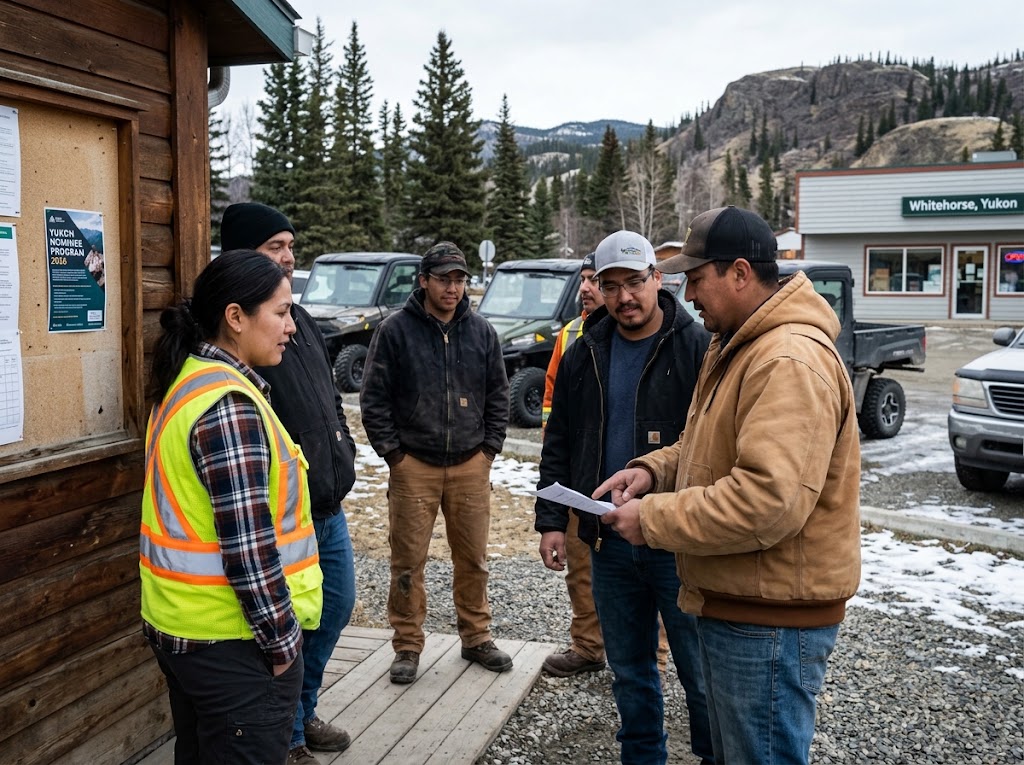
If you are a foreign worker reading this, the single most useful sentence in the Yukon Nominee Program 2026 operational guidance is this one: "The YNP is an employer-driven program, meaning only employers can submit applications." The same document closes the door on the workaround people reach for next: "Foreign nationals are not eligible to apply, even if they have the consent of their employer."
That is not a formality you can get around with a cover letter. There is no worker-side form, no worker-side portal, and no exception process. The Government of Yukon's Yukon Nominee Program page says each employer submits one application per foreign worker, and that only employers can ask about application status. In the northern nomination files Ansari Immigration is asked about, the first question is almost always some version of "how do I apply", and the honest answer is that the thing the reader is picturing does not exist.
So what does exist? A sequence that starts with a Yukon employer who has already failed to hire a Canadian or permanent resident, and ends, if everything holds, with you filing a permanent residence application to IRCC. You are a participant in that sequence from the second step onward. You are never the applicant at the territorial stage.
Not sure whether your Yukon job offer is even the kind of offer the program recognises? That is a 30 minute question, and Ansari Immigration's licensed RCIC will tell you plainly if the answer is no.
Both 2026 Yukon Nominee Program intakes have closed, and 2027 has not been published
Expressions of interest are accepted only inside two short windows a year. For 2026 the Government of Yukon published these:
Stage |
Intake 1 |
Intake 2 |
Expression of interest window |
January 19 (9 am) to January 30, 2026 (4:30 pm) |
July 6 (9 am) to July 17, 2026 (4:30 pm) |
Invitations sent |
February 9 to 13, 2026 |
August 3 to 7, 2026 |
Information sessions |
February 16 or 18, 2026 |
August 10 or 12, 2026 |
Full application due |
March 4, 2026 |
August 26, 2026 (4:30 pm) |
Share of the 282 nominations |
75 per cent |
25 per cent |
Source: Government of Yukon, Yukon Nominee Program 2026 process page (modified September 10, 2026) and the 2026 operational guidance (updated July 3, 2026). Verified October 2026.
Three things in that table decide whether a plan is realistic.
The windows are two weeks long. An employer who learns about the program in March has missed Intake 1 and has to wait until July. An employer who learns about it in September has missed both.
Nothing carries over. The Yukon states that expressions of interest from 2025 or from Intake 1 did not carry into Intake 2, and that Intake 2 applicants had to submit current information. On the invitation side the guidance is blunter: invitations "are only valid for the specific 2026 intake noted in the invitation to apply" and "cannot be deferred, transferred or applied to any future intake."
Intake 2 is the small one. It holds 25 per cent of the allocation, topped up only by slots freed when Intake 1 applications are withdrawn or refused. An employer who treats Intake 1 as optional is competing for a quarter of the year's room.
As of October 16, 2026, the Government of Yukon had not published 2027 intake dates or a 2027 allocation. The 2026 process page, modified September 10, 2026, and the program landing page, modified September 3, 2026, both still describe 2026 only. What Yukon has published about 2027 is not a calendar but a review: a public engagement on the Yukon Nominee Program launched September 9, 2026 and closed October 8, 2026, intended to inform recommendations "for future program improvements, with changes expected to begin in 2027". So the planning assumption should not be that the 2026 rules simply carry over. Check the Yukon Nominee Program 2026 process page rather than a third party summary, and expect the 2027 version to differ.
The three streams, and which TEER band decides yours
The stream is not a choice. It follows from the National Occupational Classification TEER category of the job the employer is filling.
Stream |
Job level |
Minimum relevant experience |
Language, Canadian Language Benchmark |
Critical Impact Worker |
TEER 4 or 5, entry level |
6 months |
CLB 4 |
Skilled Worker |
TEER 0 to 3, management or jobs needing more education |
12 months |
CLB 6 for TEER 0 and 1, CLB 5 for TEER 2 and 3 |
Express Entry |
TEER 0 to 3, candidate already in the federal Express Entry pool |
6 months |
CLB 7 for TEER 0 and 1, CLB 5 for TEER 2 and 3 |
Source: Government of Yukon, Yukon Nominee Program 2026 process page, the Skilled Worker and Critical Impact Worker streams page and the Express Entry stream page, all modified September 10, 2026. Verified October 2026.
Read the last two rows against each other, because the comparison is counter-intuitive and the top ranking pages do not make it. For the same TEER 0 or 1 job, the Express Entry stream asks for a higher language score than the Skilled Worker stream, CLB 7 rather than CLB 6, while asking for half the experience, 6 months rather than 12. The reason is federal, not territorial: the Express Entry stream only works if you already qualify for the Canadian Experience Class, the Federal Skilled Worker Program or the Federal Skilled Trades Program, and those programs carry their own minimums.
If you want the TEER band for a specific occupation, our guide to NOC codes and TEER categories walks through how to find it. One caution worth repeating: canada.ca currently prints two different NOC codes for licensed practical nurses on two pages about the same rule, so for health care occupations confirm the code against the officer instructions and the public page before relying on it.
Language test results must come from a designated testing organization and must be less than two years old at the time of application.
What the EOI points actually score, and who wins a tie
This is the part the AI Overview summarises as "priorities" and then leaves as a list. The 2026 operational guidance publishes an actual grid. Top scoring expressions of interest are invited.
Priority |
Points |
Yukon regulated health care profession |
8 |
Francophone or French speaking candidate |
5 |
Lived and worked full time in Yukon over 4 years |
4 |
Lived and worked full time in Yukon over 3 years |
3 |
Lived and worked full time in Yukon over 2 years |
2 |
Lived and worked full time in Yukon over 1 year |
1 |
Yukon University graduate |
1 |
Submitted an Intake 1 EOI and was not invited |
2 |
No Intake 1 EOI |
1 |
Was invited to apply in Intake 1 |
0 |
Source: Government of Yukon, Yukon Nominee Program 2026 operational guidance, updated July 3, 2026. Verified October 2026.
Ties are broken first by the longest consecutive period living and working in Yukon, then by the earliest expiring work permit.
Two features of that grid change how a realistic plan looks.
A regulated health care profession is worth more than four years of Yukon residence. Eight points against four. In 2026 the territory also made an expression of interest mandatory for Yukon regulated health care professions, so health care employers are inside the same ranked queue as everyone else rather than beside it.
Missing out once is worth points next time. An employer who submitted in Intake 1 and was not invited scores 2, while an employer who did not submit at all scores 1, and an employer who was already invited in Intake 1 scores 0. The grid is designed to clear the backlog of employers it turned away.

A worked ranking, using only the published grid
Here is how two realistic profiles score. Both are illustrative, built only from the published grid, not real files.
A Whitehorse dental clinic hiring a dental hygienist. Regulated health care profession, 8. The candidate has lived and worked in Yukon for just over two years, 2. Not a Yukon University graduate, 0. Not Francophone, 0. The clinic submitted in Intake 1 and was not invited, 2. Total: 12, against a theoretical maximum of 20 if you add the top value in each category. That maximum is our arithmetic, not a published ceiling.
A Dawson City hotel hiring a housekeeping supervisor. Not a regulated health care profession, 0. The candidate is Francophone and meets CLB or NCLC 5 in French across all four competencies, 5. Lived and worked in Yukon just over four years, 4. Yukon University graduate, 1. The hotel did not submit in Intake 1, 1. Total: 11.
The decision this forces: the hotel's candidate is, on paper, far more settled in Yukon, and still ranks below the clinic. The health care weighting is heavy enough that an employer outside health care needs to stack almost everything else to compete. And a candidate with no health care credential, no French, and no Yukon residence history scores 1 or 2 and should not plan around an invitation in a 25 per cent Intake 2. The two levers that actually move such a profile are time in Yukon on a valid work permit and French to CLB or NCLC 5, not a better cover letter.
One nuance worth stating precisely, because it is easy to overstate. A nominee who meets CLB or NCLC 5 in French across all four competencies "will not be counted as part of the YNP allocation." That is an accounting rule, not a scoring bonus. It makes a Francophone nominee cheaper for the territory to issue, since the nomination does not consume one of the 282. It does not add points beyond the 5 already in the grid, and it does not move that candidate above a higher scoring one.
282 nominations, and where they are reserved before anyone is ranked
The 2026 allocation is fixed and perishable. The guidance states that "For 2026, the Yukon has received an allocation from IRCC of 282 nominations" and that "These must be used by December 31, 2026 and cannot be carried forward for a future year."
Set that against the territory's own recent history, because the obvious inference here is wrong and worth correcting. The Government of Yukon announced on January 12, 2026 that it nominated 312 individuals for permanent residence in 2025, which looks at first like a cut to 282. It is not. Yukon's 2025 allocation started at 215 and received an additional 67 in August 2025, bringing the 2025 total to 282 as well, and the territory still nominated 312 because Francophone nominees meeting CLB or NCLC 5 are not counted against the allocation. So the ceiling is flat year over year, not reduced, and no 2026 top-up has been announced. What the territory itself says about the direction of travel is the part worth reading: in launching a public engagement on the program on September 9, 2026, Yukon stated that "the number of allocations in the Yukon from the Government of Canada has declined" while demand for the program has increased. The pressure on an invitation is real, and it comes from demand against a flat ceiling.
Before any employer is ranked, two reservations come off the top.
Recipients of a 2024 or 2025 Temporary Measure Letter of Support are counted first, and they get a separate intake rather than competing in the general one. The January 2026 announcement confirms they did not need to submit an expression of interest.
What remains is then split 85 per cent to Whitehorse based employers and 15 per cent to rural Yukon. Rural Yukon is named as a 2026 priority, but it is not a line in the points grid: the guidance handles it through that reserved share and by "creating a separate process for Whitehorse and the surrounding area" and one for rural communities. A rural employer is therefore not competing against the whole territory, and a Whitehorse employer is competing for the large but crowded share.
Check which side of that line you are on before assuming you are rural. The guidance counts Ibex Valley, Marsh Lake, Mount Lorne, Hidden Valley, Grizzly Valley and Mendenhall as part of the Whitehorse surrounding area, not as rural Yukon.
Advertised the position within Canada for at least four weeks, in at least three places including the Canada Job Bank and at least two local media outlets
Each advertisement stating the job title, specific duties, weekly hours and the exact wage
No qualified Canadian citizen or permanent resident having applied
A full time, permanent position, offered at or above the Yukon median wage for the occupation
At least one year operating in Yukon as a registered business, industry association, or municipal or First Nations government, or at least two years for a non profit with funding secured for the coming year
All required federal, territorial and municipal licences held
A business type that is not on the restricted list, which excludes "bed and breakfasts of less than 10 rooms", hobby farms, "home-based businesses or distribution operations", taxi-cab companies, "businesses owned and operated by active Yukon business nominees", passive investments, "business consultation and personal services", real estate and "holdings companies"
Free health insurance for the worker until they qualify under the Health Care Insurance Plan Act, and the worker's airfare to Yukon if they are not already there
Source: Government of Yukon, Skilled Worker and Critical Impact Worker streams page (modified September 10, 2026) and Find out if you are eligible to hire a foreign worker (modified September 3, 2026). Verified October 2026.
Notice the last two lines. The employer pays the worker's airfare to Yukon, and must pay the worker's return airfare if the worker does not get permanent residence or leaves the program. The employer is also forbidden from charging the worker application fees or recovering costs from them, and the territory charges nothing either: the 2026 guidance states that "There is not a fee to apply to the YNP in 2026." If anyone has asked you for money to secure a Yukon nomination, that is the rule they are breaking. The one fee that does exist in this sequence is federal and arrives later, at the work permit stage, where the employer must have paid IRCC's employer compliance fee.
One more mechanic the ranking pages leave out. Only the expression of interest is an online form. The guidance is explicit that "All applications must be submitted in hard copy format, either in-person or by mail." An invited employer in another country assembling a paper package against a fixed deadline should build in courier time.
Is Yukon an easy back door to permanent residence? The honest case both ways
People searching this term are usually really asking which province is easiest to get a provincial nomination from. Here is the case each way, then the resolution.
The case for Yukon being easier. The territory is small, and 282 nominations spread across a labour market that size means a single employer's expression of interest carries real weight in a way it never would in Ontario or British Columbia. A provincial or territorial nomination adds 600 points to a Comprehensive Ranking System score, which in practice means an invitation to apply in the next Express Entry provincial nominee round regardless of what the candidate scored before. The Critical Impact Worker stream accepts TEER 4 and TEER 5 work at CLB 4, a band that is shut out of the Canadian Experience Class and the Federal Skilled Worker Program entirely. For comparison, BC PNP Skills Immigration, last updated May 28, 2026, lists a Skilled Worker stream whose job offer "must be in a NOC TEER 0, 1, 2, or 3 occupation" and a Health Authority stream whose job offer "must be in a Health Authority-eligible occupation", without stating the TEER levels for that second stream on the page itself. BC also runs a Temporary Rural and Remote Health Support initiative and points readers to its Skills Immigration Program Guide for the eligible occupations, so check the guide rather than assuming the band. For a hotel housekeeper or a food counter attendant, Yukon is one of a very small number of open federal or territorial doors.
The case against. You cannot start the process. The only person who can is an employer who has already run a four week national advertisement, failed to hire locally, and is willing to pay your airfare and your health insurance. There are two two week windows a year. The 2026 allocation is flat against 2025 at 282, while the territory itself reported in September 2026 that federal allocations to Yukon have declined as demand has risen. Fifteen per cent of what is left after the Temporary Measure reservations is ring fenced for rural employers, so a Whitehorse job competes in the crowded share. The points grid rewards people already living in Yukon, so the profile the program favours is the person who is already there on a work permit, not the person applying from abroad. And the Yukon publishes no processing estimate at all.
The resolution. Yukon is not an easier place to apply, because there is no applying. It is a genuinely easier place to be nominated once a specific Yukon employer wants you and has done the recruitment work. The variable that decides your odds is not the territory, it is whether a real employer in Whitehorse or Dawson City or Watson Lake is prepared to put your name into a two week window. That reframing is the practical takeaway, and it is why "which province is easiest" is usually the wrong question. Our guide on what actually makes a province easier for permanent residence works through the same logic across the other programs.
If you have a Yukon employer who is interested but has not advertised yet, the sequencing matters more than the paperwork, and getting it wrong costs a full intake cycle. Tell us in the comments where your plan is stuck, keeping it general.

After the nomination: the T13 work permit, and the four things Yukon has to say
A nomination is not a work permit and it is not permanent residence. If you are outside Canada, or inside Canada and need to start the job before your permanent residence application is decided, the route is an employer specific work permit issued without a labour market impact assessment under paragraph 204(c) of the Immigration and Refugee Protection Regulations, using administrative exemption code T13.
IRCC's program delivery instruction for provincial nominees, updated on December 12, 2025 according to IRCC's own program delivery update, sets out what has to be in that application. Note that the instruction page itself still carries a 2022 date stamp, so a reader checking it will see the older date. Three eligibility requirements:
a valid nomination from a province or territory other than Quebec, or proof that the permanent residence application was submitted before the nomination expired
an LMIA exempt offer of employment from an employer based in the nominating province or territory, submitted through the Employer Portal with proof the employer paid the compliance fee
a provincial support letter indicating the urgent requirement for the foreign national to begin the job before permanent residence
Then the part almost nobody writes about. The province or territory has to provide a statement that it has determined all the factors required for a work permit under R204(c) have been met, and the instruction enumerates them: that the nominated individual is urgently required by the province based employer, that the job offer is genuine and will create economic benefits or opportunities, that the employment is not part time or seasonal, and that the wages and working conditions would be sufficient to attract and retain Canadian citizens or permanent residents.
Read that fourth factor again. It is a prevailing wage test applied to a work permit that is supposed to be labour market exempt. And the first factor has a definition attached in the instruction: "Urgently required means there should be no unreasonable delay between approval and start of employment." A support letter drafted as a formality, with a start date months out, is the element most likely to be missing.
The consequence is stated plainly: "Applications that do not include the requested information will be refused since they do not meet the eligibility requirements under paragraph R204(c)." Our guide to LMIA exempt work permits covers how the wider exemption framework fits together, and our work permit service page sets out how Ansari Immigration handles employer specific filings.
Two mechanics worth knowing before you assemble anything. The instruction tells officers not to request the nomination certificate, because provincial nominees are not issued a copy, so the document to produce is the confirmation of nomination letter. And officers are told to check whether the nomination has been paused by the issuing province, for example because a job offer was withdrawn or the province is running an investigation.
The permit itself is issued for the duration specified in the offer, to a maximum of three years or until the passport expires, whichever is earlier, with mandatory conditions limiting work to that employer, that occupation and that location.
Why a Yukon nominee tied to one employer cannot get a bridging open work permit
This is the single most expensive misunderstanding in the sequence, and it is stated in one sentence of the T13 instruction: where the nomination letter issued by the province indicates that the employment is restricted to a specific employer, the nominee is not eligible to apply for a bridging open work permit. They may apply for another employer specific work permit if eligible.
Yukon nominations are employer specific by design. The whole program runs on a guaranteed employment offer from one named employer, a Tripartite Agreement signed by the employer, the nominee and the Government of Yukon, and an extension rule requiring the nominee to stay "in the same NOC position with the same employer." So the usual safety net that other permanent residence applicants reach for while they wait, the bridging open work permit, is not there. If you are counting on a BOWP to cover the gap between filing and decision, read our bridging open work permit guide and then check your nomination letter, because the two may not be compatible.
What is available instead:
Same employer, extending: a new offer of employment is required, but no new proof of nomination, provided the permanent residence application went in before the confirmation of nomination expired
New employer: a new offer of employment and a new support letter from the territory, and again no new confirmation of nomination if the permanent residence application was filed before expiry
No permanent residence application filed and the nomination has expired: a new nomination certificate is required to extend the work permit, which in Yukon means going back through an intake
That third row is the trap. An expired nomination with no permanent residence application behind it sends you back to the start of a program you cannot apply to. The Yukon side offers one cushion: participants can apply for a one time nomination extension, and the territory says to apply at least four weeks before the nomination or work permit expires, with the honest caveat on its own page that "There is no guarantee an extension will be issued."
On the federal side the sequencing rule is the one to internalise. File the permanent residence application before the nomination expires and your work permit options stay open. Let the nomination lapse first and they close.
Family members are a separate branch, and the TEER band matters again. Family of a principal working in a TEER 0 to 3 occupation may apply for an open work permit under codes C41 and C46. Workers in TEER 4 or 5 fall under codes C47 and C48 instead, per IRCC's LMIA exemption code list, modified September 23, 2026. That means a Critical Impact Worker nominee's spouse is not on the same footing as a Skilled Worker nominee's spouse.
What IRCC checks after Yukon nominates you
The territorial decision and the federal decision are two different exams. Under section 87 of the Immigration and Refugee Protection Regulations, the provincial nominee class is prescribed for people "who may become permanent residents on the basis of their ability to become economically established in Canada", and a nomination certificate counts only if it was "made on the basis of the foreign national's ability to become economically established in Canada and their intention to reside in the province that has nominated them." Subsection 87(3) then gives the nominating government "the sole responsibility to evaluate" both of those things.
That is the authority behind the Yukon's requirement that you intend to live in Yukon permanently. It is a legal element of the class, not a preference.
One change worth noting because it is recent and almost nothing published reflects it: the former subsection 87(4), the substituted evaluation provision, was repealed by SOR/2026-63. The regulations are current to July 21, 2026 and were last amended July 15, 2026. What survives is subsection 87(5), which excludes a nominee where "the nomination was based on the provision of capital by the foreign national" or where the person participates in an immigration linked investment scheme, and subsection 87(6), which carves out that exclusion where the capital goes to a business in the nominating province, the nominee controls an equity share of at least 33 and one third per cent or an equity investment of at least $1,000,000, provides active and ongoing management from within that province, and the investment carries no redemption option. Those thresholds are the ones to check against the separate Yukon Business Nominee Program, not the worker streams on this page.
Two federal checks catch people after a successful nomination.
Your underlying federal class still gets assessed. An Express Entry stream nominee is placed in whichever of the Canadian Experience Class, Federal Skilled Worker Program or Federal Skilled Trades Program they actually meet, and each of those carries its own test. The widely repeated version of the story, that 600 points makes an invitation effectively automatic, is true about the invitation and silent about the application behind it.
Your nomination has to be valid at the right moment. IRCC's officer instructions for determining membership in the provincial nominee class, modified April 17, 2026, tell officers to confirm that a valid nomination certificate is on file, "that the certificate was not expired at the time IRCC received the permanent residence application". That is why the filing sequence in the previous section is not a technicality. The same page notes that amendments to these regulations took effect on March 30, 2026 and that section R87 "applies to existing inventory (pending applications that have not yet passed eligibility)" as well as new intake.
Processing times: what Yukon will not estimate, and what IRCC does publish
The Yukon's answer is explicit and unusual: "We do not have an estimated time for how long an application takes for processing." What the guidance states instead is that "All applications received in 2026 must be assessed by December 31, 2026." Read that as a consequence of the allocation expiring that day rather than as a service standard.
IRCC does publish a figure for the federal half, and the two routes are very far apart.
Route |
Estimated processing time |
People waiting for a decision |
Provincial nominees, online via Express Entry |
About 7 months |
About 13,100 |
Provincial nominees, not via Express Entry |
About 13 months |
About 96,500 |
Source: IRCC, Check our current processing times. Figures last updated October 9, 2026, page modified October 13, 2026. Verified October 2026. Figures are estimates, not a maximum or a guarantee, and are updated monthly.
The practical reading: the Yukon Express Entry stream and the two base streams are not just different eligibility routes, they are roughly a six month difference at the federal stage, and the queues behind them are not remotely the same size. About 13,100 people are waiting on the Express Entry route against about 96,500 on the other one. A TEER 0 to 3 candidate who could qualify for a federal Express Entry program and who takes the Skilled Worker stream instead has chosen the slower lane. That is a real decision, and nobody at the territorial counter will flag it for you.
Add the territorial stage on top. An expression of interest submitted in the January window produced invitations in February and an application deadline of March 4, with assessment to follow, and only then does the federal clock start. Planning on the federal number alone will underestimate the whole sequence by months.
Where the official sources are silent or disagree
Four places where a careful reader should slow down.
Yukon publishes no processing estimate while IRCC publishes two. The territory declines to estimate its own stage. If a third party page quotes you a Yukon Nominee Program processing time, ask where it came from.
The family open work permit code depends on where you are in the sequence, and assuming C41 is the common mistake. IRCC's T13 instruction gives C41 for spouses and common law partners and C46 for dependent children of a principal "transitioning to permanent residence under T13", and in the very next paragraph gives C49 for family of a principal who has "applied for permanent residence but still have not been issued a bridging open work permit". IRCC's LMIA exemption code list, modified September 23, 2026, sharpens the line: for applications received on or after January 21, 2025, C41 applies only where the principal foreign national is not transitioning to permanent residence. For a Yukon nominee who has already filed for permanent residence, C49 is the code to assess first, with C41 as the alternative.
The Yukon Community Program pilot has ended, but IRCC's code list has not caught up. The Government of Yukon announced on July 29, 2025 that the pilot "concluded as planned on June 30, 2025" following the completion of the agreement between the two governments, and that the Business Nominee, Critical Impact Worker, Skilled Worker and Express Entry streams remain in place. IRCC's own program delivery update for the pilot, published July 14, 2023, gives the pilot period as January 22, 2020 to June 22, 2025, eight days earlier than Yukon's own date. Its open work permit code, A75, is nonetheless still listed on IRCC's exemption code page as modified September 23, 2026. The pilot is closed. Treat any page still presenting it as a live route as out of date, and note that the territory calls it the Yukon Community Program, which is why searching for the pilot name misses the announcement.
The Business Nominee figures are published by Yukon, just not on the page most summaries cite. Google's AI Overview for this search quotes a net worth of $500,000 and liquid assets of $300,000 for the Yukon Business Nominee Program and attributes them to a competitor's website. The figures are right; the sourcing is not. The Yukon Business Nominee Program landing page, modified September 3, 2026, carries no figures at all, but its eligibility sub-page, also modified September 3, 2026, requires an applicant to "Have a net worth of at least CAD $500,000", to "Have a minimum of CAD $300,000 in liquid assets", to "Show how you will invest at least CAD $300,000 in capital investments for the business in the first 2 years", and to "Achieve a score of at least 65 points on the assessment grid". Neither Yukon page states whether the program is currently accepting applications, so confirm that separately before planning around it.
Where the rules are, and where to go if Yukon is closed to you
If both 2026 intakes have passed and you have no Yukon employer, the useful next step is to stop working the Yukon angle and look at the doors that are actually open to your TEER band. For TEER 0 to 3 work, the federal Express Entry programs and most provincial nominee programs are available, including BC PNP Skills Immigration if your job offer is in British Columbia, which our BC PNP requirements guide covers in full. For TEER 4 and TEER 5 work, the field is much narrower, and the realistic options are the community based pilots and the Atlantic Immigration Program rather than Express Entry, and a permanent residence route assessment is the faster way to find out which one fits.
Doing it alone |
With Ansari Immigration |
You read the Yukon guidance, the stream page and the federal T13 instruction and hope the employer's support letter says the four things it has to say |
The firm's licensed RCIC checks the nomination route, the support letter and the filing sequence before the intake window, so a missing element is found in October and not in March |
You discover the bridging open work permit is unavailable after the nomination is already employer specific |
You know which work permit route you are on before the Tripartite Agreement is signed |
You pay nothing until something goes wrong, then pay for a fix |
Flat, transparent fees quoted upfront, with Express Entry plus provincial nominee representation at a flat CAD $4,000 total, and a 30 minute consultation at $80 if the one answer is all you need |
Every Ansari Immigration file is handled personally by the firm's licensed RCIC, regulated by CICC and practicing since 2019: all forms, IRCC correspondence and follow ups included, with a reply within one business day.
If you have been through a Yukon intake, which stage slowed you down, the employer's recruitment or the federal work permit? Share it in the comments, keeping it general, and if you want your own file read, book a 30 minute consultation.
Frequently asked questions about the Yukon Nominee Program
Who is eligible for the Yukon Nominee Program?
Eligibility runs on two sides at once: the employer must be a Canadian citizen or permanent resident operating a registered Yukon business for at least one year, with all required licences and a business type that is not on the restricted list, and the worker must have a guaranteed full time permanent job offer, the education and experience for the TEER level, the stream's Canadian Language Benchmark score, and valid work status if already in Canada. Refugee claimants and people in Canada on visitor status are not eligible. Only the employer can submit.
How do you apply to the Yukon Nominee Program?
You do not apply, because the Yukon's 2026 operational guidance states that only employers can submit applications and that foreign nationals are not eligible to apply even with their employer's consent. The employer advertises the job in Canada for at least four weeks, offers you a full time permanent position, submits an expression of interest during a published intake window, and if invited attends an information session and files the full application in hard copy by the deadline.
What is the Yukon PNP quota for 2026?
The Yukon received an allocation of 282 nominations for 2026, which must be used by December 31, 2026 and cannot be carried forward. Those nominations are split 75 per cent to Intake 1 and 25 per cent to Intake 2, and after Temporary Measure Letter of Support recipients are counted, what remains is reserved 85 per cent for Whitehorse based employers and 15 per cent for rural Yukon.
What is the latest update on the Yukon Nominee Program?
The most recent published changes are the 2026 operational guidance updated July 3, 2026, the program pages refreshed on September 3 and September 10, 2026, and the January 12, 2026 announcement of the 282 nomination allocation and the two intake windows. Both 2026 expression of interest windows have now closed, and as of October 16, 2026 no 2027 intake dates or allocation had been published.
How long does the Yukon Nominee Program take to process?
The Government of Yukon does not publish an estimate and states that it has no estimated processing time, committing only to assess all 2026 applications by December 31, 2026. IRCC publishes the federal half separately: about 7 months for provincial nominees applying online via Express Entry and about 13 months for provincial nominees not applying via Express Entry, both last updated October 9, 2026.
Can you work in Yukon while your nomination is being processed?
A nominee can apply for an employer specific work permit without a labour market impact assessment under exemption code T13, which requires a valid nomination or proof that the permanent residence application was filed before the nomination expired, an LMIA exempt offer of employment submitted through the Employer Portal, and a territorial support letter confirming the worker is urgently required. The permit is capped at three years or passport expiry, whichever comes first.
Can a Yukon nominee get a bridging open work permit?
No, where the nomination letter restricts the employment to a specific employer the nominee is not eligible for a bridging open work permit, and Yukon nominations are employer specific by design. The alternative is another employer specific work permit, which for the same employer needs a new offer of employment but no new proof of nomination, provided the permanent residence application was filed before the confirmation of nomination expired.
How many points does a provincial nomination add to a CRS score?
A provincial or territorial nomination is worth 600 additional points in the Comprehensive Ranking System, which in practice means an invitation to apply in the next provincial nominee round. That figure governs the invitation only, and IRCC still assesses the application against the federal economic class underneath the nomination once it is filed.
What happens if your Yukon nomination expires?
If the permanent residence application was filed before the nomination expired, the work permit routes stay open and no new confirmation of nomination is needed for an extension with the same employer. If no permanent residence application was filed and the nomination has expired, a new nomination certificate is required to extend the work permit, which in Yukon means another employer expression of interest in a future intake. Yukon participants may apply for a one time nomination extension, with no guarantee it will be issued.
Which province is easiest to get a provincial nomination from?
There is no province or territory where a worker can simply apply and be nominated, because every stream that leads to a nomination runs through either a job offer, an employer, or an expression of interest system that ranks candidates. Yukon has a high allocation for its size and the rare Critical Impact Worker route for TEER 4 and 5 work, but it is employer driven with only two short intake windows a year, so the deciding variable is whether a specific employer will put your name forward.
Related Posts
SINP Streams in 2026: Which Ones Are Actually Open, and Which One Fits You: The same open-or-closed audit applied to Saskatchewan, including which streams still accept new applications.
Bridging Open Work Permit (BOWP): Who Qualifies and How to Apply in Canada (2026): Why the usual bridge between filing and decision exists, and the eligibility rules an employer specific nominee runs into.
Easiest Province to Get PR in Canada: What Actually Makes One Easier (2026): A comparison of what really changes your odds across the provincial programs, rather than the headline allocation numbers.
This article is for general information only. It is not legal advice. Program criteria, requirements, processing times, and selection approaches can change without notice. Always confirm details on official government websites or consult a licensed Regulated Canadian Immigration Consultant (RCIC) for advice specific to your situation.