


Proof of Canadian citizenship is a citizenship certificate: an official document issued by Immigration, Refugees and Citizenship Canada (IRCC) that shows you are a Canadian citizen. You use it to apply for a passport, a pension, a social insurance number, or a job. It is not a passport, and it does not prove your identity.
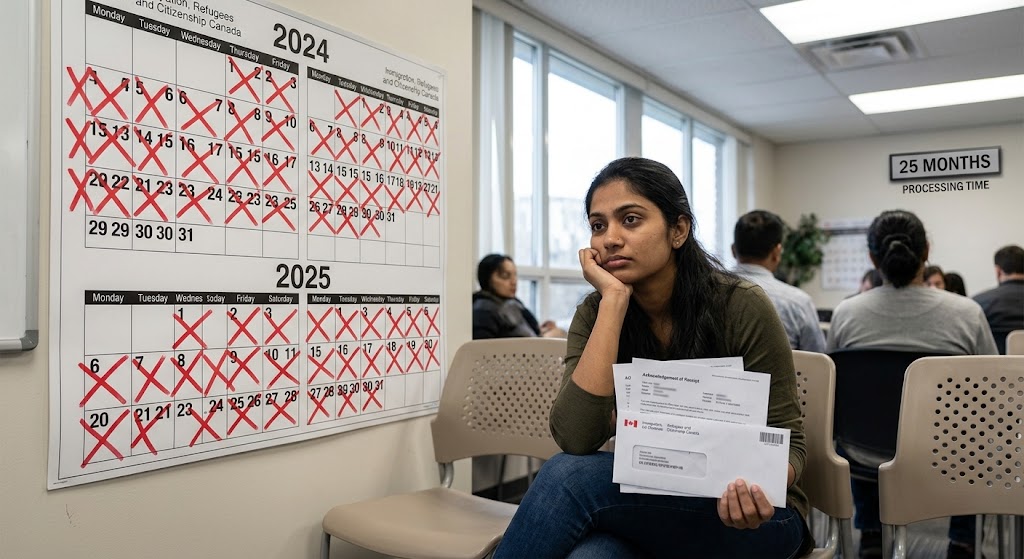
That last line is where people get caught. A citizenship certificate proves your status, not who you are, and it is not a travel document. The most common reason someone suddenly needs one, in our experience, is a lost passport: to get a new passport you have to prove you are a citizen, and if you were born outside Canada you may have no other document that does it. The catch in 2026 is timing. IRCC's own published processing time for a citizenship certificate is about 25 months, so this is not a document you can produce in a hurry. Knowing which document counts, and applying before you need it, is the whole game.
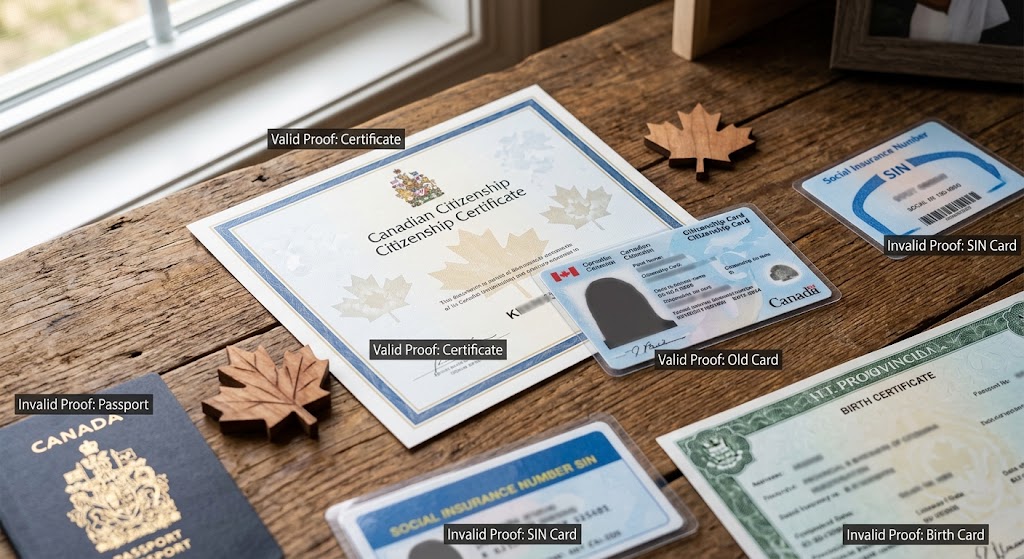
What counts as proof of Canadian citizenship (and what does not)
Only certain documents are valid proof. Many documents that mention your citizenship do not prove it, and submitting the wrong one is a common reason people waste time.
Valid proof of citizenship |
Not valid proof |
Citizenship certificate (electronic or paper) |
Citizenship record letter from a records search |
Older paper citizenship certificates |
Commemorative certificate that came with a citizenship card |
Citizenship card issued before February 2012 (still valid) |
Some birth certificates (diplomatic-parent exception; DND 419 certificates) |
Provincial or territorial birth certificate, with exceptions |
A social insurance number (you use proof to get a SIN, it is not proof) |
Naturalization certificate issued before January 1, 1947 |
A Canadian passport (IRCC does not list it among valid proofs; it is a travel document) |
Registration of birth abroad or certificate of retention (Jan 1, 1947 to Feb 14, 1977) |
A citizenship card commemorative certificate or record letter |
Source: IRCC, Valid proofs of Canadian citizenship and Invalid proofs of Canadian citizenship. Verified August 2026.
Two details from IRCC's guidance save real headaches. A citizenship certificate now comes in an electronic format (an e-certificate, with a certificate number that starts with X) or a paper format (number starts with K); you choose which when you apply. And IRCC stopped issuing the plastic citizenship card in February 2012. Old cards are still valid, but if you want to replace or update one, IRCC sends you a certificate, not another card.
Who needs to apply for proof of Canadian citizenship
You only apply if you are already a citizen and need the document, or you want to confirm that you are a citizen. Your situation decides whether you even need to.
If you were born in Canada, your provincial or territorial birth certificate is usually enough to prove citizenship on its own. You can still apply for a certificate, but for most people born here it is optional.
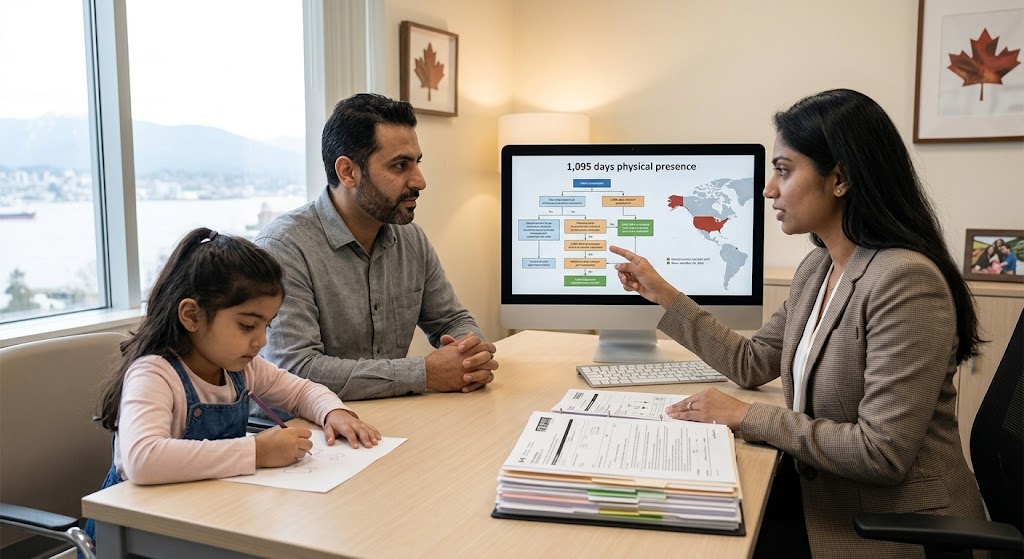
If you were born outside Canada to a Canadian parent, you may be a citizen by descent, but limits apply, and a citizenship certificate is how you prove it. One rule changed recently and matters a great deal: for a child born outside Canada on or after December 15, 2025 to a Canadian parent who was also born outside Canada, IRCC requires proof that the Canadian parent spent at least 1,095 days physically in Canada before the child's birth. This is the first-generation-limit reform (the generation limit you may have read about) taking practical effect, and it changes the documents a by-descent applicant has to assemble. Our guide to Canadian citizenship by descent walks through who is affected.
A few other situations behave differently. If you were born and adopted outside Canada, you are not automatically a citizen and should check the citizenship-by-descent rules for adopted people first. If your child is a permanent resident, you usually need to apply for a grant of citizenship, not just a certificate; families who reached Canada through permanent residence or family sponsorship often sort out a child's proof of citizenship at the same time. And if you become a citizen through naturalization, you receive your certificate at the citizenship ceremony, so there is nothing separate to apply for.
How to apply for a citizenship certificate
You can apply online or on paper. Online is now the default route for most applicants, and IRCC asks a short set of questions to tell you whether your situation is eligible for the online application.
Choose your reason: a first-time certificate, a replacement (lost, stolen, or destroyed), an update (name, date of birth, country of birth, or gender), or both.
Get the application package. The paper form is the Application for a Citizenship Certificate (CIT 0001), which comes with an instruction guide and a document checklist. Provide clear colour copies of your documents; any document not in English or French needs a translation plus a sworn affidavit from the translator (a family member cannot do the translation).
Pay the fee. Proof of citizenship costs $75, paid online. There is no refund once IRCC starts processing.
Submit, and choose the electronic or paper format of your certificate.
One warning from IRCC's own instructions: if you have already applied on paper, do not also apply online for the same request, or IRCC will not process the online one.
Before you start, gather:
Clear colour copies of documents proving your citizenship (or your Canadian parent's, grandparent's, or ancestor's, for a by-descent claim)
Your provincial or territorial birth certificate, if you were born in Canada
A certified translation plus translator's affidavit for any document not in English or French
The $75 fee, paid online
Your choice of electronic or paper certificate
Re-download the form the week you mail it
Here is a trap that is easy to miss. IRCC updated the CIT 0001 form in August 2026 (the official form page now reads Last updated: August 2026). Application forms are swapped in place, sometimes with no news release, and IRCC's guide does not clearly say whether an older version is still accepted or for how long. If you fill out a paper package weeks in advance, download a fresh copy of the form from the official CIT 0001 page right before you mail it, and check that the version matches. This matters most for citizenship-by-descent packages, which are paper-only and often assembled across several family members and countries.
How to replace a lost, stolen, or destroyed proof of Canadian citizenship
If you lost your certificate, card, naturalization certificate, or registration of birth abroad, you replace it by applying for a citizenship certificate, the same application as a first-time request. If it was your Canadian birth certificate that was lost, contact the province or territory that issued it, or apply for a citizenship certificate instead (IRCC will send a certificate, not a birth certificate).
Two practical rules protect the document you get back. Never laminate or re-laminate a proof of citizenship: IRCC says lamination makes the document invalid, because it blurs the security features. Citizenship cards came already laminated, so even if the original lamination peels, do not add more. And keep the document (digital or paper) somewhere secure, because replacing it means the 25-month wait all over again.
How to update a citizenship certificate
If your legal name changed, or your date of birth, country of birth, or gender on the certificate is wrong or has changed, you apply to update the certificate. It uses the same application and the same $75 fee. If IRCC issues a certificate with a mistake that was their error, there is a separate process to correct it, so keep the acknowledgement of receipt (AOR) and your unique client identifier (UCI) that IRCC sends after you apply.
How much it costs and how long it takes
The two numbers people search for most, straight from IRCC's service page:
Item |
Current figure |
Fee (proof of citizenship / citizenship certificate) |
$75 |
Processing time |
About 25 months (longer from outside Canada and the United States) |
Certificate format |
Electronic (e-certificate) or paper, your choice |
Source: IRCC, Apply for a Canadian citizenship certificate: About the process. Verified August 2026.
Twenty-five months is not a typo, and it is the single most important planning fact on this page. If you are refused because IRCC decides you are not a citizen, the fee is not refunded. If you genuinely need proof sooner, IRCC does offer urgent processing in limited situations, so ask about it rather than assuming the standard timeline is the only option.
Not sure a certificate is even the right application for your situation, or whether a by-descent claim will hold up? A short consultation with Ansari Immigration can confirm which document you actually need and what to submit before you commit to the 25-month wait.
From Amir's desk: the real-world trigger, and how to stay ahead of it
In practice, the people who struggle are those who wait until they need the document. If you were born outside Canada and your citizenship rests on a parent, treat the certificate as something to secure early, not the week your passport goes missing. Two habits prevent most of the pain we see: apply for proof before you have a deadline, and never laminate the certificate when it arrives. For clients born in British Columbia, the good news is simpler: a BC birth certificate from the provincial Vital Statistics Agency is usually enough to prove citizenship, so many Vancouver-area families born here do not need a certificate at all until they are helping a relative born abroad.
Common mistakes that delay or void your proof of Canadian citizenship
Submitting the wrong document. A record letter, a commemorative certificate, or a passport does not prove citizenship, no matter how official it looks.
Laminating the certificate. It voids the document. Store it flat and unlaminated.
Applying online after you already applied on paper. IRCC will not process the online application.
Sending an incomplete package. IRCC returns incomplete paper applications with a letter to resubmit, which restarts the wait.
Using an out-of-date form. Re-download CIT 0001 right before you mail it.
Have you been caught by the 25-month wait, or found a document you thought was proof that IRCC did not accept? Tell us in the comments, real timelines and examples help others planning ahead. Keep it general; for advice on your own file, book a consultation.
Frequently asked questions about proof of Canadian citizenship
What is proof of Canadian citizenship?
Proof of Canadian citizenship is a citizenship certificate issued by IRCC. It confirms you are a citizen and is used to apply for a passport, pension, SIN, or job. It is not a travel document and does not prove your identity.
Is a SIN card proof of Canadian citizenship?
No. A social insurance number is something you can apply for using your proof of citizenship, but a SIN or SIN card is not itself proof that you are a Canadian citizen.
How do I get proof of Canadian citizenship?
Apply for a citizenship certificate through IRCC, online or on paper (form CIT 0001), pay the $75 fee, and choose an electronic or paper certificate. If you were born in Canada, your provincial or territorial birth certificate usually already serves as proof.
How long does it take to get proof of Canadian citizenship?
IRCC's published processing time is about 25 months, and longer for applications from outside Canada and the United States. Limited urgent processing may be available if you have a pressing need.
How much does a citizenship certificate cost?
The fee is $75. It is the same fee whether you are applying for the first time, replacing a lost certificate, or updating one, and it is not refunded if IRCC decides you are not a citizen.
Is a Canadian passport proof of citizenship?
IRCC does not list a Canadian passport among valid proofs of citizenship. A passport and a citizenship certificate are different documents, which is exactly why you need the certificate to prove your status when you apply for or renew a passport.
Get your proof of Canadian citizenship right the first time
We often meet people who realized they were Canadian, born abroad to a Canadian parent, only when a lost passport forced the question, and then discovered the proof they needed was almost two years away. The ones who move fastest are the ones who applied with the right documents the first time, so the file was never returned.
Why work with Ansari Immigration: Flat, transparent fees quoted upfront, additional family members quoted separately. Every file is handled personally by the firm's licensed RCIC (regulated by CICC), practicing since 2019, with 6,000+ cases and no juniors or call centers. If your claim is clean, we will tell you so.
Confirm your document and your eligibility before the clock starts, and tell us in the comments if the 25-month timeline changes your plans.
Book a consultation with Ansari Immigration ($80, 30 min)
Related Posts
Canadian Citizenship by Descent: New Legislation and What It Means for You: Who qualifies for citizenship through a Canadian parent and how the first-generation limit changed.
UCI Number in Canada: What It Is and Where to Find It: The unique client identifier that appears on your citizenship certificate and IRCC correspondence.
How Much Does Canadian Citizenship Cost in 2026? Full Fee Breakdown: Every citizenship-related fee, including the proof-of-citizenship certificate.
This article is for general information only. It is not legal advice. Program criteria, requirements, processing times, and selection approaches can change without notice. Always confirm details on official government websites or consult a licensed Regulated Canadian Immigration Consultant (RCIC) for advice specific to your situation.