

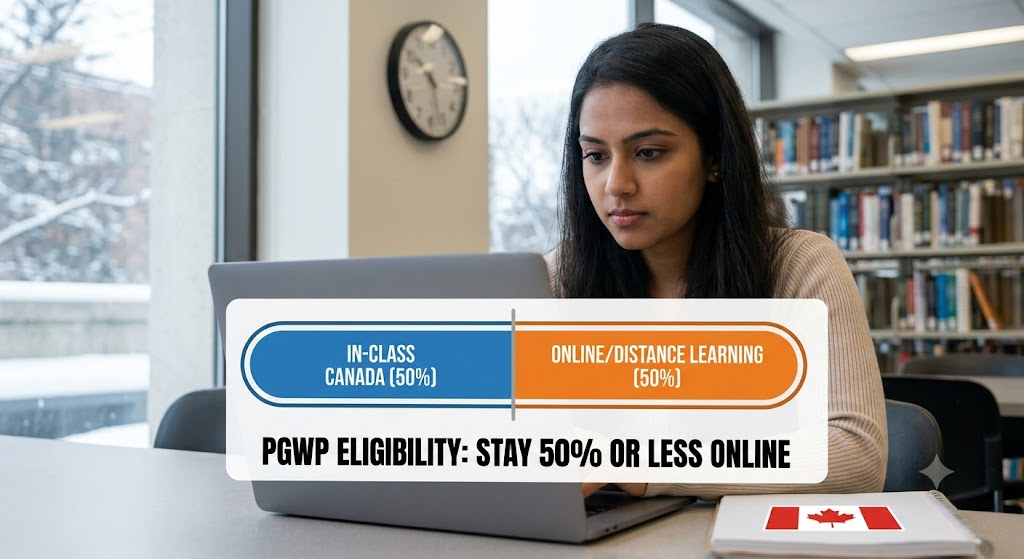
You can get a PGWP if you study online in Canada, as long as no more than 50 percent of your program is distance learning and you meet every other requirement. Study more than half of your program online, or complete too much of it from outside Canada, and your post-graduation work permit is at risk.
Get this wrong and IRCC can refuse the PGWP outright, or issue one shorter than you expected because the time you studied outside Canada was deducted. A refusal here does more than cost you a work permit: without the PGWP you cannot build the Canadian work experience that most graduates need for permanent residence as a former international student. The rules come straight from IRCC's official PGWP eligibility page, and they turn on two things: how much of your program was distance learning, and where you were sitting when you did it.
The 50 percent distance learning rule
The core rule is simple. You are not eligible for a PGWP if you completed over 50 percent of your study program through distance learning, meaning online courses, e-learning, or correspondence. Half or less is fine. Cross the halfway line and the program no longer qualifies, no matter how strong your grades or how long the program was.
This limit applies to distance learning generally. A separate question, and the one that trips students up, is where you were physically located when you studied online.
Can I get a PGWP if I study online in Canada?
Yes, you can take online courses and still qualify, as long as distance learning is 50 percent or less of your program. Online, e-learning, and correspondence courses all count as distance learning whether you take them in Canada or abroad, so the halfway limit is the number that decides it. Stay at or below 50 percent distance learning and the online portion does not disqualify you. Go over it and you are not eligible.
Where you were sitting still matters for a second reason: studying online from outside Canada is treated differently from studying online while you are here, and it depends on your lock-in date.
Studying from outside Canada: how it affects your PGWP length
If part of your program was done online from outside Canada, IRCC applies rules based on your lock-in date. Your lock-in date is the earlier of the date you started your program or the date on your study permit application receipt. The table below shows how each period is treated.
Your lock-in date |
Distance learning rule |
Time studied from outside Canada |
Program began March 2020 to August 31, 2022 (COVID-19 policy) |
Up to 100% online from outside Canada allowed if you met the temporary criteria |
May count toward your PGWP if you met all the criteria |
September 1, 2022 to August 31, 2024 |
At least 50% of the program must be completed within Canada (online or in class) |
Time online from outside Canada before August 31, 2024 counts, as long as it is less than 50% of the program |
On or after September 1, 2024 |
At least 50% of the program must be completed in class within Canada |
Time studied outside Canada is deducted from the length of your PGWP |
Source: IRCC, Post-graduation work permit: Who can apply (canada.ca), page updated June 2026. Program criteria and dates can change without notice, so confirm your lock-in date against your own study permit receipt.
Two kinds of time never count toward the length of your PGWP: time spent studying online from outside Canada after August 31, 2024, and any time you studied before IRCC received your study permit application.
There is one more location wrinkle. If your Canadian program included an official overseas component, you can still be eligible as long as you earned a credit from your Canadian school for it, but the PGWP is valid only for the length of the time you actually studied in Canada. And if it turns out you are not eligible for a PGWP at all, you may still qualify for another type of work permit to stay and work in Canada after you graduate.
The outside-Canada deduction catches a lot of graduates off guard. If the length math surprised you, or you are unsure how your terms are being counted, tell us in the comments, we read every one.
The full-time rule most students miss
From Amir's desk: the distance-learning limit gets all the attention, but it is not the only way students quietly lose a PGWP. To stay eligible, you must have kept full-time student status during each semester of your program. Many international students, for perfectly understandable reasons, drop to a part-time load in one semester, and that single choice can create a real problem at PGWP time.
IRCC does allow two exceptions worth knowing. You may study part-time during your final semester, and scheduled breaks between terms do not count against you. There is also room, in limited cases, for an authorized leave of up to 150 days if your designated learning institution approved it and you can prove it. What you cannot do is quietly carry a light course load through a regular semester and assume it will not matter. If you are thinking about easing your schedule, read the rules first: we cover the trade-offs in our guide on whether students can take a semester off.
If part of your program was online or completed from outside Canada and you are not sure how it affects your PGWP, that is a 30-minute question worth putting to Ansari Immigration's licensed RCIC before you apply ($80).
Book a consultation ($80, 30 min)
Confirm these before you apply for a PGWP
No more than 50% of your program was distance learning (in class within Canada for lock-in dates on or after September 1, 2024)
You held full-time status in every semester (part-time is only allowed in your final semester)
Your program was at least 8 months long at a PGWP-eligible designated learning institution
Your study permit was valid at some point during the 180 days after you completed your program
You apply within 180 days of confirmation that you finished your program
If you submitted your study permit application on or after November 1, 2024 and did not graduate with a bachelor's, master's, or doctoral degree, your program is in an eligible field of study (degree graduates are exempt from this requirement)
Two of these details, the distance-learning share and the full-time status, are the ones most likely to surprise a graduate at the finish line. This is also where the difference shows between a general read of PGWP eligibility and a look at your actual transcript and study permit dates.

Frequently asked questions about studying online and the PGWP
Can I get a PGWP if I study online in Canada?
Yes, if distance learning is 50 percent or less of your program. Online, e-learning, and correspondence courses count as distance learning wherever you take them, so as long as you stay at or below the halfway mark and meet all other requirements, studying some courses online does not disqualify you.
Can I get a PGWP if I studied online during COVID-19?
You may qualify under a temporary policy that allowed up to 100 percent online study from outside Canada if your program began between March 2020 and August 31, 2022 and you met the specific criteria. That time may count toward your PGWP. The policy changed as of September 1, 2022.
How much of my program can be online?
Up to 50 percent. Complete over half of your study program through distance learning and you are not eligible for a PGWP, unless the COVID-19 online-from-outside-Canada exception applies to you.
Does time studying from outside Canada count toward my PGWP?
It depends on your lock-in date. For lock-in dates on or after September 1, 2024, time studied outside Canada is deducted from the length of your PGWP. Time studied online from outside Canada after August 31, 2024 does not count at all.
Does a program with an overseas component qualify?
It can. If your Canadian program has an official overseas component and you earn a credit from your Canadian school for it, you may still be eligible, but the PGWP will only be valid for the length of time you studied in Canada.
Can I still get a PGWP if I went part-time for one semester?
Possibly not. You must keep full-time status during each semester, with exceptions only for your final semester and for an authorized leave. An unplanned part-time semester can put your PGWP eligibility at risk, so confirm your status before you apply.
Related Posts
PGWP Canada 2026: Complete Guide to Eligibility, Length, and Application: The full walkthrough of who qualifies for a post-graduation work permit, how long it lasts, and how to apply.
What Is a Designated Learning Institution (DLI) in Canada?: Why studying at a PGWP-eligible DLI matters and how to confirm your school is on the list.
PGWP Processing Time Canada 2026: How Long After Graduation?: What to expect on timing once you submit your post-graduation work permit application.
Why work with Ansari Immigration
Three signs your PGWP eligibility is worth a professional read: more than a handful of your courses were online, you completed part of the program from outside Canada, or you dropped below full-time in any semester. A clean PGWP most graduates file themselves, and if yours is straightforward Ansari Immigration will tell you so rather than sell you. Where the flat $750 fee for an open work permit like the PGWP earns its place, quoted upfront with additional family members quoted separately, is the borderline case. Every file is handled personally by the firm's licensed RCIC. Book a 30-minute consultation ($80).
Did studying online or from abroad change your PGWP length? Share what happened in the comments, real numbers help other graduates, and keep it general, for advice on your specific case use a consultation.
This article is for general information only. It is not legal advice. Program criteria, requirements, processing times, and selection approaches can change without notice. Always confirm details on official government websites or consult a licensed Regulated Canadian Immigration Consultant (RCIC) for advice specific to your situation.