


By Amir Ansari, RCIC, Ansari Immigration, Vancouver. RCIC R709304, regulated by CICC.
If a document is not in English or French, IRCC needs the translation and the original, or a certified copy of it. Its officer instruction accepts a certified translator's stamp and asks for a sworn affidavit only when a certified translation is impossible. In the returned files Ansari Immigration reviews, the defect is almost never the translation itself.

The stakes are simple and expensive. IRCC's own instruction says that applicants who send required documents without translations "will have their application returned as incomplete." A returned application is not a refusal you can argue with. It is a file that was never opened, sent back to the start of the queue, after you have already paid, waited, and in Express Entry, burned part of a 60 day window. One missing translator stamp can cost months.
IRCC translation requirements: what the official pages actually say
The rule starts in the regulations, not on a web page. Section 10(1)(c) of the Immigration and Refugee Protection Regulations says an application must "include all information and documents required by these Regulations, as well as any other evidence required by the Act." That is the provision an incomplete file is returned under. The translation standard itself is not written into section 10. It lives in IRCC's instructions and document checklists, which is exactly why it is stated in more than one place, and not always the same way.
The clearest version is the officer guidance, IRCC's instruction on translation of supporting documents, published on the department's website "as a courtesy to stakeholders." It sets out three parts. A document in another language must come with a translation of the original or of a certified copy of the original. That translation must be certified by a certified translator, or, where a certified translator cannot provide it, be accompanied by an affidavit. Both must be included with the application.
Here is where it gets awkward. Four live IRCC pages state this rule, and the wording does not match. On two points the difference changes what you would send.
The four official statements, side by side
Official IRCC page |
Date on the page |
What it says you must send |
Officer instruction, translation of supporting documents |
Issued January 10, 2025 |
Translation of the original or of a certified copy, certified by a certified translator, or an affidavit if a certified translator cannot do it |
Help Centre: what language should my supporting documents be in |
November 3, 2026 |
The translation, and an affidavit from the person who translated, and a certified photocopy of the original |
Help Centre glossary: certified English or French translations |
August 5, 2026 |
A translator "certified in Canada", or a translator who is not you, your family or your representative plus an affidavit and a certified photocopy. The same page's separate entry for "certified translator" says "in Canada or abroad" |
Apply for permanent residence through Express Entry |
November 18, 2026 |
Translation stamped by a certified translator, or an affidavit "only if a translation cannot be completed by a certified translator", plus a scan of the original |
Source: the four IRCC pages linked in this guide, each read on November 25, 2026. Verified November 2026.
Read the second row closely. It is the odd one out. The Help Centre answer on document language makes the affidavit sound mandatory in every case and never mentions a certified translator at all. The officer instruction, the glossary and the Express Entry application page all treat the affidavit as a fallback for when a certified translator cannot do the work.
If you are applying through Express Entry, the practical answer is the Express Entry version, because that is the page attached to the checklist your documents are judged against. For other programs, use the checklist attached to your own application. But if you are reading the Help Centre answer and paying a notary for an affidavit you do not need, nobody at IRCC is going to stop you.
The two tracks: police certificates are not treated like your other documents
This is the part the comparison above hides. IRCC's published pages do not treat a police certificate the way they treat your marriage certificate.
For a police certificate, the IRCC Help Centre answer on police certificate translations (November 3, 2026) is blunt: "you must send a translation from a certified translator with your application. We don't accept translations by family members." No affidavit alternative is offered.
For everything else, the affidavit route exists.
That is the public page. IRCC's own internal material is less absolute: its current rejection wording for a missing police certificate translation still offers the affidavit alternative, so the published Help Centre answer is stricter than the instruction behind it.
The internal material also dates the split. In the 2025 release of IRCC's Express Entry intake manual, obtained under the Access to Information Act, the mandatory documents appendix carries two headings on one page, "For PCs" and "For all other Documents". The police heading asks for a copy of the original plus a translation by a certified translator. The all other documents heading carries the three part form: the translation, an affidavit from the translator, and a certified photocopy. That appendix is marked "Information obtained December 19 2017".
In the more recent release, the same appendix is marked "Information obtained March 11, 2026" and the two heading split is gone. One rule now covers all supporting documents, in the certified translator or affidavit wording the Express Entry page uses. The Help Centre answer on document language still carries the shape of the older version.
So part of the divergence is a real difference between document types, and part of it is a page that has not kept up.

Who is not allowed to translate your documents
This list is short, specific, and the single most common thing people get wrong. The officer instruction says translations must not be done by:
the applicants themselves
members of the applicant's family
the applicant's representatives or consultants
"Family" is then defined, and it is wider than people expect: parent, guardian, sibling, spouse, common-law partner, conjugal partner, grandparent, child, aunt, uncle, niece, nephew and first cousin. The instruction adds that a family member who happens to be a lawyer, notary or translator is still not permitted to translate. The same bar applies to who may swear the affidavit.
Note the third bullet. Your own immigration representative cannot translate your documents, and neither can your consultant. If your representative's office offers to "handle the translation in house", that is a question worth asking directly before the file goes in. The IRCC glossary states the same limit in its own words: a translator "who is not you, your family member or your representative or consultant."
One more trap in the same paragraph: a translator who has applied for certification but has not received it yet "is not considered a certified translator for IRCC's purposes." Nearly certified is not certified.
Certified translator or affidavit: which one you actually need
A certified translator, in IRCC's definition, is "a member in good standing whose certification can be confirmed by a seal or stamp that shows the translator's membership number of a professional translation association in Canada or abroad." The test is membership in a professional association, not a roster that IRCC maintains. That matters, because "ircc certified translator list" is searched about 110 times a month in Canada (Semrush, Canada database, November 2026) and the pages read for this article point to the association membership test rather than to any IRCC approved list. If you find a site offering an "IRCC approved translator" badge, ask which association issued the number on the stamp. In Metro Vancouver this is usually a matter of asking for the stamp before you pay, not after.
If a certified translator genuinely cannot do it, the affidavit route opens. An affidavit for a translation is the translator swearing, in front of a commissioner authorized to administer oaths where they live, that the translation is accurate. The officer instruction adds a detail the Help Centre definition of a translation affidavit leaves out: the commissioner or notary public must be proficient in English or French in order to administer the oath. In Canada, the affidavit can be taken by a notary public, a commissioner of oaths, or a commissioner of taking affidavits. Outside Canada, a notary public or the local equivalent.
The Express Entry page offers one small, genuinely useful piece of housekeeping that appears on none of the other pages read here: "You can include a scanned copy of a letter explaining that you don't need an affidavit because you used a certified translator." If you have ever wondered how to answer a checklist that seems to demand an affidavit you do not need, that is the answer.
What makes a translation fail the completeness check
The public pages tell you what to send. They say much less about how the package is checked. IRCC's internal intake instructions, obtained under the Access to Information Act, are specific about the failures, and some of them appear on no public page read for this article.
The first is relay translation. The instruction tells officers:
There is a standard rejection letter insert for exactly this. The sentence is written about "documents" generally, but in the released material it appears in the police certificate section and the matching rejection letter is police certificate worded, so treat it as firmly established for police certificates and as a sensible rule everywhere else. If your document is in a less common language and your translator worked from an existing English or Russian or Arabic version, you may have a problem nobody has told you about.
The second is linking, and it is written for police certificates. Officers are told that most police certificates carry items that need no translation, a unique number, the client's name, the date of birth, and to use those to link the original certificate to its translation. If they cannot, "the document is not acceptable and the file is considered incomplete." There is a public cousin of this rule: both the Express Entry page and the glossary require the source document and the translation to be stamped by the translator or referred to in the affidavit. A clean looking translation on its own letterhead, with nothing tying it to the page behind it, is a risk on any document and a stated problem on a police certificate.
The third is stamps. On police certificates specifically, a certificate stamped "Copy", "Certified Copy" or "Certified True Copy" is rejected, with an exception for certificates issued online. A translator's own stamp on the certificate is fine, as long as the stamp does not say copy. The instruction is explicit that this rule applies only to police certificates.
And when IRCC writes to ask for original documents, its own request letter says plainly: "We do not accept copies signed by notaries." A notarized copy is not a substitute for the original when the original is what was asked for.
These are officer instructions rather than published law, and they describe practice at the date of the documents, not current regulation. Where they differ from a current official page, the official page governs. But as a checklist of what actually gets a file sent back, they are the best record available.
The traps worth checking before you upload
Every document not in English or French has a translation attached, not just the ones you thought mattered
The translation was made directly from the original language, with no intermediate language in between
Police certificates: a unique number, name or date of birth appears on both the original and the translation so the two can be matched
Stamps and seals that are not in English or French have been translated too, including the notary's
The translator is not you, not a relative, and not your representative
Where a certified copy was used, the translator stamped both the certified copy and the translation
Police certificates are scans of the original, with no "copy" stamp on them
Does an IRCC translation expire?
No, and this is worth money. The officer instruction is unusually clear:
As long as the translator's certification was valid when they signed, the translation stays valid. The only trigger for a new translation is a change to the underlying document: your birth certificate was reissued, your police certificate expired, your marriage certificate was replaced. Nothing on the applicant facing pages says this, which is one reason people pay twice for the same translation when they move from a study permit to a work permit to permanent residence.
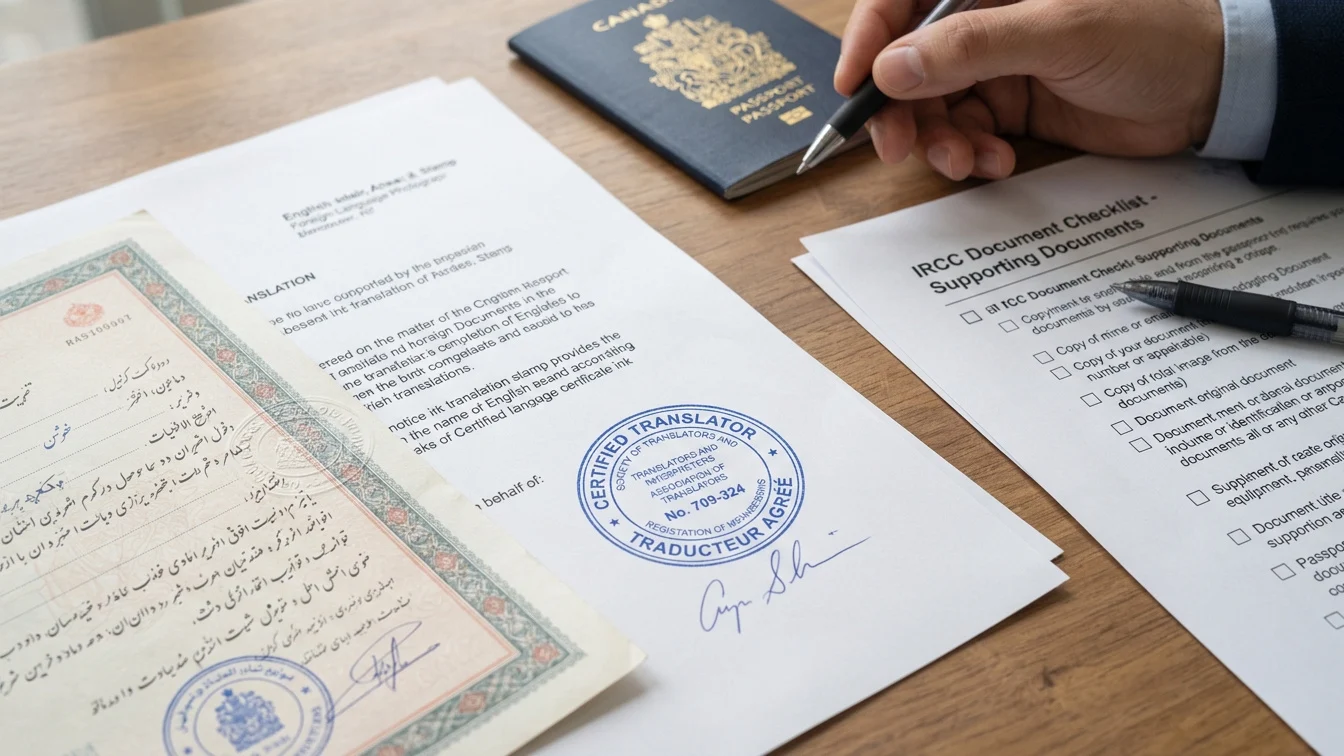
A worked example: one marriage certificate, two outcomes
This is an illustrative scenario built only from the rules and rejection wording verified above, not a real client file.
Two people apply through Express Entry on the same week in January 2026. Both are married, both hold a marriage certificate in Farsi, and both have 60 days from their invitation.
The first uploads a clean English translation from a translation shop, and nothing else. The package is checked against the document list. IRCC's standard rejection wording for this exact situation reads: the marriage certificate provided was the translated version only, and the original version was not provided. The file is returned as incomplete. The fees come back. The invitation does not. The pool is re entered and the wait starts again.
The second uploads three things: a scan of the Farsi original, the English translation stamped by a certified translator whose association membership number is on the stamp, and a short letter noting that no affidavit is included because a certified translator was used. The certificate number is visible on both pages. Total extra effort: one scan and three sentences. The file is complete.
The difference between those two outcomes is not translation quality. It is assembly.
Where IRCC's own pages disagree, and what that means for you
Three honest observations from reading these pages on the same day.
First, only one of the four is genuinely out of step. The Help Centre answer on document language, date modified November 3, 2026, omits the certified translator route altogether and reads as though an affidavit is required every time. The officer instruction, the glossary and the Express Entry page all treat the affidavit as the fallback. Nobody reading only that one page would know the other three exist.
Second, the glossary disagrees with itself. Its entry for "certified English or French translations" says a translator "certified in Canada". Its own entry for "certified translator", further down the same page, says "a member in good standing of a professional translation association in Canada or abroad", which is exactly what the officer instruction and the Express Entry page both say. So the narrower wording is an inconsistency inside one page rather than a settled IRCC position. If you are applying from outside Canada and you read only the first entry, you could conclude you need a Canadian translator. Three other official statements, including one on the same page, say otherwise.
Third, a small thing that tells you something about the date stamps themselves. The officer instruction page carries an "issued" date of January 10, 2025 and prints a "date modified" of January 10, 2027, a date that has not yet happened. We mention it only because it means the date on that page is not a reliable signal of when the guidance was last reviewed. As of November 2026, IRCC's published guidance does not reconcile these four statements of the translation rule. Confirm the wording on the page attached to your own document checklist before you rely on any single version, and keep what you sent.
What follows: send the strongest package that satisfies every version at once. Original or certified copy, plus a certified translator's stamp, plus the explanatory letter. That package passes the Help Centre reading, the glossary reading, the Express Entry reading and the officer instruction, and it costs you one extra page.
If you have been through a document return over a translation, what tripped it, the missing original or the translator? Add it in the comments, keeping it general, because the pattern is more useful to the next reader than any guidance page.
How this plays out in the applications we see most
Translations cut across every application type, so the practical advice changes with the program. For Express Entry, the squeeze is the 60 day window after an invitation: a translation problem discovered on day 50 is very hard to fix, which is why the Express Entry document checklist is worth reading before the invitation arrives, not after. For family sponsorship, the volume of civil documents is the issue: marriage, birth, divorce and death certificates, each with its own original. Relationship evidence has its own quirks, which is why we wrote separately about translating a WhatsApp chat for IRCC.
Two more places translation trips people up. Police certificates are the strictest document in the file, as set out above. And name spellings on a translated certificate often do not match the passport, which is a different problem with its own rules, covered in our guide to given name versus legal name on immigration forms.

If one row of the table above made you unsure which version applies to your document, that is a thirty minute question rather than a thirty day one: Ansari Immigration's licensed RCIC will tell you which track your document is on.
Check your document package ($80, 30 min, credited to your fee)
Frequently asked questions about IRCC translation requirements
Does IRCC accept a translation by a family member?
No, IRCC does not accept a translation done by a family member, and the bar covers a parent, guardian, sibling, spouse, common-law partner, conjugal partner, grandparent, child, aunt, uncle, niece, nephew or first cousin. A relative who is a professional translator, lawyer or notary is still excluded, and the same bar applies to swearing the affidavit.
How do I find a translator for Canadian immigration?
IRCC defines a certified translator as a member in good standing of a professional translation association in Canada or abroad whose membership number appears on their seal or stamp, so the practical step is to confirm that association membership number before you pay rather than looking for an IRCC approved list. Inside Canada, that means a translator certified by the provincial or territorial association; outside Canada, a translator accredited in the country where the work is done.
Does a certified translation need to be notarized for IRCC?
A certified translation does not need to be notarized when a certified translator stamped it, because the notarized affidavit is the alternative route for when a certified translator cannot do the work. The Express Entry page even suggests including a short letter saying no affidavit is attached because a certified translator was used.
Do IRCC translations expire?
IRCC translations do not expire: the officer instruction says a translation should be valid indefinitely unless the original document itself has changed or expired, and an expired translator or notary signature does not invalidate a translation that was validly signed. A new translation is needed only when the underlying document is reissued, replaced or has expired.
What happens if I forget to translate a document?
If a required document is submitted without its translation, IRCC's instruction says the application will be returned as incomplete, which means it is sent back unprocessed rather than refused, and you have to translate the document and resubmit the whole application. For Express Entry that usually means losing the invitation and returning to the pool.
Do I need to translate stamps and seals on a document?
Yes, every stamp and seal that is not in English or French has to be translated as well, including a notary's seal and the translator's own stamp if it is in another language. This is one of the most commonly missed items, because people translate the body of the certificate and leave the markings around it untouched.
Does IRCC need the original document or is the translation enough?
IRCC needs both: the translation plus a scan of the original document, or a scan of the certified photocopy that the translator actually worked from. A translation submitted on its own is one of IRCC's standard reasons for returning a file as incomplete, and it applies to marriage certificates, birth certificates and police certificates alike.
Why work with Ansari Immigration
Doing it alone: you read one IRCC page, assemble the translations it describes, and find out which version of the rule applied when the package comes back.
With Ansari Immigration: flat, transparent fees quoted upfront, a document package built against the checklist your file is actually judged on, and the firm's licensed RCIC regulated by CICC, who teaches immigration law at three institutions, handling every form and IRCC follow up personally.
Which part of the translation rule caught you out, the original, the affidavit or the stamps? Tell us below, and keep it general. For advice on your own documents, a consultation is the place for that.
Book a document review ($80, 30 min, credited to your fee)
Related Posts
Express Entry Document Checklist (2026): Every Document You Need for Your e-APR: The full list of what an e-APR has to contain, and the order to gather it in.
How to Get a Police Clearance Certificate in Canada: What IRCC Actually Requires (2026): The strictest document in your file, including the stamp rules that get certificates rejected.
How to Translate Your WhatsApp Chat for IRCC Canada: What to do with chat logs and other relationship evidence that is not in English or French.
This article is for general information only. It is not legal advice. Program criteria, requirements, processing times, and selection approaches can change without notice. Always confirm details on official government websites or consult a licensed Regulated Canadian Immigration Consultant (RCIC) for advice specific to your situation.