


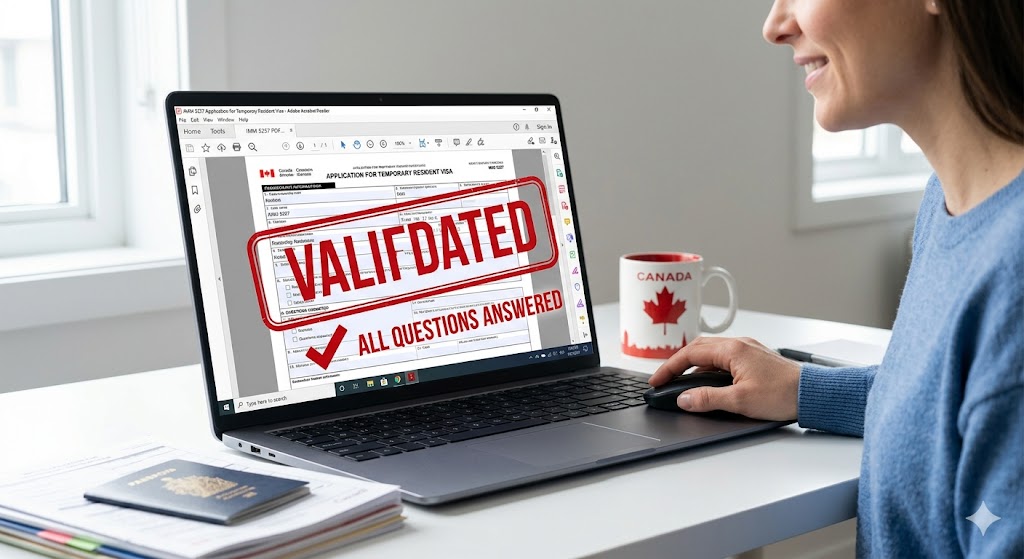
IMM 5257 is the official Canada visitor visa application form, also called the Application for a Temporary Resident Visa. You complete it to ask a visa office for a visitor visa (TRV) to enter Canada. Each person who needs a visa fills out their own IMM 5257, and every question must be answered or the application can be returned as incomplete.
That last point is where most problems start. As an RCIC who files these applications, the single most common reason an IMM 5257 comes back is a blank field the applicant thought did not apply to them. This guide walks through who needs the form, how to fill it out, and how to submit it without slowing down your file.
When you need the IMM 5257 form (and when you don't)
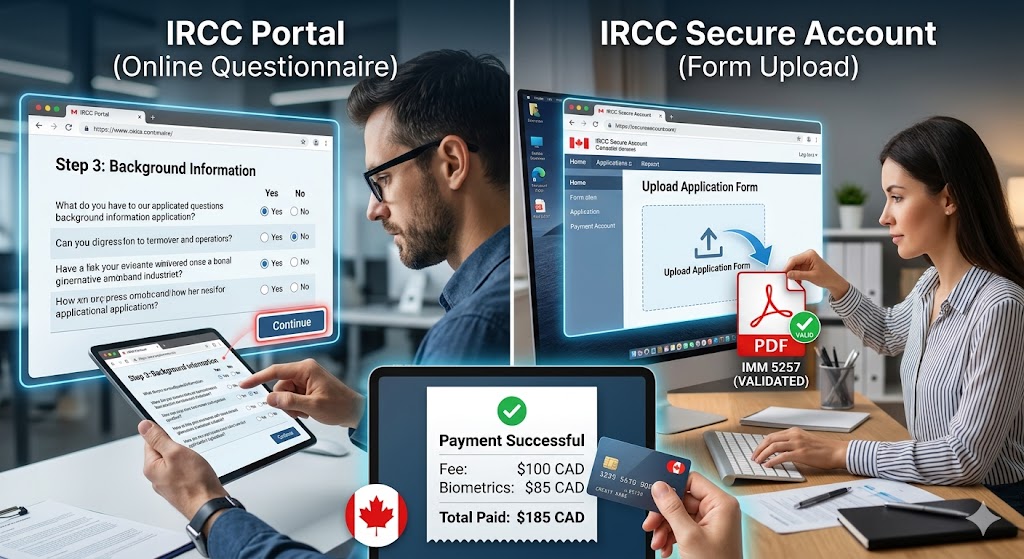
Whether you need to download IMM 5257 at all depends on how you apply. IRCC now runs two different streams:
If you apply through the IRCC Portal, you do not use the IMM 5257 PDF. You answer the questions directly in the online questionnaire, and the Portal builds your application for you.
If you apply through the IRCC secure account or on paper, you do download and complete the IMM 5257 form and upload or mail it.
This trips up a lot of applicants who search for "imm 5257 form" after starting in the Portal and cannot find where to attach it. If your application path never asked you to upload a form, you are likely in the Portal and do not need the PDF.
The current IMM 5257 is the September 2023 version, and IRCC’s form page was last updated February 24, 2026. Always download a fresh copy from the official IRCC application forms page rather than reusing an old file, because an outdated form can be rejected.
How to download, open, and sign the IMM 5257 form
The IMM 5257 is a dynamic PDF, and it will not open properly in a browser preview or on a phone.
Use a computer, not a tablet or mobile phone.
Save the form to your computer first. If clicking the link only previews it, right-click and choose "Save as."
Open the saved file in Adobe Acrobat Reader, version 10 or higher.
If you see a message that the form cannot be displayed, it almost always means it opened in a browser instead of Acrobat Reader. Download Adobe Acrobat Reader, then open the saved file from inside that program.
IRCC’s dynamic PDF forms are completed and validated electronically rather than signed by hand for online submission. When you finish, follow the validation or signing instructions printed at the end of the form itself. If you are mailing a paper application, sign by hand where the form indicates.
How to fill out the IMM 5257 form, section by section
The IMM 5257 form asks you to answer every question unless it tells you otherwise. Here is what each main section covers and where applicants most often go wrong.
Personal details. Enter your name exactly as it appears on your passport, even if it looks misspelled, and do not use initials. If your passport has no given name, leave that field blank rather than typing "NA" or an asterisk. Name mismatches between the form and the passport are a frequent cause of delays.
UCI. If you have dealt with IRCC before, enter your Unique Client Identifier; if this is your first application, leave it blank. You can read more about where to find your UCI number if you are unsure.
Type of visa. Choose "Visitor visa" for a normal visit, or "Transit Visa" only if you are passing through Canada for less than 48 hours on the way to another country.
Residence and immigration status. Declare your current country of residence and status. If you are not a citizen of the country you are applying from, you must include proof of your legal status there.
Details of your visit. State your purpose (tourism, business, family visit, super visa, and similar), your planned dates, and the funds in Canadian dollars available for the trip.
Background information. This is the section officers read most carefully. You must answer every question about prior refusals, overstays, criminality, and military service. Answering "Yes" does not automatically mean refusal, but leaving any of these blank means the application is treated as incomplete and returned.
If you are unsure how to present a past refusal, an overstay, or a complex travel history on your IMM 5257, speak with Amir Ansari, RCIC before you submit. A short consultation to frame these answers correctly is far cheaper than a refusal that sits on your record. You can reserve a consultation time directly.
Other forms you may need with your IMM 5257
The IMM 5257 is rarely the only document in a visitor visa application. Depending on your situation, your document checklist may also ask for:
A Family Information (IMM 5645) form, which lists your family members.
A Statutory Declaration of Common-Law Union (IMM 5409), if you are in a common-law relationship.
A Use of a Representative (IMM 5476) form, if a consultant or other representative is acting for you. If someone is helping you file, the Use of a Representative (IMM 5476) form is what authorizes them.
Some applicants also search for an "IMM 5257 Schedule 1." As of June 2026, IRCC’s official IMM 5257 and visitor visa pages do not list a separate Schedule 1 for this form; the background and declaration questions are built into the IMM 5257 itself. Your personalized document checklist in the IRCC Portal or secure account is what tells you if any additional form is required, so rely on that and the official IRCC application forms page.
Fees and how to submit your application
For a visitor visa, the IRCC fee list (last updated April 30, 2026) shows a processing fee of 100 Canadian dollars per person, with a maximum of 500 dollars for a family of five or more applying together. If you need to give biometrics, the biometrics fee is 85 dollars per person, up to a maximum of 170 dollars per family. You pay these fees at the end of your online application, and first-time applicants generally pay the biometrics fee when they submit.
Most visitor visa applicants must apply online. Paper applications are limited to people who cannot apply online, including for reasons of disability, or who travel on a refugee or stateless travel document. One practical note: if your spouse or partner has sponsored you for permanent residence and you have an acknowledgement of receipt, your visitor visa may automatically receive faster processing. This is a useful bridge while a family sponsorship application is in progress.
Why getting the IMM 5257 right matters for your application
A visitor visa is a discretionary decision. The officer is deciding whether they believe you will leave Canada at the end of your authorized stay, and the IMM 5257 is the main place you make that case. When teaching this to students, the distinction I stress is between a "complete" form and a "convincing" one: a complete form passes the intake check, but a convincing application also lines up your stated funds, ties, and travel history so the officer is not left guessing. Thin or inconsistent answers on the visit and employment sections are what lead to refusals, not a single wrong box.
If you are visiting from outside Canada, strong supporting documents around your reason to return home matter as much as the form itself. Our guide on how to show ties to your home country explains what officers actually look for.
Amir Ansari, RCIC, regularly reviews visitor visa packages before clients submit them. If you want a second set of eyes on your IMM 5257 and supporting documents, or you are applying after a previous refusal, book a consultation and we will go through your file together.
Frequently asked questions about IMM 5257
What is IMM 5257?
IMM 5257 is the Application for a Temporary Resident Visa, the official Canada visitor visa form. Each person applying for a visitor visa or transit visa completes their own copy when applying through the IRCC secure account or on paper.
How to fill out IMM 5257 form?
Download it to a computer, open it in Adobe Acrobat Reader version 10 or higher, and answer every question. Enter your name exactly as shown on your passport, complete all background questions, and validate the form when finished.
How to submit IMM 5257 online?
If you apply through the IRCC secure account, upload the validated IMM 5257 PDF with your other documents and pay your fees online. If you apply through the IRCC Portal, you will not upload IMM 5257 at all, because you answer the same questions directly in the Portal.
How to sign IMM 5257?
Follow the validation or signing instructions printed at the end of the IMM 5257 form itself. IRCC’s dynamic PDF forms are validated electronically for online submission; for a paper application, sign by hand where the form indicates.
Is IMM 5257 mandatory for a student visa?
No. IMM 5257 is only for visitor visas and transit visas. A study permit has its own separate application form, so a student should not use IMM 5257 to apply to study in Canada.
What is IMM 5257 Schedule 1?
As of June 2026, IRCC’s official IMM 5257 and visitor visa pages do not list a separate "Schedule 1" for this form. The background and declaration questions are contained within the IMM 5257 itself. If an older guide or third-party tool refers to a Schedule 1, confirm what currently applies to you on the official IRCC application forms page and follow your personalized document checklist.
Related Posts
UCI Number Canada: What It Is and Where to Find It: Where to find the Unique Client Identifier you may need to enter on the IMM 5257.
IMM 5476: What It Is, Who Needs It, and How to Fill It Out: The Use of a Representative form you include when a consultant files on your behalf.
How to Show Ties to Your Home Country for Temporary Resident Visas in Canada: What officers look for to be satisfied you will leave Canada at the end of your visit.
This article is for general information only. It is not legal advice. Program criteria, requirements, processing times, and selection approaches can change without notice. Always confirm details on official government websites or consult a licensed Regulated Canadian Immigration Consultant (RCIC) for advice specific to your situation.