


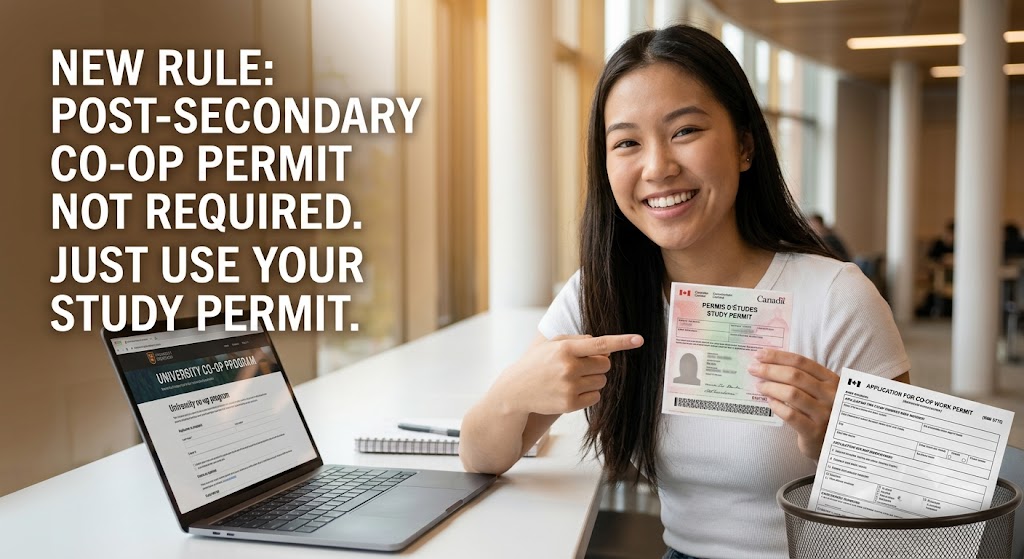
The co-op work permit Canada rules changed on April 1, 2026, and the change is big: as a post-secondary international student, you no longer need a co-op work permit to do a required co-op, internship, or practicum. Secondary (high school) students still need one, and anyone who already holds a co-op work permit can keep using it until it expires.
Getting this wrong cuts both ways. Start a required placement without the right authorization on your study permit and you risk working without status, which can follow you into a future study permit extension or PR application. Spend three months chasing a permit you no longer need and you delay your own placement for nothing. The current rules are set out on IRCC's official student work placement page, which is the source for everything below.
Co-op work permit Canada rules: what changed on April 1, 2026
As of April 1, 2026, post-secondary international students do not need a separate co-op work permit for student work placements such as co-ops or internships. IRCC now treats these placements as part of your studies, so your study permit conditions do the work the co-op permit used to do.
If you already hold a co-op work permit, you can keep using it for its full validity. You do not have to withdraw it.
If you applied for a post-secondary co-op work permit but no longer need one, you can withdraw the application, or IRCC may withdraw it and send you a letter confirming you do not need it.
Who still needs a co-op work permit in Canada
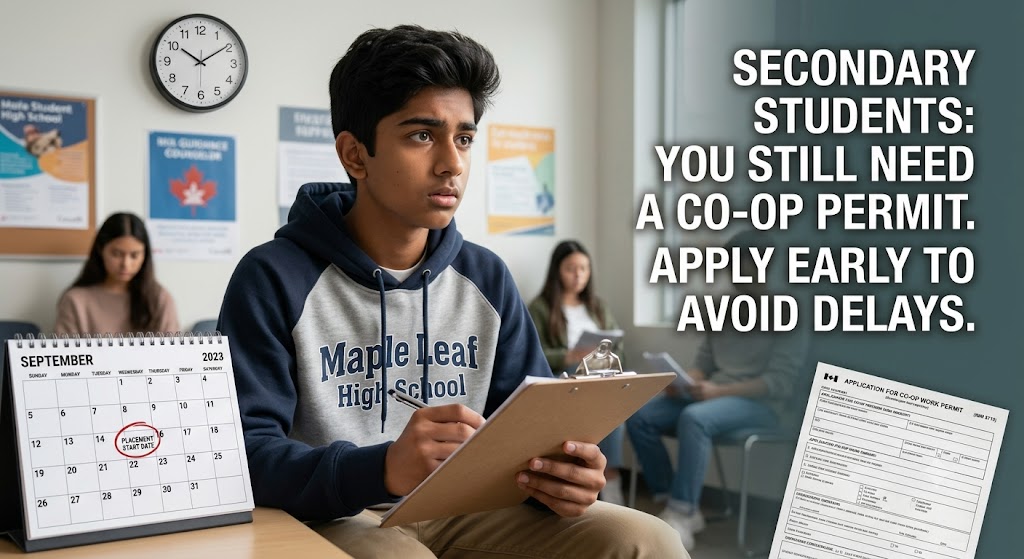
Secondary school (high school) international students still need a co-op work permit to take part in a student work placement. You can apply if you have a valid study permit, your program requires the work to complete it, you have a letter from your designated learning institution confirming all students in the program must do work placements, and the placement is 50% or less of your program. There is no fee to apply.
From Amir's desk: for the students who still need this permit, the number one mistake I see is applying late. Processing is not instant, and without the permit a student cannot start the co-op component, which stalls their whole program. My advice is simple: apply as soon as you arrive in Canada, well before the placement term. Because processing times change, confirm the current wait on IRCC's official processing times tool before you plan around a date.
Did the April 2026 change land in the middle of your program? Tell us in the comments how your school handled it, real experiences help other students reading this.
What post-secondary students need instead
Not needing a permit does not mean anything goes. To work in a required placement as a post-secondary student, you need a valid study permit (or an extension applied for before it expired), full-time enrolment at a DLI, a DLI letter confirming the work is required, and the placement must be 50% or less of your program. Your study permit must also carry a condition allowing you to work; if it does not, you can ask IRCC to add it at no cost.
You may also need a social insurance number to be paid, and a medical exam if your placement is in a hospital or similar setting. You are not eligible for a student work placement at all if you are taking English or French as a second language, general interest courses, or courses to prepare for another program.
Not sure whether your study permit already lets you work a required placement, or whether you land in the group that still needs a permit? That is a 30-minute question for Ansari Immigration's licensed RCIC ($80): check your situation.
Who needs a co-op work permit now, at a glance
Post-secondary student doing a required co-op or internship: no longer need one, as of April 1, 2026.
Secondary (high school) student doing a required placement: yes, you still need a co-op work permit.
Already hold a co-op work permit: no new permit needed, keep using the one you have until it expires.
Taking ESL or FSL, general interest, or prep courses only: not eligible for a student work placement.
Source: IRCC, Work in a student work placement. Verified August 2026.
Frequently asked questions about the co-op work permit Canada
How do I apply for a co-op work permit in Canada?
If you are a secondary school student who still needs one, you apply online through your IRCC account in most cases, after reading the co-op guide (Guide 5580). Post-secondary students no longer apply for a separate permit as of April 1, 2026.
Can I get a co-op work permit from Service Canada?
No. The co-op work permit is issued by Immigration, Refugees and Citizenship Canada (IRCC), not Service Canada. Service Canada handles your social insurance number, which you may still need to be paid for a placement.
How much does a co-op work permit cost?
There is no fee. IRCC does not charge for a co-op work permit. If you are told you must pay a government fee for the permit itself, treat that as a warning sign.
How do I extend a co-op work permit in Canada?
Existing co-op work permit holders can use their permit until it expires. If your studies continue past that date and you are still a post-secondary student, you generally rely on your study permit conditions instead of renewing the co-op permit, since post-secondary students no longer need one.
Can I start my co-op before the permit or paperwork is sorted out?
Do not begin a required placement in Canada until you have the right authorization. Post-secondary students must meet the study permit conditions above first; secondary students must have their co-op work permit in hand.
Related Posts
How Many Hours Can International Students Work in Canada? (2026 Rules): The current limits on working while you study, and how placement hours fit in.
PGWP Canada 2026: New Changes to the Post-Graduation Work Permit: What your work options look like after you finish your program.
Canada PR Eligibility for International Students: How the study permit to permanent residence path actually works.
Why work with Ansari Immigration: Study permit representation is a flat $500 for an application made inside Canada, $1,500 from outside Canada, with additional family members quoted separately, all quoted upfront. Every file is handled personally by the firm's licensed RCIC, regulated by CICC, who teaches immigration law at three colleges and trains other consultants, so a student walking the study permit to PGWP to PR path talks to the same person the whole way.
Confused about whether the new co-op rule applies to your program? Ask in the comments, we read every one (keep it general; for advice on your own file, a consultation is the place). Or get a straight answer now and book a $80, 30-minute consultation with Ansari Immigration.
This article is for general information only. It is not legal advice. Program criteria, requirements, processing times, and selection approaches can change without notice. Always confirm details on official government websites or consult a licensed Regulated Canadian Immigration Consultant (RCIC) for advice specific to your situation.