
Canada's 2026 consultations on immigration levels: what to do before June 14, 2026
- Ansari Immigration

- May 19
- 7 min read
Updated: Jul 1
IRCC has opened the 2026 consultations on immigration levels. Your feedback will help shape the 2027 to 2029 Immigration Levels Plan that the Minister will table in Parliament this fall. If you are studying or working in Canada, planning a family sponsorship, or considering a transition from temporary to permanent residence, this is a rare window to influence the mix between students, workers, families, and economic immigration.
If you want to speak up but also need to protect your own file, we can review your status, timing, and
extension options before you act. You can reserve a consultation time for a focused plan tailored to you.

What the 2026 consultations on immigration levels cover
IRCC's online survey runs from May 12 to June 14, 2026. The questions are more open ended this year and invite concrete input from individuals and organizations on targets for temporary and permanent residents, regional capacity, transitions to permanent residence, and barriers in the system. IRCC has posted the full question list so you can prepare your answers in advance.
Official announcement and survey link: IRCC's 2026 consultations on immigration levels
Full question list: Survey questions for 2026 immigration levels
Here are the key dates and policy signals shaping this round:
Item | Detail |
Consultation window | May 12 to June 14, 2026. Survey closes at 11:59 p.m. ET. |
Parallel file | Separate Express Entry reform consultation runs Apr 23 to May 24, 2026. |
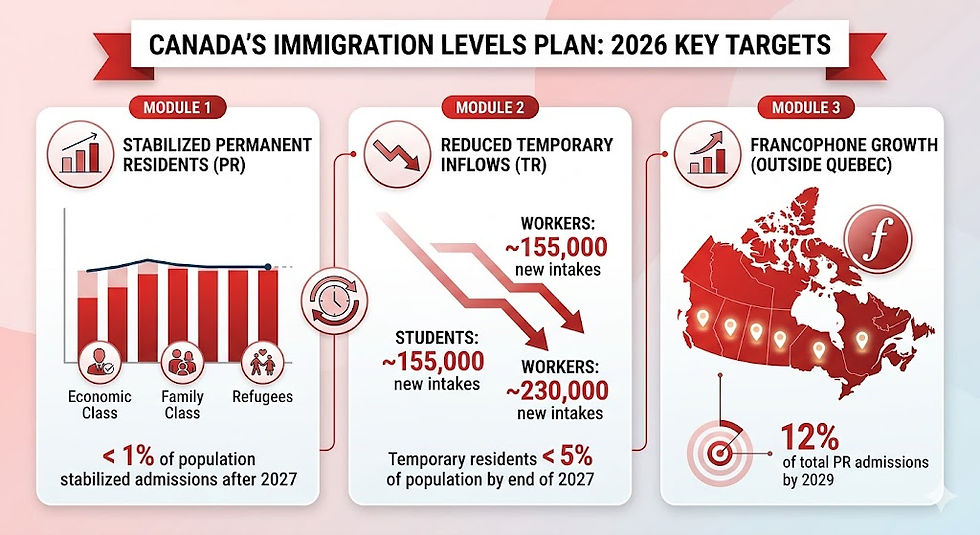
2026 intake direction | Lower planned entries vs last year: about 155,000 new students, 230,000 new temporary workers, 380,000 new permanent residents. |
Framing commitments | Temporary residents under 5 percent of Canada's population by end of 2027. Permanent resident admissions stabilized under 1 percent after 2027. Francophone permanent residents outside Quebec at 12 percent by 2029. |
The pattern is clear. Canada is tightening new temporary resident inflows, stabilizing permanent resident admissions, and emphasizing transitions to permanent residence and Francophone growth. For you, this means more attention on quality of applications, better proof of readiness, and planning your move from temporary to permanent status early.
If Express Entry affects you, do not miss the separate reform consultation closing May 24. We explain the proposals and strategy in our post, What IRCC's 2026 Express Entry consultation could change for CRS.
Why this matters for you in Metro Vancouver and across Canada
Tighter caps and stabilized levels can change your timing and your options. Here is how we see the
immediate impact for common situations in Vancouver, North Vancouver, West Vancouver, Coquitlam, Burnaby, Surrey, and Richmond, and across Canada.
Students already in Canada
Expect continued caps and readiness checks for new intakes. If you plan to extend your Study Permit or transition to a PGWP, prepare strong proof of funds and academic progress.
If you study in French or have French ability, this can open extra opportunities given the Francophone target.
For individual planning under the current caps, see our study permit service page.
Temporary foreign workers and PGWP holders
Plan your path to PR early. Keep language results valid, document your TEER 0 to 3 work, and track category based selection if you have French or high demand skills.
Employers in the Lower Mainland should plan recruitment timelines carefully, given reduced temporary inflows in 2026.
Families planning sponsorship
Family class is not ranked by CRS, but overall permanent resident allocations and processing capacity can affect timelines. Prepare complete, well documented files to reduce back and forth.
Prospective permanent residents abroad
The levels plan will set the volume, but selection still depends on program rules. Express Entry remains the main route for skilled workers. Keep building language to CLB 9 if possible and verify that your NOC and work history align with skilled work definitions. Learn how selection works on our Express Entry page.

How to take part effectively and protect your file
The survey favors practical stories and clear solutions. Short, specific answers are more useful than long narratives.
Name your location and pressure point. For example, "Surrey, BC, shortages in early childhood
educators with housing near workplaces."
Offer one or two solutions. For example, "Prioritize TR to PR transitions for TEER 2 and 3 roles with Canadian work experience and verified wages."
Support Francophone targets with a concrete idea. For example, "Incentives for French language training in Coquitlam and Burnaby for PGWP holders."
If you are an employer or program partner, include data points like vacancies or retention outcomes.
If you want a quick, professional second look before you submit or before you extend, you can book a focused file check. We run a boutique, technology-friendly process, respond fast, and give you personal attention. Many of our clients come through educational partners such as FIC and UICC.
Express Entry proposals are separate, and still open until May 24
IRCC is running a separate consultation on potential Express Entry reforms through May 24, 2026. The ideas include simplifying eligibility and re weighting some CRS signals. Nothing changes until the government publishes final rules. While proposals are under review, the current CRS structure still applies. You can review the current CRS factors on IRCC's official CRS criteria page.
For context, we summarized the reform ideas and immediate strategy in our in depth post, IRCC's 2026. If you need a plan that fits the current grid but also anticipates likely changes, we can help you map both paths in one session.
Quick examples to help you plan
Take Alex in Vancouver. He is on a PGWP with CLB 9 English, two years of TEER 1 experience in a
professional role, and no spouse or French points. Under today's system, he is competitive in Canadian Experience Class and in some category based draws. If the future system rewards strong language and high wage roles more, his profile could gain strength. The best move now is to keep English at CLB 9 or higher and document his skilled duties clearly.
Meet Riya abroad. She has a bachelor's, CLB 7, and three years of foreign TEER 2 experience with no
Canadian job offer. She wants to enter the pool this month. Today, her CRS may be on the edge. The single biggest lever is language. If she pushes to CLB 9 and considers adding French, she improves her chances under both current and potential future models. Our Express Entry page explains these factors in plain language.
Consider Marc in Richmond, a French bilingual graduate on a PGWP with CLB 9 English and CLB 7
French. He benefits today from French category draws, and the government has a firm commitment to reach 12 percent Francophone permanent residents outside Quebec by 2029. Keeping both test results valid and current is his top task.
For broader levels context, you can also read our explainer on the 2026 to 2028 Immigration Levels Plan and what it means for PR and temporary residents.
What happens next
May 12 to June 14: Public submits responses to the 2026 consultations on immigration levels.
Late spring: Express Entry reform consultation closes May 24. IRCC analyzes both files.
Summer to early fall: IRCC typically publishes a short "what we heard" report. Timing varies.
Fall 2026: The Minister tables the 2027 to 2029 Immigration Levels Plan in Parliament.
Practical tip: keep proof of your submission. IRCC usually releases a summary report that confirms the themes it heard. This does not change rules on its own, but it signals where policy may move.
FAQs
Does answering the survey increase my chances of PR?
• No. Your feedback informs policy design. It does not affect your current application or profile. IRCC
confirms that the consultation is for input only, not for case-specific outcomes.
Should I delay my application until the new plan is tabled?
• Usually, no. If you qualify now, waiting often adds risk without benefit. The current rules and selection systems are still in force. If you are unsure, we can time your file against both current and likely fall scenarios in a short planning call. You can reserve a consultation time before you pay government fees.
Do I need to be a Canadian citizen to answer the survey?
• No. IRCC invites individuals and organizations, including temporary residents and employers, to share input. If you study or work in Canada, your on the ground experience is valuable.
What should local employers include?
• Be specific. Share vacancy data, retention outcomes, and how TR to PR transitions help stabilize your workforce. For Metro Vancouver, it helps to tie your comments to housing, transit, and training capacity.
How do the Francophone targets affect me?
• If you can study or work in French, or you are bilingual, opportunities may continue through French
category draws and community programs. The government aims to reach 12 percent Francophone
permanent residents outside Quebec by 2029. Keep valid language tests and consider French training if it fits your goals.
Can I challenge the final levels plan in court if I disagree?
• Public consultations guide policy, but they do not create personal legal rights. In a 2018 decision, the Supreme Court of Canada explained that courts do not review the legislative process itself when the government develops policy. The lesson is practical. Participate now, since later legal challenges are not a remedy for lack of input. You can read the Court's case summary here: Mikisew Cree First Nation v. Canada, 2018 SCC 40.
Have Express Entry rules changed already?
• Not yet. The proposals are still under consultation. Until IRCC publishes new regulations, use today's CRS rules. The official factors are listed on IRCC's CRS criteria page.
How can a consultant help with a public survey?
• We will not write generic talking points. We help you frame concise, credible input that reflects your real status, timelines, and risks. We also review your file and next steps so you do not harm your own position while you speak up.
Get personal, practical help before you submit or extend
We are a boutique, reliable practice that supports students, workers, and families in Vancouver and across Canada. We give personal attention, move quickly, and use secure online tools. If you want us to review your status, timeline, and extension strategy before you submit your survey or file, you can reserve a consultation time. We offer competitive prices and focused reviews, including Express Entry strategy, PGWP and bridging Work Permits, and provincial nominee program targeting.
Disclaimer
This ties into IRCC's plans to modernize the federal high-skilled classes.
This news post is for general information only and is not legal advice. Policies can change. Always check official IRCC pages or book professional advice for your specific situation.


Comments