
Express Entry reforms Canada: what IRCC's 2026 consultation could change for CRS scores, job offers, and skilled workers

Updated: Sep 28
IRCC has opened a real, official consultation on changing Express Entry reforms Canada, and this one deserves attention.
On April 23, 2026, IRCC launched 2026 consultations on potential Express Entry reforms. This is not a
rumor, not an Access to Information leak, and not a random policy speech. It is a public consultation page
that says IRCC is considering major changes to both Express Entry program structure and the
Comprehensive Ranking System. The consultation is open until May 24, 2026.
That matters because the page does not just ask general questions. It outlines a serious reform direction.
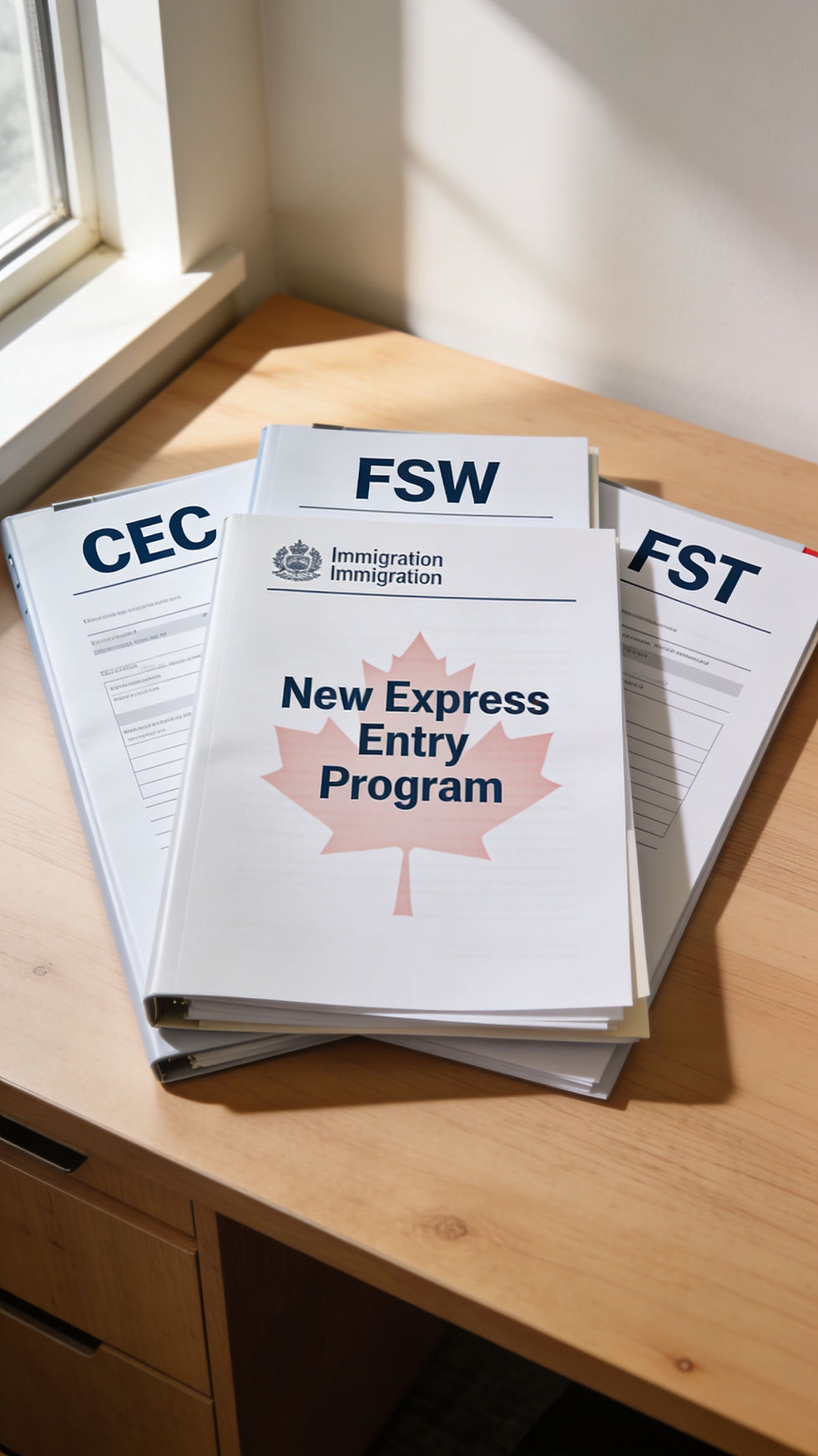
IRCC says it is considering replacing the three current Express Entry programs with one program, updating
CRS factors to better match economic-outcome research, and adding a new high-wage occupation factor. It
also says job offer points, which were removed in March 2025, could return, but only for job offers in
high-wage occupations.

If you are already in the Express Entry pool, planning to enter it soon, or deciding whether to focus on Express Entry or a provincial nominee program, this is the kind of official development you should read carefully. It does not change the law today. But it does show where IRCC appears to want the system to go next.
Express Entry reforms Canada: what IRCC is officially proposing
The core proposal is surprisingly simple: IRCC says it wants to simplify the current structure by replacing
the three current Express Entry programs with one program.
Right now, applicants generally enter the pool through one of three routes:
Canadian Experience Class
Federal Skilled Worker Program
Federal Skilled Trades Program
Under the consultation proposal, pool entry would instead be based on one new common program with
these minimum requirements:
education at the Canadian high school level or foreign equivalent
official language ability at CLB or NCLC 6 in reading, writing, speaking, and listening
one year of TEER 0 to 3 skilled work experience in Canada or abroad in the past three years
That is a meaningful shift. It suggests IRCC is considering a simpler front-end gate into the pool, and then
relying on CRS ranking and category-based selection to sort applicants afterward.
The same consultation also says IRCC wants CRS factors to better reflect the latest data on newcomer
economic outcomes. The page breaks the factors into three groups:
Category | Factors IRCC highlights |
Strongest predictors | Strong English, or English plus French; high earnings as a temporary resident |
Moderate predictors | Canadian work experience; a Canadian job offer; university education; younger age |
Weaker predictors | Spousal points; sibling in Canada points; French bonus points; education in Canada points |
IRCC is also considering a new high-wage occupation factor and says job offer points could return, but only
for job offers in high-wage occupations.
That last point is one of the biggest practical signals in the whole consultation.
This is a consultation, not a final rule
This needs to be said clearly because this is where readers can panic for no reason.
Nothing on the consultation page says these changes are already law. IRCC says it is looking for feedback
from organizations and the public. It also says any eventual program changes would later be published in
the Canada Gazette. In other words, the system you use today is still the current system, not the proposed
one.
That means:
you do not need to rewrite your current Express Entry profile tonight just because this page exists
CEC, FSW, and FST rules are not automatically gone today
CLB 6 is not a new final minimum for everyone today
job offer points are not already back
But the consultation still matters. It gives us an unusually clear look at what IRCC thinks should matter more
in the next version of Express Entry. That is valuable even before the law changes, because it helps
applicants understand what the department is trying to reward.
Why this consultation is more important than a routine policy page
Some official pages are mostly informational. This one is not.
The page openly says IRCC wants to simplify Express Entry and ensure that the system reflects the latest research on economic outcomes. That means the department is not just asking whether the rules are easy to understand. It is also asking whether the current system is rewarding the right kinds of skilled workers.
That has real strategic implications.
If IRCC moves ahead with a one-program model, the biggest decision point may shift away from "Which of the three federal programs do I fit?" and more toward "How competitive is my profile once I am in the pool?" That makes CRS composition even more important.
IRCC's own Express Entry year-end report 2024 fact sheet says the department issued 98,903 invitations through 52 rounds in 2024, and 43,475 of those invitations, or 43%, came through category-based selection. That is a useful reality check. Targeted selection is already a major part of the current system, not a side feature. If you want a deeper backgrounder on that shift, our Express Entry Category Based Selection 2025 article is a good companion read.
Recent official rounds also show how different current cutoffs can be depending on the draw type. On April
15, 2026, IRCC's French-language round issued 4,000 invitations at a CRS cutoff of 419. One day earlier,
the April 14, 2026 Canadian Experience Class round issued 2,000 invitations at a cutoff of 515. Those
numbers matter because they show how much strategy already depends on the kind of profile you have, not
just on being in the pool. Readers who want a current example of how a CEC round behaves in practice can
also review our Latest Express Entry Draw Canadian Experience Class April 14 2026 breakdown.
If high earnings as a temporary resident and high-wage occupations are given more weight, applicants with
strong Canadian work history and stronger wages may benefit. If weaker predictors such as sibling points or
some bonus-style factors matter less, some profiles that currently rely on those smaller advantages could
become less competitive.
The page also says category-based selection, introduced in 2023, remains part of the broader architecture,
and that later category consultations are expected this year. So this is not a signal that category-based
selection is disappearing. It looks more like IRCC is trying to simplify the entry gate while still keeping strong
control over who rises in the pool.
What could change for applicants already in the Express Entry pool
For people already in the pool, the biggest mistake is reading this page only through a legal lens. Yes, it is
still a proposal. But it is also a strategy signal.
Here is what the proposal could mean in practice if it moves forward.
1. Program labels may matter less than rank inside the pool.
If IRCC eventually moves to one shared entry program, the main strategic question becomes less about
whether you fit CEC, FSW, or FST neatly and more about how strong your file looks once it is competing
against everyone else in the pool.
2. Canadian work experience and earnings may matter even more.
IRCC is not speaking vaguely here. It explicitly says strong language and high earnings as a temporary
resident are among the strongest predictors of economic success, which suggests that a profile with solid
in-Canada experience may be rewarded more heavily if the CRS is reweighted. That is especially relevant
for workers already building experience in Canada, which is why our August 6 2025 Express Entry Draw
What Temporary Residents In Canada Need To Know post is a useful companion piece.
3. Job offers may become more selective, not more generous.

The proposal does not say all employer-backed files will get a lift. It says job-offer points could return only for high-wage occupations, so some workers with employer support may gain while others may find their job offer carries much less strategic value than expected.
4. A simpler entry gate could still mean tougher competition.
People outside Canada should not assume a one-program model automatically makes immigration easier. A broader entry gate may allow more profiles into the pool, but that can also make the actual ranking battle harder unless your language, work history, and overall CRS profile remain strong.
Likely winners if IRCC moves in this direction
The strongest likely winners are applicants whose profiles already match the signals IRCC is now
emphasizing.
One obvious group is people with strong official-language scores, especially where English is very strong or
where English and French both add real value. The consultation page clearly puts language near the top of
the economic-success ranking.
Another likely winner is the worker already in Canada in a well-paid skilled occupation. If IRCC ends up
rewarding high-wage occupations or high temporary-resident earnings more directly, those files may
become stronger than they look under a flatter scoring model.
Employer-backed applicants may also benefit, but only selectively. The important nuance is that this is not a
general promise that all job offers will matter more. The proposal is narrower. It points toward job offer
points for high-wage occupations only.
People with solid Canadian work experience and university education also look relatively safer under this
framework than profiles that rely mainly on small bonus factors.
Likely losers or weaker-positioned profiles
The most exposed group may be profiles whose competitiveness depends on smaller add-on advantages
rather than core profile strength.
For example, if CRS weighting shifts more toward language strength, earnings, and labour-market
outcomes, then people relying heavily on spousal points, sibling points, or smaller bonus-style profile
enhancements may see less relative value from those factors.
Another group to watch is lower-wage employer-backed workers. Under the proposed direction, having a
job offer may no longer be enough on its own if that offer does not sit in a high-wage occupation.
Some applicants outside Canada may also face a harder practical market if the system increasingly rewards
recent Canadian earnings or Canadian labour-market strength. That does not mean they will be shut out. It
does mean the balance of advantage could move further toward some in-Canada workers.
Finally, people who assume a simplified one-program model automatically means "easier immigration"
could be disappointed. Simpler program architecture does not necessarily mean lower competition. In fact,
it can mean the opposite.
A simple example: current system versus the proposed direction
Because IRCC has not published new point values, the safest way to think about this consultation is
comparatively, not mathematically.

Imagine one applicant is 30 years old, has CLB 9 English, one year of Canadian TEER 1 work experience, and a strong salary in a skilled occupation, but no sibling points and no spousal bonus. Under the current system, that person still lives and dies by the round type and the cutoff in force at that moment. Under the consultation's proposed direction, that same profile could become relatively stronger because it lines up with the factors IRCC now describes as strongest: language, earnings, and labour-market outcomes.
Now imagine another applicant has moderate language scores, a valid but lower-wage employer-backed job, and depends more on spouse or sibling points to stay competitive. Under the current system, that file can still be workable depending on the round mix. Under the proposed direction, it could become relatively weaker if job-offer points return only for high-wage occupations and smaller bonus factors are worth less than they are today.
The important point is not that either person is guaranteed to win or lose. It is that this consultation signals a different theory of who should rise in the pool, and that can change how you should prepare long before any regulation is finalized.
What applicants should do now instead of overreacting
The right move right now is not to panic and not to ignore the consultation. It is to use it as a planning tool.
1. Review your profile the way IRCC is now describing economic success.
That means asking whether your strongest assets are really language, earnings, skilled work, and credible
labour-market fit, or whether your file depends too much on secondary bonuses that IRCC is now treating
as weaker predictors.
2. If you are working in Canada, pay attention to wage positioning.
IRCC is openly testing a high-wage occupation factor. If your current role is employer-backed but low-wage,
do not assume future job-offer points would help you the same way they might help a worker in a
higher-wage occupation.
3. If you are outside Canada, do not treat the one-program idea as automatic good news.
A simpler entry model could widen access to the pool, but it may also increase competition once applicants
are inside. That makes strong language results and a clean skills profile even more important.
4. If you are borderline for Express Entry, compare federal and provincial timing now.
This consultation is another reason not to build your whole strategy around one hoped-for federal score
outcome. In some cases, a provincial nominee program may still be the more practical bridge, especially
while current round cutoffs continue to swing sharply from one draw type to another. If you are still
comparing targeted federal selection against a provincial backup, our Express Entry targeted draws guide
adds useful context.
5. Separate today's rules from tomorrow's signals.
You still need to comply with the current system today. But it is smart to prepare for the direction of travel
IRCC is signaling, especially if your case will stay active for months rather than days and you still have time
to improve language scores, earnings, or work experience quality.

Frequently asked questions about these Express Entry reform proposals
Is IRCC changing Express Entry right now?
Not yet. The April 23, 2026 page is an open public consultation, not a final legal change. IRCC says any eventual program changes would later be published in the Canada Gazette. The practical takeaway is that applicants should not assume the current rules have already been replaced, but they should take the consultation seriously as a sign of where policy may move next.
Would CEC, FSW, and FST really disappear under this proposal?
That is what IRCC is consulting on. The page says it proposes replacing the current three programs with one program that would have shared minimum requirements. That does not mean the change is final, but it does mean the government is openly considering a major structural simplification. If your current plan depends on a narrow reading of one existing program, this is the moment to stress-test that plan.
Do job offer points come back automatically under the new plan?
No, the proposal is narrower than that: IRCC says it is considering reintroducing job offer points only for job offers in high-wage occupations. So a worker with employer support should not assume all job offers would benefit equally. The action step is to check whether your role would likely fit that higher-wage logic before building a strategy around future job-offer points.
If I am already in the pool, should I change anything today?
Usually not immediately, because your first move should be to understand whether the consultation changes how you should strengthen the profile over the next few months, not to make random edits today. A useful next step is to review your language scores, recent work history, and any employer-backed advantage with the proposed direction in mind.
Does this make provincial nomination less important?
No. If anything, it may make federal and provincial strategy comparison more important. If federal ranking becomes even more tied to labour-market outcomes, wages, and stronger core factors, some applicants may still need a provincial route to stay competitive. That is why a serious services review should compare both routes, not just one.
Every profile will react differently to these signals depending on your current CRS score, language results,
wage level, work history, and whether you already have a provincial backup in play.
If you want help understanding whether these proposed Express Entry changes make your profile stronger,
weaker, or simply different, reserve a consultation time. We can review your CRS strategy, language profile,
work history, employer-backed options, and whether you should stay focused on Express Entry or build a
provincial backup now.
Disclaimer: This article is for general information only and is not legal advice. The April 23, 2026 Express
Entry consultation is not a final rule change, and any prediction about future Express Entry structure or CRS
scoring remains only an informed interpretation until official regulations are adopted.


Comments