


A person can have an approved Canadian visa and still be unable to travel if their immigration document
is suspended under the new public-health measures.
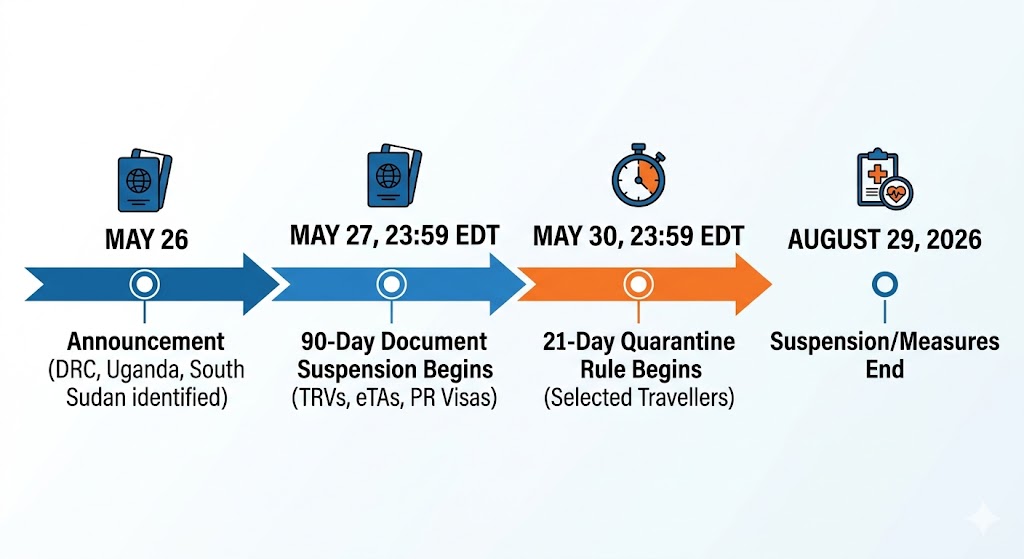
On May 26, 2026, the Public Health Agency of Canada announced temporary border measures in response
to an Ebola disease outbreak in the Democratic Republic of the Congo and increasing risks in Uganda and
South Sudan. The immigration part of the announcement is the part many families, workers, students, and
employers may miss: Canada says it intends to suspend certain immigration documents for residents of
high or very high risk Ebola outbreak countries for 90 days beginning May 27, 2026 at 23:59 EDT.
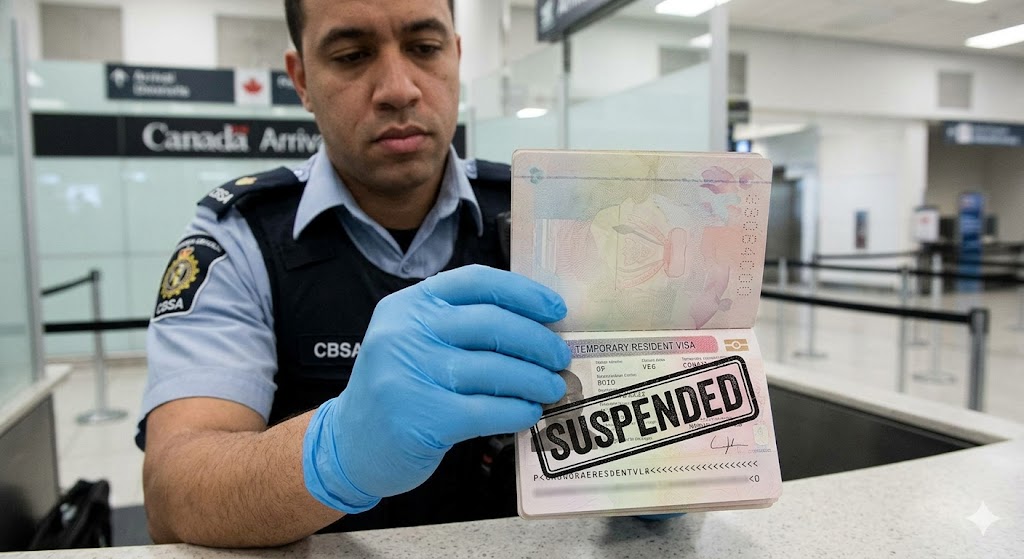
At the time of the announcement, the named countries are the Democratic Republic of the Congo, Uganda,
and South Sudan. The Government says this may affect people who already have a temporary resident
visa, an electronic travel authorization, or a permanent resident visa. It also says it intends to temporarily
pause decisions on applications for these documents from residents of those countries.
If you or a family member is affected, do not treat this as a normal visa delay. The Canada Ebola border
measures are tied to public-health screening, document suspension, and quarantine rules. Before anyone
books a flight, cancels plans, or assumes a visa is still usable, the first step is to identify the person's
residence, document type, travel history, location, and current immigration status.
Canada Ebola border measures: who is affected first
The announcement is aimed at residents of countries that Canada considers to have a high or very high risk
of Ebola outbreak. As of May 26, 2026, Canada listed the Democratic Republic of the Congo, Uganda, and
South Sudan. That list may change, so affected travellers should check the official Government of Canada
announcement and current Travel.gc.ca guidance before travel.
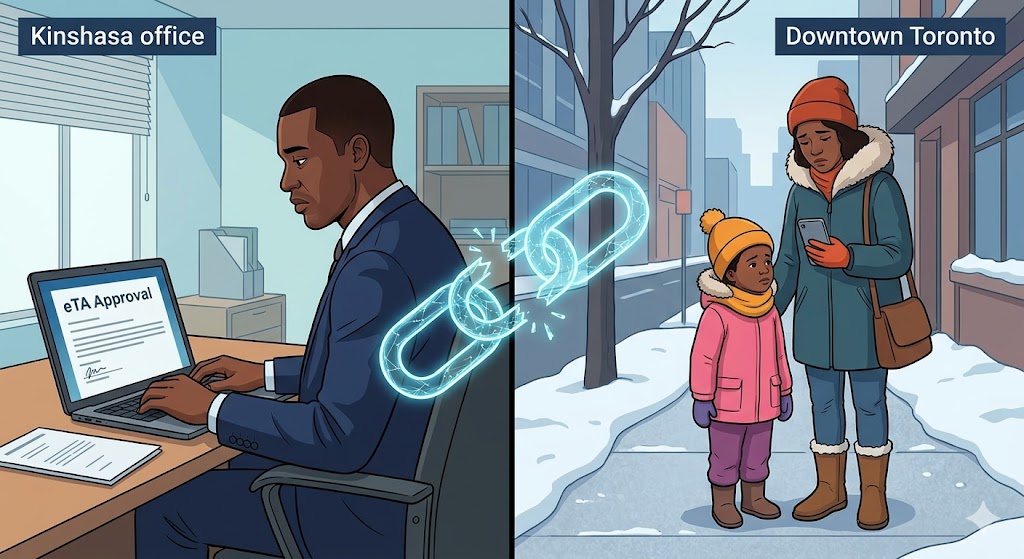
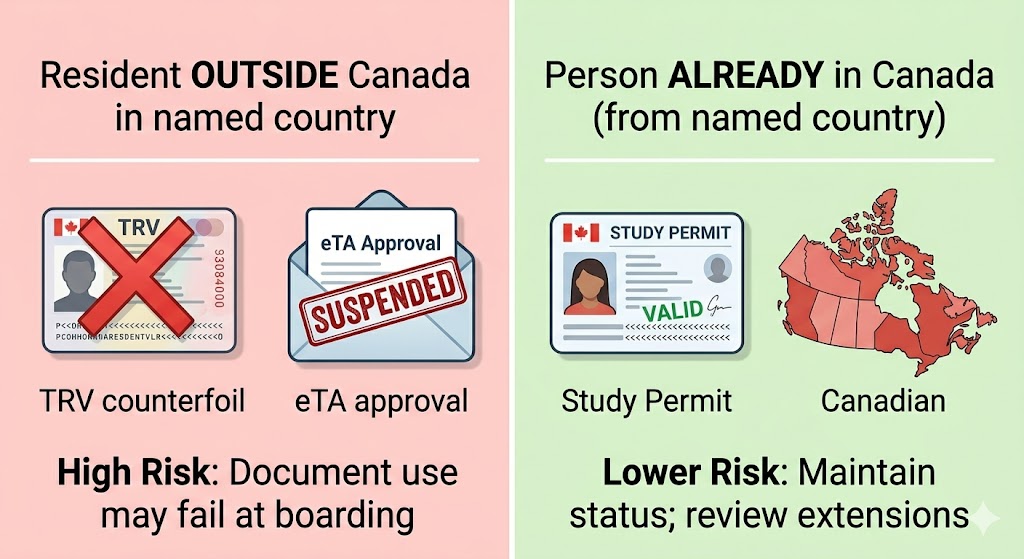
The most urgent group is people outside Canada who live in one of the named countries and already hold a
Canadian travel document. The announcement specifically names temporary resident visas, eTAs, and
permanent resident visas. If the document is suspended, the person may not be allowed to travel to Canada
while the suspension is in place, even if the document was previously approved.
Situation |
What the announcement suggests |
Practical risk |
Resident of DRC, Uganda, or South Sudan with an approved TRV |
Document may be suspended for the 90-day period |
Airline boarding and entry plans may fail |
Resident of one of the named countries with an eTA |
eTA may be suspended |
Do not assume an eTA approval is enough to fly |
Resident with a permanent resident visa but not yet landed |
PR visa may be suspended |
Landing plans may need urgent review |
Pending TRV, eTA, or PR visa applicant resident in a named country |
Decisions may be paused temporarily |
Processing timeline may no longer be predictable |
Person already in Canada |
Announcement says they are not impacted and may stay for their authorized period |
Status expiry and extension planning still matter |
This table is not a substitute for legal advice, but it shows the main point: the risk is not just whether a
person qualifies for Canada in the normal way. The risk is whether the document can be used during a
public-health suspension period.
Suspension is not the same as losing status in Canada
One of the most important lines in the announcement is that people already in Canada are not impacted by
these measures and may continue to stay for their authorized period of stay. That matters for visitors,
students, workers, and family members who are physically in Canada when the measure begins.
If you are already in Canada, the measure does not appear to erase your current temporary resident status
simply because you are from, or recently connected to, one of the named countries. But that does not mean
you can ignore your status expiry date. If your visitor status, study permit, or work permit is close to expiry,
you still need to review extension timing, conditions, passport validity, and whether travel outside Canada
would create a re-entry problem.
This is also where the new document-control powers from Bill C-12 matter. IRCC explains that Canada now
has tools to manage groups of immigration documents and applications, including the ability to suspend or
change documents, pause intake, or suspend application processing in the public interest. IRCC also says
these tools do not grant, change, or revoke temporary or permanent resident status, and do not affect
asylum claims. We reviewed that broader legal framework in our earlier article on Bill C-12 immigration
For a person already in Canada, the practical question is usually not "Did I lose my status?" It is "What
should I do before my current status expires, and should I avoid international travel while this measure is
active?"
If you are already in Canada and worried about an expiring permit, travel plans, or a family member
overseas, book a status and application strategy review. We can review your current document, expiry date,
extension options, family travel issue, and whether leaving Canada could create a bigger problem than
staying and extending properly.
Approved visa, delayed travel: what families should check now
Families may be hit hardest by this update because they often plan around approved documents. A parent
may have a visitor visa. A spouse may have a permanent resident visa and be preparing to land. A student
may have travel plans after a permit approval. An employer may expect a worker to arrive.
The first mistake is to treat the approval letter or visa counterfoil as the final answer. Under the May 26
announcement, a previously approved document may still be suspended if the person is resident in a
named high-risk or very-high-risk country. That means the travel plan must be checked again after the
announcement, not just against the original visa approval date.
Here is the decision path we would use before travel:
Question |
Why it matters |
Where does the person reside now? |
The document suspension is aimed at residents of named high-risk countries |
What document do they hold? |
The announcement names TRVs, eTAs, and PR visas |
Are they already in Canada? |
People already in Canada are treated differently in the announcement |
Have they been in the affected area in the last 21 days? |
This connects to quarantine and screening rules |
Is there an expiring visa, COPR, work permit, school start date, or job start date? |
Timing may determine whether a legal strategy is needed quickly |
Is travel urgent or optional? |
Optional travel may carry avoidable risk during a temporary suspension |
If the person has an approved document but has not travelled, do not buy a ticket just because the visa is
visible in the passport. Check the current government page, airline rules, Travel.gc.ca updates, and whether
there is a new notice on the person's IRCC account. Keep screenshots of the approval, correspondence,
flight booking history, and any government notice that affects the plan.
Pending applications may sit longer than expected
The announcement also says Canada intends to temporarily pause decisions on applications for temporary
resident visas, eTAs, and permanent resident visas from residents of the affected countries. That does not
necessarily mean every application is refused. A pause is different from a refusal. But for planning
purposes, a pause can still create serious consequences.
For a visitor, it may mean missing a planned family event. For a worker, it may affect a job start date. For an
international student, it may affect whether the person can arrive in time for classes. For a sponsored
spouse or permanent resident applicant, it may delay landing after a long process.
The safest response is not to flood IRCC with repeated webform messages that say the same thing. The
better response is to organize the file. Confirm the application type, residence, submission date, biometrics,
medical validity, passport validity, and any document expiry. If there is a time-sensitive reason, such as a
school start date, employment start date, expiring permanent resident visa, or medical issue, prepare a
clear explanation with proof.
If you have a pending application affected by the Canada immigration document suspension, book a
focused file review. We will check what stage the application is at, what evidence should be preserved,
whether a webform update is useful, and whether your plan should shift to status maintenance, deferral, or
a new travel timeline.
The May 30 quarantine rule is separate from the visa suspension
The immigration document suspension is only one part of the announcement. Canada also says it intends
to implement an additional measure effective May 30, 2026 at 23:59 EDT until August 29, 2026. Under that
measure, Canadian citizens, permanent residents, persons registered under the Indian Act, and foreign
nationals who have been in the affected areas within the previous 21 days and do not have symptoms will
have to quarantine for 21 days.
Travellers with symptoms will be isolated at a hospital for further assessment. The Government says these
measures are being implemented under the Quarantine Act. This is why a person's immigration eligibility
and public-health obligation must be reviewed separately. A person may have the right to return to Canada,
but still face screening, quarantine, or isolation requirements.
Canadian citizens and permanent residents can still return to Canada, according to the announcement. But
"can return" does not mean "can return without conditions." If someone has been in a named area within the
previous 21 days, they should prepare for screening and quarantine rules. They should also check the
Travel Health Notice for Ebola disease in the Democratic Republic of Congo and any destination-specific
Travel Advice and Advisories before travelling.
How this differs from the May eTA expansion
Two immigration travel announcements appeared within days of each other, but they move in opposite
directions. On May 25, IRCC announced that eligible travellers from Indonesia and Malaysia could use an
eTA instead of a visitor visa in specific circumstances. We covered that update in our article on the Canada
eTA Indonesia Malaysia change.
The Ebola measure is different. It is not an expansion of easier travel. It is a public-health restriction that
may suspend existing documents and pause decisions for residents of named countries. That difference
matters because readers may see "eTA," "visa," and "travel to Canada" in both updates and assume they
work the same way. They do not.
The broader lesson is that Canadian immigration documents are no longer only about eligibility at the
moment of approval. Under the new document-management framework, a document can be affected later
by public-health, safety, fraud, administrative error, or national-security concerns. That does not mean every
visa holder should panic. It means travellers should check current rules close to departure, especially when
there is a public-health or border announcement.
What you should do before making a decision
If you are affected by this announcement, start with facts, not fear. Write down the person's current country
of residence, citizenship, travel history in the last 21 days, Canadian document type, document expiry date,
current location, and whether they are already in Canada. Then check whether the person is trying to enter
Canada, remain in Canada, extend status, land as a permanent resident, or wait for a decision.
For approved-document holders outside Canada, the main question is whether the document can be used
during the 90-day period. For pending applicants, the main question is how the pause affects timing and
what evidence should be preserved. For people already in Canada, the main question is how to maintain
status and avoid unnecessary travel risk. For citizens and permanent residents returning to Canada, the
main question is quarantine and screening compliance.
Do not assume a friend's situation applies to you. A permanent resident returning to Canada, a foreign
national with a TRV, a sponsored spouse with a PR visa, and a worker already in Canada are not in the
same legal position. The announcement treats location, residence, document type, and symptoms
differently.
If your travel or application is time-sensitive, use our services page to identify the right type of review, then
reserve a consultation time before you take the next step. We can help you separate immigration status
from travel authorization, review extension or deferral options, and prepare a careful plan if a family visit,
work start date, school start date, or landing deadline is at risk.
Common questions about the measure
Does this mean Canada cancelled all visas from DRC, Uganda, and South Sudan?
No. The announcement says Canada intends to suspend immigration documents for residents of countries with high or very high Ebola outbreak risk for the next 90 days, and at the time of announcement this includes DRC, Uganda, and South Sudan. Suspension is not the same as a normal refusal or permanent cancellation, but it may still prevent travel while active.
If I am already in Canada, do I have to leave?
The announcement says people already in Canada are not impacted by these measures and may continue to stay for their authorized period. You still need to respect your status conditions and expiry date.
Can Canadian citizens and permanent residents return to Canada?
Yes. The announcement says Canadian citizens and permanent residents could still return to Canada, with screening at ports of entry. Depending on travel history and symptoms, quarantine or hospital isolation rules may apply.
Will my pending application be refused?
The announcement refers to temporarily pausing decisions on certain applications from residents of affected countries. A pause is not the same as a refusal. But it may affect timelines, so applicants should preserve documents and plan around delay.
Should I cancel my flight?
Do not make that decision based only on headlines. Check the official government pages, your document type, your country of residence, your travel history, and whether the trip is urgent. If the trip involves a permanent resident visa, school start date, work start date, or family emergency, get case-specific advice quickly.
The Canada Ebola border measures are temporary, but they can have immediate consequences. If you
have an approved visa, an eTA, a PR visa, or a pending application connected to DRC, Uganda, or South
Sudan, the next few days matter. Confirm the current rule before travelling, protect your Canadian status if
you are already here, and keep a careful record of every government notice or delay that affects your file.
This article is for general information only and is not legal advice. Public-health border measures and
immigration instructions can change quickly. Get advice for your own facts before you travel, withdraw an
application, miss a deadline, or make a status decision.