
Can a Permanent Resident of Canada Work in the USA?

Updated: 2 days ago
A permanent resident of Canada can work in the USA, but not through the TN visa. TN status
under USMCA is restricted to Canadian and Mexican citizens only, not permanent residents. If you
hold a Canadian PR card but have not yet obtained Canadian citizenship, you need separate US
work authorization to legally work south of the border.

Why the TN Visa Is Not Available to Canadian Permanent Residents
The TN visa is one of the most convenient work pathways for professionals crossing into the
United States. Canadian citizens in eligible occupations can simply appear at a port of entry,
present their documents, and begin working in the US without applying in advance.
That shortcut does not apply to permanent residents of Canada who are not Canadian citizens.
US Customs and Border Protection (CBP) limits TN status to nationals of Canada and Mexico.
Your PR card identifies you as a lawful resident of Canada, not a Canadian national, which means
you fall outside TN eligibility.
This surprises many newcomers. After years of building a career in Canada, it is natural to assume
permanent residency confers the same cross-border work rights as citizenship. It does not.
Your Work Authorization Options as a Canadian Permanent Resident
If you are a permanent resident of Canada who wants to work in the USA, you have real options.
Each requires a separate US application:
H-1B visa: The most common route for skilled workers from any country. Your US employer must
sponsor you and file a petition. H-1B is subject to an annual cap of 85,000 and a lottery, so
planning and timing matter. A key advantage: H-1B permits dual intent, meaning you can apply for
a US green card while working in H-1B status without jeopardizing your visa.
L-1 visa: If you work for a multinational company with US operations and have been employed by
that company for at least one year in the past three years, an L-1 intracompany transfer may be an
option. There is no annual cap.
O-1 visa: For workers with extraordinary ability or achievement in their field, such as significant
academic publications, awards, or national media coverage. No cap, no lottery, but the eligibility
bar is high.
US green card: Some Canadian PRs pursue US permanent residency directly through employer
sponsorship (EB-2 or EB-3), a US citizen family member, or an investor route. This is a longer
process, but it grants permanent US work rights.
There is no shortcut that matches the speed of the TN visa for Canadian citizens. If your goal is
long-term US employment, speak with a US immigration lawyer alongside your Canadian
immigration consultant so you are planning both sides of the border.
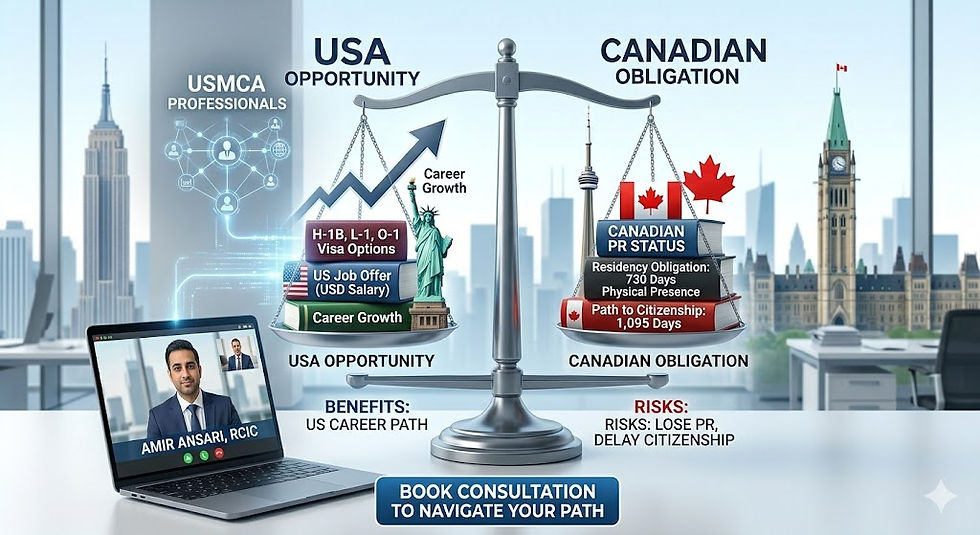
A Critical Risk: Working in the USA Can Affect Your Canadian PR Status
Before you accept a US job offer, you need to understand a risk that catches many Canadian PRs
off guard.
Canadian permanent residents must meet a residency obligation: at least 730 days physically
present in Canada during every rolling five-year period. If you relocate to the United States for
work and spend years there, you risk falling below that threshold.
The consequences can be severe. IRCC can revoke your Canadian PR status if you fail the
residency obligation, and you will lose your path to Canadian citizenship.
There is one exception worth knowing: time spent outside Canada working for a Canadian
employer or accompanying a Canadian citizen spouse may count toward your residency
obligation. Whether that exception applies to your situation depends on the specific employment
arrangement.
If you are weighing a US opportunity, do not move first and ask questions later. Talking to an RCIC
before you go can help you understand whether your PR status and citizenship timeline are at risk,
and what steps you can take to protect them.
Book a consultation with Amir Ansari, RCIC to review your situation before you accept a US job offer. Many permanent residents in this situation have options they did not know about. Reserve your consultation here.
Frequently Asked Questions: Can a Permanent Resident of Canada Work in the USA?
Can a Canadian permanent resident apply for a TN visa?
No. TN status under USMCA is only available to citizens of Canada and Mexico. Permanent
residents of Canada who have not obtained Canadian citizenship are not eligible for TN status,
regardless of how long they have held their PR card.
Does a Canadian permanent resident need a US work visa?
Yes. A Canadian PR card does not grant any right to work in the United States. You need
separate US work authorization, such as an H-1B, L-1, or O-1 visa, depending on your occupation
and employer.
Will working in the USA cause me to lose my Canadian PR status?
It can. Canadian PRs must spend a minimum of 730 days in Canada within every five-year period
to maintain their status. Relocating to the US for work may put that obligation at risk. Certain
exceptions apply if you work for a Canadian employer abroad. Get advice before you go.
What is the fastest US work option for a Canadian permanent resident?
There is no single fast option. The H-1B is the most common but involves an annual lottery. An L-1
transfer may be faster if you already work for a qualifying multinational. The right path depends on
your occupation, employer, and how quickly you need to start.
If I become a Canadian citizen, can I then use the TN visa?
Yes. Once you obtain Canadian citizenship, you qualify for TN status under USMCA. This is one of
several reasons many permanent residents choose to pursue citizenship before planning a US
move.
Does living and working in the USA affect my Canadian citizenship application?
Yes. Canadian citizenship requires physical presence of at least 1,095 days within the five years
before you apply. Time spent in the United States does not count toward that requirement. The
longer you delay your citizenship application by working abroad, the further you push back your
eligibility date.
For a full overview of how Canadian permanent residency and work permits interact with long-term
planning, Ansari Immigration offers consultations tailored to your specific situation.
You can also read How Long Does It Take to Get Canada Permanent Residency? for context on
the PR timeline before making cross-border moves.
Planning to work in the USA while protecting your Canadian PR or citizenship timeline? Amir Ansari, RCIC, works with permanent residents navigating exactly this situation. Book your appointment here.
This article is for general information only. It is not legal advice. Program criteria, requirements, processing times, and selection approaches can change without notice. Always confirm details on official government websites or consult a licensed Regulated Canadian Immigration Consultant (RCIC) for advice specific to your situation.



Comments