

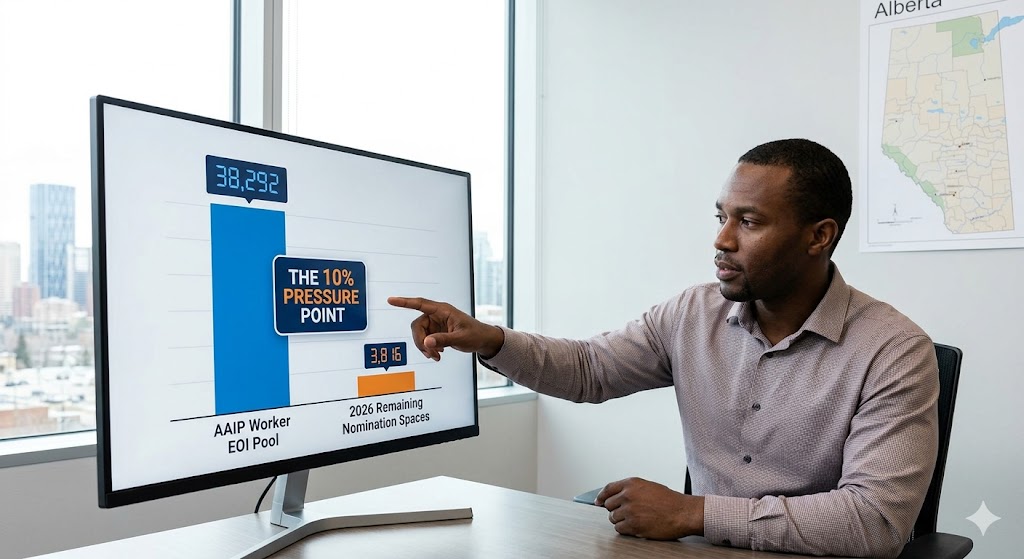
Alberta is still inviting workers, but the pool is much larger than the number of nomination spaces left.
If you are in Alberta, this is the part of the update that should get your attention. The June 2026 Alberta AAIP draw result was not a huge round. It was a targeted manufacturing selection: 49 invitations, a minimum score of 53, and a clear signal that Alberta is still using priority-sector draws to manage a limited 2026 nomination allocation.
The Government of Alberta's AAIP processing information shows 6,603 nomination spaces for 2026 as of August 25, 2026,
4,560 nominations already issued, and 2,043 spaces remaining. It also shows 36,255 Worker EOIs in the
pool. That does not mean every EOI is competing for the same stream, but it does tell you the basic
pressure point: if you compare remaining spaces to the total pool, Alberta has room for only about 6
percent of the current Worker EOI inventory.
That is why this update is not just "Alberta invited 49 people." The better question is whether your profile
matches the stream, sector, employer evidence, work authorization, and timing that Alberta is actually
selecting.

Alberta AAIP draw June 2026: what changed in the latest round
The latest listed selection was an Alberta Express Entry Stream Priority Sectors draw for manufacturing on
June 2, 2026. Alberta issued 49 invitations and the minimum Worker EOI score was 53.
Here is the useful comparison, not just the raw draw result:
Date |
Stream or pathway |
Focus |
Minimum score |
Invitations |
June 2, 2026 |
Alberta Express Entry Stream |
Priority sectors, manufacturing |
53 |
49 |
May 29, 2026 |
Alberta Express Entry Stream |
Accelerated Tech Pathway |
55 |
200 |
May 27, 2026 |
Alberta Opportunity Stream |
General AOS selection |
51 |
993 |
May 25, 2026 |
Rural Renewal Stream |
Rural Renewal |
50 |
83 |
May 22, 2026 |
Alberta Express Entry Stream |
Priority sectors, agriculture |
48 |
76 |
May 21, 2026 |
Alberta Express Entry Stream |
Priority sectors, manufacturing |
56 |
99 |
The table shows a rotation strategy, not a broad reopening. Manufacturing was selected twice in less than
two weeks, but the June 2 round issued about 51 percent fewer invitations than the May 21 manufacturing
round while the score dropped from 56 to 53. Tech moved in the opposite direction: the May 29 Accelerated
Tech Pathway round issued 200 invitations, about 37 percent more than the May 7 tech round, and the
score fell from 57 to 55. The Alberta Opportunity Stream is the strongest volume signal, with 993 invitations
on May 27, up about 19 percent from the May 6 AOS round and more than double the April 10 AOS round.
So the practical message is mixed. Alberta is active. Scores in several recent rounds are not sky-high. But
the province is rotating by stream and sector, and a low score in one draw does not mean a weak or poorly
documented file is safe.
A low AAIP score does not mean a simple application
For first-time readers, the Worker EOI score is Alberta's provincial ranking score. It is not the same as the
federal Comprehensive Ranking System score used in Express Entry. Alberta's Worker EOI points grid is
out of 100 points, with up to 69 points for human capital factors and up to 31 points for economic factors.
In plain language, Alberta is looking at things like education, language, work experience, Canadian or
Alberta experience, age, family in Alberta, job offer, job location, and regulated-occupation certification. It
also collects non-scored information that can matter for selection and assessment, including immigration
status, occupation, employer industry, and stream information.
This is where many candidates misread the draw. A score of 53 in an AAIP manufacturing draw sounds
accessible. But if the candidate's job offer is thin, the duties do not match the NOC, the employer
documents are incomplete, the work permit is close to expiry, or the Express Entry profile is not aligned with
the Alberta pathway, the number alone will not carry the file.
If you received an AAIP invitation in manufacturing, tech, agriculture, construction, health care, or AOS,
book a focused 30-minute AAIP invitation review before you submit. We can check the invited stream,
Worker EOI score, NOC and TEER, employer documents, job offer, wage and hours, Express Entry profile,
status expiry, and whether your federal work-permit or PR timing needs to be protected at the same time.
What the current allocation says about competition
The most important number in Alberta's current snapshot may not be the June 2 draw itself. It is the gap
between remaining nomination spaces and people waiting in the pool.
AAIP 2026 snapshot |
Current figure |
Practical meaning |
Total nomination allocation |
6,603 |
Alberta has a fixed annual capacity. |
Nominations issued |
4,560 |
About 69 percent of the allocation has already been used. |
Spaces remaining |
2,043 |
Alberta still has room, but not unlimited room. |
Total Worker EOIs in pool |
36,255 |
The pool is much larger than remaining capacity. |
Alberta Opportunity Stream EOIs |
22,648 |
AOS is the largest pressure point. |
Priority sector and other initiative EOIs |
5,012 |
Priority-sector fit still matters. |
Accelerated Tech Pathway EOIs |
2,102 |
Tech remains active but competitive. |
This table is why "I am eligible" is not the same as "I am likely to be invited soon." On a raw comparison, the
remaining nomination spaces equal about 6 percent of the total Worker EOI pool. The Alberta Opportunity
Stream has 22,648 EOIs and 1,011 remaining spaces, which is about 4.5 percent if you compare the pool to
remaining AOS capacity. The Accelerated Tech Pathway looks somewhat less crowded on that raw
comparison, with 197 remaining spaces against 2,102 EOIs, about 9 percent, but tech is still filtered by
occupation, employer, industry, and selection priorities.
This is also where AAIP priority sectors 2026 matter. Alberta says worker-stream draws and nominations
are being prioritized for key sectors including health care, technology, construction, manufacturing, aviation,
agriculture, and communities designated under the Rural Renewal Stream. That list does not guarantee an
invitation, but it does explain why the recent draw pattern keeps moving between manufacturing,
agriculture, tech, AOS, Rural Renewal, health care, and construction.
If you were invited, what should you check first?
Start with the obvious deadline, but do not stop there. An invitation is only the start of the application stage.
Alberta can still assess whether the information in the EOI is accurate, whether the stream requirements are
met, and whether the employer or Express Entry facts support the invitation.
For example, imagine Mira works full-time for a manufacturing employer in Alberta and receives an
invitation after the June 2 draw. Her score is based on language, Alberta experience, a full-time Alberta job
offer, and her occupation. Before she submits, she should not just upload the offer letter and hope. She
should compare the job title and duties against the NOC, confirm the wage and hours match pay records,
check whether the employer can support the file, confirm her work permit still authorizes the job, and make
sure her Express Entry profile has not become inconsistent with the Alberta application.
If her police certificate or employer document is delayed, the decision tree is practical:
• If the document can be obtained before the deadline, wait and submit a complete package.
• If the document cannot be obtained in time, gather proof that it was requested, upload the best available explanation where the portal allows, and get advice before submitting an incomplete file.
• If the missing item affects eligibility itself, do not assume a letter of explanation will fix it.
• If status is expiring, treat the AAIP plan and work permit strategy as one problem, not two separate
problems.
Recent work-permit litigation is a useful reminder of the same evidence issue. The official Federal Court
page for Singh v Canada (Citizenship and Immigration), 2026 FC 732 confirms a recent immigration judicial
review involving an employment-based work-permit dispute. For AAIP candidates, the lesson is practical
even without turning this blog into a court-case article: if your pathway depends on an employer, your
documents should explain the job, duties, worksite model, wage, business reality, and why the position
makes sense. Do not leave Alberta or IRCC to guess from a short offer letter.
That point matters even more after nomination. Alberta's post-nomination instructions explain that an
Alberta Express Entry nominee must accept the nomination in the federal Express Entry profile within 30
days, and that a nomination does not mean permanent residence is guaranteed. If IRCC later issues an
Invitation to Apply, the federal PR application normally has a 60-day submission clock. A provincial
nomination can add 600 CRS points, which can effectively secure a federal ITA in a PNP-specific Express
Entry round, but IRCC still reviews admissibility, completeness, work history, NOC, status, and supporting
evidence.
Still waiting? Do not treat the pool like a waiting room
If you were not invited, the wrong move is to refresh the draw page and do nothing else. Alberta says draws
are not on a fixed schedule, and the EOI score is not the only selection factor. Selection can depend on
labour market needs, available nominations, application volumes, occupation, sector, and other provincial
priorities.
For an Alberta Opportunity Stream candidate, the recent trend is encouraging but still competitive. The May
27 AOS draw issued 993 invitations at 51. Compared with April 10, invitations increased by 546 and the
minimum score dropped by 14 points. That is a real opening. But with more than 24,000 AOS EOIs in the
pool, it is not a promise that every lower-score Alberta worker will be selected soon.
For a tech candidate, the May 29 round was also positive: 200 invitations at 55, compared with 146 at 57 on
May 7. But the Alberta Express Entry Stream still depends on being selected by Alberta from the federal
Express Entry pool and matching the pathway's selection approach. For many candidates, the real strategy
question is whether the Alberta route is stronger than waiting for federal Express Entry, a BC PNP route, a
Manitoba route, or another provincial option.
If you are still waiting in the AAIP pool, book a PNP route comparison before another month passes. We
can compare Alberta against Express Entry, BC PNP, Manitoba, Ontario, work-permit timing, and your
realistic document strength. If Alberta is still your best route, we help you strengthen the file. If it is not, we
tell you before you lose time around an expiring permit or a weak EOI.
For comparison, our earlier article on Alberta AAIP April 2026 draws and priorities shows how Alberta was
already using targeted selections this spring. Our analysis of the BC PNP June 2026 draw is also useful if
you want to see how another province is using narrow, sector-based selection rather than broad
all-occupation rounds.

Which candidates are most affected by this update?
Manufacturing candidates should pay attention first because the June 2 AAIP manufacturing draw is the
newest signal. A second manufacturing draw after May 21 suggests Alberta has not moved away from
manufacturing, but the smaller June round suggests the province may be selecting more carefully rather
than simply expanding volume.
Alberta Opportunity Stream workers should pay attention because AOS had the biggest recent invitation
volume. If you are already working in Alberta, your status, employer, wage, hours, occupation, and work
authorization need to be clean. A larger draw does not protect a file with a weak employment record.
Tech candidates should pay attention because Alberta issued a larger tech round on May 29 with a lower
score than the May 7 round. That is encouraging, but tech candidates still need to prove the occupation,
employer, industry, and Express Entry facts that made the profile selectable.
Rural Renewal candidates should pay attention because the score stayed at 50 across recent rounds while
invitation volume moved sharply. In Rural Renewal, the community, employer, and local pathway fit can
matter more than a small score movement.
Employers should pay attention too. A strong candidate can still run into problems if the employer package
does not explain the business, the job, the wage, the hours, the work location, and why the position is real.
For small employers, mobile employers, construction employers, and manufacturing employers, that
explanation should be built before the officer has questions.
What you should do next
If you were invited, your next move is document control. Confirm the stream, score basis, job duties,
employer evidence, work authorization, language results, education, family facts, Express Entry profile, and
status expiry. Do not submit a package that depends on a claim you cannot prove.
If you were not invited, your next move is profile triage. Identify whether your problem is score, sector fit,
stream fit, employer evidence, work permit timing, or the wrong province. A 53-point manufacturing draw is
useful information only if your facts match the pathway that Alberta actually selected.
If you are close to a work permit expiry, your next move is urgent timing review. A nomination may help, but
it is not an automatic work permit extension. Alberta's post-nomination guidance makes clear that nominees
still need to renew or maintain work authorization properly while PR processing continues.
The bottom line: Alberta is still selecting, but it is selecting with priorities, quotas, and evidence
expectations. The strongest move is not to chase every draw headline. The strongest move is to make your
Alberta file accurate, provable, and timed correctly before the province or IRCC has to decide it.
This article is for general information only and is not legal advice. AAIP rules, draw patterns, federal
Express Entry rules, work-permit options, and nomination spaces can change. Get advice for your own facts
before accepting an invitation, submitting an AAIP application, changing an EOI, or making a status
decision.