


A work permit interview can become much more than a refusal risk. If IRCC frames the concern as
misrepresentation, the consequences can follow you for years.
On May 29, 2026, the Federal Court released Li v. Canada (Citizenship and Immigration), 2026 FC 697.
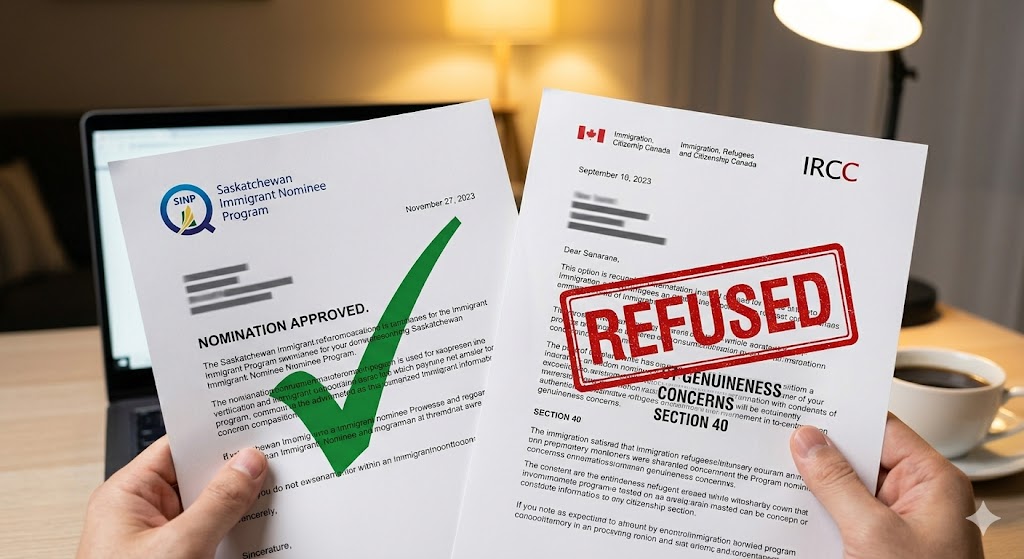
The case involved a work permit applicant who had a Saskatchewan Immigrant Nominee Program
nomination, a job offer, and a work permit support letter. IRCC still refused the work permit and found
misrepresentation because the officer was concerned about whether the applicant could perform the job
and whether the job offer was genuine.
The applicant won judicial review. But the lesson is not that every employer-backed work permit refusal can
be fixed in court. The better lesson is more practical: if IRCC questions your job offer, your ability to perform
the job, or your employer's capacity, you need to respond with evidence before the concern hardens into a
refusal or misrepresentation finding.
This work permit misrepresentation Canada issue matters for PNP-supported workers, employer-specific
work permit applicants, and employers who assume a provincial nomination or job offer makes the federal
work permit stage automatic. It does not.

Work permit misrepresentation Canada: what happened in Li?
Ms. Li had a job offer from a Saskatoon car repair business to work as an office manager. She also had a
Saskatchewan Immigrant Nominee Program nomination and a work permit support letter. Those facts made
the file look strong on the surface.
But IRCC looked deeper. The applicant had previously been refused a work permit because she had not
shown that she could perform the work sought. In the later application, she disclosed that previous refusal.
IRCC then invited her to an interview and asked her to bring documents, including pay slips, bank
statements showing payroll, tax and social insurance documents, and correspondence with the Canadian
employer.
At the interview, the officer asked questions about how she would perform duties in a car repair business.
The officer also reviewed employer-side evidence and questioned whether the employer had the capacity to
pay the offered wage and whether the job offer was genuine.
IRCC refused the work permit and found misrepresentation under section 40 of the Immigration and
Refugee Protection Act. That is serious. Misrepresentation can create a five-year inadmissibility
consequence, not just a refused application.
Can IRCC still question a job offer if you have a PNP support letter?
Yes, IRCC can still question the job offer, because a provincial nomination or PNP work permit support letter can be very helpful but it does not remove IRCC's role.
For an employer-specific work permit, the permit is tied to a specific employer, occupation, and location.
IRCC can still assess whether the person meets the work permit requirements, whether the offer is genuine,
whether the applicant can perform the work, and whether there are admissibility concerns.
That is where many applicants misunderstand the process. The province may have accepted the
nomination pathway, but IRCC still controls the federal work permit decision. Under IRPR section 200,
officers can look at the genuineness of the offer and other work permit requirements.
If your work permit is connected to a PNP file, compare the nomination support letter with our broader
provincial nominee program guidance. The provincial and federal stages should support each other, but
they are not the same decision.
What did the Court actually decide?
The Federal Court did not say that the applicant must receive a work permit. The Court said the decision was reached in a procedurally unfair manner.
The core fairness problem was timing and opportunity. The Court found that the applicant was not given a
full and fair opportunity to respond to the officer's concerns about the employer and the genuineness of the
job offer. The Court also noted that if an officer is going to rely on subjective assumptions, such as whether
experience in one type of business transfers to another, the reasoning needs a clear basis and the applicant
needs a fair chance to respond.
That is why the application for judicial review was granted and the matter was sent back to a different
officer.
For readers, this is the most important point: winning judicial review usually means the decision is set aside
and reconsidered. It does not mean the work permit is automatically approved. The applicant still has to
face the substance of the concerns again.
What if IRCC says you cannot perform the job?
Do not answer this type of concern with general confidence, because "I can learn" or "I am hardworking" may be true but may not be enough.
If IRCC questions your ability to perform the job, build a duty-by-duty response. Start with the job
description. Then match each major duty to evidence:
IRCC concern |
Evidence that may help |
Mistake to avoid |
You lack direct industry experience |
Prior management duties, transferable skills, training plan, employer onboarding details |
Saying the industry knowledge is "not important" without explaining why |
You cannot perform technical duties |
Course records, licences, prior tools/software, supervised training plan |
Ignoring duties that appear in the job offer |
Your previous work does not match the offered job |
Reference letters, pay records, organizational charts, detailed duty letters |
Submitting vague job letters with no real duties |
You gave a weak interview answer |
Written clarification, supporting documents, employer explanation |
Repeating that the application is "legal" without addressing the concern |
What this means: the best response is not a longer version of the original application. It is a focused
explanation that shows the officer exactly how your background connects to the offered role. If the job is in a
different industry, explain the transferable skills and the employer's training expectations directly.
If you received an interview request, procedural fairness letter, or work permit concern about your job
duties, book a focused work permit review. We can review the job offer, NOC or TEER alignment, prior
experience evidence, employer documents, and the risk of a misrepresentation finding before you respond.
What if the employer documents are weak?
Li also matters because the officer looked at the employer, not only the applicant. The concerns included whether the employer had submitted enough information and whether the business appeared able to support the offered wage.
This is common in employer-backed work permit files. The applicant may have strong personal documents,
but the employer evidence may be thin. That can create a genuine job offer Canada issue.
Employer evidence may need to explain:
what the business does
how long the business has operated
why the role is needed now
who currently performs the duties
whether the wage is realistic for the business
whether payroll and staffing records support the position
how the foreign worker was recruited or selected
whether the job duties match the business reality
Take Mei, for example. She has a PNP support letter and a job offer as an office coordinator for a small
business. IRCC asks why the employer needs a full-time coordinator when payroll records show only one
employee. Mei should not respond only with her resume and the job offer. She should ask the employer for
a business explanation, current staffing details, payroll or financial support, an organizational chart, a
role-need letter, and any evidence showing why the position is real and sustainable.
If the employer cannot provide those records, the decision tree changes. The file may need a narrower
explanation, a better employer package, a reconsidered timing strategy, or in some cases a decision not to
submit a weak response that creates a larger credibility problem.
Can a bad interview answer become misrepresentation?
Sometimes, yes, but not every weak answer is misrepresentation.
Misrepresentation under IRPA section 40 is about a direct or indirect misrepresentation, or withholding
material facts, that could induce an error in the administration of the Act. A confused answer, a bad
interview moment, or a weak explanation is not automatically misrepresentation. But if IRCC believes the
answer shows the job offer is not real, the applicant cannot perform the job, or the applicant withheld
important facts, the risk becomes serious.
This is why procedural fairness matters. A procedural fairness letter work permit response should not be
treated like a casual webform explanation. It may be the applicant's best chance to prevent a refusal and a
five-year inadmissibility finding.
If you are answering an IRCC concern, organize the response around the exact concern:
Identify what IRCC is worried about.
Correct any factual misunderstanding.
Attach objective evidence, not only explanation.
Explain inconsistencies directly.
Avoid blaming the officer, employer, or representative without proof.
Keep the tone calm, specific, and complete.
This is also where representation matters. If someone else prepared the application, the applicant still
needs to understand what was submitted in their name. Our recent article on work permit refusal and
compliance history is useful background if you are trying to understand how officer concerns can carry into
future applications.
What should you do if the refusal already happened?
If the refusal has already been issued, the next step depends on what the refusal says and how much time has passed.
A simple refusal may call for a corrected reapplication if the missing evidence can be fixed. A
misrepresentation finding is different. It may require urgent legal review because the consequences can
affect future temporary resident, permanent residence, and even PNP-supported strategies.
The decision tree usually looks like this:
Situation |
First move |
Why it matters |
Refusal only, no misrepresentation finding |
Review reasons and evidence gaps |
A stronger reapplication may be possible |
Procedural fairness letter received, no decision yet |
Prepare a full evidence response before the deadline |
This may be the best chance to prevent the finding |
Misrepresentation finding issued |
Check judicial review timing immediately |
Missing the deadline can close the strongest remedy |
Employer evidence was the problem |
Review whether the employer can now support the file |
Refiling with the same weak employer package may repeat the refusal |
If your refusal involved job duties, NOC, or whether your work experience matches the claimed role, also
read our article on NOC code mistakes after an ITA. The context is different, but the evidence lesson is
similar: duties and documents need to match the legal claim being made.
For refused applicants, we can help with a work permit refusal and misrepresentation review. The review
can look at the refusal letter, officer concerns, employer evidence, previous application history, and whether
the better path is judicial review, reconsideration, or a carefully rebuilt application.

How employers can prevent this problem
Employers often think their role ends once they sign the job offer. In employer-specific and PNP-supported
work permit files, that is risky.
The employer should be ready to explain why the role exists, how the wage will be paid, how the applicant
was selected, whether the duties match the business, and what training or onboarding will happen. If the
employer is small, new, seasonal, or has limited payroll history, the file needs even more care.
The IRCC work permit guide reminds applicants that employer steps and offer details can matter before a
work permit is filed. The employer-side story should be consistent from the job offer, to the portal or
LMIA-exempt submission, to the applicant's forms, to any interview answer.
If you are an employer supporting a foreign worker, the goal is not to write a dramatic letter. The goal is to
make the business reality easy to verify.
Bottom line for work permit applicants
Li v. Canada is helpful because the applicant succeeded in challenging an unfair process. But the case is
also a warning. A work permit file can fail even when there is a provincial nomination, a support letter, and a
real intention to work in Canada.
The strongest applicants do not wait for an interview to think about job duties. They prepare the duty match,
employer capacity evidence, previous refusal history, and explanation of inconsistencies before IRCC asks.
If IRCC does ask, they respond to the exact concern with evidence, not hope.
If your work permit depends on a Canadian employer, a PNP support letter, or a job offer that may raise
questions, the best time to fix the record is before a misrepresentation finding appears. Once that finding is
made, the file becomes harder, faster, and more expensive to repair.
Someone found inadmissible to Canada may still be able to enter temporarily with a temporary resident permit.
This article is for general information only and is not legal advice. Immigration rules, court deadlines, and
work permit evidence requirements can change, and every case depends on its own facts.