
What Is the Record of Landing (IMM 1000)? And What Replaced It

Updated: Sep 2
The Record of Landing (IMM 1000) is the paper Canada handed you the day you became a permanent resident, and years later it can still be the one document that proves exactly when your PR status began. It records your name, date of birth, and the date and place you landed, and if you immigrated in earlier years it remains your original proof of that status, from before the Confirmation of Permanent Residence (COPR) replaced it. IRCC explains its role in the official Verification of Status guide.
Why the Record of Landing still matters
Your Record of Landing is not just an old souvenir. It is the document that proves exactly when and where you became a permanent resident, and that date follows you for the rest of your immigration and benefits life. You may be asked for it when you apply for Canadian citizenship, and Service Canada may ask for proof of your immigration history when you apply for your pension. Lose it, and you cannot simply reprint one: you have to apply to IRCC for a replacement record, which takes time you may not have when a deadline is already running. Getting the document, and the landing date on it, right is worth the same care you would give any other part of your file.
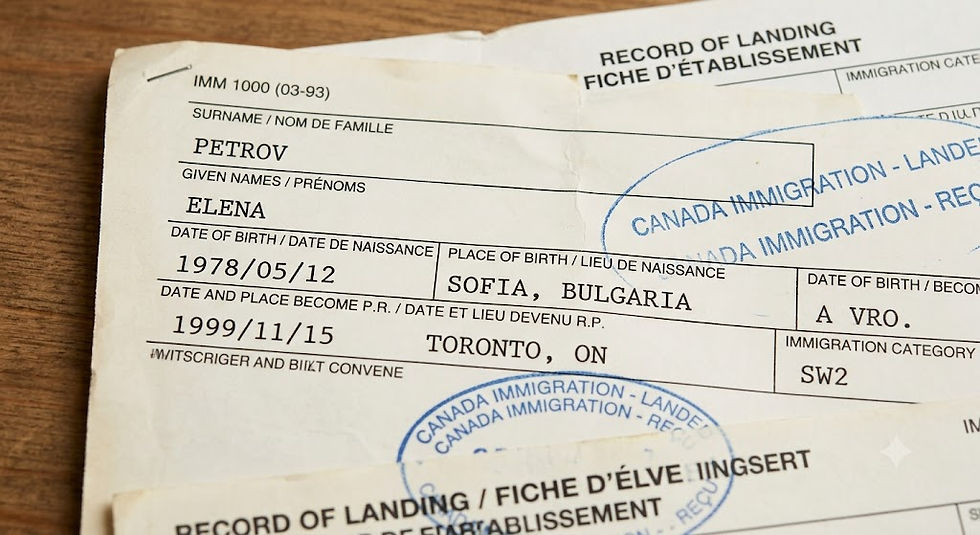
What the Record of Landing (IMM 1000) is and what it shows
The IMM 1000, officially the Immigrant Visa and Record of Landing, is a historical document. IRCC describes it as a record that "remains the property of the Government of Canada," even though you hold the physical copy. It captures the core facts of your landing:
Your full name as it was recorded at landing
Your date and country of birth
The date you became a permanent resident (your "landing date")
The place where you landed
The immigration category you were admitted under
Because it is a record of a past event, the Record of Landing does not lapse or need renewal. The information printed on it at the time of landing stays fixed, which is exactly why it works as lifelong proof of when your permanent residence began.
In practice, the people who contact us about a Record of Landing fall into two groups. The first is newcomers who confuse it with the Confirmation of Permanent Residence they were just handed and think something is missing. The second is long-settled permanent residents, or brand-new citizens, who suddenly need to prove their precise landing date for a pension or citizenship file and cannot find the original paper. Both situations are routine, and both have a clear path forward.
What replaced the Record of Landing
Canada replaced the Record of Landing with the Confirmation of Permanent Residence (COPR) in more recent years. People who became permanent residents in earlier years generally hold an IMM 1000, while those who landed later received a COPR, issued as form IMM 5292 or, more recently, IMM 5688. IRCC lists both the IMM 1000 and the IMM 5292 or IMM 5688 as landing documents in the same official guide, which is why they serve the same purpose one generation apart.
If you are not sure which document you hold, check the form number in the corner. The distinction matters less than the landing date on it: a Record of Landing and a COPR both prove the same thing, that you became a permanent resident on a specific day. Neither one is a landed immigrant status card, and neither one lets you travel: the PR card and the permanent resident travel document do that job.
What to do if you lost your Record of Landing
You cannot get a duplicate original of the IMM 1000. What you can get is a Verification of Status (VOS) document, which reproduces the information from your Record of Landing on plain paper. You apply using the Application for a Verification of Status or Replacement of an Immigration Document (IMM 5545) and its form, IMM 5009. As of July 2026, IRCC’s fee is $30 per document. The VOS is not an identity document and cannot be used for travel, but it is accepted as proof of your historical landing information.
If your Record of Landing exists but has an error on it, such as a misspelled name or wrong date of birth, that is a different request. You use the Request to Amend the Record of Landing, Confirmation of Permanent Residence or Valid Temporary Resident Documents (IMM 5218) to correct it. Fixing an error before it spreads into a citizenship or pension application saves you from explaining the mismatch later.
Not sure whether your situation needs a VOS, an amendment, or nothing at all? That is a 30-minute question you can put directly to Ansari Immigration's licensed RCIC for $80.
How the Record of Landing works when you become a citizen
Here is a detail most explainers miss, and it comes straight from IRCC’s own instructions to its officers. When a permanent resident becomes a Canadian citizen, IRCC updates the Record of Landing by stamping it "The holder is no longer a permanent resident." You are told, in your test, hearing, and ceremony notices, to bring your IMM 1000 to the appointment so it can be stamped, and it is handed back to you afterward because it still holds your personal information. If your document was lost or destroyed, you complete a solemn declaration instead. IRCC sets this out in its operational guidance on updating the Record of Landing on citizenship.
When we explain this to students, the key distinction is that the stamp does not erase the document’s history. It still proves the day you landed as a permanent resident, which is often exactly the fact a later application depends on.

Frequently asked questions about the record of landing
What is a Record of Landing in Canada?
It is the document, form IMM 1000, that Canada issued to new permanent residents when they landed, showing their name, date of birth, and the date and place they became a permanent resident. It has since been replaced by the Confirmation of Permanent Residence.
How do I get a copy of my Record of Landing?
You apply to IRCC for a Verification of Status document using form IMM 5545 and IMM 5009. IRCC issues the information on plain paper rather than a duplicate original. The fee is $30 per document as of July 2026.
What if I lost my Record of Landing?
Apply for a Verification of Status document with IMM 5545. It reproduces your landing information and is accepted as proof of when you became a permanent resident, though it cannot be used for travel or as identification.
Where can I find my Record of Landing number?
The reference number appears on the printed IMM 1000 itself. If you no longer have the document, a Verification of Status document obtained through IMM 5545 will contain the historical information from your original record.
Is the IMM 1000 the same as the IMM 5688?
They serve the same purpose in different eras. The IMM 1000 is the older Record of Landing; the IMM 5688 (or the earlier IMM 5292) is the Confirmation of Permanent Residence that replaced it. Both prove the date you became a permanent resident.
Do I need my IMM 1000 to apply for Canadian citizenship?
IRCC asks citizenship applicants who hold an IMM 1000 to bring it to their appointment so it can be stamped. If yours is lost, you complete a solemn declaration. Confirm the current requirements on the official IRCC citizenship pages before your appointment.
Related Posts
What Is a Confirmation of Permanent Residence (COPR) in Canada? — The modern landing document that replaced the Record of Landing, and how to read it.
What Is a Landed Immigrant in Canada? — What the older "landed immigrant" term means and how it relates to permanent resident status today.
What Is a Permanent Resident Travel Document (PRTD)? — The document permanent residents use to return to Canada when they are abroad without a valid PR card.
Why work with Ansari Immigration. Your Record of Landing proves the day your status in Canada began, and that date resurfaces years later in citizenship, pension, and PR card files. Every Ansari Immigration file is handled personally by the firm’s licensed RCIC, regulated by CICC, with document-expiry reminders that continue even after your file closes. Flat, transparent fees are quoted upfront, and a consultation is $80 for 30 minutes. Sat on an old landing document you can never quite find? Tell us in the comments what tripped you up, and book a consultation with Ansari Immigration when you want a straight answer, keeping it general since specific cases belong in a consultation. For where this fits your permanent residence path, see our permanent residence and Express Entry services.
This article is for general information only. It is not legal advice. Program criteria, requirements, processing times, and selection approaches can change without notice. Always confirm details on official government websites or consult a licensed Regulated Canadian Immigration Consultant (RCIC) for advice specific to your situation.


Comments