

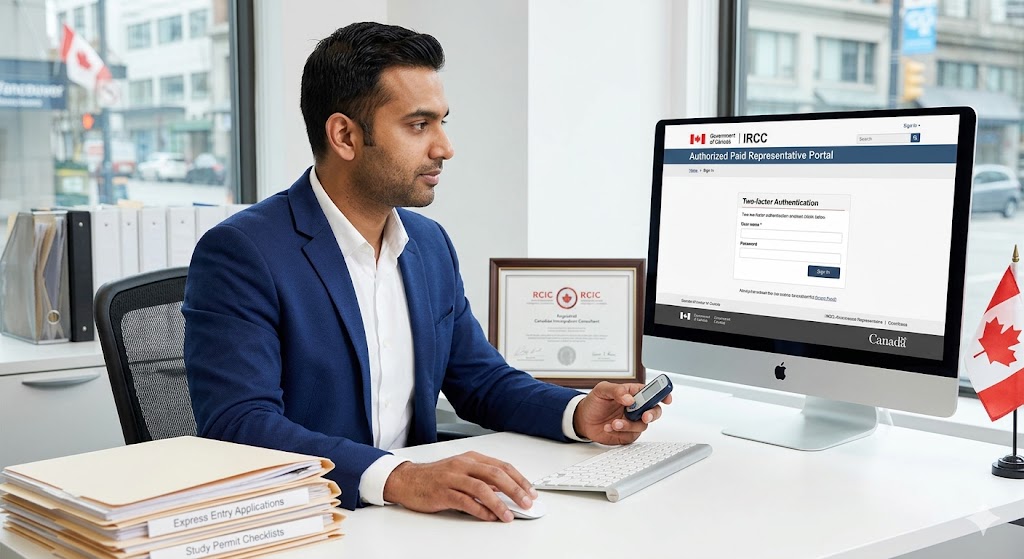
The authorized paid representative portal Canada is a secure IRCC online system that lets
licensed immigration professionals, such as Regulated Canadian Immigration Consultants
(RCICs) and immigration lawyers, submit and manage applications on behalf of their clients. If
you have hired someone to help with your immigration case, they are likely using this portal or
one of its companion systems to file your paperwork.
Understanding how the APR portal works can help you ask better questions of your
representative and know what to expect during the application process.
What is the authorized paid representative portal?
The APR portal is one of three separate IRCC portals available to authorized paid
representatives. IRCC designed it specifically for representatives; it is not the same as the
applicant portal that you log into to check your own application status.
An authorized paid representative is anyone who charges a fee for immigration services and is a
member in good standing of a recognized professional body. In Canada, this includes:
Regulated Canadian Immigration Consultants (RCICs) licensed by the College of
Immigration and Citizenship Consultants (CICC)
Members of a Canadian provincial or territorial law society
Members of the Chambre des notaires du Quebec
Representatives who are not members of one of these bodies are not permitted to charge fees
for immigration services.
The three portals: which one does your representative use?
IRCC provides three separate portals for authorized representatives. Each handles a different
category of applications.
APR Portal
Used for the majority of temporary and economic applications, including:
Visitor visas, study permits, and work permits
Express Entry applications
International Experience Canada (IEC)
Electronic travel authorization (eTA)
Interim Federal Health Program (IFHP)
Permanent Residence Portal
Used for all non-Express Entry permanent residence applications, including:
Family sponsorship (spousal, parental, dependent children)
Provincial Nominee Program (non-Express Entry)
Atlantic Immigration Program, Start-up visa, refugee and humanitarian applications
IRCC Portal for Representatives
Used for in-Canada refugee claims and certain temporary resident visas.
Your representative will choose the correct portal based on the type of application they are filing
for you. It is common for a client to have applications processed through more than one portal
over the course of their immigration journey.
Why does this matter if you are an applicant?
If you have hired an RCIC or immigration lawyer to manage your file, you will not log into the
APR portal yourself. Your representative accesses it with their own credentials and submits
everything on your behalf.
What this means for you practically:
Your representative sees your file through a different interface than you do
Changes to your application are initiated from the representative's portal account
Documents uploaded by your representative appear on your IRCC account after
submission
If you want to track your application independently, you do so through your own IRCC
If your representative asks you to share your own IRCC login credentials, that is a red flag. They
should never need your personal login; they have their own portal access.
How do representatives enrol in the APR portal?
Before a representative can use the APR portal, they must be enrolled through IRCC's enrolment
process. This requires proof of membership in good standing with a recognized regulatory body.
RCICs provide their CICC licence number; immigration lawyers provide their law society
membership details.
IRCC verifies the membership before granting access. This is part of how IRCC ensures that
only legitimate, licensed professionals can submit applications through the representative
portals.
If you are working with an RCIC and want to verify that they are authorized, you can search the
CICC public register to confirm their licence is active. Amir Ansari, RCIC, is licensed and in good
standing; his registration is publicly verifiable.

Express Entry, work permits, and family sponsorship applications at Ansari Immigration are
handled through the authorized representative portals, with full accountability under CICC
regulation.
Frequently asked questions about the authorized paid representative portal Canada
Can I use the APR portal myself as an applicant?
No. The APR portal is only for authorized paid representatives. Applicants manage their own files through a separate IRCC secure account at canada.ca.
What is the difference between the APR portal and the IRCC portal?
Both portals are used by authorized representatives, but they handle different application types. The APR portal covers temporary permits and Express Entry. The IRCC portal for representatives handles in-Canada refugee claims and certain visitor visa applications. A third portal, the PR portal, handles most permanent residence applications.
How do I know if my representative is actually authorized to use the portal?
You can verify any RCIC's licence through the College of Immigration and Citizenship Consultants public register. For immigration lawyers, check the relevant provincial law society website.
Does using an authorized representative speed up my application?
IRCC does not process applications faster because a representative submitted them. However, a licensed representative can reduce errors, submit complete documentation the first time, and respond correctly to IRCC requests, all of which reduce delays caused by incomplete or incorrect applications.
What happens if my RCIC loses their licence?
If your representative loses their authorization while your application is being processed, IRCC will typically notify you and may put your file on hold. You would then need to either proceed without a representative or hire a new licensed professional. This is one of several reasons to verify your representative's licence status before hiring them.
Why work with Ansari Immigration
Flat, transparent fees quoted upfront. Every Ansari Immigration file is handled personally by the firm's licensed RCIC, start to finish: all forms, IRCC correspondence, webforms and follow-ups included, with direct access to your consultant throughout. No juniors, no call centers. Practicing since 2019, 6,000+ cases.
Have you used the APR portal to check on a representative? Share how it went in the comments, keep it general. For advice on your own application, book an $80, 30-minute consultation with Ansari Immigration.
This article is for general information only. It is not legal advice. Program criteria, requirements, processing times, and selection approaches can change without notice. Always confirm details on official government websites or consult a licensed Regulated Canadian Immigration Consultant (RCIC) for advice specific to your situation.