


A case processing centre (CPC) is an IRCC office in Canada that receives and processes immigration and citizenship applications, mostly from people already in Canada. CPCs are not open to the public, do not advise on individual files, and you cannot choose which one handles yours: IRCC assigns it by application type.
CPC Ottawa is the IRCC case processing centre that handles visitor visa (temporary resident visa) applications filed from inside Canada by people who already hold a valid study or work permit, plus permanent resident visa applications from the United States and Canada once another office has checked them for completeness. It is not open to the public and it publishes no phone line. In practice the centre is set by application type: IRCC's office index lists each centre by the work it processes, not by where applicants live.
In the files Ansari Immigration sees go sideways, the centre itself is almost never the problem. The problem is an applicant mailing paper to an address that belongs to a different IRCC office in the same Ottawa building.
That is not a small risk. IRCC's own Case Processing Centre: Ottawa page puts it plainly: "Complete addresses must be listed on all packages. Documents sent without complete addresses risk being misdirected or returned to sender causing application processing delays." A returned package means IRCC never received your application, so no processing clock ever started. If your permit is running out while your envelope travels back to you, the delay lands on you.
Which case processing centre has your file
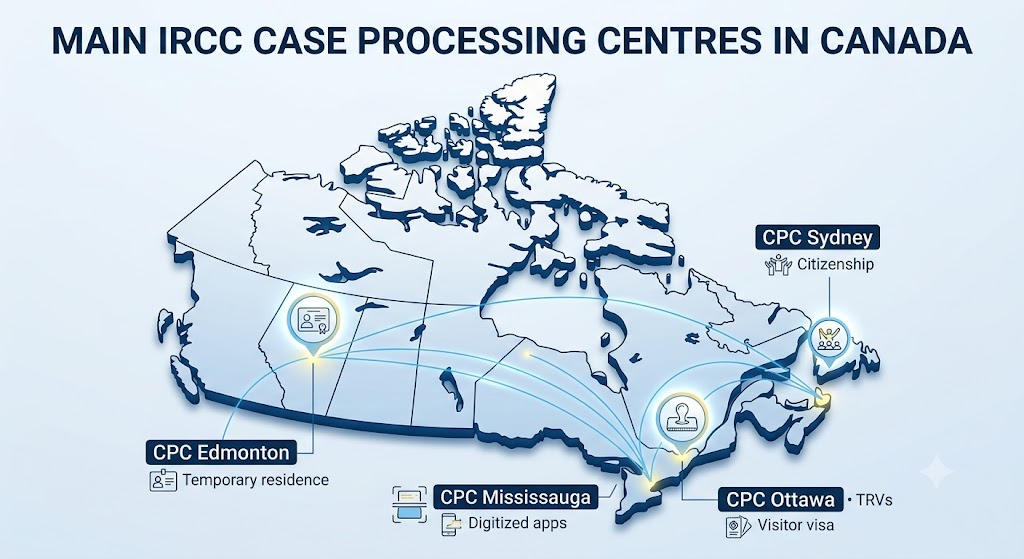
Every centre below sits inside Canada, none of them is open to the public, and each one owns a different slice of the work. The processing times are IRCC's own current figures, which lets you sanity check whether your file is actually late or simply sitting in a normal queue.
Office |
What it processes |
Current IRCC processing time |
CPC Ottawa |
Visitor visa (temporary resident visa) applications submitted in Canada by applicants holding a valid study or work permit, and permanent resident visa applications from the US and Canada after CPC Mississauga or CIO Sydney has checked them for completeness |
11 days for the in-Canada visitor visa |
CPC Edmonton |
Visitor records and extensions of stay as a visitor |
393 days |
CPC Edmonton |
Study permit extensions |
62 days |
CPC Edmonton |
Work permit extensions |
107 days |
CPC Sydney |
New permanent resident cards |
35 days |
CPC Sydney |
PR card renewals |
38 days |
CPC Sydney |
Citizenship: grants, proof of citizenship, searches, renouncing, revoking and resuming. Also family sponsorship |
Published separately by application type |
CPC Mississauga |
Family sponsorship, permanent residence for protected persons and Convention refugees in Canada, PR for the temporary resident permit holder class |
Published separately by application type |
CIO Sydney |
Intake for the Federal Skilled Worker Program, Federal Skilled Trades Program, Canadian Experience Class, Provincial Nominee Program, Start-up Visa, Self-Employed Persons and the Quebec economic programs |
Published separately by program |
OSC Ottawa |
International Experience Canada work permits, in-Canada temporary resident applications submitted online, verification of status, replacement and amendment of documents |
IEC 6 weeks, verification of status 11 weeks, replacement 8 weeks, amending a valid temporary resident document 8 weeks, amending an immigration document 11 weeks |
Source: IRCC, Find an IRCC office and IRCC's published processing times. Verified October 2026; the processing-time figures were last updated by IRCC on September 22, 2026. IRCC publishes processing times by application type, not by office, so the times above are matched to each centre's work rather than quoted as an office-wide figure. Processing times move monthly and are an estimate, not a maximum or a guarantee.
Two things in that table surprise most people. The first is that there is no single "immigration office" handling your whole journey: a student who extends a study permit, then applies for a visitor visa to travel at Christmas, then later renews a PR card has dealt with three different centres in three provinces. The second is the gap between 11 days and 393 days, which is covered below, because it is the single most consequential number on this page.
What CPC Ottawa processes, and the two Ottawa addresses people mix up
CPC Ottawa's public-facing office page describes one function: the Temporary Resident Visa Section, processing visitor visa applications made from within Canada. That is the work behind the 11-day figure above, and it is why most people who search for CPC Ottawa are study or work permit holders who need a valid visa in their passport before they travel.
The trap is the second Ottawa office. The Operations Support Centre, OSC Ottawa, sits at the same street address and handles a completely different list: International Experience Canada work permits, in-Canada temporary resident applications filed online, verification of status, and the replacement or amendment of documents. Compare the two:
Office |
Mailing address |
Courier address |
CPC Ottawa, Temporary Resident Visa Section |
P.O. Box 8780 STN T CSC, Ottawa, Ontario K1G 5A9 |
365 Laurier Avenue West, Ottawa, Ontario K1A 1L1 |
Operations Support Centre (OSC) |
P.O. Box 8784 STN T CSC, Ottawa, Ontario K1G 5J3 |
365 Laurier Avenue West, Ottawa, Ontario K1A 1L1, published for verification of status or replacement of an immigration document only |
Source: IRCC, Case Processing Centre: Ottawa, Ontario and Operations Support Centre: Ottawa, Ontario. Verified October 2026.
Read those two rows again. Same street, same courier postal code, post office box numbers four apart, and mailing postal codes that differ by only two characters. Someone copying an address off a forum thread, or off a guide they downloaded two years ago, will not notice. The OSC page carries its own flat note: "Note this office is not open to the public."
A note on the box number people keep searching for. An old pairing, P.O. Box 9640 with the postal code K1G 6T2, still circulates in guides and forum threads. As of October 2026, neither appears on IRCC's current Case Processing Centre: Ottawa page, which gives P.O. Box 8780 STN T CSC, Ottawa, Ontario K1G 5A9. IRCC updates these addresses periodically and old guides keep circulating afterwards. Confirm the address in the instruction guide for your own application, then cross-check it against IRCC's office page before anything leaves your hands.
Why you cannot phone or visit a case processing centre
No case processing centre publishes a phone number for applicants or accepts walk-ins. IRCC states that case processing centres, the Centralized Intake Office and the Operations Support Centre are not open to the public. The centres are back-office operations: they open mail, digitize it, and process files in queue order.
This answers the question people actually type, which is some version of "how do I contact CPC Ottawa." You do not contact the centre. You contact IRCC, and IRCC routes the enquiry. The working channels are your IRCC secure account, the IRCC web form, and the client support centre. If your application is genuinely past the posted processing time, the route is an IRCC case specific enquiry, not a phone call to Ottawa. Our guide to how to contact IRCC sets out each channel and what it can realistically do.
One more thing worth knowing before you spend an afternoon on it. The acronym CPC also belongs to the Canadian Police College, and to federal employee directory listings, both of which clutter the search results for anyone looking for the immigration office. Neither is an application intake channel, and neither will have any idea what your file is.
Mailing traps that send applications to the wrong province
Three of these come up again and again, and all three are the kind of thing that only shows up once the envelope has already gone.
The Mississauga centre's mail does not go to Mississauga. IRCC's own page for CPC Mississauga gives a mailing address of ATTN: CPC-M, IRCC Digitization Centre, PO Box 12153, Station A, Sydney, Nova Scotia B1P 0L1, and a courier address of ATTN: CPC-M, IRCC Digitization Centre, 3050 Wilson Avenue, New Waterford, Nova Scotia B1H 5V8. The page says this office "only processes digitized applications and documents." If you address a family sponsorship package to an Ontario street because the centre is named Mississauga, it is going to the wrong place, and the ATTN line is not optional.
CPC Edmonton needs a station number, not just a street. Every Edmonton address shares the same building, 9700 Jasper Avenue NW, Suite 55, Edmonton, Alberta T5J 4C3, and then splits by application type into station numbers: visitor applications to Station 303, study permits to Station 101, work permits with a new employer to Station 555, extensions with the same employer to Station 202, spousal work permits to Station 777. IRCC publishes a different station number for each application type, so the station line is what routes your package once it reaches the building.
Courier and regular mail are frequently different addresses. CPC Ottawa, the OSC, CPC Mississauga and CPC Sydney all publish one address for ordinary mail and a different one for couriers. Couriers generally cannot deliver to a post office box, which is why the courier line exists. Picking the wrong one of the two is the most common version of the mistake IRCC's own warning about misdirected packages is describing.
Have you had a package returned or misrouted by IRCC? What address were you given, and where did it come from? Real examples in the comments help the next person more than any guide does.
Three signs the centre is not your real problem: your file is still inside the posted processing time and nothing has been requested from you; the status has changed at least once since submission; and the address you used came from the instruction guide for your exact application, not from a forum. If any of those three is missing, the thing to check is your submission, not the queue. Ansari Immigration has handled more than 6,000 cases since 2019, which means most versions of "is my file stuck or is this normal" have crossed this desk before. Book a 30-minute consultation for $80 and get a direct read on which it is.
11 days or 393 days: why your centre changes the decision
Knowing which centre handles your application type can be the difference between an 11-day wait and a 393-day one, because the two documents that sound interchangeable to an applicant are processed by different centres on wildly different timelines. Here is how that plays out in practice.
Picture a software developer in Burnaby on a closed work permit valid until next August. Her multiple-entry visitor visa expired last year. Her sister is getting married overseas in February and she needs to be able to re-enter Canada afterwards. She has two instincts, and they lead to wildly different places.
The first instinct is to "extend her status" so everything is current before she travels. An application to stay longer as a visitor produces a visitor record, which is processed at CPC Edmonton. IRCC's current posted time for that is 393 days. It would also be the wrong document: a visitor record is an in-Canada status document, not a visa, and IRCC says it "doesn't guarantee that you can leave and then re-enter Canada." Returning requires a valid entry document such as a visitor visa or an eTA.
The second route is the right one. Her work permit is already valid until August, so her status is not the issue. What she needs is a valid visa in her passport to re-enter, which means a temporary resident visa applied for from inside Canada: CPC Ottawa's file, posted at 11 days. Her expired multiple-entry visa is what makes her eligible for that route in the first place. She applies in November, her passport goes in and comes back, and she flies in February with months to spare.
Same person, same trip, two routes separated by more than a year of posted processing time, because one route is a travel document and the other is an in-Canada status document. IRCC's guidance on applying for a visitor visa from inside Canada recommends applying at least two months before you plan to leave Canada, which builds in room for the passport to travel both ways. We walk through the mechanics in how to apply for a TRV inside Canada, and the document she does not need is explained in what is a visitor record in Canada.
The eligibility conditions for the CPC Ottawa route are narrow, and they are worth checking before you count on 11 days. IRCC's page requires that you meet all four: you are already in Canada, you hold a valid study or work permit, you want to leave and return to Canada in the near future, and you already have a visitor visa that has expired, is about to expire, or was valid for only one entry. Miss any of those four and your application does not belong at CPC Ottawa at all.
Why paper is now the exception, not the route
For the in-Canada visitor visa that CPC Ottawa handles, online is the default and paper is a narrow carve-out: IRCC's page says "You need to apply online in your IRCC secure account," and allows a paper application only where you cannot apply online because of a disability, an exceptional circumstance beyond your control, or a specific situation the IRCC secure account questionnaire does not cover, such as travelling on an alien's passport. If none of those describes you, applying on paper is not a shortcut, it is a detour.
A parallel rule covers applicants outside Canada, and it is worth knowing because it explains why the mailing addresses that survive are mostly in-Canada ones. Ministerial Instructions 62, signed on March 30, 2023 and effective April 1, 2023, directs that "All applications for a temporary resident visa (including a transit visa), a work permit, or a study permit submitted for foreign nationals who are outside Canada at the time of application must be submitted using electronic means (apply online)." It is made under section 87.3 and subsections 92(1.1) and (2) of the Immigration and Refugee Protection Act. MI62 lists its own exemptions, including applicants who cannot apply online and need accommodation, holders of certain non-national travel documents, and seasonal agricultural workers applying under an international agreement.
MI62's mandate is scoped to applicants outside Canada, so it does not reach the in-Canada streams at all. That is consistent with CPC Ottawa still publishing post office boxes: the paper that still moves is overwhelmingly paper from people already here.
Why CPC Ottawa has your PR file but publishes no PR address
If you have been told your permanent residence application is at CPC Ottawa, and you then go looking for somewhere to send a document, you will find a page that does not mention permanent residence at all. That is not an error, and the explanation is sitting in a parenthetical most readers skip.
IRCC's Find an IRCC office index, updated August 14, 2026, says the CPC in Ottawa processes "visitor visa (temporary resident visa) applications submitted in Canada by applicants with a valid study or work permit" and also "permanent resident visa applications submitted from the United States and Canada (after CPC Mississauga or CIO Sydney receives them and checks their completeness)." That last clause is the whole answer. Permanent residence files reach CPC Ottawa only after another office has received them and checked them for completeness, which is why CPC Ottawa publishes no permanent residence mailing address: you never send a PR package there in the first place. Its own office page, last modified December 8, 2023, simply does not mention the function.
The practical rule that follows is the safe one in every case: the address that governs is the one in the instruction guide for your specific application, or the one in the letter IRCC sent you asking for the document. An office page tells you who has your file. It is not a substitute for your own application's instructions. The same pattern explains CPC Mississauga, where the index lists family sponsorship and protected-persons permanent residence while the centre's own page says it handles only digitized applications and documents. Both are true and they describe different layers of the same process, but neither page explains the other.
From Amir's desk
Case processing centres are simply the offices where IRCC officers sit and process files. They are not a service counter, and there is no version of calling one to move your application up the queue or to have it reassigned somewhere faster. When clients come to us convinced their file is lost because nobody will talk to them about it, the file is almost always exactly where it should be, in a normal queue, and the correct move is the IRCC account or the web form rather than a phone hunt.
What is worth your attention instead is whether anything was requested from you and you missed it. A file that looks stalled is sometimes a file waiting on the applicant. Check your account messages and your junk folder before you assume the centre is the bottleneck, and if you are past the posted time with nothing outstanding on your side, escalate through the proper channel.
What to do when your file sits too long at a case processing centre
Work through this in order, because each step rules out the cheaper explanation first.
Confirm the current posted processing time for your exact application type on IRCC's processing times page, and count from the date IRCC received your application, not the date you submitted payment.
Check your IRCC secure account and your email, including spam, for a request for documents, biometrics, a medical exam, or a passport. An unanswered request stops the clock on your side.
Confirm the application actually arrived, if you sent paper. A package that was returned to sender was never received, and the processing clock never started.
Submit an IRCC web form or case specific enquiry once you are genuinely past the posted time with nothing outstanding from you.
Consider ordering GCMS notes if the enquiry produces nothing, since the notes show what has actually happened on the file.
Treat a Federal Court application as the last step, not the first. A writ of mandamus is available where a decision is unreasonably delayed, and it is a real remedy, but it is not the answer to a file that is three weeks past an estimate.
Why this matters for your immigration application
Knowing which case processing centre holds your file converts two of the most common self-inflicted delays into non-events. You stop mailing documents to an office that does not process your application type, and you stop measuring your wait against the wrong number. A visitor record applicant comparing their eighth month to CPC Ottawa's 11 days will conclude something has gone badly wrong, when 393 days is the posted figure for what they actually applied for.
It matters most on the applications where timing compounds. A permanent residence file that sits unanswered because a requested document went to the wrong province is not just a delayed file; it can expire a medical exam, a police certificate, or a passport, and each of those is another round trip. The same is true in reverse: a PR card renewal sent correctly to CPC Sydney and tracked against the right posted time is a non-event, which is exactly what you want from administrative work.
For anyone in Metro Vancouver, there is no local processing centre and there is no advantage to being closer to one. Every centre in the table above is in Alberta or further east, the nearest being CPC Edmonton, and none of that changes the queue. Distance is not a factor; application type is the only thing that is.
Frequently asked questions about CPC Ottawa
What is CPC Ottawa?
CPC Ottawa is the IRCC case processing centre that processes visitor visa, or temporary resident visa, applications submitted from inside Canada by applicants who already hold a valid study or work permit. It is a back-office processing site, not an office you can visit or call.
How do I contact CPC Ottawa?
You cannot contact CPC Ottawa directly, because no case processing centre publishes a phone number or email address for applicants, so enquiries go to IRCC instead through your IRCC secure account, the IRCC web form, or the client support centre. If your application is past the posted processing time and nothing has been requested from you, a case specific enquiry is the right channel.
What is the CPC Ottawa address?
IRCC's current Case Processing Centre: Ottawa page gives a mailing address of Temporary Resident Visa Section, Case Processing Centre Ottawa, P.O. Box 8780 STN T CSC, Ottawa, Ontario K1G 5A9, and a courier address of 365 Laurier Avenue West, Ottawa, Ontario K1A 1L1. Always confirm against the instruction guide for your own application before mailing, since addresses differ by application type and are updated periodically.
Can I visit an IRCC office without an appointment?
No case processing centre accepts walk-ins, and IRCC states that case processing centres, the Centralized Intake Office and the Operations Support Centre are not open to the public at all. IRCC does have offices across Canada that see clients, but you can only visit one if you have an appointment.
What is CPC in immigration?
In Canadian immigration, CPC stands for case processing centre, an IRCC office inside Canada that receives and processes applications, mostly from people who are already in the country. There are several, each handling different application types, and you cannot choose which one gets your file.
Is CPC Ottawa the same as the Operations Support Centre in Ottawa?
No, they are two separate IRCC offices that share the street address 365 Laurier Avenue West but have different post office boxes and handle different work. CPC Ottawa processes in-Canada visitor visa applications, while the Operations Support Centre handles International Experience Canada work permits, in-Canada online temporary resident applications, verification of status, and document replacement and amendment.
Which case processing centre processes PR cards and citizenship applications?
CPC Sydney in Nova Scotia processes permanent resident card applications, both new cards and renewals, along with citizenship work that IRCC's office index describes as new grants, renouncing, revoking and resuming, plus proof of citizenship and citizenship searches. Its mailing addresses differ by application type, so a PR card package and a citizenship package go to different post office boxes, and its courier address is the IRCC Digitization Centre at 3050 Wilson Avenue, New Waterford, Nova Scotia B1H 5V8.
What does a CPC/SCP charge on my credit card have to do with immigration?
Nothing that we could confirm on any official IRCC page, so treat the acronym overlap between a CPC/SCP line on a bank statement and IRCC's case processing centres as a coincidence rather than evidence that an immigration fee was charged. As of October 2026, IRCC does not publish anywhere that its fees appear under that descriptor. To check whether IRCC charged you, open your IRCC secure account and match the receipt against the amount and date on your statement, then raise anything you still cannot account for with your bank.
Related Posts
How to Apply for a TRV Inside Canada: For Work and Study Permit Holders (2026): The step-by-step process behind the CPC Ottawa file, including who qualifies to apply from inside Canada and what happens to your passport.
IRCC Case Specific Enquiry: How to Ask About Your Delayed Application (2026): The correct channel for chasing a file that is past its posted processing time, and what to write.
Does IRCC Work on Weekends? Hours, Processing Times, and What to Expect: When applications actually move inside IRCC and why your status can change on a Saturday.
Talk to Ansari Immigration about the file you are waiting on
Why work with Ansari Immigration. Flat, transparent fees quoted upfront, with no surprise add-ons. Every file is handled personally by the firm's licensed RCIC regulated by CICC, start to finish, including forms, IRCC correspondence, web forms and follow-ups, with a reply within one business day. No juniors, no call centers, and document-expiry reminders continue even after your file closes.
If you are not sure whether your application is genuinely delayed or simply sitting in a normal queue at a case processing centre, a 30-minute consultation for $80 will tell you which, and what to do about it. And if something on this page did not match what you were told, ask in the comments, we read every one. Keep it general, and for advice on your own file use a consultation.
This article is for general information only. It is not legal advice. Program criteria, requirements, processing times, and selection approaches can change without notice. Always confirm details on official government websites or consult a licensed Regulated Canadian Immigration Consultant (RCIC) for advice specific to your situation.