


A labour market impact assessment is a document a Canadian employer usually needs from Employment and Social Development Canada before hiring a foreign worker. A positive LMIA does not give you a work permit. It lets you apply for one, and IRCC then tests the same job offer again, separately.
That second test is where most of this goes wrong, and almost nothing published explains it. Employment and Social Development Canada decides whether the job should go to a foreign worker. IRCC decides whether the offer behind it is genuine, and whether you personally can do the work. Two departments, two decisions, one job offer. A positive LMIA clears the first and says nothing about the second.
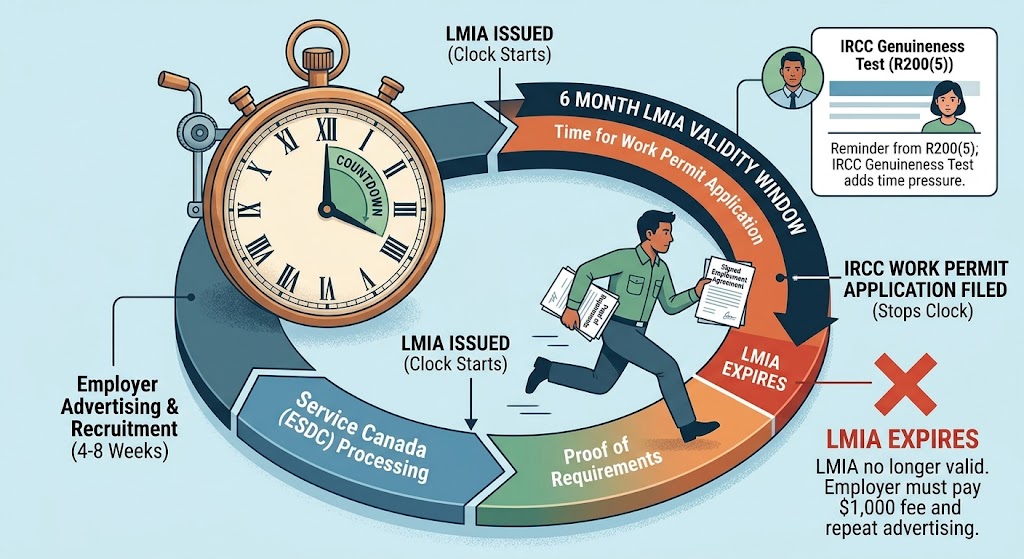
The stakes are concrete. In practice the problem is almost never the LMIA itself, it is what the employer did or failed to do after it was issued. An LMIA is valid for up to six months. If your work permit is refused inside that window and the employer has to start over, the LMIA expires and they pay the $1,000 fee and run the advertising again, four consecutive weeks for a high-wage position and eight for a low-wage one, assuming they are still willing to.
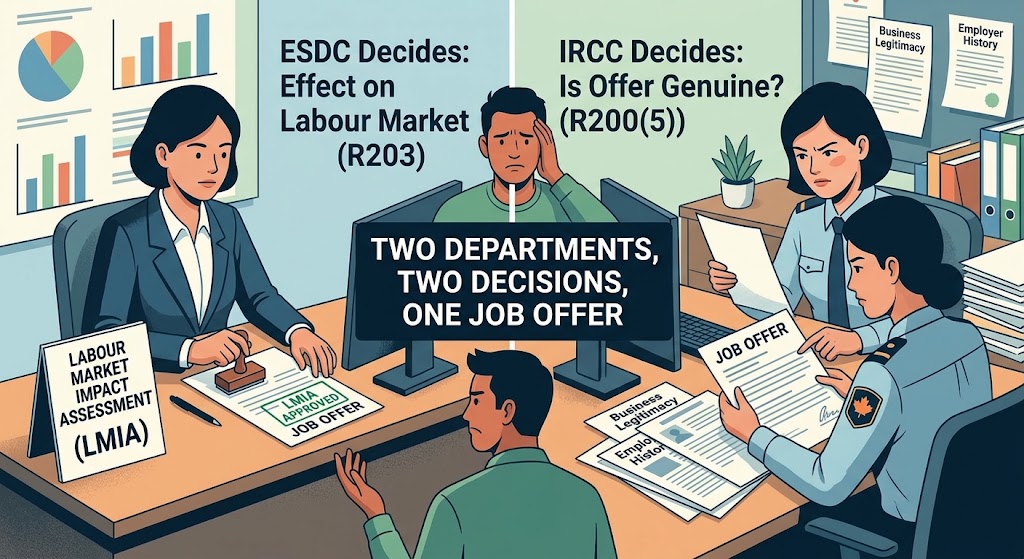
What a labour market impact assessment actually is, and who applies for one
The employer applies, not the worker. IRCC's own definition is deliberately cautious: a labour market impact assessment is "a document that an employer in Canada may need to get before hiring a foreign worker." The word may is doing real work in that sentence, because a large share of foreign workers in Canada never need one.
The assessment asks one question: will hiring this foreign worker have a positive, neutral or negative effect on the Canadian labour market. Employment and Social Development Canada, through Service Canada, answers it. If the answer is positive or neutral the employer gets a positive LMIA, sometimes called a confirmation letter. If it is negative, there is no work permit to apply for on that offer.
Three things follow from the employer owning the application, and all three catch workers out:
You cannot buy, apply for, or hold your own LMIA. An offer to sell you one is a fraud indicator, not a service.
You do not control the timeline. The employer's advertising, documents and responsiveness set it.
If the employer loses interest, your file stops. There is no mechanism for you to continue without them.
What the employer must hand you. Once the LMIA is positive, the employer has to give you a signed employment agreement in your choice of English or French, plus "a copy of the LMIA letter and the Annex A to the temporary foreign worker (required to obtain a work permit to work in Canada)." Annex B stays with the employer and is not shared with you, for privacy reasons. If an employer tells you they cannot give you the LMIA letter, that is not a rule, and it is worth asking why.
Gather these before you start your work permit application:
A copy of the positive LMIA letter
Annex A
The LMIA number
The signed employment agreement or job offer letter
Proof you meet the job requirements set out in the LMIA
What an LMIA costs, how long it takes, and how long it lasts
The processing fee is $1,000 per position requested, paid by the employer. Service Canada publishes average LMIA processing times by stream, and they are not interchangeable: the same job can wait 10 business days or 156 depending on which stream it sits in.
LMIA stream |
Average processing time (business days) |
Seasonal Agricultural Worker Program |
6 |
Global Talent Stream |
10 |
Agricultural Stream |
25 |
Low-wage Stream |
82 |
High-wage Stream |
90 |
Permanent Resident Stream |
156 |
Source: Labour Market Impact Assessment application processing times, Employment and Social Development Canada, August 2026 data. Verified October 2026.
Read that table with one correction in mind, because it is the single most common misreading of LMIA processing time. Those averages run from the point Service Canada has a complete application. The required advertising has to be finished before the employer applies at all, four consecutive weeks for high-wage, eight for low-wage and 14 calendar days for the agricultural stream, so none of that time sits inside the published figure. A high-wage LMIA advertised for the minimum four consecutive weeks and then processed in the published 90 business days is already past the five-month mark before you file anything.
Six months, then it is gone. Positive decisions on LMIA applications received as of May 1, 2024 are valid for up to six months. ESDC states it plainly: "If the temporary foreign worker hasn't applied by that date, the LMIA is no longer valid and employers must apply for a new LMIA to hire a temporary foreign worker." The Seasonal Agricultural Worker Program is outside this rule, and Service Canada can issue an LMIA with a shorter validity for things like emergency or warranty work. Everyone else is on a six-month clock that starts the day the letter is issued, not the day you receive it.
Does any of this sound like it is drifting past your own permit expiry? That is the point at which a 30 minute conversation is cheaper than a restoration application. Have the timing read before you commit to it.
Book a consultation ($80, 30 min)
High wage or low wage: the threshold that decides your stream
Your wage decides which stream the employer applies under, and the rule changed. The threshold is not the provincial median hourly wage. It is the median plus 20 percent, and the current figures took effect on July 17, 2026. If the offered wage is at or above the threshold it is a high-wage application; below it, low-wage.
This is worth saying bluntly because the pages currently ranking for this topic, and the AI answers built on them, still describe the split as at or above the provincial median. That was true once. It is not the rule now, and an employer who budgets to the old number lands in the low-wage stream with caps, a refusal to process screen and a different set of obligations they did not plan for.
Province or territory |
Hourly wage threshold |
British Columbia |
$38.40 |
Alberta |
$37.50 |
Ontario |
$36.92 |
Quebec |
$36.00 |
Saskatchewan |
$34.62 |
Newfoundland and Labrador |
$33.60 |
Nova Scotia |
$31.96 |
New Brunswick |
$31.73 |
Manitoba |
$31.33 |
Prince Edward Island |
$31.20 |
Northwest Territories |
$48.00 |
Yukon |
$45.60 |
Nunavut |
$45.00 |
Source: Temporary Foreign Worker Program wage thresholds, Employment and Social Development Canada, effective July 17, 2026. Verified October 2026.
What changes on each side of that line. A high-wage application generally carries a transition plan, at least four consecutive weeks of advertising within the three months before applying, a business legitimacy assessment, and employment duration of up to three years. A low-wage application instead runs into a cap: "There's a 10% cap on the proportion of temporary foreign workers that you can hire in low-wage positions at a specific work location." Construction, food manufacturing, hospitals, and nursing and residential care facilities sit at 20 percent. On-farm primary agriculture, caregiving in healthcare institutions, positions of 120 calendar days or less that are genuinely one-off or highly mobile, and seasonal positions of 270 days or less, carry no cap at all. An employer with fewer than 10 employees at a work location can hire one temporary foreign worker at the 10 percent cap, or two at 20 percent.
Low-wage applications also meet a screen that has nothing to do with the employer's merits: since September 26, 2024, applications for positions below the provincial threshold located in a census metropolitan area with an unemployment rate of 6 percent or higher are refused processing. That screen has carve-outs, and they matter: primary agriculture, construction (NAICS 23), food manufacturing (NAICS 311), hospitals (NAICS 622), nursing and residential care facilities (NAICS 623), in-home caregivers, applications in support of permanent residence only, and most positions of 120 calendar days or less are still processed regardless of the local unemployment rate. Our refusal to process LMIA explainer covers what an employer can do when that lands, and the high-wage versus low-wage comparison goes through the recruitment, transport and housing differences in full.
The BC addition. Employers in British Columbia, Manitoba and Nova Scotia must hold a provincial employer registration before the LMIA application is submitted. In BC that is registration under the Temporary Foreign Worker Protection Act, and an application without it is incomplete. Saskatchewan works differently: it requires a certificate of registration under The Immigration Services Act before an employer recruits a foreign national on an employer-specific work permit. Vancouver employers hiring for the first time routinely discover this after they have already advertised.
The second test, and why a positive LMIA does not guarantee a work permit
A positive LMIA satisfies Employment and Social Development Canada. It does not satisfy IRCC, which runs its own genuineness assessment on the same offer before issuing the permit. This is the step that is missing from essentially every guide to this subject, and it is the step that produces the refusals.
The authority is section 200(5) of the Immigration and Refugee Protection Regulations, and it is short enough to read in full. A determination of whether an offer of employment is genuine "shall be based on the following factors":
"whether the offer is made by an employer that is actively engaged in the business in respect of which the offer is made, unless the offer is made for employment as a live-in caregiver"
"whether the offer is consistent with the reasonable employment needs of the employer"
"whether the terms of the offer are terms that the employer is reasonably able to fulfil"
"the past compliance of the employer, or any person who recruits the foreign national for the employer, with the federal or provincial laws that regulate the employment or recruitment of employees, including foreign nationals, in the province in which it is intended that the foreign national will work"
Notice who those four factors are about. Not one of them is about you. They are about your employer, and you carry the consequence of all four.
Labour Market Impact Assessment |
IRCC work permit decision | |
Who decides |
Employment and Social Development Canada (Service Canada) |
IRCC officer |
Who applies |
The employer |
The worker |
The question asked |
Effect of the hire on the Canadian labour market |
Is the offer genuine (R200(5)), and can this person do the work (R200(3)(a)) |
Fee |
$1,000 per position, employer pays |
Work permit fee, worker pays |
Outcome |
Positive or negative LMIA |
Permit issued or refused |
Source: IRPR section 200 and IRPR section 203, Department of Justice. Verified October 2026.
There is a second IRCC ground that catches people with perfectly good LMIAs. Under R200(3)(a), an officer shall not issue a work permit where "there are reasonable grounds to believe that the foreign national is unable to perform the work sought." Your LMIA proves the job exists. It does not prove you can do every duty listed in the National Occupational Classification code the job was approved under. If the NOC code includes supervising staff, costing menus or maintaining inventory, and your evidence only shows the hands-on part of the role, that gap is the officer's to find. Our note on NOC code mistakes after an ITA deals with the same failure in the permanent residence context.
What goes wrong: the 15-day letter, and what IRCC's own register shows
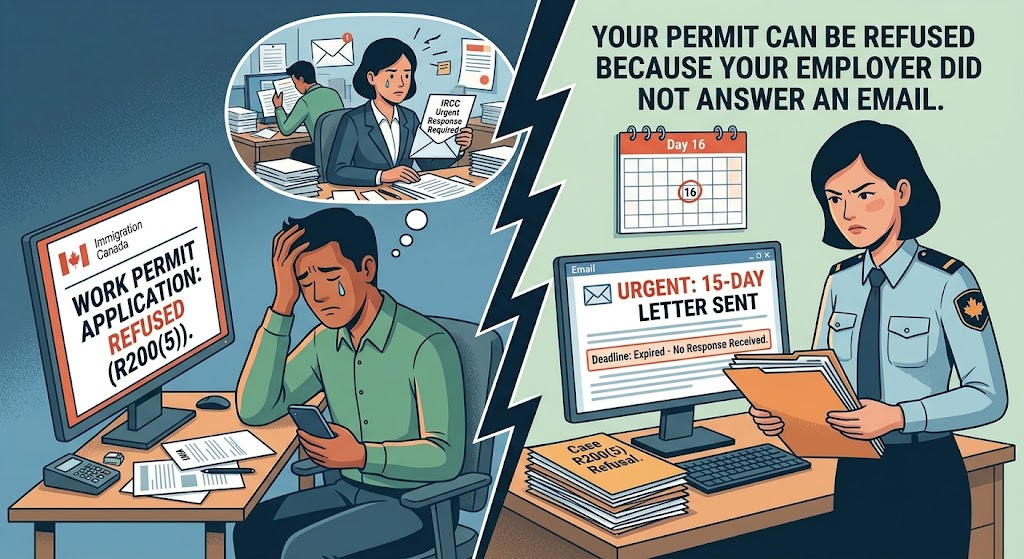
Here is the most important operational fact on this page, and it is one almost no applicant knows: your work permit can be refused because your employer did not answer an email.
Where an IRCC officer has genuineness concerns, the published instructions say the officer should send a procedural fairness letter specifying which of the four factors is of concern and why, and telling the applicant that the employer should provide evidence directly to IRCC within 15 days, or the applicable office standard. If the employer does not, the instruction is explicit: "If an employer does not respond to the request for information, the officer should review the application with the information at their disposal, and if they are not satisfied that the offer is genuine, they should refuse the work permit application because not all of the requirements of R200 have been met."
You cannot compel your employer to reply. There is no separate remedy. The refusal is yours.
Two further details from the same instructions, both current as of September 17, 2026. If the officer researches your employer beyond what is in the offer of employment, that is extrinsic information, defined as "information that is being used in the decision, but that the applicant would not reasonably be aware of," and a procedural fairness letter must be sent so you can respond to it. And the assessment itself differs by program: under the International Mobility Program the offer "is not reviewed until the work permit application has been submitted," while a Temporary Foreign Worker Program file is assessed against the positive LMIA letter and the LMIA record together.
Where the sources go quiet. IRCC's September 17, 2026 program delivery update to these instructions lists its own reasons for the rewrite, among them adding the procedural fairness process, addressing extrinsic information, and one line that stands out: to "correct discrepancies between the internal and external versions." On the test that decides employer-specific work permits, the department has confirmed in writing that the guidance its officers worked from and the guidance the public could read did not match. It does not say what the discrepancies were, or for how long they lasted, and neither will we. The honest reading for an applicant is narrower and more useful: do not assume the public page is the whole instruction, and do not assume an officer's concern is unreasonable just because you cannot find it written down.
The employer risk, measured. IRCC publishes a register of employers found non-compliant after an inspection. Read in full on October 5, 2026, it held 1,415 employers, with the most recent final decision dated September 28, 2026, and 741 of them currently ineligible to hire a temporary foreign worker at all. IRCC publishes no running total, so those counts are ours, taken from the register itself on that date. The reason codes overturn the intuitive story about what employer non-compliance is:
Reason an employer was listed |
Provision |
Employers |
Share |
"The employer didn't give the inspector the documents they asked for." |
R209.4(1)(b) |
836 |
59.1% |
"The pay or working conditions didn't match, or were not better than, what was listed on the offer of employment, or the job was not the same as what was listed on the offer of employment." |
R209.2(1)(a)(iii) or R209.3(1)(a)(iv) |
483 |
34.1% |
"The employer was not actively engaged in the business that the foreign national was hired to work for (aside from live-in caregivers)." |
R209.2(1)(a)(i) or R209.3(1)(a)(i) |
233 |
16.5% |
Source: Employers who have been found non-compliant, IRCC, page updated October 1, 2026. Counts compiled by Ansari Immigration from a full read of the register on October 5, 2026; IRCC does not publish totals, and the register changes as decisions are added. Employers can carry more than one reason, so the shares exceed 100 percent.
Nearly three in five penalised employers are there for a records and response failure during an inspection, not for what they paid anyone. That matters to you directly, because factor four of the genuineness test is the employer's past compliance, and because reason three on that list, the employer was not actively engaged in the business, is the same test as factor one of the genuineness assessment under R200(5)(a).
The British Columbia number is the one we keep coming back to. Of the 1,415 listed employers, Ansari Immigration counted 427 with a British Columbia business address, which is 30.2 percent, ahead of Ontario at 342 and Alberta at 291, in a province with roughly a third of Ontario's population. Treat that carefully: the register counts findings, and findings depend on inspection volume and industry mix as much as on conduct. The fair statement is that British Columbia accounts for more listed employers than any other province despite its size, and that a worker weighing a Vancouver job offer has a free, official place to check the employer's name before they accept it.
How this plays out in practice. Take a Burnaby food manufacturer offering $31.00 an hour. BC's threshold is $38.40, so this is a low-wage application, with the 20 percent cap that applies to food manufacturing (NAICS 311) rather than the usual 10 percent, and the same NAICS 311 carve-out keeps it clear of the refusal to process screen. The employer registers under the BC Temporary Foreign Worker Protection Act, advertises for the eight consecutive weeks the low-wage stream requires, applies, pays $1,000, and waits the published 82 business days. The LMIA comes back positive in February and is valid until August. The worker applies for the permit in March. In May an officer sends a procedural fairness letter: the business was incorporated eight months ago and the officer is not satisfied it is actively engaged in food manufacturing at the scale the offer implies. The employer has 15 days, or whatever that office's standard is, to send incorporation records, payroll and premises evidence directly to IRCC. If they send it, the file usually resolves. If they are busy and let it slide, the permit is refused, and by the time anyone reacts the six-month LMIA has run out and the whole thing starts again from the advertising. Nothing in that sequence required anyone to behave badly. It required an employer to miss a deadline. (An illustrative scenario built from the verified rules and figures above, not a specific client file.)
When you do not need a labour market impact assessment at all
Many foreign workers never touch this process. If a work permit is LMIA-exempt, the employer does not apply to Service Canada at all, there is no $1,000 fee and no advertising requirement, and the timeline collapses accordingly.
The main routes out are the International Mobility Program and its exemption codes, which cover intra-company transferees, free trade agreement professionals, significant benefit cases and reciprocal employment, plus every open work permit, which by definition is not tied to one employer. Our LMIA-exempt work permit guide runs through who qualifies, and the comparison of work permit types is the quickest way to see where you sit.
One correction that saves people months: LMIA-exempt does not mean paperwork-exempt. Under the International Mobility Program the employer still submits an offer of employment through the Employer Portal under a valid LMIA exemption code, and pays the $230 employer compliance fee. And the genuineness test in R200(5) applies there too. It simply runs at the work permit stage instead of being preceded by a Service Canada assessment.
A final point that has changed the arithmetic for a lot of people. An LMIA-backed job offer no longer earns Express Entry points. As of March 25, 2025, IRCC removed job offer points from the Comprehensive Ranking System for current and future candidates in the pool, which previously ran to 200 points for senior management roles and 50 for other skilled occupations. A valid job offer can still be an eligibility requirement for specific programs, and it still gets you into Canada to build Canadian work experience, but pursuing an LMIA purely to raise a CRS score is pursuing something that no longer exists. If permanent residence is the real destination, the honest comparison is between this route and Express Entry on its own terms, and LMIA jobs and what they mean for PR sets out where the two still meet.
Have you been through an LMIA-backed application recently? Real timelines from the advertising start to the permit in hand are more useful to the next reader than any published average, so if you have one, leave it in the comments.
Frequently asked questions about the labour market impact assessment
What is a labour market impact assessment in simple terms?
A labour market impact assessment is an official document a Canadian employer usually needs from Employment and Social Development Canada confirming that hiring a foreign worker will have a positive or neutral effect on the Canadian labour market.
It is often shortened to LMIA and sometimes called a confirmation letter. The employer applies for it, not the worker, and a positive result lets the worker apply for an employer-specific work permit. It is not itself permission to work.
Who is eligible for an LMIA in Canada?
Employers are the ones eligible to apply, not workers, and the employer must be an active Canadian business able to meet the terms of the job offer and compliant with employment and recruitment law in the province where the work will happen.
The business must complete a legitimacy assessment, meet the advertising requirements for the stream, and in British Columbia, Manitoba and Nova Scotia hold a provincial employer registration before applying. Saskatchewan requires a certificate of registration before recruiting a foreign national on an employer-specific work permit. A worker cannot obtain or hold an LMIA independently.
How much does an LMIA cost?
The LMIA processing fee is $1,000 for each position requested and it is paid by the employer, not the worker, with exemptions for some applications that support permanent residence.
The employer cannot have you pay it and cannot recover it from you, and doing so is a breach of program conditions that an inspection can catch. Your own costs come later and separately: the work permit application fee, biometrics, and any medical examination IRCC asks for.
How long does an LMIA take to process?
Average LMIA processing times for August 2026 range from 6 business days for the Seasonal Agricultural Worker Program to 156 business days for the permanent resident stream, with high-wage at 90 and low-wage at 82.
Those averages start only when a complete application is received and exclude the mandatory recruitment period, which runs from 14 calendar days to 8 weeks beforehand. Add your own work permit processing on top, and six months end to end is a realistic planning assumption.
Is it hard to get an LMIA approved?
Approval is less about difficulty than about whether the employer did the prescribed work, and in the files we see, negative outcomes usually trace to recruitment that did not meet the advertising rules, a wage below the provincial threshold, a low-wage cap already filled, or a refusal to process screen rather than any judgment about the worker.
The employer-side compliance record matters too. Our October 2026 read of IRCC's non-compliance register counted 1,415 employers, and the most common reason was failing to give an inspector requested documents.
Does a positive LMIA guarantee a work permit?
No, a positive LMIA does not guarantee a work permit, because IRCC assesses the same job offer again under section 200(5) of the Immigration and Refugee Protection Regulations and can refuse the permit even though Service Canada approved the hire.
The officer looks at whether the employer is actively engaged in the business, whether the offer matches its reasonable needs, whether the terms can be fulfilled, and the employer's past compliance. An officer can also refuse under R200(3)(a) if there are reasonable grounds to believe you cannot perform the work sought.
How long is an LMIA valid for?
Positive decisions on LMIA applications received as of May 1, 2024 are valid for up to six months, and the worker must apply for the work permit inside that window.
If the worker has not applied by that date the LMIA is no longer valid and the employer must apply for a new one. The Seasonal Agricultural Worker Program is excepted, and Service Canada may issue an LMIA with shorter validity in circumstances such as emergency or warranty work.
What is the difference between an LMIA and a work permit?
An LMIA is the employer's labour market clearance from Employment and Social Development Canada, while the work permit is the document IRCC issues to you that actually authorises you to work in Canada.
The LMIA comes first and is a precondition for most employer-specific permits; the work permit is a separate application you file, with its own fee and its own assessment. Holding a copy of a positive LMIA is not authorisation to begin working.
Related Posts
LMIA Exempt Work Permit in Canada: Who Qualifies and How to Apply (2026): the routes that skip the assessment entirely, and what the employer still has to file.
High-Wage vs Low-Wage LMIA in Canada: Which Stream Applies and What's Different (2026): the caps, recruitment, transport and housing rules on each side of the wage threshold.
Temporary Foreign Worker Program Canada: What Workers Need to Know in 2026: the wider program this assessment belongs to, from a worker's point of view.
Doing this alone, or with Ansari Immigration
Reading the government pages alone will not show you the second assessment, because it is not on them. Flat fees from $750 for open work permits and $1,000 for LMIA-based permits, quoted upfront, additional family members quoted separately. Every file is handled personally by the firm's licensed RCIC, regulated by CICC, practicing since 2019. If you can file this yourself, that is the answer you will get.
Consultations are $80 for 30 minutes. Book below, or ask your question in the comments and keep it general, since advice on your specific file needs a consultation. If you are the employer side of this, our work permit services and employer support pages set out how we work.
Book a consultation ($80, 30 min)
This article is for general information only. It is not legal advice. Program criteria, requirements, processing times, and selection approaches can change without notice. Always confirm details on official government websites or consult a licensed Regulated Canadian Immigration Consultant (RCIC) for advice specific to your situation.