


December 2025 turned out to be a record-breaking month for Canada's Express Entry immigration draws. Multiple invitation rounds were held in quick succession, targeting different groups of candidates. A remarkable number of Invitations to Apply (ITAs) were issued in just a few draws. In this post, we’ll summarize all the Express Entry draws that took place in December 2025 – including Provincial Nominee Program (PNP) draws, Canadian Experience Class (CEC) draws, and category-based draws. We will provide key details like dates, types of draws, numbers of ITAs, and minimum Comprehensive Ranking System (CRS) scores. We’ll also highlight trends from these draws and provide an outlook for what might be in store for January 2026. If you’re a Canadian resident considering applying for Permanent Residence through Express Entry, read on for an accessible breakdown and some encouraging insights!
December 2025 Express Entry Draws at a Glance
Figure: Express Entry draws in December 2025 by number of ITAs issued.
This visual shows how category-based and CEC-specific draws offered thousands of invitations each, whereas PNP-specific rounds were smaller in scale. Notably, the largest draws – on December 10, 16, and 17 – each issued 5,000 to 6,000 ITAs, reflecting an end-of-year surge. Such unprecedented volumes made December 2025 the single most active month of Express Entry in the entire year, far surpassing the previous month’s totals.
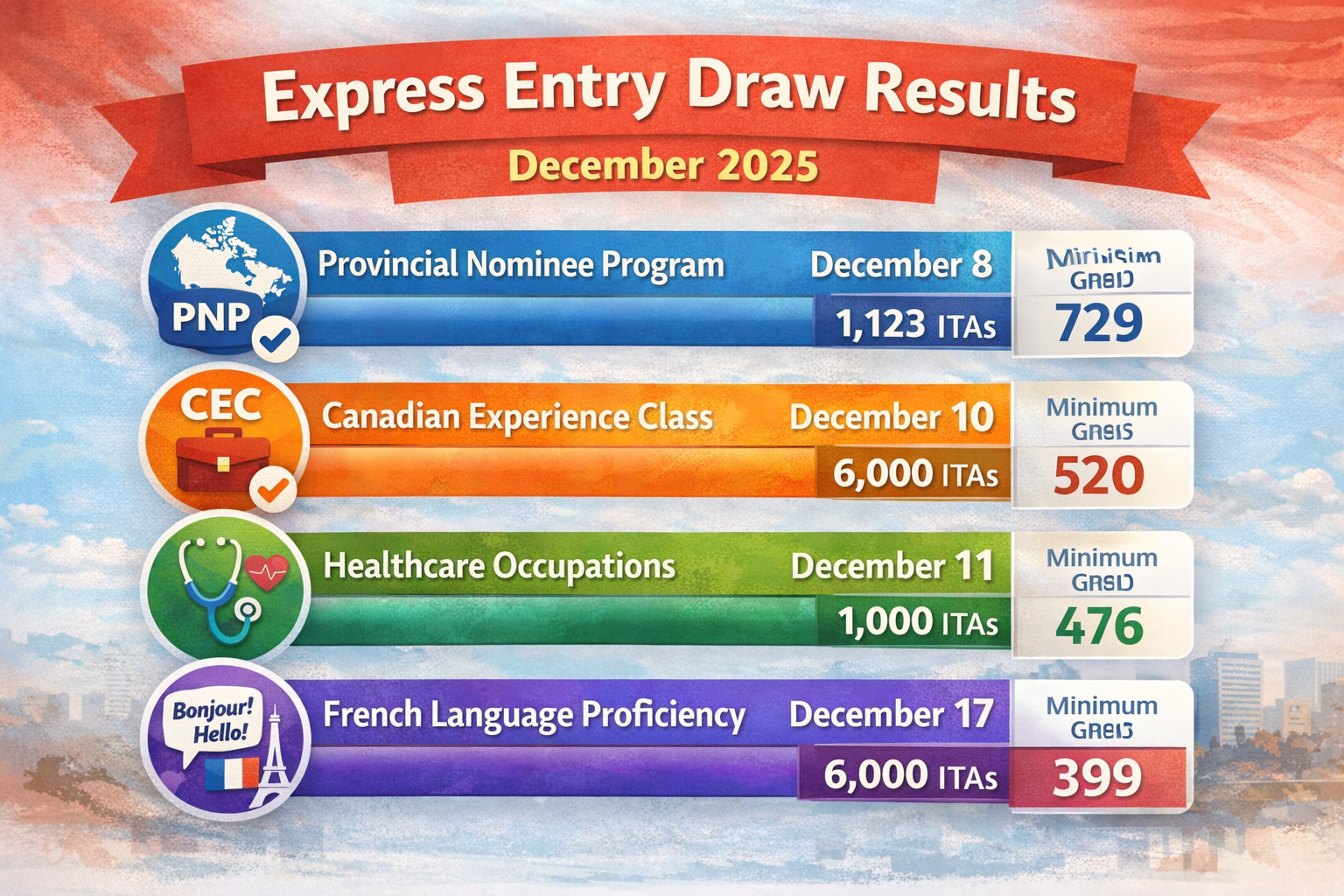
In total, six Express Entry draws took place in December 2025, and all were targeted draws rather than general all-program draws. This means each round focused on specific programs or categories of candidates (no draw invited all programs together). The table below summarizes each draw, with their date, round type, number of ITAs issued, and the minimum CRS score of the lowest-ranked candidate invited:
Date (2025) |
Draw Type |
Invitations Issued (ITAs) |
Minimum CRS Score |
December 8 |
Provincial Nominee Program (PNP) |
1,123 |
729 |
December 10 |
Canadian Experience Class (CEC) |
6,000 |
520 |
December 11 |
Category-based: Healthcare occupations |
1,000 |
476 |
December 15 |
Provincial Nominee Program (PNP) |
399 |
731 |
December 16 |
Canadian Experience Class (CEC) |
5,000 |
515 |
December 17 |
Category-based: French-language proficiency |
6,000 |
399 |
Table: All Express Entry draws in December. Each draw focused on a specific program or category. There were no general (all-program) draws in this month.
As shown above, draw types varied throughout December – including two PNP-specific draws, two CEC-specific draws, and two category-based draws (targeting Healthcare and social services occupations on Dec 11, and French-language proficiency on Dec 17).
Notably, there were no “general” all-program draws held in December. Instead, IRCC spread out invitations across different streams, strategically targeting in-Canada candidates, provincial nominees, high-demand occupations, and Francophone profiles. This diverse approach meant that Federal Skilled Worker (FSW) and Federal Skilled Trades (FST) candidates were only invited if they fell into one of the above categories. For example, an FSW candidate with healthcare experience or French proficiency could be picked in those category draws, since no draw exclusively for FSW or FST profiles occurred in December.
Let’s break down what each draw meant:
Provincial Nominee Program (PNP) Draws
On December 8 and December 15, IRCC held PNP-only draws, issuing 1,123 and 399 ITAs. These were smaller draws by invitation count, but the CRS cut-offs were very high (729 and 731). The high CRS scores are because candidates with a provincial nomination receive an automatic 600-point boost to their CRS. In other words, only candidates who had provincial nominations (hence already 600 points added) were invited in those rounds. If you secure a PNP nomination, it essentially guarantees an invitation due to that points boost. The PNP draws in December allowed nearly 1,522 nominees to apply for PR, supporting regional labor needs across Canada.
Canadian Experience Class (CEC) Draws
On December 10 and December 16, large CEC-specific draws took place, with 6,000 ITAs and 5,000 ITAs issued. These draws were exclusive to candidates with Canadian work experience (CEC). The CRS cut-offs (520 on Dec 10, and 515 on Dec 16) were notably in the 510+ range, reflecting the competitive scores often needed for CEC draws. In fact, CRS 515 on Dec 16 was the lowest CEC cut-off of 2025 up to that point, slightly lower than the earlier CEC round that month. These massive CEC draws demonstrate Canada’s commitment to transitioning temporary workers and graduates (with Canadian experience) to permanent residency. For candidates already working or studying in Canada, these rounds were very encouraging, as thousands of in-Canada profiles were invited.
Category-Based Draw – Healthcare
On December 11, IRCC held a category-based draw targeting healthcare and social services occupations. 1,000 ITAs were issued to healthcare professionals, with a CRS cut-off of 476. This cut-off was significantly lower than the CEC draws’ cut-offs, despite including some FSW candidates, because it was limited to in-demand healthcare workers. This draw (dubbed “Version 2” of the healthcare category) reflects Canada’s ongoing need for healthcare talent. It provided an opportunity for candidates with mid-range CRS scores to receive ITAs, as long as they had qualifying healthcare work experience – a great example of how targeted draws can have more forgiving score thresholds for those who meet specific criteria.
Category-Based Draw – French-Language Proficiency
On December 17, a landmark draw took place targeting French-speaking candidates. A massive 6,000 ITAs were issued to profiles with French-language proficiency, and astonishingly the CRS cut-off dropped to 399. A CRS cut-off below 400 is virtually unheard of in recent years’ Express Entry draws and was the lowest score seen in 2025 for any round. This was possible because French-speaking candidates benefit from bonus CRS points for French ability and face less competition in their category.
For context, 399 is over 100 points lower than the typical cut-off in a CEC draw (which often exceeds 510). This draw opened the door to permanent residence for many candidates with moderate CRS scores who might otherwise never receive an invite in a general round. It also underscores Canada’s emphasis on welcoming Francophone immigrants – aligning with goals to strengthen French-speaking communities outside major urban centers. If you have strong French language skills, this draw was a clear message that you have a significant advantage! In short, the December 17 French category draw was a game-changer, making Express Entry more accessible to those bringing valuable language skills even if their overall score wasn’t.
Overall, 19,522 invitations were issued through Express Entry in December 2025 (up to the 17th). To put that in perspective, this one month’s ITA count far exceeded the totals of many previous months.
For candidates in the pool, December’s flurry of draws was extremely encouraging. The chances of getting invited increased dramatically due to the sheer volume of ITAs and the variety of criteria being targeted. IRCC demonstrated that it is not relying on a single pathway to select immigrants, but instead is inviting candidates through multiple channels: in-Canada experience, provincial nomination, key occupations, and language proficiency. This multi-pronged approach is great news for applicants because it creates more than one way to qualify for an invitation. If your CRS score isn’t competitive in a general draw, you might still get selected through a category-based draw or a PNP route.

Key Trends and Highlights from December 2025
December 2025 was the busiest month of the year for Express Entry. After a relatively cautious start to 2025 with smaller draws, IRCC ramped up its efforts in December. The second half of the month especially saw back-to-back draws with huge invitation numbers. In one week alone, over 11,000 invitations were sent. This end-of-year surge suggests that IRCC was catching up on annual targets and taking advantage of the new Immigration Levels Plan announced in November 2025, which likely set higher targets for 2026. The result? December 2025 became the month with the highest number of Express Entry ITAs issued in all of 2025. For anyone waiting in the pool, this was a welcome development – more invitations mean more chances for you to be selected.
Focus on Targeted Draws: Another clear trend was the absence of all-program general draws in December. Instead of inviting a mix of everyone above a certain CRS, IRCC exclusively held program-specific or category-specific rounds. This targeted strategy allowed lower CRS cut-offs for certain groups and ensured specific immigration objectives were met. For example, inviting French speakers with CRS 399 addressed Francophone immigration needs, and dedicated CEC draws ensured those with Canadian work experience (often seen as easier to integrate) were prioritized. From an applicant’s perspective, this means it’s increasingly important to identify if you fit into a specific category or program that Canada is targeting. The days of solely relying on a high CRS score in an all-program draw are evolving into a system where being eligible under a particular stream can give you a big advantage.

CRS Score Variations: December highlighted a wide range of CRS cut-offs depending on the draw type. On one end, PNP draws had cut-offs around 730, reflecting the 600 bonus points for nominees. CEC draws hovered in the low 500s (515–520), indicating that candidates needed very strong profiles (or a mix of human capital factors) to be invited under CEC alone. Meanwhile, the healthcare occupations draw at CRS 476 was a middle ground – still challenging, but noticeably lower than CEC-only draws. At the low extreme, 399 in the French draw showed that even mid-range candidates can succeed if they possess a sought-after skill (in this case, French language). The takeaway here is that CRS “competitiveness” is now highly context-dependent. As IRCC themselves noted, a “competitive” score is not one-size-fits-all: CEC draws might demand 510+ points, but category-based draws can sometimes go below 400. This is actually good news for applicants – a lower CRS score doesn’t automatically mean you have no chance! December proved that by excelling in a particular area (like language or occupation), you can overcome a lower overall CRS.
Opportunities for Candidates: For Canadian residents and prospective immigrants, the December draws carry an encouraging message. IRCC is actively looking for a variety of talent – from international students and workers already here (CEC), to skilled workers abroad with needed skills (healthcare, trades, etc.), to bilingual candidates. The current trend rewards those who can fit into Canada’s targeted categories. If you have French language skills or experience in healthcare/social services, your prospects of getting an ITA were especially bright this month. If you don’t fit those, pathways like Provincial Nominee Programs are still very much open and can dramatically boost your chances. The key highlight from December is that Express Entry is not just about having the highest score anymore – it’s about having the right mix of qualities that Canada needs. This creates new opportunities for many candidates who may have felt sidelined by high CRS cut-offs in the past.
Actionable Insights for Aspiring Applicants
If you haven’t yet applied for Permanent Residence but are considering it, here are some tips inspired by December 2025’s trends:
Leverage Category-Based Pathways: Identify if you qualify for any of the new Express Entry categories. For example, if you speak French or have work experience in healthcare, agriculture, STEM, or other targeted fields, make sure to highlight those in your profile. Category-based draws often have significantly lower CRS cut-offs (sometimes below 400), which can give you an edge even if your overall score isn’t the highest.
Boost Your CRS with a PNP Nomination: Don’t overlook Provincial Nominee Programs. Every province has streams aligned with Express Entry. Securing a nomination adds 600 CRS points to your score, practically ensuring you’ll get an invitation in a subsequent draw. Research provinces where your occupation or profile is in demand, and consider applying – it’s a powerful shortcut to increase your chances.
Capitalize on Canadian Experience (CEC): If you’re currently in Canada as a worker or recent graduate, gaining or maximizing your Canadian work experience can pay off. IRCC is running large CEC draws, but the CRS cut-offs are high, so use any advantage you have – e.g. improve your language test scores, add a year of work experience, or get a job offer if possible – to push your CRS into the competitive range. The good news is IRCC clearly values CEC candidates, as seen by the volume of invitations issued to this group.
Don’t Be Discouraged by a Lower Score: Even if your CRS score is on the lower side, stay optimistic and keep your Express Entry profile active. With the new draw patterns, candidates with modest scores can still get picked via provincial streams or category draws. For instance, December’s French draw invited candidates with scores in the 300s, and many PNP nominees started with core scores well under the typical cut-off before nomination. IRCC has confirmed that lower CRS candidates “can still receive invitations” through these targeted draws. The key is to be in the pool and seize opportunities to improve your profile (e.g. retake language tests, gain more experience, or pursue a nomination).

Outlook – What to Expect in January 2026
What might the Express Entry landscape look like in the new year? Based on December’s whirlwind of activity, January 2026 is likely to continue the momentum of targeted and large-scale draws. The Canadian government’s recent announcements signal a sustained focus on categories that meet economic priorities. We can reasonably expect IRCC to keep emphasizing category-based selection as 2026 unfolds. That means draws for French-language proficiency, healthcare occupations, and candidates with Canadian experience are likely to remain front and center. If you belong to one of these groups, you could see more frequent opportunities in the coming weeks.
The trend of issuing high volumes of ITAs could also carry forward. December showed that IRCC is willing to conduct consecutive draws and invite thousands of candidates in short order. If that momentum carries into January 2026, we might see additional large draws early in the month, especially as IRCC works toward the new year’s immigration targets with an efficient approach. There’s a possibility that rather than waiting until later in the year, the authorities will continue “front-loading” invitations to meet their quotas – great news for those in the pool now.
In practical terms, candidates should be ready. Update your profiles, ensure all your documentation is in order, and stay tuned to the draw announcements. The end of 2025 demonstrated that surprises can happen (like three draws in three days!). Being prepared means you can quickly submit your application if you get that ITA. And if you didn’t make it in December, don’t lose heart – the new year is bringing even more opportunities, and the path to PR is looking brighter for a diverse range of applicants.
Bottom Line: December 2025’s Express Entry draws were unprecedented in scope and specializations, signaling a more inclusive and dynamic immigration selection process. For Canadian PR hopefuls, this is an encouraging development. As we move into 2026, keep an eye on the draw trends, play to your strengths (be it language, work experience, or provincial ties), and don’t hesitate to throw your hat in the ring. With Canada’s ambitious immigration targets and refined draw categories, now is an excellent time to pursue your Express Entry application. Good luck, et bonne chance!