


A proof of funds procedural fairness letter is IRCC's warning that an officer doubts your study permit money is genuinely yours and readily available, not that you are short of the amount. Under regulation 220 your funds must be "sufficient and available," so where the money came from and whether it can actually reach Canada can matter as much as the balance on the page.
What a proof of funds procedural fairness letter actually means
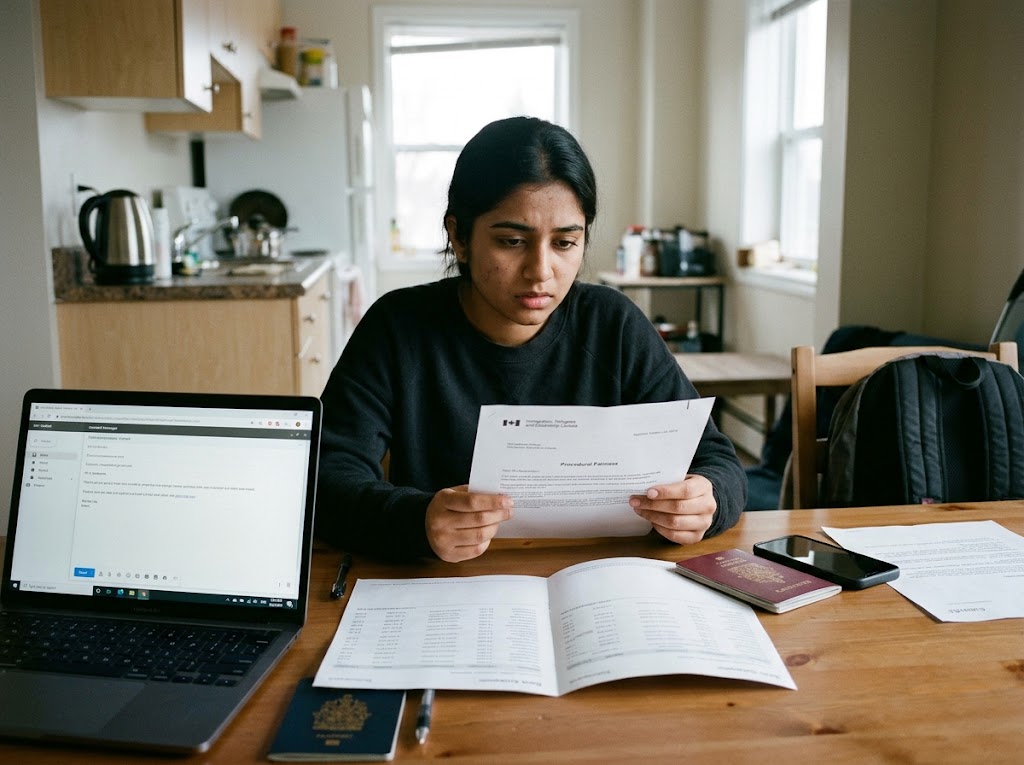
A proof of funds procedural fairness letter (often shortened to PFL) is a formal notice that an officer has a specific concern that could sink your application, and is giving you a chance to answer it before deciding. For study permit money, that concern falls into one of two camps: the officer is not satisfied the funds are sufficient and available, or the officer suspects a document is not authentic. The response window is short, sometimes as little as seven days, so the letter is the opposite of a formality.
Here is the part most applicants miss. A refusal on money does not always arrive with a fairness letter first. The Federal Court has repeatedly held that study permit applicants are owed only a low degree of procedural fairness, which means an officer who simply finds your evidence thin can refuse without writing to you at all. The fairness letter tends to show up when the officer's doubt is about credibility or authenticity, where fairness law requires a chance to respond. So if you did get a letter, treat it as the one opening you are guaranteed, because you may not get a second.
Enough money, still refused: the officer looks past the balance
Yes, a study permit can be refused even when the account holds more than the required amount, because the officer assesses the source and reliability of the funds, not just the number. A 2025 Federal Court decision shows exactly how this plays out.
In Du v. Canada, 2025 FC 1744, the applicant submitted a BMO balance certificate of roughly 25,857 dollars and an HSBC certificate listing about 84,000 dollars across three accounts, comfortably above any study permit threshold. The officer refused anyway, and the Court found the refusal reasonable. The HSBC certificate was a single-day snapshot with no transaction history and no proof that tuition had been paid, and the Court held that officers "must look beyond the bank balance" to assess the origin, source, nature and reliability of the funds. The money was there. The story behind it was not.
That is the whole mechanism of a proof of funds procedural fairness letter in one case: a balance proves a moment, and an officer is assessing a plan that runs for a year or more.
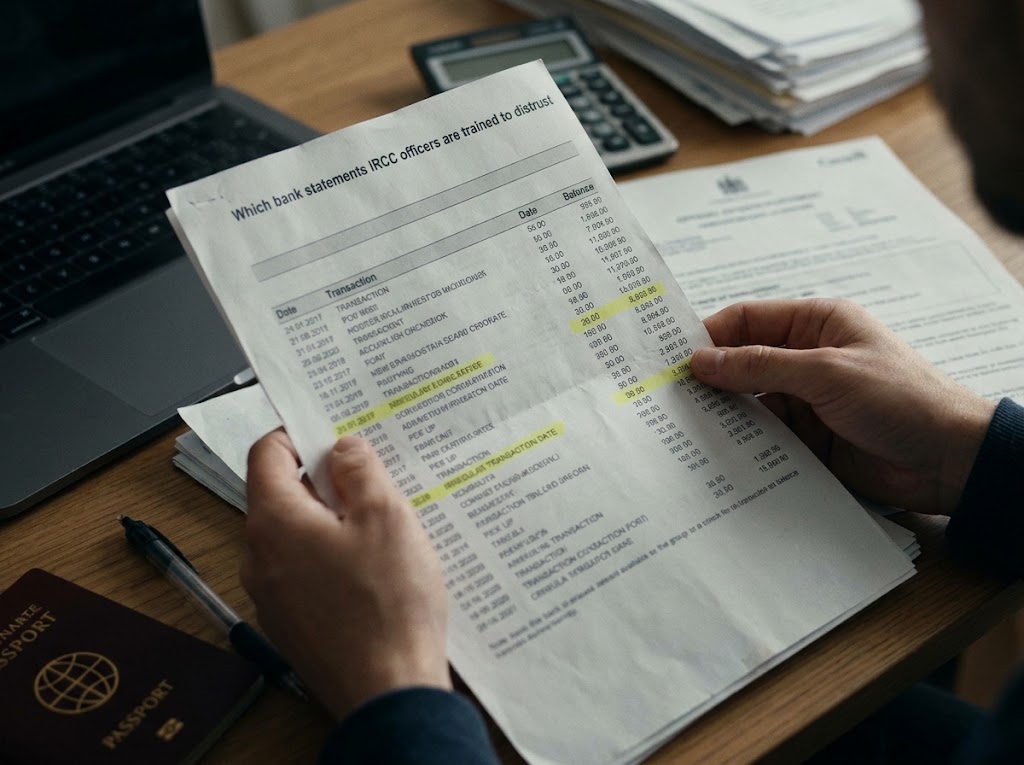
Which bank statements IRCC officers are trained to distrust
Officers are instructed to treat the type of account the money sits in as a signal, not just the amount. An internal IRCC training document released under the Access to Information Act sets out stock concerns an officer uses when the funds come from certain institutions, and knowing them tells you what a clean file looks like before you apply.
A statement from a microfinance bank draws a request for a commercial bank statement instead, on the reasoning that microfinance institutions serve people the conventional banking system does not reach and are restricted from foreign currency or overseas transfers, so the money may not be movable to Canada. A statement from a microfinance or mortgage bank whose licence has been revoked, or that has stopped filing returns, is treated as unreliable on its face. And an altered or fraudulent statement is the most serious of the three: under section 40(1)(a) of the Immigration and Refugee Protection Act, a misrepresentation that "could have induced an error in the administration of this Act" can trigger a five-year bar, a consequence that dwarfs a single refusal.
These are office-level instructions, not law, and several of the dollar figures in that material predate current rules, so they describe how officers reason rather than what you must prove today. The underlying test is the regulation itself: funds that are "sufficient and available." The practical takeaway is simple. Check the type and standing of the bank before you rely on its statement, and move money into a mainstream commercial account with a real history well before you file, not the week before.
Not sure whether your bank or your deposit history will pass that test? That is a thirty-minute question for Ansari Immigration's licensed RCIC, and asking it before you file is cheaper than answering a fairness letter after.
Third-party and family funds: proof of relationship is the trap
When the money belongs to a parent, a relative, an employer or a company rather than the student, the proof of relationship is where files fail. IRCC's own officer guidance states that a letter from the person or institution providing money "is not enough on its own" and must be backed by documents that show the funds and the connection.
The internal refusal templates make the pattern concrete. For a company account, the officer asks how the business would cover its own expenses if the funds were given away, who owns it, and whether other shareholders agree. For an employer's funds, a leave of absence letter and the employer's healthy balances are not enough without direct proof of support such as actual transfers. For family funds, affidavits and statements without a birth certificate or other proof of the relationship mean the family link is simply not established. Each path ends in a refusal under regulation 216(1)(b) and regulation 220.
Akindumila v. Canada, 2025 FC 1382 is the worked example. The applicant relied in part on his mother's support, but the bank statements showed lump-sum deposits against low or decreasing balances, and the officer found the source of those funds was not documented. The Court upheld the refusal, finding the officer reasonably concluded the source, nature and stability of the funds had not been established. If someone else is funding your studies, file the sponsor's own funds history, proof of the relationship, and evidence the money has actually moved, not just a snapshot and a promise.
How much money, and in what form, IRCC accepts in 2026
For a study permit application made on or after September 1, 2026, a single applicant outside Quebec must show 23,448 dollars for living costs, on top of first-year tuition and travel. The amount rises with each accompanying family member, and these figures are set by IRCC and updated annually rather than fixed in the regulation.
Study permit living-cost requirement (outside Quebec, 2026)
Family members (including you) |
Applications Jan 1, 2025 to Aug 31, 2026 |
Applications on or after Sep 1, 2026 |
1 |
22,895 dollars |
23,448 dollars |
2 |
28,502 dollars |
29,192 dollars |
3 |
35,040 dollars |
35,888 dollars |
4 |
42,543 dollars |
43,572 dollars |
Each additional member |
6,170 dollars |
6,318 dollars |
Source: IRCC, Proof of financial support, canada.ca. Verified October 2026. Amounts exclude tuition and transportation.
Form matters as much as amount. IRCC accepts a Canadian bank account holding transferred funds, a guaranteed investment certificate (GIC), a bank-issued student or education loan, a paid tuition and housing receipt, a scholarship or Canadian-funded program, pension or rental income, and bank statements, which must cover the past six months and show the source of the money. A letter from whoever is giving you money must state their job, their relationship to you, their number of dependants and the amount, with supporting evidence and their ID. If your country has foreign exchange controls, you must also prove you can actually export the funds. International students cannot use the Canada Student Loan Program.
Where the official guidance goes quiet
The official pages tell you the amount; they are nearly silent on the thing that actually decides these files. Canada.ca publishes the dollar figures and the list of acceptable documents, and IRCC's officer manual says only that "the source of funds available to the applicant, either at present or in future, as applicable, must be assessed." Neither one defines when funds are "not available," names which banks draw a second look, or tells you whether a weak file gets a fairness letter or a straight refusal.
That gap is the reader's real question, and it resolves like this. If your doubt is "do I have enough," the published tables answer you. If your worry is "will the officer believe this money is mine and usable," no public page does, because that is a credibility judgment made case by case, and, per Du, one an officer can often make without writing to you first. The common belief that a healthy balance settles the matter is simply wrong, and the common fear that a large balance guarantees a fairness letter is equally wrong. The reliable move is to make the source and history of your funds obvious on the face of the file, so the question never has to be asked.
Did your study permit funds sit in the account for less than six months, or arrive as one large deposit just before you applied? Tell us what your bank history looked like in the comments, and keep it general; for advice on your own file, use a consultation.
Frequently asked questions about proof of funds for a study permit
What documents can I use as proof of funds for my Canadian study permit?
IRCC accepts a Canadian bank account holding transferred funds, a guaranteed investment certificate, a bank-issued student loan, a paid tuition and housing receipt, a scholarship, pension or rental income, and bank statements covering the past six months that show the source of the money. A letter from anyone funding you must be backed by evidence of the funds and proof of your relationship.
Can a study permit be refused even if I have enough money?
Yes, a study permit can be refused even with more than the required amount, because officers assess the source, availability and reliability of the funds and not just the balance, as the Federal Court confirmed in Du v. Canada, 2025 FC 1744 where about 84,000 dollars was still found insufficient. A single-day balance with no transaction history is the classic failure.
How much proof of funds do I need for a study permit in 2026?
For an application on or after September 1, 2026, a single applicant outside Quebec must show 23,448 dollars for living costs plus first-year tuition and travel, with higher amounts for accompanying family members. These figures are set by IRCC and updated each year, so confirm the current table on canada.ca before you apply.
What usually happens when you receive a procedural fairness letter?
A procedural fairness letter sets out a specific concern and gives you a short window, sometimes as little as seven days, to respond with evidence before the officer decides. It is your one guaranteed chance to answer, so read the exact concern closely and address it directly with documents rather than explanations alone.
Do I need proof of funds for a study permit extension?
Yes, you must prove sufficient and available funds for a study permit extension, and the first year after the extension is the period assessed. Officers reviewing extensions also look at your account history over time, so unexplained deposits that do not fit a student's situation can trigger questions even on a renewal.
Related Posts
Study Permit Proof of Funds 2026: What IRCC Changed and What It Means for Students: How the financial requirement and acceptable proof have shifted for current applicants.
Mastering the Proof of Funds for Your Canadian Study Permit: A step-by-step guide to assembling a funds package that an officer will accept.
Study Permit Refusal in Canada: Top Reasons and How to Reapply (2026): The most common grounds for a study permit refusal and how to rebuild a stronger application.
Talk to Ansari Immigration before your funds become the reason
Students regularly come to us after a refusal that turned on a single-day balance or a parent's deposit no one documented, when a six-month history and a short source letter would have closed the question before it was asked. The same funds scrutiny returns when you later apply for a work permit or permanent residence, so getting the habit right now pays off twice. Ansari Immigration's licensed RCIC reads your funds file the way an officer will, and tells you plainly whether it is ready, including when it already is. A 30-minute consultation (80 dollars) is where that review starts.
Why work with Ansari Immigration: flat fees of 500 dollars for a study permit from inside Canada and 1,500 dollars from outside, quoted upfront, with each additional family member at the same fee. Every file is handled personally by the firm's licensed RCIC, regulated by CICC, with direct access to your consultant from first form to final decision. No juniors, no call centres.
If a proof of funds procedural fairness letter is sitting in your inbox right now, do not answer it alone and book after; bring it to the consultation. And if you have already been through this, tell us in the comments what finally satisfied the officer, because it helps the next applicant.
Book a consultation with Ansari Immigration
This article is for general information only. It is not legal advice. Program criteria, requirements, processing times, and selection approaches can change without notice. Always confirm details on official government websites or consult a licensed Regulated Canadian Immigration Consultant (RCIC) for advice specific to your situation.