
PR Refused? Can You Keep Working on Your Bridging Open Work Permit? We Asked IRCC (2026)

If your permanent residence application is refused or returned, your bridging open work permit does not automatically stop being valid. We could not find a clear answer to this published anywhere, so we asked IRCC directly. Its Representative mailbox replied in writing on September 17, 2026, and set out when a work permit can be revoked. A refused or returned permanent residence application is not on that list.
That is the short answer, and it matters because the panic that fills the forums gets all three parts of it wrong: it assumes the permit dies the moment the refusal lands, that it happens silently, and that you must stop working that day. As you will see, the current rules point the other way. But the honest version comes with a hedge that IRCC used itself, and getting this wrong, and working when you are not authorized, is exactly the kind of mistake that follows a person into future applications. So it is worth reading past the headline.

Why this question has no clean answer online
Start with the official page, because it is where the gap lives. IRCC's own bridging open work permit page explains that a bridging open work permit lets you keep working while you wait for a decision on your permanent residence application. It says nothing about what happens to that permit if the PR application is refused. Neither does the work permit fee page or the application guide.
So people fill the silence, and they fill it with opposite answers. On the same first page of Google, one law firm's site says a refused PR application means the permit "may be cancelled and the applicant may lose the right to work," another says it "may still remain valid unless it is subject to cancellation," and the top Reddit and Facebook threads swing between "voided immediately, stop working" and "valid until the printed expiry date." When the published web contradicts itself this cleanly, and the government page is silent, guessing is not good enough. So we asked the source.
What we asked IRCC, and what they told us
Amir Ansari, the firm's licensed RCIC (R709304), sent a general policy question to IRCC's Immigration Representatives mailbox: where a foreign national holds a bridging open work permit and the permanent residence application is then refused or returned, does the permit remain valid to its printed expiry, or is it rendered invalid, and are there circumstances where it would be cancelled instead of running to expiry.
IRCC replied in writing on September 17, 2026, under file REP-2026-1732. This is official correspondence, not published guidance, so we quote it exactly and treat it as IRCC's stated position on that date:
Work permits may be revoked only in specific circumstances, such as when an LMIA has been revoked, a foreign national has a significantly greater negative effect than benefit with respect to the development of a strong Canadian economy, where an employer has provided false, misleading or inaccurate information, the employer has been made ineligible, or if the work permit was issued based on their relationship with another foreign national and the principal foreign worker's work permit is now revoked. If a decision is made to revoke the work permit, the foreign worker will be sent a notification letter stating that their work permit will be revoked in 90 days. The foreign national will have temporary resident status and continued authorization to work until the specified date in the letter. Aside from revocation of work permits due to public policy considerations as listed above, work permits are not usually otherwise cancelled or rendered invalid.
Read that list again. A refused or returned permanent residence application is not on it.
Clients regularly reach us the week a PR refusal lands, convinced they have to stop working the next morning. Usually they do not, and an Ansari Immigration file review says so plainly, then turns to the decision that actually matters: how to answer the refusal. That review starts with a 30-minute consultation ($80).
What this does, and does not, mean
Here is where we have to be careful, because the valuable version of this answer is the honest one. IRCC did not say "your bridging open work permit stays valid." It never used the term bridging open work permit, and it did not address a returned application separately from a refused one. What it did was list the circumstances in which a work permit may be revoked, and a PR refusal is not among them, then add that permits are "not usually otherwise cancelled or rendered invalid."
So the strongest thing we can fairly say is this: we asked IRCC directly, and it answered by setting out when a work permit can be revoked, and the refusal or return of a permanent residence application is not on that list. The word "not usually" is IRCC's own, and it has to survive into any conclusion you draw. Anyone relying on this is relying on an inference from a list, not on a sentence that says "you are fine."
That also settles a smaller debate honestly. Other practitioners have quoted the IRCC mailbox saying outright that the permit "remains valid until its printed expiry." Our own reply reaches the same place, but by omission, and with a hedge. Better sourced, more cautiously worded. Both things are true, and you deserve both.
How a work permit can actually end in 2026
The reply lines up with the current published rules, and this is the part that turns a hedge into something you can plan around. On January 31, 2025, new regulations gave officers explicit authority to cancel temporary resident documents on a case-by-case basis, and IRCC published the operating instructions on November 4, 2025. They are the clearest current statement of how a work permit can end, and a refused PR application is still not one of the triggers.
How a work permit can end | Authority | Does a refused PR application trigger it? |
|---|---|---|
Revocation (LMIA revoked, employer ineligible or gave false information, negative benefit finding, or the principal worker's permit revoked) | IRCC's work permit revocation grounds for public policy considerations, as set out in IRCC's correspondence to our office (the underlying published instrument was not locatable online, see the note below) | No |
Individual cancellation, discretionary: administrative error | IRPR s.209.01 | No |
Cancellation by operation of law: you become a permanent resident | IRPR s.209.02(a) | No, this is the opposite outcome |
Cancellation by operation of law: death of the holder | IRPR s.209.02(b) | No |
Automatic cancellation when a removal order becomes enforceable | Regulations in force March 15, 2024 | Only if a refusal eventually leads to an enforceable removal order, which a PR refusal by itself does not |
Source: IRCC, Individual cancellation of temporary resident documents (date modified November 4, 2025), and IRCC correspondence REP-2026-1732 (September 17, 2026). Verified September 2026.
Notice what is missing. The new rules do let an officer cancel a temporary resident visa or an eTA because another application was refused after it was issued, but that discretionary ground (IRPR s.180.1(e)) applies to visas and travel authorizations, not to work permits. For a work permit, the only new individual-cancellation grounds are an administrative error, becoming a permanent resident, or death. A PR refusal is on none of the lists, published or correspondence.
There is one honest caveat. IRCC's list is not the whole universe of how a permit can end. A finding of misrepresentation under IRPA s.40, a separate inadmissibility, or an enforceable removal order can all bring a permit to a stop, and none of those is triggered simply by a PR refusal on its own. Do not read "a refusal does not cancel your permit" as "nothing can."
The 90-day rule almost nobody mentions
The reply volunteered something we did not ask for, and it may be the most useful line in it. Revocation is not instant, and it is not silent.
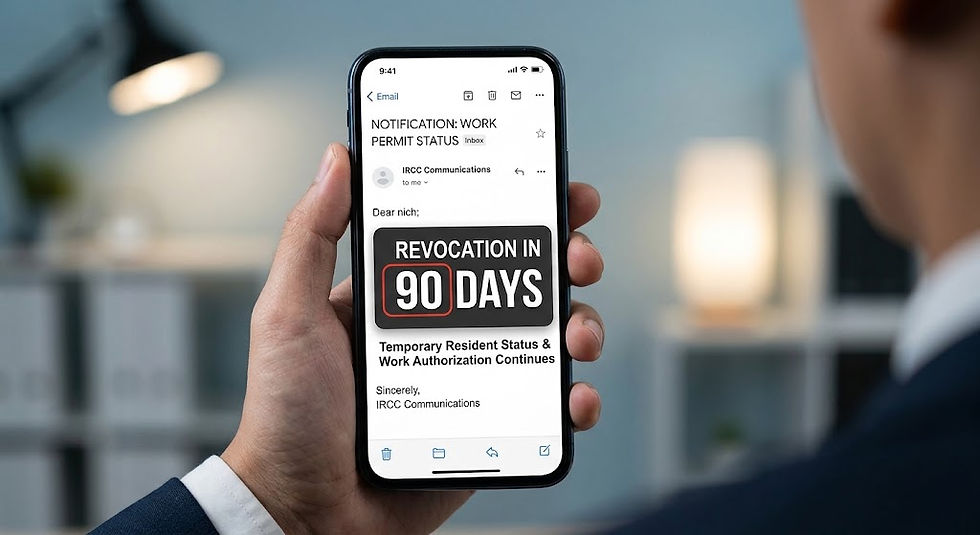
If IRCC decides to revoke a work permit, it sends a notification letter stating the permit will be revoked in 90 days, and the holder keeps temporary resident status and the authorization to work until the date in that letter.
So even in the situations where a permit is revoked, you get a letter, a date, and roughly three months in which you remain in status and can keep working. The "my permit could be cancelled tomorrow and I would not even know" fear that dominates the forums is wrong on all three counts: there is warning, there is a date, and your right to work continues until it.
The part that catches people off guard: your employer
Here is the objection worth pre-empting. "Fine, my own PR refusal does not touch my permit, so I am safe." Look again at the revocation list, because three of the five grounds are about your employer, not you: an LMIA revoked, an employer found ineligible, an employer that gave false or misleading information. A bridging open work permit is an open permit, so it is less exposed to a single employer than a closed one, but any worker should know the risk does not live only in their own file.
This is not abstract in British Columbia. IRCC publishes a running list of employers found non-compliant, and as of its September 2026 update BC employers appear on it more than those of any other province, ahead of Ontario and Alberta. In practice, the most common reason an employer lands there is not underpaying anyone. It is a records failure during an inspection, not giving officers the documents they asked for. For a Metro Vancouver worker, that is the quieter risk to a work permit than a PR refusal ever was.
In practice, the clients who reach us in a panic after a PR refusal are usually asking the wrong question. The refusal is real and needs a plan, but it is rarely what threatens their ability to work.
If any of that made you unsure where your own permit stands, that uncertainty is exactly what a short eligibility check with Ansari Immigration is for.
A worked example (illustrative)
Here is how this typically plays out. Picture a candidate we will call an Express Entry applicant in the Canadian Experience Class, holding a bridging open work permit valid until August 2027, working for a Burnaby employer. In March 2026 the PR application is refused over a work-experience concern.

The refusal does not cancel the bridging open work permit. Under the current rules, and consistent with what IRCC told us, the permit runs to its August 2027 expiry, and the person can keep working while they decide their next step, whether that is a reconsideration request, judicial review, or a fresh application. The one thing that would change the picture is a separate event, for example the employer being found non-compliant, in which case the worker would receive a revocation letter and still have 90 days of continued work authorization from the date in it. Same permit, two very different triggers, and the PR refusal is not the dangerous one. This is an illustration built from the rules above, not a specific client file.
What to do if your PR is refused and you hold a bridging open work permit
Do not assume you must stop working. On the current rules, a refused or returned PR application does not, by itself, cancel your bridging open work permit.
Check the printed expiry date on your permit. That date still governs, and if it is approaching you may need to plan your next status step before it arrives.
Watch for a notification letter. A revocation, if it ever applies to you, comes with a letter, a date, and 90 days of continued work authorization. No letter means no revocation.
Mind your status if your permit lapses. If your permit expires and you have not maintained status or applied to restore your status, you may lose the right to work regardless of the refusal.
Decide your PR response deliberately. A reconsideration, a judicial review, and a fresh application are different tools with different deadlines, and the refusal reason usually decides which one fits.
Where the sources are silent or disagree
It is worth naming the gap out loud, because it is the reason this post exists. IRCC's own bridging open work permit page does not address the refusal question at all. The published web answers it in both directions at once. And when IRCC's mailbox answered us, it pointed to a page titled "Revocation of work permit due to public policy considerations," which we were unable to locate on canada.ca despite searching for it directly. So the most authoritative answer available to a person searching this question tonight is an inference from a list IRCC set out in an email, cross-checked against the cancellation regulations. That is exactly why the honest framing, hedge included, is the responsible one.
Frequently asked questions about the bridging open work permit after a PR refusal
What happens to my bridging open work permit if my PR application is refused?
On the current rules, it is not automatically cancelled. IRCC's cancellation regulations do not list a refused PR application as a trigger for a work permit, and IRCC's Representative mailbox told us the same by omission, adding that permits are "not usually" otherwise cancelled. Confirm your own situation before relying on it.
Can IRCC revoke a work permit?
Yes, but only in specific circumstances, and IRCC named them to us: an LMIA revoked, an employer found ineligible or that gave false information, a negative benefit finding, or the principal worker's permit being revoked. A PR refusal is not among them.
Under what conditions can a work permit be cancelled in 2026?
Under regulations in force since January 31, 2025, an officer may cancel a work permit for an administrative error, and a permit is cancelled by operation of law when the holder becomes a permanent resident or dies. A permit is also automatically cancelled when a removal order becomes enforceable. None of these is a PR refusal on its own.
What happens when my work permit is revoked?
IRCC sends a notification letter stating the permit will be revoked in 90 days. You keep temporary resident status and the authorization to work until the date in the letter. Revocation is not instant and not silent.
How long is a bridging open work permit valid?
It is valid until the printed expiry date on the permit, unless it is cancelled or revoked for one of the specific reasons above. A refused PR application does not, by itself, shorten it.
Does becoming a permanent resident cancel my work permit?
Yes. When you become a permanent resident your work permit is cancelled by operation of law under the 2025 regulations, because you no longer need it. That is the successful outcome, not the refusal you may be worried about.
Three signs your situation needs a professional read: you received a revocation or refusal letter and are not sure what it actually requires of you, your permit is close to its expiry date, or you are weighing a reconsideration against a fresh application. Any one of these is what Ansari Immigration's licensed RCIC untangles in a $80, 30-minute consultation, and you will hear the honest answer, including when the answer is to wait. Every file is handled personally by the firm's licensed RCIC, with flat, transparent fees quoted upfront.
Did your work permit survive a PR refusal, or did an employer issue change things for you? Share what happened in the comments, and keep it general, for advice on your own file use a consultation.
Related Posts
Bridging Open Work Permit (BOWP): Who Qualifies and How to Apply in Canada (2026): who is eligible for a bridging open work permit, when to apply, and the timing traps that get applications refused.
Restoration of Status in Canada: Processing Time and How to Apply in 2026: what to do if your permit lapses and you need to get your status and your right to work back.
Work Permit Refusal in Canada: What Zavala 2026 FC 660 Says About Dual Intent: how the Federal Court reads work permit refusals, and what a compliance history does to your file.
This article is for general information only. It is not legal advice. Program criteria, requirements, processing times, and selection approaches can change without notice. Always confirm details on official government websites or consult a licensed Regulated Canadian Immigration Consultant (RCIC) for advice specific to your situation.


Comments