
MSP BC for Newcomers: How to Apply, the Wait Period, and What a BC Health Card Covers (2026)

MSP BC, the province's Medical Services Plan, is the public health insurance every resident of British Columbia must enrol in, and applying is one of the first things you should do after you land in Vancouver or anywhere else in the province. MSP pays for medically necessary doctor visits, hospital care, and many diagnostic services, and there are no longer any monthly premiums to pay. The catch that surprises most newcomers is the coverage wait period: your MSP does not start the day you arrive. This guide walks through who qualifies, how to apply for your BC health card, exactly how the wait period works, what MSP covers and what it does not, and how your immigration status decides your eligibility.

Why the MSP wait period is the part newcomers cannot afford to get wrong
Here is the single most important thing on this page: new and returning residents must complete a wait period before MSP coverage begins, and that period is the rest of the month you become a resident plus two more months. During those weeks you are in British Columbia with no public health coverage. If you need a doctor, a prescription, or worse, an emergency room, you pay the full cost yourself unless you bought private insurance to bridge the gap. The Province is explicit that emergency and hospital care before MSP starts can be very high. Newcomer families who skip the bridge insurance because they assume coverage is automatic are the ones who get caught, and a single unplanned hospital visit in that window can cost thousands. Read the wait-period section below before you do anything else, because the fix, temporary private insurance arranged before you arrive, only works if you set it up in advance.
What is MSP BC and what does it cover?
The Medical Services Plan (MSP) is British Columbia's provincial health insurance program. It is the BC equivalent of OHIP in Ontario or AHCIP in Alberta, and enrolment is mandatory for every eligible resident. When people say BC health card, they are usually talking about the card that proves your MSP enrolment, which today is the BC Services Card.
MSP is the provincial insurance program that pays for required medical services. According to the Province of British Columbia, covered services include medically necessary services provided by physicians and midwives, dental and oral surgery when it is performed in a hospital, eye examinations if they are medically required, some orthodontic services, and diagnostic services including x-rays. On top of those core medical benefits, MSP offers supplementary benefits that provide partial payment toward services from certain other practitioners, specifically acupuncture, chiropractic, massage therapy, naturopathy, physiotherapy, and non-surgical podiatry, for people who qualify for that assistance. Residents enrolled in MSP also receive 100 percent coverage of some prescription drugs under PharmaCare Plan Z and Plan NP.
What MSP is not is a plan that covers everything. Routine dental care, prescription drugs you pick up at a pharmacy, ambulance fees, and cosmetic procedures generally fall outside MSP, which is why many BC residents also carry extended health benefits through an employer or a private plan. The covered-versus-not table further down spells this out.
Who is eligible for MSP in BC?
To qualify for MSP, you must be a B.C. resident. The Province defines a resident as a person who meets all of the following conditions: they are a citizen of Canada or are lawfully admitted to Canada for permanent residence, they make their home in British Columbia, and they are physically present in B.C. at least six months in a calendar year. Eligible residents who leave B.C. only for vacation are allowed a total absence of up to seven months in a calendar year without losing coverage.
That definition sounds like it excludes anyone on a temporary permit, but it does not. This is where MSP eligibility and your immigration status intersect, and it is the part newcomers most often misread.
Permanent residents and citizens who make their home in B.C. qualify as residents directly.
Study and work permit holders whose permits are issued under the federal Immigration and Refugee Protection Act and are valid for six or more months may be deemed residents and enrolled in MSP. If you hold a study permit or a work permit, the six-month validity rule is the number that decides your eligibility.
Working Holiday participants (a program generally for people aged 18 to 35 who work while travelling, with its own employment conditions) may qualify under the same six-month rule.
Spouses and dependent children of an eligible resident can also be covered, and a spouse or child may even be deemed a resident once an application for permanent residence has been submitted to Immigration, Refugees and Citizenship Canada (IRCC) and the sponsorship fee (if applicable), the application for permanent residence fee, and the Right of Permanent Residence fee have been paid in full. This overlaps directly with family sponsorship timelines.
Maintained status holders (people whose permit expired while a renewal is pending, formerly called implied status) who continue to reside in B.C. may be eligible for an initial period of temporary coverage while they wait for the next permit.
Here is how the most common newcomer situations line up:
Your status in Canada | MSP eligibility | Key condition |
|---|---|---|
Canadian citizen or permanent resident | Eligible as a resident | Makes home in B.C.; present 6+ months/calendar year |
Study permit holder | May be deemed a resident | Permit valid for 6 or more months |
Work permit holder | May be deemed a resident | Permit valid for 6 or more months |
Working Holiday (IEC) participant | May be deemed a resident | Permit valid 6+ months; age 18 to 35 program |
Spouse or child of a PR applicant | May be deemed a resident | PR application submitted to IRCC and required fees paid in full |
Maintained (implied) status while renewing | May get temporary coverage | Continues to reside in B.C. while a new permit is pending |
Source: Eligibility for MSP, Province of British Columbia. Verified August 2026.
How to apply for MSP in BC, step by step
You can apply for MSP online, in person at a Service BC location, or by mail, using the B.C. Application for Health and Drug Coverage. The same application can also register you for Supplementary Benefits and Fair PharmaCare, which are processed once your MSP enrolment is complete. Here is the sequence for a typical newcomer:
Apply for MSP as soon as you arrive in B.C. Do not wait until your wait period ends; applying early only gives Health Insurance BC time to process your file.
Complete the B.C. Application for Health and Drug Coverage online at the government's health and drug coverage portal, or on the paper form if you prefer.
Add your spouse and dependent children to the same application so their enrolment is processed together.
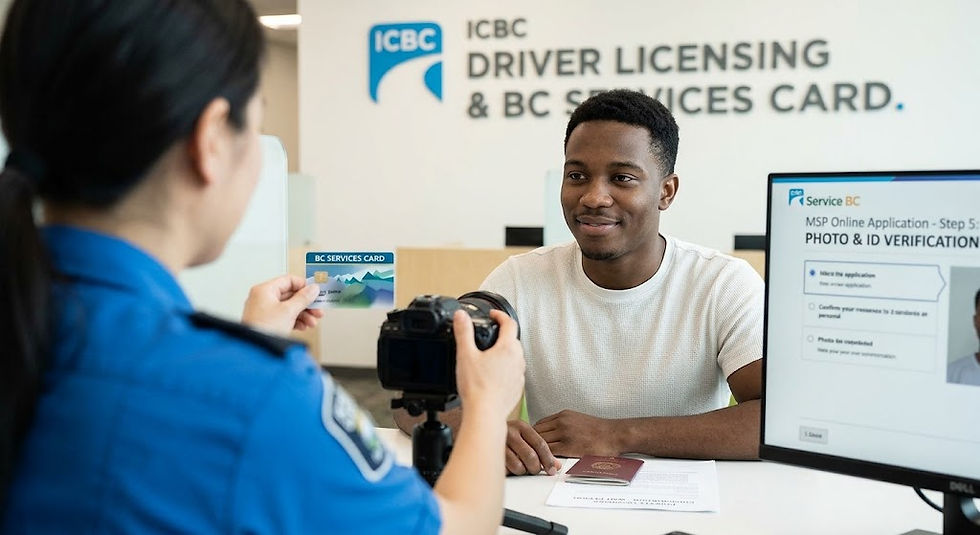
Once enrolled, obtain your BC Services Card, which carries your Personal Health Number (PHN). Most adults 18 years and six months and older book an appointment at an ICBC driver licensing office, bring primary and secondary identification, declare that they are a B.C. resident, and have their photo taken.
Children under 18 years and six months and temporary document holders automatically receive a Non-Photo BC Services Card in the mail from Health Insurance BC, so they do not need the ICBC office visit.
Arrange private health insurance to cover the wait period (see the next section) before you rely on MSP.
Your BC Services Card is the card you present to obtain insured medical and health care services once your coverage begins, and it is also used to access PharmaCare prescription drug benefits. If you already have MSP and only receive a letter to renew your card, you do not submit a new application; you simply renew the card as the letter instructs. Because the ICBC office visit is the same one you use to exchange a foreign driver's licence, many newcomers handle both in one appointment, and pairing it with opening a Canadian bank account gets the core first-week paperwork done.
The MSP wait period, and how to cover the gap
The wait period is the rule that catches newcomers off guard, so it is worth being precise. Coverage starts after a wait period that is the balance of the month in which you become a resident of B.C., plus two more months. In practice that works out to roughly two to three months depending on which day of the month you arrive. Because the calendar month you land in is only partly counted, someone who arrives on the 2nd waits almost three full months, while someone who arrives on the 28th waits a little over two.
One nuance matters for people whose status changes after arrival: the Ministry of Health decides the date you become a resident for MSP purposes, and that date depends on your immigration status. If you enter Canada as a visitor and later change to a qualifying status, your wait period starts from that later date, not from your original arrival.
What do you do during the gap? The Province's guidance is direct. If you are moving from another Canadian province or territory, keep your former provincial health plan active through the wait period. If you are arriving from outside Canada, contact a private insurance company and arrange coverage before you arrive, keeping it until your MSP coverage starts. Most private plans do not cover pre-existing conditions, including pregnancy, so buying early matters. If you need care before MSP begins, you can receive it, but you must pay the full cost yourself unless you have that private insurance.
In practice, the wait period is the single most common thing newcomer clients overlook when they picture life in Canada.
Many newcomer clients ask us about health coverage during consultations, and the pattern is consistent: people budget carefully for rent, flights, and proof of funds, then assume public health care switches on the moment they clear the airport. It does not. The families who avoid a painful surprise are the ones who treat bridge insurance as a non-negotiable line item, the same way they treat first and last month's rent. If you are landing with children or anyone with ongoing medical needs, arranging that private coverage before departure is not optional, it is part of arriving prepared.
There is a narrow exception: discharged Canadian Armed Forces members, and their spouses and children, do not have to complete the wait period. There is also a formal process to request a waiver of the wait period, but the Province approves waivers only in the most serious and exceptional cases, and you must already be found eligible for MSP before you can apply for one. Do not plan around a waiver; plan around private insurance.
Not sure whether keeping your permit valid for six or more months, or extending it before it lapses, protects both your status and your MSP eligibility? That timing is exactly the kind of straight-answer question Ansari Immigration's licensed RCIC handles in a 30-minute consultation ($80), no sales pitch attached.
What MSP does not cover
Understanding the boundaries of MSP prevents both nasty bills and the opposite mistake of paying for private coverage you do not need. The table below summarizes the split based on the Province's own benefit pages.
Generally covered by MSP | Generally not covered by MSP |
|---|---|
Medically necessary physician and midwife services | Routine dental care outside a hospital |
Diagnostic services including x-rays | Prescription drugs picked up at a pharmacy (see PharmaCare) |
Dental and oral surgery performed in a hospital | Routine eye exams for adults aged 19 to 64 |
Eye examinations when medically required, plus routine eye exams for residents aged 0 to 18 and 65 and older | Cosmetic procedures |
Some orthodontic services | Ambulance service fees |
Partial payment for certain supplementary services (acupuncture, chiropractic, massage therapy, naturopathy, physiotherapy, non-surgical podiatry) for those who qualify | Most prescription eyeglasses and contact lenses |
Source: Services Covered by MSP, Province of British Columbia. Verified August 2026.
Two things fill part of the gap. PharmaCare is B.C.'s drug program, and MSP enrolees receive full coverage of some drugs under PharmaCare Plan Z and Plan NP, with broader help available through the income-based Fair PharmaCare plan you can apply for on the same health-and-drug-coverage application. For routine dental, vision, and most prescriptions, many residents rely on extended health benefits from an employer or a private insurer. If you are job hunting in Metro Vancouver, extended health coverage is a benefit worth asking about, because it typically covers exactly what MSP leaves out.
How your immigration status affects your MSP, and what to watch
MSP eligibility is not a one-time box you tick. It tracks your status, and changes in your immigration situation can change your coverage. A work or study permit that dips below the six-month validity threshold, a permit that expires without a timely renewal, or a move out of the province can all affect whether you remain a resident for MSP purposes. This is the same status you are managing for immigration reasons, which is why the two conversations belong together.
If you are on a temporary permit, the practical rule is to keep your status continuous and your permits valid for six months or more so your MSP eligibility holds. If you are extending a study or work permit, apply before it expires so you preserve maintained status, which can also protect an initial period of MSP coverage while the renewal is pending. If you are transitioning from a temporary permit toward permanent residence, your MSP picture generally strengthens, and a spouse or child can even be deemed a resident once the permanent residence application and its fees are in with IRCC.
For newcomers whose next step is a permit extension or a permanent residence application, getting the immigration timing right is what keeps the health coverage intact underneath it. Ansari Immigration works with clients across Vancouver, Burnaby, Surrey, and Richmond on exactly these transitions, whether that is a study permit, a work permit, or a permanent residence pathway. Keeping status continuous is good immigration practice and, as a bonus, it is what protects your place in MSP.
Common mistakes newcomers make with MSP
A handful of avoidable errors show up again and again:
Assuming coverage is instant. The wait period is real. Not arranging bridge insurance is the costliest mistake on this list.
Waiting to apply. Some newcomers delay their MSP application until the wait period is over, which only pushes their coverage start date later. Apply as soon as you arrive.
Forgetting to add family members. Each person has their own enrolment, and if your spouse or children arrive on different dates, each wait period is based on that person's own arrival date. Add them promptly.
Confusing the BC Services Card with a driver's licence. They can be combined into one card at ICBC, but the Services Card is what carries your Personal Health Number and proves MSP enrolment. If you never complete the Services Card step, your enrolment is incomplete.
Letting a permit lapse. A permit that expires without a pending renewal can interrupt both your status and your MSP eligibility. Extend early.
Expecting MSP to cover drugs and dental. Budget for PharmaCare, extended benefits, or out-of-pocket costs for what MSP does not cover.
Frequently asked questions about MSP BC
Is MSP free in British Columbia?
There are no longer any monthly MSP premiums to pay. The Province eliminated MSP premiums as of January 1, 2020, so eligible residents are not billed a monthly rate for coverage. MSP is funded through general provincial revenue rather than individual premiums. One caveat: premium debts from before January 1, 2020 remain payable, so an old outstanding balance is not forgiven. For current care, though, enrolled residents do not pay a monthly MSP premium.
How much is MSP in BC per month?
Nothing. Since January 1, 2020, MSP has charged no monthly premium to residents. Before then, premiums were income-based and were cut in half in 2018 before being removed entirely. Today your MSP coverage itself carries no monthly cost. You may still choose to pay for private extended health benefits to cover dental, vision, and prescription drugs, but that is separate insurance, not an MSP premium.
Is the BC Services Card the same as a health card?
Yes, in practice. The BC Services Card is the card that gives eligible residents access to provincial health care benefits, and your Personal Health Number is printed on it, so it functions as your BC health card. It can be issued as a standalone card or combined with your driver's licence into a single card. You present it to receive insured medical services once your MSP coverage begins, and it is also used to access PharmaCare prescription benefits.
How long is the MSP wait period for new residents?
The wait period is the balance of the month in which you become a resident of B.C., plus two more months, which works out to roughly two to three months depending on your arrival date. The Ministry of Health sets the exact date you become a resident, and it depends on your immigration status. If your qualifying status begins after you arrive, the wait period starts from that later date. Apply as soon as you arrive so processing is done by the time coverage begins.
Do international students and work permit holders qualify for MSP?
They can. Holders of study or work permits issued under the Immigration and Refugee Protection Act that are valid for six or more months may be deemed residents and enrolled in MSP, and the same applies to many Working Holiday participants. You still complete the coverage wait period, and you should carry private insurance until MSP begins. If your permit is shorter than six months, you generally will not qualify, so plan private coverage for the full stay.
Can I use my BC health card in another province?
Your BC Services Card is tied to MSP, which insures services in British Columbia. Canada's health system offers some reciprocal coverage between provinces for medically necessary physician services, but the rules vary, some services are excluded, and you should confirm with Health Insurance BC and the province you are visiting before you rely on it. If you move permanently to another province, you enrol in that province's plan and notify Health Insurance BC that you have left B.C.; failing to pay attention to this can leave you without proper coverage.
Why work with Ansari Immigration: newcomers regularly come to us mid-move, unsure how a permit renewal or a permanent residence step affects the status their health coverage, driver's licence, and everything else depends on. An Ansari Immigration file is handled personally, start to finish, by the firm's licensed RCIC regulated by CICC, practicing in Vancouver since 2019, with fast, direct answers and flat, transparent fees quoted upfront. If the honest answer is that you can handle a step yourself, that is the answer you get, not a pitch. Which part of settling in B.C. is tripping you up right now? Tell us in the comments (keep it general; for advice on your specific case, book a consultation), or start with a 30-minute consultation ($80).
Related Posts
How to Find a Family Doctor in Canada: A Newcomer's Complete 2026 Guide: Your next step after MSP enrolment, including how to register for a doctor in British Columbia.
Tenant Rights BC: A Complete 2026 Guide for Renters and Newcomers: The renting rules that protect you while you get settled in British Columbia.
Newcomer to Canada Checklist: The full list of first-week settlement tasks, from SIN to banking to health coverage.
This article is for general information only. It is not legal advice. Program criteria, requirements, processing times, and selection approaches can change without notice. Always confirm details on official government websites or consult a licensed Regulated Canadian Immigration Consultant (RCIC) for advice specific to your situation.



Comments