

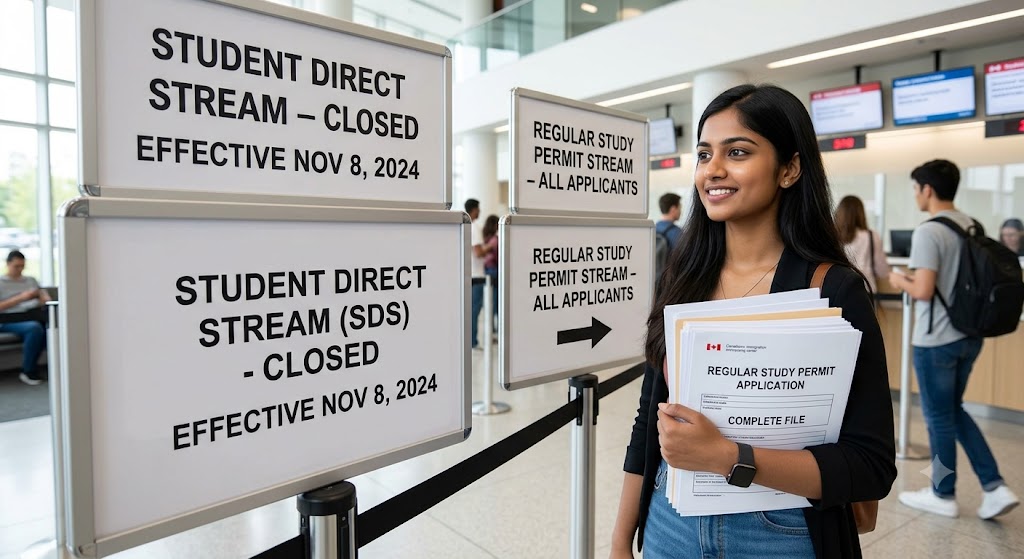
The Student Direct Stream is no longer available. Immigration, Refugees and Citizenship Canada closed the Student Direct Stream (SDS), and the Nigeria Student Express, at 2:00 p.m. ET on November 8, 2024. Canada did not stop issuing study permits, though. Everyone now applies through the regular study permit stream instead.
That distinction is the whole point. The fast lane closed; the road did not. What ended was the guaranteed expedited processing and the fixed upfront checklist. What did not change is that a well-prepared application from any country can still get you a study permit. The two documents that now decide most files are your provincial attestation letter and your proof of funds, so getting those right matters more than ever.
What was the Student Direct Stream?
The Student Direct Stream was an expedited study permit processing initiative launched in 2018 for people applying to study at a post-secondary designated learning institution. It was open to legal residents of 14 countries: Antigua and Barbuda, Brazil, China, Colombia, Costa Rica, India, Morocco, Pakistan, Peru, Philippines, Saint Vincent and the Grenadines, Senegal, Trinidad and Tobago, and Vietnam. Nigeria had a parallel process, the Nigeria Student Express.
The deal was simple: applicants who provided a specific set of documents up front got faster processing than the regular stream. To qualify, you had to meet those requirements before you applied, which is why the SDS felt like a checklist rather than a judgment call.
Is the Student Direct Stream still available?
No. The Student Direct Stream ended on November 8, 2024, at 2:00 p.m. ET. Applications received before that moment were processed under the SDS; anything submitted on or after it is processed as a regular study permit. IRCC framed the change as giving all international students equal and fair access to the same application process, regardless of country.
For a prospective student, the practical effect is this: there is no separate fast form to fill out anymore. There is one study permit application, and everyone uses it.
How to apply for a study permit now that SDS is closed
You apply through the regular study permit stream. The government processing fee is $150. Here is what you gather:
A letter of acceptance from a designated learning institution (your school confirms it is valid).
A provincial or territorial attestation letter (PAL or TAL) in most cases; in Quebec, a Quebec Acceptance Certificate (CAQ) instead.
Proof of identity: a valid passport and passport-size photos that meet IRCC's specifications.
Proof of funds showing you can cover tuition, living costs, and travel without working.
A letter of explanation (recommended), plus a medical exam or police certificate if your situation calls for it.
The Guaranteed Investment Certificate that so many SDS applicants used is still accepted. A GIC from a participating Canadian financial institution remains one of the cleanest ways to show proof of funds in the regular stream, alongside bank statements, a paid tuition receipt, or a loan.
In practice, the closure removed the safety net of a fixed checklist, so officers now read the whole application. That means your money has to be genuinely available and traceable, not parked in an account the week before you apply, and your study plan has to make sense for someone who intends to study and then comply with the terms of their stay. For students heading to Metro Vancouver, your PAL comes through the BC process once you accept your offer and pay tuition, so build that step into your timeline early. A study permit is also the first step in a longer plan for most students, from a post-graduation work permit to permanent residence, so it is worth setting it up correctly from the start.
Did you apply under the SDS before it closed, or are you working through the regular stream now? Tell us what caught you off guard in the comments, and keep it general; for advice on your own file, book a consultation.
Why this matters for your study permit application
The single figure most students underestimate is the living-expense requirement, which is separate from tuition and rose for applications submitted on or after September 1, 2025.
Family members (including you) |
Funds required per year, outside Quebec (CAN$) |
Just you (1) |
$22,895 |
2 people |
$28,502 |
3 people |
$35,040 |
4 people |
$42,543 |
Source: IRCC, Proof of financial support (canada.ca). Verified August 2026. These amounts exclude tuition and transportation and are updated each year.

Getting the proof of funds and the PAL right is now what separates an approval from a refusal, because there is no expedited track to smooth over a thin file. If a study permit refusal is already on your record, that history follows you, so it is worth understanding the reasons refusals happen before you reapply.
Not sure your proof of funds will read as genuinely available to an officer? That is exactly the kind of 30-minute question worth putting to Ansari Immigration's licensed RCIC before you submit ($80).
Ask a consultant ($80, 30 min)
Frequently asked questions about the Student Direct Stream
Is the Student Direct Stream closed for good?
Yes. IRCC ended the SDS on November 8, 2024, and has not announced a replacement fast-track stream. All study permit applications are now processed through the regular stream.
What replaced the Student Direct Stream?
Nothing replaced it as a separate stream. Former SDS applicants now use the same regular study permit application as everyone else, which still accepts a GIC as proof of financial support.
Can I still use a GIC for my study permit?
Yes. A Guaranteed Investment Certificate from a participating Canadian financial institution is still an accepted way to show proof of funds in the regular study permit stream.
Does the end of SDS hurt my chances of approval?
IRCC has said the change does not adversely affect eligibility. All students must meet the same study permit requirements; a complete, well-documented application is what matters.
How long does a study permit take now?
Processing times vary by country and are no longer fixed by a fast-track guarantee. Check the current estimate on IRCC's official processing times tool before you plan your travel.
I am from a former SDS country. Do I apply differently?
No. Applicants from the 14 former SDS countries and from Nigeria use the same regular study permit stream and the same documents as applicants from anywhere else.
Related Posts
Study Permit Proof of Funds 2026: What IRCC Changed: The current proof-of-funds amounts and what IRCC now looks for in a student's finances.
What Is a Designated Learning Institution (DLI) in Canada?: Why your school's DLI status decides whether you can get a study permit at all.
Study Permit Refusal in Canada: Top Reasons and How to Reapply: The most common reasons study permits are refused and how to rebuild a stronger application.
Why work with Ansari Immigration
Most students can file a clean study permit application themselves, and if yours is straightforward we will say so, not sell you a service. Where Ansari Immigration earns its fee is the harder file: a prior refusal, a complicated funding source, or a study plan that has to hold up. Study-permit fees are flat and quoted upfront, $500 from inside Canada and $1,500 from outside, with additional family members quoted separately.
Applying from a former SDS country and unsure whether your funds and PAL will hold up? Every Ansari Immigration file is handled personally by the firm's licensed RCIC, regulated by CICC. And if you have been through the new process, tell us in the comments how long your study permit took, since real timelines help everyone still waiting.
Book a consultation ($80, 30 min)
This article is for general information only. It is not legal advice. Program criteria, requirements, processing times, and selection approaches can change without notice. Always confirm details on official government websites or consult a licensed Regulated Canadian Immigration Consultant (RCIC) for advice specific to your situation.