
How to Verify an Immigration Consultant in Canada (and Avoid Ghost Consultants)

Updated: Aug 5
To verify an immigration consultant in Canada, search the person’s name or licence number on the College of Immigration and Citizenship Consultants (CICC) public register and confirm they are a licensed RCIC in good standing. Anyone who charges a fee to advise on or handle your immigration application must be authorized. If they are not listed, do not hire them.
That one check protects the most important application of your life. Below is how to do it properly, who is actually allowed to charge for immigration advice, and how to recognize a ghost consultant before your money and your file are at risk.
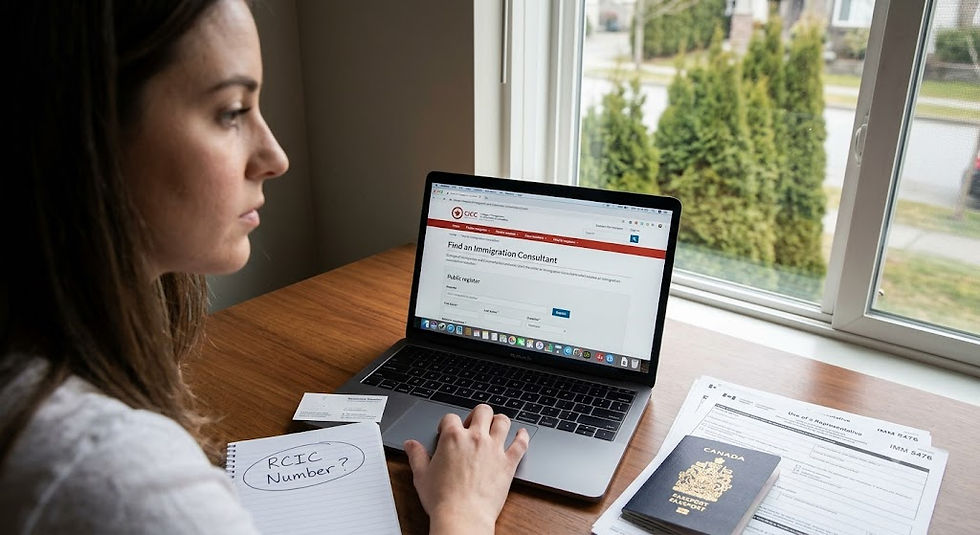
How to verify an immigration consultant on the CICC register
Licensed immigration consultants in Canada are called Regulated Canadian Immigration Consultants (RCICs), and every one of them must be a member in good standing of the College of Immigration and Citizenship Consultants. IRCC directs applicants to that register to confirm a consultant is licensed. Here is the process:
Open the CICC public register (the College’s "Find an Immigration Consultant" tool).
Search by the person’s full name, their company name, or their RCIC number.
Confirm the record shows an active, in-good-standing licence, not one that is suspended, revoked, or expired.
Match the name on the register to the person you are actually dealing with, and to the name that will go on your use of a representative form.
If the person does not appear, or their status is anything other than active and in good standing, IRCC’s guidance is clear: you should not use their services.
Who is allowed to charge for immigration advice in Canada
This is where most people get caught. Under IRCC’s rules for representatives, only certain people can charge a fee or accept any payment to represent you or advise you on an immigration or citizenship application. These authorized representatives are:
immigration or citizenship consultants who are members in good standing of the CICC (RCICs)
lawyers who are members in good standing of a provincial or territorial law society, and paralegals who are members of the Law Society of Ontario
notaries who are members in good standing of the Chambre des notaires du Québec
Most law societies let you check membership online, the same way the CICC register works for consultants. If you pay someone, or compensate them in any way, in exchange for immigration help, IRCC treats that as paid representation, and the person must be authorized. IRCC has stated plainly that it will not deal with representatives who charge a fee but are not authorized, and that using one, in Canada or abroad, can lead it to return or refuse your application.
What is a ghost consultant, and the red flags
A ghost consultant is an unlicensed person who charges for immigration advice or quietly prepares your application while staying invisible to IRCC. They often do not put their name on your forms at all, so on paper it looks like you did everything yourself. When something goes wrong, there is no licensed professional accountable, and no regulator you can complain to.
They cannot give you an RCIC number, or their name is not on the CICC register.
They call themselves an "immigration agent" or "advisor" instead of a licensed RCIC or lawyer.
They tell you to leave their name off your application, or to say you had no representative.
They advertise "free" help and later ask for a fee, or they push you to put information on your forms that is not true.
They guarantee approval. No honest professional can promise an outcome.
Have you ever been quoted by someone who could not show a licence? Tell us in the comments what they claimed, it helps other readers spot the same pattern. Keep it general here, and for advice on your own case use a consultation.
From Amir’s desk: verify the licence first, then do the real research
In practice, verifying the licence is the easy part. Go to the CICC register, search the name, confirm the person is a licensed RCIC in good standing, and you have cleared the first gate. The mistake I see is treating that as the finish line. It is the beginning of your due diligence, not the end.
Treat it the way you would choose a doctor. You assume they are licensed, but you still ask around. Talk to the consultant directly and see how they answer real questions about your case. Look at their track record and reviews. If you can, speak to former clients about how the person actually works and what you are signing up for. Licence first, then real research. The families we meet at our Metro Vancouver office who got burned almost always skipped that second step.
Not sure whether the person you are talking to is authorized for your type of case? That is a 30-minute question, and you can put it to Ansari Immigration’s licensed RCIC directly for $80: book a consultation.
What happens if you use an unauthorized consultant
The hard truth is that you carry the consequences, not the ghost. IRCC’s guidance on fraud is explicit that you are responsible for all the information in your application, even if a representative fills it out for you. So when an unlicensed operator lies to strengthen your file, it is your name attached to the fraud.
Under that guidance, if you, your representative, or your interpreter send false documents or information, your application can be refused, you can be banned from Canada for at least five years, a permanent record of fraud can be attached to your file, and your status or citizenship can later be taken away. A licensed RCIC is bound by a professional code and a regulator, and files everything through the proper channels, including the authorized paid representative portal. A ghost consultant simply disappears, and Canada continues to tighten oversight of paid consultants precisely because unlicensed operators cause the most harm.

Why this matters for your immigration application
Hiring help is optional. IRCC is clear that you do not need a representative, that using one will not draw special attention to your file, and that all the forms and instructions are free on its website. The point of verifying a consultant is not to find someone impressive, it is to make sure the person guiding a decision this important is real, accountable, and qualified. Whether you are building an Express Entry profile or a permanent residence application, confirming a licence takes two minutes. Undoing the damage from a ghost consultant can take years.
Frequently asked questions about verifying an immigration consultant
How do I check if an immigration consultant is registered in Canada?
Search the person’s name, company, or RCIC number on the CICC public register. If they appear as an active member in good standing, they are a licensed RCIC. If they are not listed, or their licence is suspended, revoked, or expired, they are not authorized to charge you for immigration help.
What is a ghost consultant?
A ghost consultant is an unlicensed person who charges for immigration advice or prepares applications without appearing anywhere on the file. Because they are not CICC members, they are not authorized to be paid representatives, and there is no regulator holding them accountable if your application fails.
Who is allowed to charge for immigration advice in Canada?
Only RCICs in good standing with the CICC, lawyers in a provincial or territorial law society (and paralegals in Ontario), and notaries in the Chambre des notaires du Québec. Unpaid helpers such as family or friends can assist for free, but anyone who takes payment must be authorized.
What happens if I use an unauthorized immigration consultant?
IRCC may return or refuse an application prepared by an unauthorized paid representative. If false information is submitted, you can face refusal, a five-year ban from Canada, a permanent fraud record, and loss of status or citizenship, because you remain responsible for everything in your application.
Do I need to hire an immigration consultant at all?
No. IRCC provides every form and instruction for free, and using a representative does not improve your odds on its own. Many applicants file successfully alone. A licensed RCIC adds value on complex files, prior refusals, or when you want your case built and represented professionally.
Why work with Ansari Immigration: clients regularly come to us after an unlicensed "agent" vanished the moment IRCC asked a question. Every Ansari Immigration file is handled personally by the firm’s licensed RCIC, with direct access to your consultant and flat, transparent fees quoted upfront. You pay for a straight answer, not a pitch, including "do not apply yet" when that is the honest call. Checked a consultant and still unsure, or want a second read before you sign anything? Tell us in the comments, or book a 30-minute consultation ($80) and start with someone whose licence you can verify yourself.
Related Posts
What Is an Authorized Representative for Immigration in Canada?: Who can legally act on your behalf with IRCC, and the difference between paid and unpaid representatives.
IRCC Consultant Regulation: What the July 15, 2026 Rules Mean for Applicants: How Canada is strengthening oversight and discipline of licensed immigration consultants.
A Comprehensive Guide to Finding a Trustworthy Immigration Consultant: A practical checklist for choosing a representative you can rely on.
This article is for general information only. It is not legal advice. Program criteria, requirements, processing times, and selection approaches can change without notice. Always confirm details on official government websites or consult a licensed Regulated Canadian Immigration Consultant (RCIC) for advice specific to your situation.


Comments