


There is no official Canada visa refusal rate by country. IRCC publishes how many applications it finalizes and notes that each is approved, refused, or withdrawn, but it does not publish a standardized public approval-rate table broken down by country. The per-country percentages you see on other sites are third-party estimates, not government figures.
That matters because chasing a country number is the wrong focus. Your visa is not decided by a national average; it is decided by one legal test applied to your file. Under paragraph 179(b) of the Immigration and Refugee Protection Regulations, an officer can only issue a temporary resident visa if they are satisfied you will leave Canada at the end of your authorized stay. Two applicants from the same country can get opposite results because one convinced the officer of that and the other did not. Below is what the official data actually shows, why the country tables mislead, and what genuinely lowers your risk.
What Canada's official numbers actually show
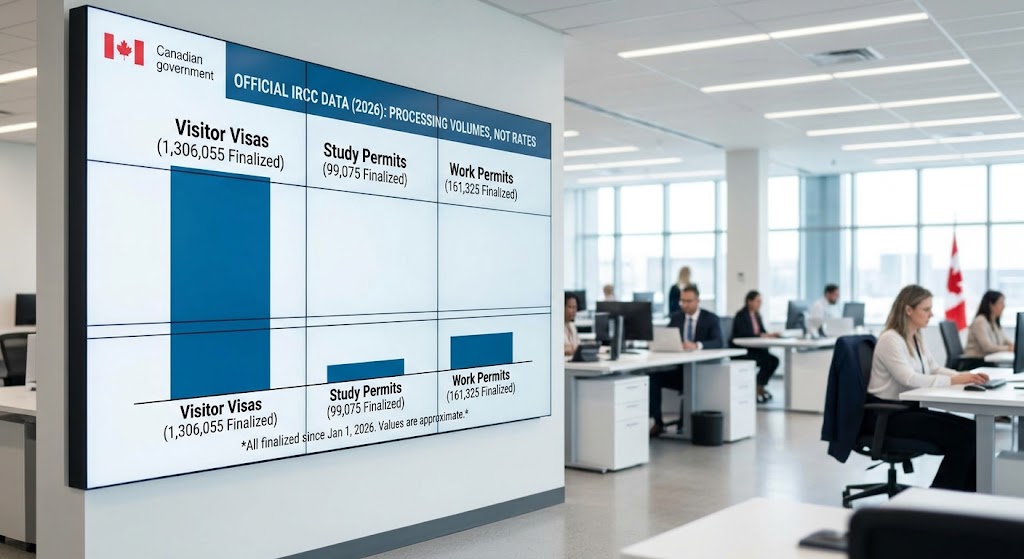
IRCC's own statistics report application volumes and processing performance, not approval rates. As of the data published on its application processing page (data as of June 30, 2026), the finalized volumes for 2026 look like this. Values are rounded to the nearest five and are approximate.
Application type (finalized since Jan 1, 2026) |
Finalized |
Not yet finalized |
All temporary residence (new applications) |
1,566,455 |
401,280 |
Visitor visas |
1,306,055 |
337,100 |
Study permits |
99,075 |
36,520 |
Work permits |
161,325 |
27,655 |
Source: IRCC, Inside IRCC's application processing system, data as of June 30, 2026. Verified September 2026.
Notice what these are: counts of applications finalized, not the share approved. IRCC states each finalized application is "approved or refused by IRCC, or withdrawn," but it does not attach a public approval percentage to these totals, and it does not break them down into a country-by-country rate table. The same page reports processing performance, for example that from July 2025 to June 2026 about 79% of Federal Skilled Worker and Canadian Experience Class applicants received a decision within the six-month service standard. That is a service-standard figure, not an approval rate.
Why the "refusal rate by country" tables online are not official
If you search this topic you will find confident tables claiming a specific approval or refusal percentage for each country. Treat them with caution. IRCC releases granular datasets through the Government of Canada open data portal, and analysts can and do estimate rates from those raw numbers, but the tidy per-country percentages presented as "official" are third-party calculations. They rely on different date ranges, different application types, and different assumptions, which is why the same country can appear with very different numbers on two different sites.
The honest takeaway is that there is no single, current, government-published "your country has an X% chance" figure. When a page presents one as fact, it is presenting an estimate as a certainty. For your decision, a national estimate tells you almost nothing, because the officer is not assessing your country. They are assessing you.
Does your country actually affect your odds? The case on each side
It would be misleading to say your country is irrelevant, so here is the honest version of each side. Country does affect some things. IRCC's own processing page lists "how many applications we receive from a given country" as a factor in how long a decision takes, and visa offices differ in capacity, local conditions, and the mix of applications they see. Historical patterns are real too: applicants from some countries are approved at visibly higher rates than others, which is exactly why the estimate tables exist in the first place.
But none of that is a probability that attaches to you. The refusal is decided one file at a time under paragraph 179(b), and two applicants holding the same passport routinely get opposite answers. A "40% approval" estimate for a country is an average of thousands of very different files, strong and weak, complete and thin. It does not tell you which half you are in. You cannot change your passport, but you can change how convincingly your application answers the one question the officer must resolve, and that is where your effort actually moves the needle. A country average does not move with anything you do.

The one rule that actually decides your visa
Almost every visitor visa refusal comes back to the same line: "I am not satisfied that you will leave Canada at the end of your authorized stay." That is not an arbitrary phrase. It is the officer applying paragraph 179(b) of the Immigration and Refugee Protection Regulations, which requires them to be satisfied a temporary resident applicant will leave at the end of their stay before a visa can be issued. The same temporary-intent test applies to visitor visas, and to the temporary resident visa attached to study permit and work permit applications.
Because the test is about you as an individual, the factors an officer weighs are personal: your ties to your home country, your financial situation and the source and stability of your funds, your immigration and travel history, the purpose and logic of your trip, and the overall consistency and completeness of your application. A weak answer on any of these is what converts into a refusal, regardless of which country the passport is from.
A tale of two applicants from the same country
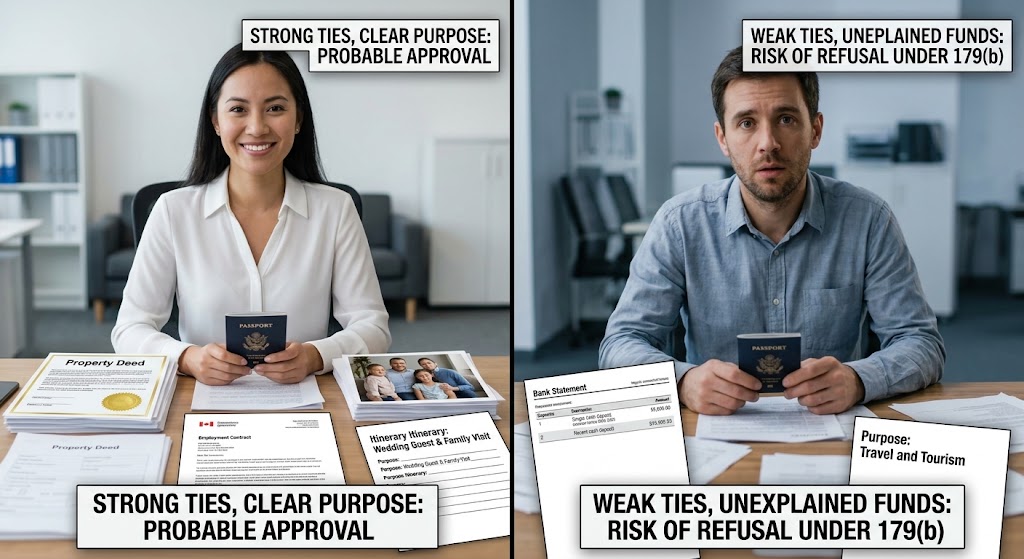
Here is how this plays out in practice, illustratively. Two visitors apply from the same country in the same month. The first has a permanent job with approved leave, property, a spouse and children staying behind, savings that have sat in the account for a year, and a clear two-week itinerary for a family wedding. The second is between jobs, single, shows a lump sum that appeared in the account last week, and gives a vague plan to travel and see family. Same country, same national estimate, opposite outcomes: the first reads as someone with strong reasons to return, the second leaves the officer unconvinced under 179(b).
The point is not that the second applicant is dishonest. They may fully intend to leave. But the officer decides on the evidence in front of them, not on private intention, and a thin file gives them nothing to be satisfied with. This is also why "my friend from the same country got approved with less" is not the reassurance it sounds like. You are not being compared to your friend; you are being assessed on your own record, against the same test.
What actually lowers your refusal risk
This is where a country percentage helps you not at all and preparation helps you a great deal. The reason for refusal is individual, so the fix is individual. In practice, the applications that clear the temporary-intent test tend to do the following well:
Show genuine ties to your home country: employment, studies, property, family, or other commitments that give you a real reason to return.
Prove funds that are clearly sufficient and clearly yours: enough to cover the stay without working, with a source and history that hold up to scrutiny.
Keep the application consistent and complete: dates, purpose, and documents that agree with one another and leave no obvious gap for an officer to doubt.
Disclose any prior refusal, from any country, honestly. Hiding it is far more damaging than the refusal itself, because a misstatement can trigger a finding of misrepresentation.
Explain anything unusual up front, rather than leaving the officer to guess, ideally in a focused letter of explanation.
If you have already been refused, the most useful first step is to find out exactly why, then rebuild around that specific weakness rather than resubmitting the same file.
Not sure whether your ties and funds will read as strong enough to an officer? That is exactly the read Ansari Immigration's licensed RCIC gives in a 30-minute consultation ($80), before you file or refile.
Are Canada's refusals actually rising?
You will also see claims that Canada is refusing far more applicants than it used to. Treat these carefully. Third-party analyses that put a specific rising percentage on it are estimates built from the open data, not a government headline rate, and they move with the method used. What is officially documented on IRCC's statistics page is the volume of applications finalized and the processing performance, not a single published approval rate you can trend over time. The honest answer is that scrutiny is widely reported to be tighter, but if you want the trend, read the open datasets yourself rather than any one site's number. Either way, it does not change what makes your individual file succeed.
Where to find the real official data
If you want the underlying numbers rather than a repackaged table, go to the source. IRCC's open data datasets publish temporary and permanent residence outcomes, and its processing system page is refreshed periodically with current volumes. For how long a decision should take on your specific application, IRCC's check processing times tool is the authoritative source. Anything else is someone's interpretation of these, and worth reading as interpretation.
Which brings us back to the point of this post: the number you were searching for does not exist in the form you hoped, and even if it did, it would not change what you should do. Do you find the country-rate tables reassuring or misleading? Tell us in the comments, and keep it general.
Frequently asked questions about Canada visa refusal rates
Is there an official Canada visa refusal rate by country?
No. IRCC publishes application volumes and outcomes and releases granular datasets through the open data portal, but it does not publish a standardized public approval-rate or refusal-rate table by country. Per-country percentages on other sites are third-party estimates, not government figures.
Which country has the highest Canada visa refusal rate?
There is no official ranking to cite. Estimates circulate online, but they use different data ranges and assumptions and are not government figures. More importantly, the refusal decision is individual under IRPR paragraph 179(b), so a country ranking does not predict your own outcome.
Why do so many Canada visitor visas get refused?
The dominant reason is that the officer was not satisfied the applicant would leave Canada at the end of their authorized stay, as required by IRPR 179(b). This usually traces back to weak home-country ties, unclear or insufficient funds, or an inconsistent application, rather than the applicant's nationality.
Does my country affect my chances of getting a Canadian visa?
Your profile matters far more than your passport. The officer assesses your individual ties, finances, history, and the consistency of your application against the temporary-intent test. Two applicants from the same country routinely get different results based on how well their files answer that test.
Is Canada refusing more visas than before?
IRCC does not publish a single headline approval rate on its main statistics page, and third-party analyses that suggest rising refusals are estimates. What is documented officially is the volume of applications finalized and the processing performance, which you can check on IRCC's processing system page and open data portal.
I was refused. How do I find out why?
Order your officer's notes. The reasons are recorded in your file, and reading them tells you the exact concern so you can rebuild around it instead of guessing. From there, address the specific weakness, whether that is ties, funds, or an inconsistency, before you reapply.
Clients regularly come to us fixated on a country percentage they found online, when the refusal in front of them turned entirely on one weak point in the file, a thin explanation of ties or an unclear source of funds. An Ansari Immigration review looks at your application the way an officer reads it, against the temporary-intent test, and tells you plainly where it is weak, including when the honest answer is that it is already strong enough to file yourself. Every file is handled personally by the firm's licensed RCIC, RCIC R709304, with flat, transparent fees quoted upfront and additional family members quoted separately. Worried about your odds after a refusal, or before a first application? A 30-minute consultation ($80) is where that gets a straight answer.
Related Posts
Study Permit Refusal in Canada: Top Reasons and How to Reapply (2026): the specific refusal reasons behind study permit decisions and how to rebuild a stronger application.
Letter of Explanation for Canada Immigration: How to Write One That Works (2026): how to address an officer's concern directly, which is often what turns a refusal risk into an approval.
GCMS Notes Canada: What They Are and How to Order Your IRCC File (2026): how to see the exact reason an application was refused before you reapply.
This article is for general information only. It is not legal advice. Program criteria, requirements, processing times, and selection approaches can change without notice. Always confirm details on official government websites or consult a licensed Regulated Canadian Immigration Consultant (RCIC) for advice specific to your situation.