
How to Sponsor Your Parents and Grandparents to Canada (2026): The Program Is Paused, Here Is What to Do Now

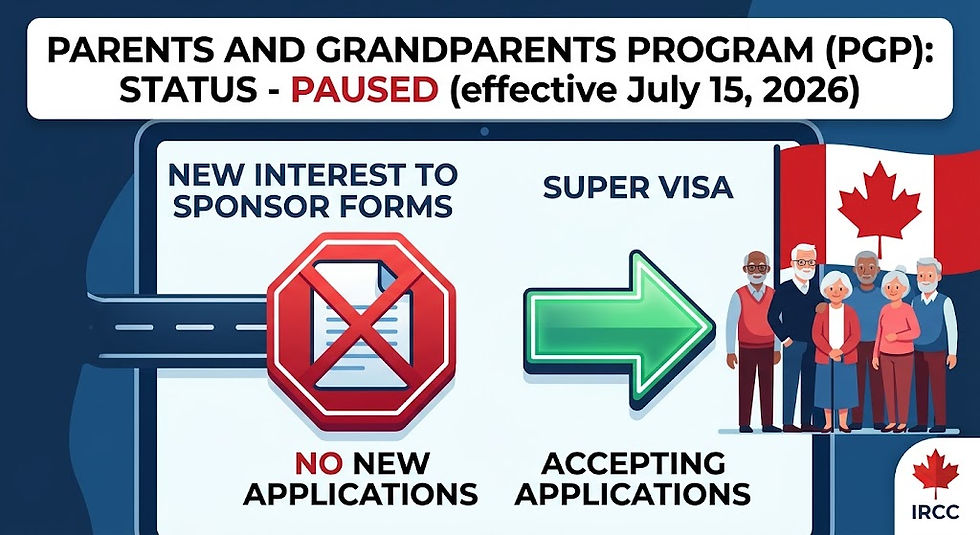
Here is the plain answer on how to sponsor your parents and grandparents to Canada in 2026: you cannot start a new application right now. On July 15, 2026, IRCC paused the Parents and Grandparents Program (PGP). It is not accepting new interest to sponsor forms and is not sending new invitations to apply until further notice. Existing applications keep being processed.
That pause is the single most important fact for any family planning this move, and it is the thing most guides online still get wrong. IRCC has confirmed it plans to approve up to 15,000 people for permanent residence through the PGP in 2026, but every one of those spots comes from the pool of people invited in earlier rounds, not from anyone applying today. If you are not already in that pool, your realistic route to keep your parents close this year is the super visa, and the rest of this guide walks through both. You can confirm the current status yourself on IRCC's official sponsor your parents and grandparents page.
Is Canada still accepting new parents and grandparents sponsorship applications?
No. As of 2026, the PGP status on IRCC's own page reads “Paused.” In its July 15, 2026 notice, IRCC said it will not receive new interest to sponsor forms or invite potential sponsors to apply until further notice, and explained the reason bluntly: interest in the program keeps exceeding the spaces available under the 2026 to 2028 Immigration Levels Plan.
Here is the part that trips people up. A paused program is not a cancelled program. IRCC is still working through applications from sponsors who were invited in past intakes, and it plans to land up to 15,000 parents and grandparents as permanent residents in 2026. So two very different families both search how to sponsor my parents: one already submitted an interest to sponsor form years ago and is waiting on an invitation, the other is starting from zero. The first family waits and prepares. The second family cannot enter the queue right now at all, no matter how strong their income is.
There is no published reopening date. IRCC has not said whether the next intake will run in 2027 or later, so anyone who tells you exactly when the interest to sponsor form returns is guessing. Treat when will parent sponsorship open as an open question and watch the official page, not a forum.
Are you already in the pool from a past intake, or starting from zero this year? Tell us where you stand in the comments, keeping it general, because the two situations call for completely different plans.
Who can sponsor their parents and grandparents to Canada
Sponsoring a parent or grandparent is one branch of Canada's family sponsorship system, and it has its own rules. When the program does run, IRCC's eligibility rules do not change just because intake is paused, so it is worth knowing where you stand now. According to IRCC's eligibility page, you can sponsor your biological or adopted parents and grandparents if you:
were invited to apply in an intake round
are at least 18 years old
live in Canada, with your primary residence in Canada when you submit and until a decision is made
are a Canadian citizen, a permanent resident, or a person registered under the Indian Act
have enough income to support everyone you will be responsible for (a spouse or common-law partner can co-sign to combine incomes)
The half of this that guides skip is who cannot sponsor, and it is where real applications fall apart. IRCC lists specific bars: you may be refused if you are in prison, have not repaid an immigration loan, a performance bond or court-ordered support such as alimony or child support, defaulted on a past sponsorship undertaking, have an undischarged bankruptcy, receive social assistance for a reason other than a disability, were convicted of a violent offence, an offence against a relative or a sexual offence, or are under a removal order. In practice, immigration officers check the who cannot sponsor list as carefully as the income test, and a past sponsorship default is one of the quiet reasons an otherwise-strong sponsor is turned down.
Income requirements to sponsor your parents and grandparents
Sponsoring a parent or grandparent for permanent residence has a stricter money test than sponsoring a spouse. You must meet a Minimum Necessary Income for your family size for each of the three tax years before you apply, proven with a Canada Revenue Agency Notice of Assessment for each year. The figures below are IRCC's amounts for the most recent (2025) intake.
Minimum Necessary Income table (2025 intake, three tax years)
Family size | 2024 | 2023 | 2022 |
|---|---|---|---|
2 people | $47,549 | $44,530 | $43,082 |
3 people | $58,456 | $54,743 | $52,965 |
4 people | $70,972 | $66,466 | $64,306 |
5 people | $80,496 | $75,384 | $72,935 |
6 people | $90,784 | $85,020 | $82,259 |
7 people | $101,075 | $94,658 | $91,582 |
Each additional person, add | $10,291 | $9,636 | $9,324 |
Source: IRCC, Income requirements for the sponsor. Verified September 2026. These are the amounts for the 2025 intake; IRCC updates them for each intake year, so confirm the current table before you rely on a number.
Two details cause most of the confusion. First, family size is counted per year, and you include everyone you are responsible for, even people who are not coming to Canada, even a separated-but-not-divorced spouse until the divorce is final. Second, a co-signing spouse or common-law partner must be counted in the family size for all three years, and their income is added to yours. If your income is close to the line, a co-signer is often the difference between eligible and refused. IRCC assesses this using the Financial Evaluation for Parents and Grandparents Sponsorship (IMM 5768) form.
The 20-year undertaking: what sponsoring actually commits you to
Sponsoring a parent or grandparent is a far longer promise than most people expect. IRCC's undertaking page sets the undertaking period at 20 years (10 years in Quebec), starting the day the person you sponsor becomes a permanent resident. During that time you are financially responsible for them, and if they receive social assistance, you must repay it, and you cannot sponsor anyone else until you do.
Once your parents become permanent residents, there is no way to cancel or shorten the undertaking. It survives almost everything: the sponsored person becoming a Canadian citizen, your relationship breaking down, either of you moving to another province or country, and your own financial trouble such as a job loss. You can only withdraw a sponsorship before the person becomes a permanent resident. When explaining this to students, the distinction I stress is that the income test proves you can afford the commitment today, but the 20-year undertaking is the commitment, and it does not flex if your life changes.

Not sure whether your income and family-size count would actually clear the Minimum Necessary Income, or whether a co-signer would tip you over the line? That one calculation is what most parent sponsorships turn on. Ansari Immigration will run your real numbers before you commit to the 20-year undertaking.
What happens when a sponsor falls short: a real refusal, and the fallback
Here is how the income rule plays out when it is missed. In Duggal (2019 CanLII 113768), a parents' permanent residence sponsorship was refused for not meeting the Minimum Necessary Income. The sponsor appealed to the Immigration Appeal Division and lost, and part of the reasoning was that the parents already held multi-year, multiple-entry super visas: they could keep visiting and staying for long periods, so the humanitarian pressure to overlook the income shortfall was weaker. Read that outcome carefully, because it cuts two ways. The income test is real and it is enforced. But the same decision shows the super visa is the recognized fallback that keeps a family together even when a PR sponsorship does not succeed.
Documentation is the other place these files stumble. Parents and grandparents applications routinely include accompanying family members, and each relationship has to be proven with the right document: IRCC asks for a marriage certificate where the relationship is by marriage, or a Statutory Declaration of Common-Law Union (IMM 5409) where it is common-law. The pattern we see at our Vancouver office is that people prepare the sponsor's income evidence meticulously and then underprepare the relationship and identity documents for everyone coming along.
The super visa: the real alternative while the PGP is paused
Because new PGP intake is closed, the super visa is the route most families can actually use in 2026. It is a multiple-entry visitor visa for parents and grandparents of Canadian citizens and permanent residents. Per IRCC, it lets them visit for up to five years at a time and gives multiple entries for up to ten years, and holders can apply to extend their stay from inside Canada. It is not permanent residence, but it keeps families together for long stretches.
To qualify, IRCC's super visa eligibility page requires a host in Canada (the child or grandchild) who is a citizen, permanent resident or registered Indian, is at least 18, lives in Canada, meets a minimum income, and writes a letter of invitation. The applicant must apply from outside Canada, pass an immigration medical exam, and show private health insurance valid for at least one year from the date of entry, from a Canadian insurer or a foreign insurer approved by the minister.
IRCC recently made the income side easier. As of March 31, 2026, under a change to how the super visa income requirement is calculated, hosts have two new ways to meet it: the income can be met in either of the two tax years before applying (not just the single most recent year), and the visiting parent's or grandparent's own income can be added to top up the host's income if the host meets a required minimum percentage. Because the exact dollar figures for the super visa income test are being re-synced across IRCC's operational guidance in 2026, confirm your family-size number on the official super visa forms and documents page before you budget to it.
Two practitioner points that save families grief. First, always apply for the super visa before your parents come to Canada, not after they arrive as regular visitors: a super visa is not a visitor-record extension or a TRV renewal, it is a separate application, and doing it from inside Canada means sending the passport out again for stamping. Second, a super visa is visitor status, full stop. It does not authorize work or study. A parent who wants to work needs a work permit, not a super visa.
In practice, the make-or-break point on a super visa is not the paperwork, it is whether the host in Canada genuinely has the financial means to support the visiting parent, because that is exactly what officers weigh.
PGP versus super visa: which route fits your family
For most families in 2026 this is not really a choice, because PGP intake is closed. But it is worth knowing the trade-offs so you are ready when the interest to sponsor form reopens.
Factor | Parents and Grandparents Program (PGP) | Super visa |
|---|---|---|
What you get | Permanent residence for your parents | Long-term visitor status, not PR |
Open in 2026? | Paused, no new applications | Open and accepting applications |
Who applies | The sponsor (must have been invited) | The parent or grandparent, with a host in Canada |
Income test | MNI for family size, 3 tax years, NOA required | Host income (two new ways to qualify as of March 31, 2026) |
Length | Permanent, with a 20-year undertaking | Up to 5 years per entry, multiple entries for up to 10 years |
Health insurance | Provincial coverage once a PR | Private insurance, minimum 1 year, required |
Can they work? | Yes, as permanent residents | No, visitor status only |
Source: IRCC PGP and super visa pages. Verified September 2026.
The honest read: if permanent residence is your goal, the super visa does not replace the PGP, and a family that wants their parents to eventually work, access provincial health coverage, and stay for good should keep an eye on the next PGP intake. But if the goal is simply to have your parents here for long stretches, starting now, the super visa is available today and the PGP is not.
What to do right now in 2026
If you already submitted an interest to sponsor form in a past intake, do nothing rash: stay in the pool, keep your income evidence current for three tax years, and watch your IRCC account for an invitation. If you are starting from zero, you cannot join the PGP queue today, so the practical move is to prepare a strong super visa application: line up the host's income proof, a genuine letter of invitation, the one-year private medical insurance, and the immigration medical exam. Either way, get your family-size count and income math right before you file anything, because that single calculation is what most refusals turn on.

Frequently asked questions about how to sponsor your parents and grandparents to Canada
Will there be a parents and grandparents sponsorship program in Canada in 2026?
The program exists but is paused. IRCC is processing applications from earlier intakes and plans to admit up to 15,000 people through the PGP in 2026, but it is not accepting new interest to sponsor forms or issuing new invitations until further notice.
Is Canada still accepting new parent and grandparent sponsorship applications?
No. New intake is closed as of the July 15, 2026 pause. You cannot submit a new interest to sponsor form right now. Existing applications continue to be processed.
What are the income requirements to sponsor my parents and grandparents?
You must meet a Minimum Necessary Income for your family size for each of the three tax years before you apply, shown by a CRA Notice of Assessment for each year. A spouse or common-law partner can co-sign to combine incomes. Confirm the current table on IRCC's income page.
How long does it take to sponsor parents to Canada?
Processing times vary and change monthly. Check the current estimate on IRCC's official processing times tool rather than relying on an older figure, since the pause and the 2026 admissions target both affect timing.
Can I bring my parents to Canada permanently right now?
Not through a new PGP application, because intake is paused. The route available today is the super visa, which is long-term visitor status rather than permanent residence. Permanent residence through the PGP would require a future intake and an invitation.
Do I need a consultant to sponsor my parents and grandparents?
You can apply yourself. Families most often seek help when the income math, the family-size count, or the relationship documents for accompanying members are complicated, since those are the areas where applications are most often refused.
Related Posts
Parents and Grandparents Sponsorship 2026: Canada Pauses New PGP Applications: A closer look at the July 2026 pause notice and what it means for families in the queue.
Super Visa Income Requirement 2026: New Rules Allow Two-Year Lookback and Visitor Income: How the March 2026 income change makes the super visa easier to qualify for.
Super Visa vs Visitor Visa: Which Is Right for Your Parents?: When a super visa beats a regular visitor visa for a parent or grandparent visiting Canada.
Why work with Ansari Immigration
Flat CAD $4,000 for a parent or grandparent sponsorship, quoted upfront, so you know the cost before you commit to a 20-year undertaking. Every Ansari Immigration file is handled personally, start to finish, by the firm's licensed RCIC regulated by CICC, with no juniors and no call centres.
Not sure whether to wait for the next PGP intake or apply for a super visa now? Tell us your parents' situation and we will map the realistic route.
If you have already submitted an interest to sponsor form, share your timeline in the comments so other waiting families can see real numbers.
This article is for general information only. It is not legal advice. Program criteria, requirements, processing times, and selection approaches can change without notice. Always confirm details on official government websites or consult a licensed Regulated Canadian Immigration Consultant (RCIC) for advice specific to your situation.


Comments