
Can a Work Permit Holder Buy a House in Canada?

Updated: Sep 28
Yes, a work permit holder can buy a house in Canada. If you have at least 183 days of validity
remaining on your work permit at the time of purchase, you are exempt from Canada's federal
foreign buyers ban. You can purchase one residential property, and you do not need to have
previously filed a Canadian tax return to qualify.

The Federal Foreign Buyers Ban and Work Permit Holders
Canada's Prohibition on the Purchase of Residential Property by Non-Canadians Act came into
force on January 1, 2023. It restricts certain foreign nationals from purchasing residential property
in Canada. The ban is currently scheduled to remain in effect until January 1, 2027.
Work permit holders are explicitly exempt from this ban, provided you meet two conditions:
Your work permit has at least 183 days of validity remaining on the date you purchase the
property.
You have not previously purchased more than one residential property in Canada under this
exemption.
That is it. There is no requirement to have filed a Canadian income tax return, and there is no
minimum income requirement under the federal ban. If your permit meets the 183-day threshold,
you are eligible to buy.
What Counts as a Work Permit Under the Exemption
The exemption applies to work permits issued under Canada's Immigration and Refugee
Protection Act (IRPA), which covers the vast majority of permits issued by IRCC, including:
Open work permits (Post-Graduate Work Permits, Spousal Open Work Permits, Bridging Open
Work Permits)
Employer-specific (closed) work permits
CUSMA/USMCA work permits
International Mobility Program work permits
LMIA-based work permits
If you are unsure whether your specific permit qualifies, a Regulated Canadian Immigration
Consultant (RCIC) can review your documents and confirm your status before you make an offer
on a property. See also: How to Extend a Work Permit in Canada if your permit is approaching the
183-day threshold and you are considering extending before you buy.
Not sure whether your work permit situation is straightforward? Book a consultation with Amir Ansari RCIC before signing any purchase agreement. A 30-minute review of your permit and immigration status can prevent costly mistakes.
Getting a Mortgage in Canada on a Work Permit
Most major Canadian banks and credit unions will approve a mortgage for work permit holders.
Lenders assess your application much the same way they would for any borrower, including your
income, credit history, employment stability, and down payment size.
A few practical differences apply:
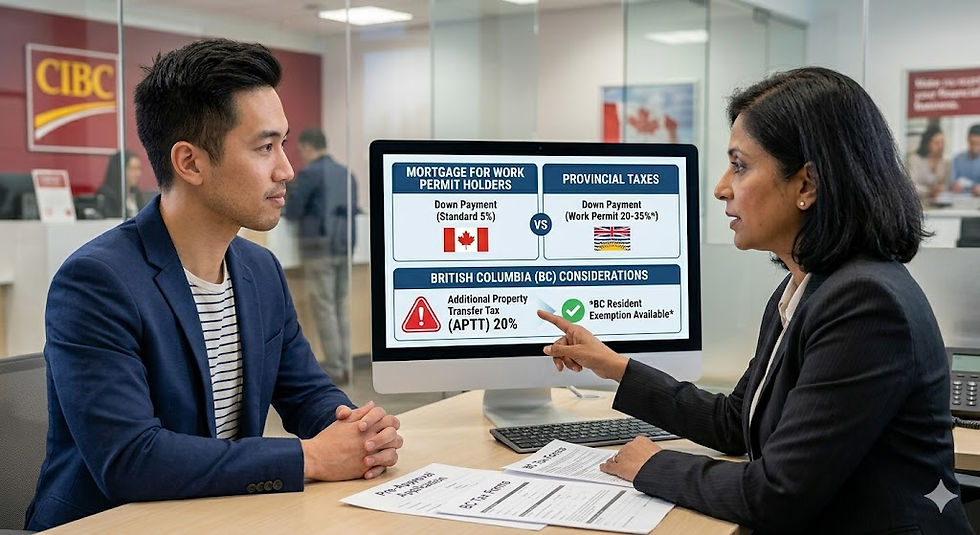
Down payment: Many lenders require a minimum 20–35% down payment for non-permanent
residents, compared to 5% for Canadian citizens or permanent residents on properties under
$500,000.
CMHC insurance: Canada Mortgage and Housing Corporation (CMHC) mortgage insurance is
available to non-permanent residents with a minimum 5% down payment under certain conditions,
though not all lenders offer this to work permit holders. Confirm with your mortgage broker whether
you qualify.
Employment verification: Lenders will want a copy of your work permit, your employment
letter, and recent pay stubs. A permit with at least 1–2 years of validity remaining strengthens your
application.
If you are relocating to Vancouver for work and planning to buy, engaging a mortgage broker with
experience in non-resident lending before you sign an offer to purchase is worth the time.
Provincial Foreign Buyer Taxes: A Separate Consideration for Work Permit Holders
The federal foreign buyers ban and provincial foreign buyer taxes are separate rules. Even if you
are fully exempt from the federal ban, provincial taxes may still apply depending on where you buy
and your residency status.
In British Columbia, the Additional Property Transfer Tax (APTT) adds 20% on top of the standard
property transfer tax for foreign nationals purchasing in designated areas including Metro
Vancouver, Fraser Valley, Kelowna, and Nanaimo. However, work permit holders who are BC
residents (meaning Canada is their primary home) can apply for a full or partial exemption from
this tax.
The rules for the BC APTT exemption are property-specific and fact-driven. Before you purchase,
consult both a BC real estate lawyer and an RCIC to confirm whether your residency status
qualifies you for the exemption.
If you are settling in Vancouver or the Lower Mainland and want to understand how your immigration status affects what you can buy, booking a consultation with Amir Ansari RCIC is a practical first step. Amir works with clients at every stage of their Canadian journey, from initial work permits through to permanent residence, and can help you understand how your immigration status interacts with major financial decisions like purchasing property.
Can a Work Permit Holder Use the First Home Savings Account (FHSA)?
Yes. Work permit holders who are Canadian tax residents are eligible to open and contribute to a
First Home Savings Account (FHSA), provided they have not owned a qualifying home in the
current year or in any of the preceding four calendar years. The FHSA allows you to contribute up
to $8,000 per year (lifetime maximum $40,000), with contributions being tax-deductible and
qualifying withdrawals tax-free.
If you are on a work permit and actively saving toward a home purchase in Canada, the FHSA is
worth setting up through your bank or investment account provider as soon as possible.
Can a Work Permit Holder Buy a House in Canada? Frequently Asked Questions
Can a work permit holder buy a house in Canada?
Yes. Work permit holders with at least 183 days remaining on their permit are exempt from Canada's federal foreign buyers ban and can purchase one residential property.
Can a temporary resident buy a house in Canada?
Temporary residents, including work permit holders and international students with valid study permits, can purchase residential property in Canada if they meet the exemption conditions under the Prohibition on the Purchase of Residential Property by Non-Canadians Act. The 183-day remaining validity requirement applies to work permit holders specifically.
Can temporary residents buy a house in Canada in 2026?
Yes. The foreign buyers ban remains in effect until January 1, 2027, but work permit holders with 183+ days remaining on their permit continue to be exempt throughout 2026. The rules have not changed since the 2023 amendment that removed the tax filing requirement.
Can a work permit holder buy property in Canada, including condos?
Yes. The exemption under the federal ban covers "residential property," which includes detached houses, semi-detached houses, townhouses, and condominiums. Commercial properties and properties with more than four dwelling units are not covered by the ban at all. If you are buying a condo or townhouse in Vancouver, the same 183-day rule applies.
Ready to understand how your work permit status affects your plans in Canada? Book a consultation with Amir Ansari RCIC at Ansari Immigration. Whether you are navigating your first year in Canada or planning your path to permanent residence, Amir provides practical, licensed guidance tailored to your situation.
This article is for general information only. It is not legal advice. Program criteria, requirements, processing times, and selection approaches can change without notice. Always confirm details on official government websites or consult a licensed Regulated Canadian Immigration Consultant (RCIC) for advice specific to your situation.



Comments