


By Amir Ansari, RCIC, Ansari Immigration (Vancouver).
Biometrics Canada means the fingerprints and photo that most visa, study permit, work permit, permanent residence, and refugee applicants must give before IRCC decides their file. The fee is CAD $85 per person, to a maximum of $170 per family. Children under 14 and applicants over 79 are exempt. For temporary residents, one set of biometrics lasts 10 years. (Verified against IRCC, November 2026.)
Getting this step wrong is one of the quiet ways an application stalls. IRCC does not start processing a file until the biometrics are collected, so a missed biometric instruction letter, an unpaid $85 fee, or a booking left too late can add weeks before an officer ever opens the case. This guide sets out, in one place, who has to give biometrics, what they cost, how long they last, how and where to give them, and the exceptions that trip people up. Every figure and rule below is drawn from IRCC's official biometrics pages, verified the week this guide was published.
In this guide
Who needs to give biometrics in Canada
Biometric fees in Canada for 2026
Who is exempt from giving biometrics
How long biometrics are valid: the 10 year rule
How to give your biometrics, step by step
What IRCC collects, and why
How biometrics affect your application timeline
When your situation does not fit the standard case
Frequently asked questions
Biometrics Canada: who needs to give fingerprints and a photo
Unless you fall under an exemption, you must give biometrics when you apply for most types of temporary or permanent status in Canada. IRCC sets the requirement by application type, not by nationality, with a small number of carve-outs.
The table below shows the common application types and whether biometrics are generally required.
Application type |
Biometrics generally required? |
Visitor visa (temporary resident visa) |
Yes |
Study permit (new or extension) |
Yes, unless you are a US national |
Work permit (new or extension) |
Yes, unless you are a US national |
Extend your stay as a visitor |
Yes, unless you are from a visa-exempt country |
Permanent residence (any class) |
Yes |
Refugee or asylum claim |
Yes |
Electronic Travel Authorization (eTA) only |
No |
Canadian citizenship application |
No (fingerprints, when asked, go through police, not a biometrics centre) |
Source: IRCC, Who needs to give their fingerprints and photo (updated July 9, 2026). Verified November 2026.
Two points are worth pulling out of that table. First, US nationals do not give biometrics for a study or work permit, but a US permanent resident applying with certain travel documents still does. Second, giving biometrics is separate from an eTA: a visa-exempt traveller who only needs an eTA does not give fingerprints at all.
Biometric fees in Canada for 2026
The biometric fee is set in regulation and is charged on top of the application and processing fees. You pay it when you submit the application, and IRCC will not issue the biometric instruction letter until the fee is paid.
Who is paying |
Biometric fee (CAD) |
One person (individual applicant) |
$85 |
A family applying together (2 or more) |
$170 maximum total |
A group of 3 or more performing artists and their staff, applying together |
$255 maximum total |
Transit visa applicant |
No fee |
Source: IRCC, Pay your fees: biometrics, and the biometric fee instruction under section 315.1 of the Immigration and Refugee Protection Regulations. Verified November 2026.
The family maximum only applies when family members apply at the same time and in the same place. A spouse and two children who file together pay $170 in total, not $85 each. The fee pays for the collection of your biometrics, so you pay it each time you are required to enrol, not once per lifetime.
Do you think the $85 fee should be clearer on the application forms? Tell us where it tripped you up in the comments, it helps other readers budget the real cost.
Who is exempt from giving biometrics
Some applicants never give biometrics, and age is the most common reason. IRCC assesses your age on the date you submit the application, so a child who is 13 on the day of submission is exempt even if they turn 14 a week later.
You are exempt from giving biometrics if you are:
A child under the age of 14 on the date you apply
An applicant over the age of 79 on the date you apply (there is no upper age exemption for asylum claimants)
A Canadian citizen, a citizenship applicant, or a Canadian passport applicant
An existing permanent resident (with one exception, below)
A visa-exempt national coming to Canada to visit only
A visitor who needs only an eTA
A head of state or head of government
An applicant who qualifies for or holds a diplomatic or official visa
A US visa holder transiting through Canada
A temporary resident applicant who already gave biometrics for a permanent residence application that is still being processed
There is one trap inside the permanent resident exemption. If you were exempt from biometrics for your PR application because of your age, and you later apply to renew or replace your PR card, you may have to give biometrics for that card application. The age exemption that applied to the first application does not automatically carry forward.
How long biometrics are valid: the 10 year rule
For temporary residence, biometrics are not a step you repeat for every application. In IRCC's own words, "Temporary residence applicants need to give their biometrics only once every 10 years." Once you have given them, you generally do not give them again for a new visitor visa, study permit, or work permit until the 10 years are up.
There is a limit attached to that rule. IRCC states that "we can't issue a visa or permit for more than 10 years from the date you gave your biometrics." So if your biometrics were collected five years ago, a new permit issued today cannot run beyond the remaining five years of that window, even if your passport is valid longer.
Permanent residence is different. Most permanent residence applicants must give their biometrics every time they apply, so a fresh PR application generally means fresh biometrics, regardless of when you last gave them for a temporary application.
Source: IRCC, When to give your biometrics (updated March 30, 2026). Verified November 2026.
How to give your biometrics, step by step
The process is the same whether you apply from inside or outside Canada. What changes is where you go to enrol.
Pay the biometric fee when you submit your application. IRCC warns that paying late can delay your file.
Wait for your biometric instruction letter (BIL). After the fee is processed, IRCC sends the BIL, which confirms you must give biometrics and tells you how to book.
Book your appointment as soon as you receive the BIL. For visa application centres some walk-in service may exist, but Service Canada offices and US application support centres require an appointment.
Go in person with your BIL and your valid passport. Asylum claimants without a passport can bring a refugee protection claimant document with a photo, or a certified copy of their passport.
Give your fingerprints and photo. You give them in person, once, at the collection point.
Where you enrol depends on where you are:
Outside Canada: at a Visa Application Centre (VAC). If there is no VAC in your country, you may use a VAC in another country.
Inside Canada: at a designated Service Canada office, by appointment booked through the eService Canada tool. You cannot simply walk into a Service Canada office without an appointment.
In the United States: at a US Application Support Centre booked through USCIS, or at a VAC in Los Angeles or New York, and only if you are already legally in the US.
A port of entry is not a general option. IRCC allows biometrics at some airports and land crossings only for people who are eligible to apply for a study or work permit at the border and who start and finish the application there. If you already submitted an application and received a BIL, you must use a regular collection point, not the border.
What IRCC collects, and why
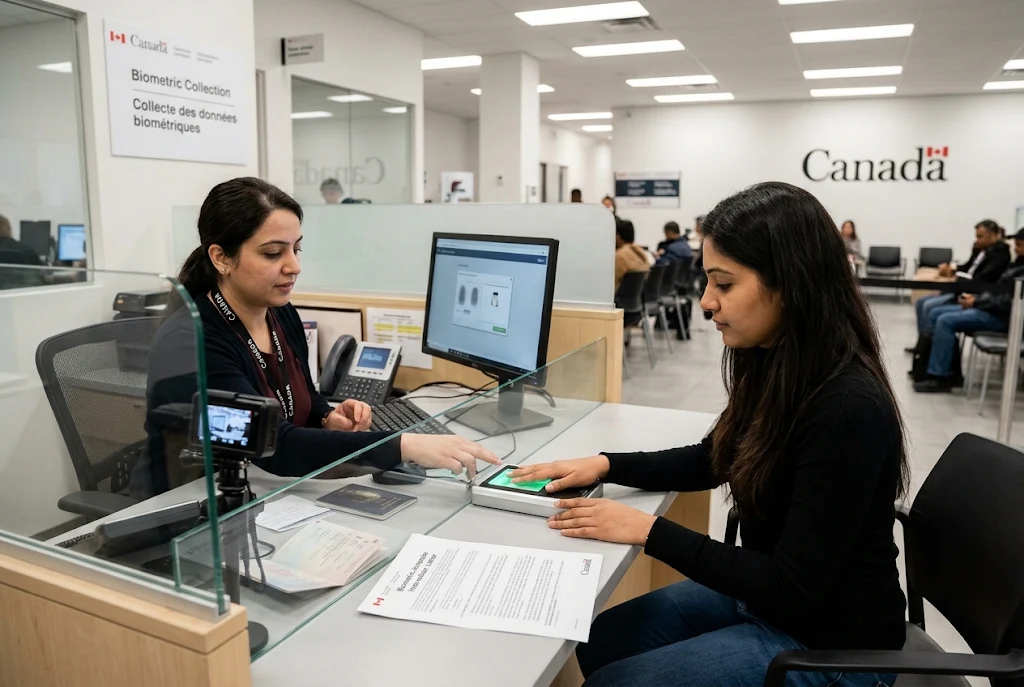
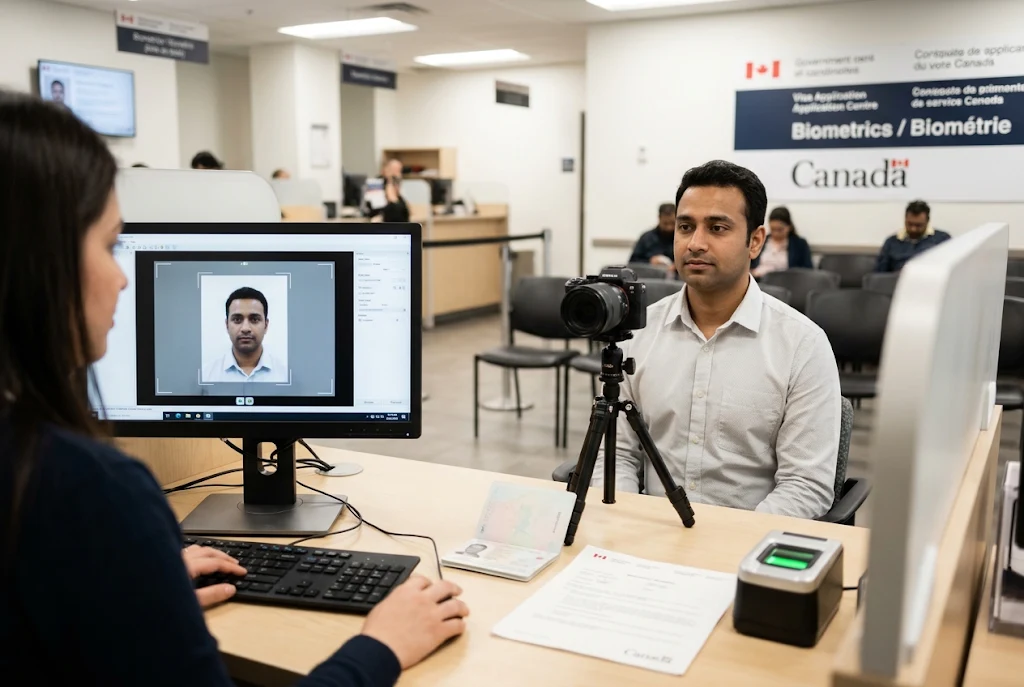
At the collection point, an officer or service provider captures your 10 fingerprints electronically and takes a digital photo, along with the biographic details from your passport. IRCC's operational manual describes the fingerprint step plainly: "Fingerprints of the applicant, captured electronically during the biometrics collection session."
The requirement itself is grounded in regulation. IRCC's identity management manual states that the obligation follows "section 12.2(2) of the Immigration and Refugee Protection Regulations (IRPR)," and that an applicant's age on the date the application is made decides whether biometrics are required. The data anchors your identity at the moment you apply and is checked against Canadian immigration and criminal records.
There is officer-level detail here that explains the delays applicants feel. For temporary residence, IRCC's case system issues the biometric instruction letter automatically once the fee is paid. For most permanent residence lines of business, an officer has to issue the letter manually, which is one reason PR applicants sometimes wait longer for the letter to arrive.
How biometrics affect your application timeline
Biometrics are a gate, not a formality. IRCC cannot finish processing your application until it has your fingerprints and photo, and for many application types the posted wait is measured from the date you give biometrics rather than the day you hit submit. You can check the current figure for your application on IRCC's processing times tool. In practice, the days between submission, the arrival of the BIL, and your appointment are often dead time for your file.
Three habits keep that dead time short. Pay the fee with the application, so the BIL is not held up. Book the appointment the day the BIL lands, because popular collection points fill up. And give the biometrics well inside the window stated in your BIL, rather than at the last moment.
Biometrics work the same way whether your permanent residence runs through Express Entry or a work permit pathway. For what happens once the biometrics are in and the clock finally starts, see our guide to the stages that follow for permanent residence applicants.
Not sure if your biometrics are still valid, or whether an exemption applies to your file? Ansari Immigration can confirm it before you pay the fee, so you do not lose processing time to a wrong assumption.
Check your biometrics with Ansari Immigration
When your situation does not fit the standard case
Most applicants fit the table above. These are the situations that do not, and how they are handled.
You turn 80 after you apply: age is set on the submission date. If you were 79 or younger when you applied, you must still give biometrics even if you have since turned 80.
A child turns 14 between the visa centre visit and IRCC receiving the file: if the child was 13 at submission but 14 by the time IRCC receives the application, they must give biometrics and will get a BIL.
You lost or never received your BIL: you cannot enrol without it, so contact IRCC to have it reissued rather than showing up at a collection point.
You already gave biometrics for a PR application still in progress: you are exempt from giving them again for a temporary application filed while that PR file is open.
You are a US national: you do not give biometrics for a study or work permit, but check the rule for the specific application, because US permanent residents with certain travel documents are treated differently.
Your fingerprints cannot be captured cleanly: henna, cuts, or cracked skin can prevent a good scan, and you may be asked to return once your hands have healed.
If your situation sits in more than one of these boxes at once, that is the point to get advice before you file, because a wrong assumption about the exemption can cost you the whole processing time while a file sits unopened.

Frequently asked questions about biometrics in Canada
How much is the biometric fee for Canada?
The biometric fee for Canada is CAD $85 for one person, or a maximum of $170 for a family applying together, and $255 for a group of three or more performing artists applying together. Transit visa applicants pay no biometric fee. You pay it when you submit your application.
Where do I pay the biometric fee for Canada?
You pay the biometric fee for Canada to IRCC when you submit your application, usually online with the application and processing fees, before you receive your biometric instruction letter. The fee is not paid at the collection point, and IRCC will not send the instruction letter until the fee has been received.
How long are biometrics valid in Canada?
For temporary residence applicants, biometrics are valid for 10 years, and you generally give them only once in that period. A visa or permit cannot be issued for longer than 10 years from the date you gave your biometrics. Most permanent residence applicants must give biometrics again with each new PR application.
Who is exempt from giving biometrics in Canada?
Children under 14 and applicants over 79 are exempt, as are Canadian citizens and citizenship applicants, most existing permanent residents, visa-exempt visitors who need only an eTA, diplomats, heads of state or government, and US visa holders transiting Canada. Age is assessed on the date you apply.
How do I book a biometric appointment for Canada?
After you pay the fee and receive your biometric instruction letter, you book an appointment at a Visa Application Centre outside Canada, a designated Service Canada office inside Canada through the eService Canada tool, or a US Application Support Centre. Booking is free, so use only the official website to avoid fraud.
Can I give my biometrics inside Canada?
Yes, you can give your biometrics at a designated Service Canada office if you are applying from inside Canada, but only with a booked appointment. Service Canada does not accept walk-ins for biometrics, and it does not take citizenship fingerprints, which go through a police service or the RCMP instead.
Related Posts
After Biometrics, What Is Next for Canada PR: What happens once your fingerprints and photo are in and the processing clock finally starts.
Work Permit Processing Time Canada 2026: Current wait times by permit type, and where biometrics sit in that timeline.
PR Card Renewal Processing Time in Canada 2026: When a PR card renewal can trigger a biometric requirement and how long it takes.
Why work with Ansari Immigration: flat, transparent fees quoted upfront, with no surprise charges on top. Every file is handled personally by the firm's licensed RCIC, start to finish, including forms, IRCC correspondence, and follow-ups, with direct access to your consultant and no call centres. Ansari Immigration is led by a licensed RCIC regulated by CICC, practising in Vancouver. A consultation is $80 for 30 minutes.
Not sure whether you or a family member needs to give biometrics, or whether your last set is still valid? Book a consultation with Ansari Immigration and we will map it to your exact application before you file. Have a biometrics question others might share? Ask it in the comments, keep it general, and for advice on your own case use a consultation.
This article is for general information only. It is not legal advice. Program criteria, requirements, processing times, and selection approaches can change without notice. Always confirm details on official government websites or consult a licensed Regulated Canadian Immigration Consultant (RCIC) for advice specific to your situation.